GILTI Tax for U.S. Owners of Foreign Corporations Before NCTI

- What Does GILTI Stand For?
- Who Had to Pay GILTI Tax?
- How Was GILTI Calculated?
- What Was the GILTI Tax Rate?
- How Did Foreign Tax Credits Work With GILTI?
- What Does a GILTI Calculation Look Like for a Small Company?
- How Could Owners Reduce or Avoid GILTI Tax?
- Do GILTI Rules Still Apply to Your Return in 2027?
- Frequently Asked Questions about GILTI Tax
- A Small Service Company Had Little to Shelter It from GILTI


GILTI tax (global intangible low-taxed income) was a U.S. tax on U.S. owners of 10% or more of a controlled foreign corporation (CFC), a foreign company more than half owned by U.S. shareholders. Each year, GILTI taxed the owner’s share of the company’s profit above a 10% return on its tangible business assets, whether or not that profit was paid out. Under Treasury’s reading of the proposed rules, GILTI covered U.S. shareholders’ tax years beginning before January 1, 2026. Net CFC tested income (NCTI) replaced GILTI for later years and drops the 10% asset return.
Without a Section 962 election, individual owners paid GILTI tax at regular income tax rates of up to 37% and got no credit for the company’s foreign tax. U.S. corporations and owners who made the Section 962 election paid about 10.5% on the GILTI inclusion before credits and could credit 80% of the foreign tax tied to it. The inclusion was calculated on Form 8992 and reported as other income on Schedule 1 of Form 1040. GILTI rules still apply to 2025 returns and to earlier years being filed late or amended.
GILTI does not apply to 2026 and later tax years. Starting with U.S. shareholder tax years beginning after December 31, 2025 (2026 for calendar-year filers), net CFC tested income (NCTI) replaces GILTI. NCTI cuts the Section 250 deduction from 50% to 40%, raises the deemed-paid credit from 80% to 90% for corporations and Section 962 electors, and removes the 10% asset return. For a 2026 or later return, use the NCTI guide.
What Does GILTI Stand For?
GILTI stands for global intangible low-taxed income. It was created by the Tax Cuts and Jobs Act, signed on December 22, 2017, and first applied to foreign corporations’ tax years beginning after December 31, 2017. It required U.S. shareholders to include part of a controlled foreign corporation’s profits in their own income each year as GILTI, whether or not the corporation paid a dividend. The IRS lists GILTI among the international changes that the law made.
The Name Covers Ordinary Business Profits
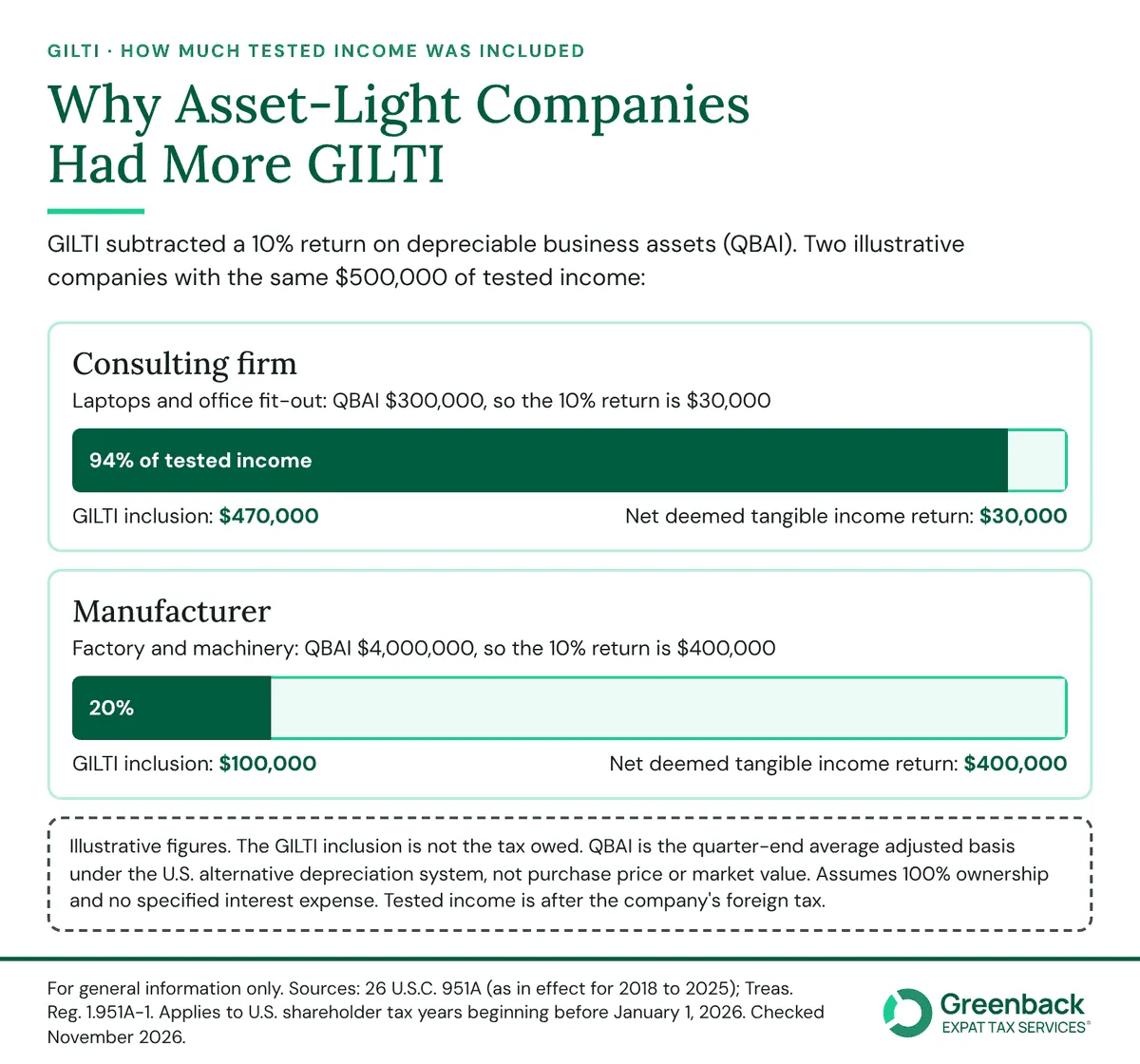
Despite the word “intangible,” GILTI was not limited to income from patents, brands, or software. The formula took almost all of the company’s business income and subtracted only a 10% return on its depreciable property. A consulting firm, agency or online business with few physical assets could see nearly all of its profit counted.
GILTI Ran Alongside Subpart F Income
GILTI did not replace the older Subpart F rules, which already taxed U.S. shareholders each year on certain CFC income, mainly passive income such as dividends, interest, and royalties, subject to exceptions. Income taxed as Subpart F income was excluded from tested income, so the same income was not counted under both. Our FAQ on GILTI vs. Subpart F compares them side by side.

Own a Foreign Company? Get Your GILTI Years Right
Who Had to Pay GILTI Tax?
GILTI applied to U.S. shareholders of controlled foreign corporations, including Americans abroad who owned a company in the country where they lived. Both the owner and the company had to meet an ownership test in the same year, and a sole American owner of a foreign corporation met both.
1. You Owned 10% or More of a Foreign Corporation
You were a U.S. shareholder if you owned at least 10% of the company’s voting power or value. Shares owned through other entities and some shares owned by family members count toward the 10%. Owners who meet these tests generally also file Form 5471 and follow the other foreign business tax reporting rules.
2. U.S. Shareholders Together Owned More Than 50%
The company was a controlled foreign corporation if U.S. shareholders collectively owned more than 50% of its voting power or value. Our FAQ on whether owning a foreign corporation automatically triggers GILTI covers the edge cases.
How Was GILTI Calculated?
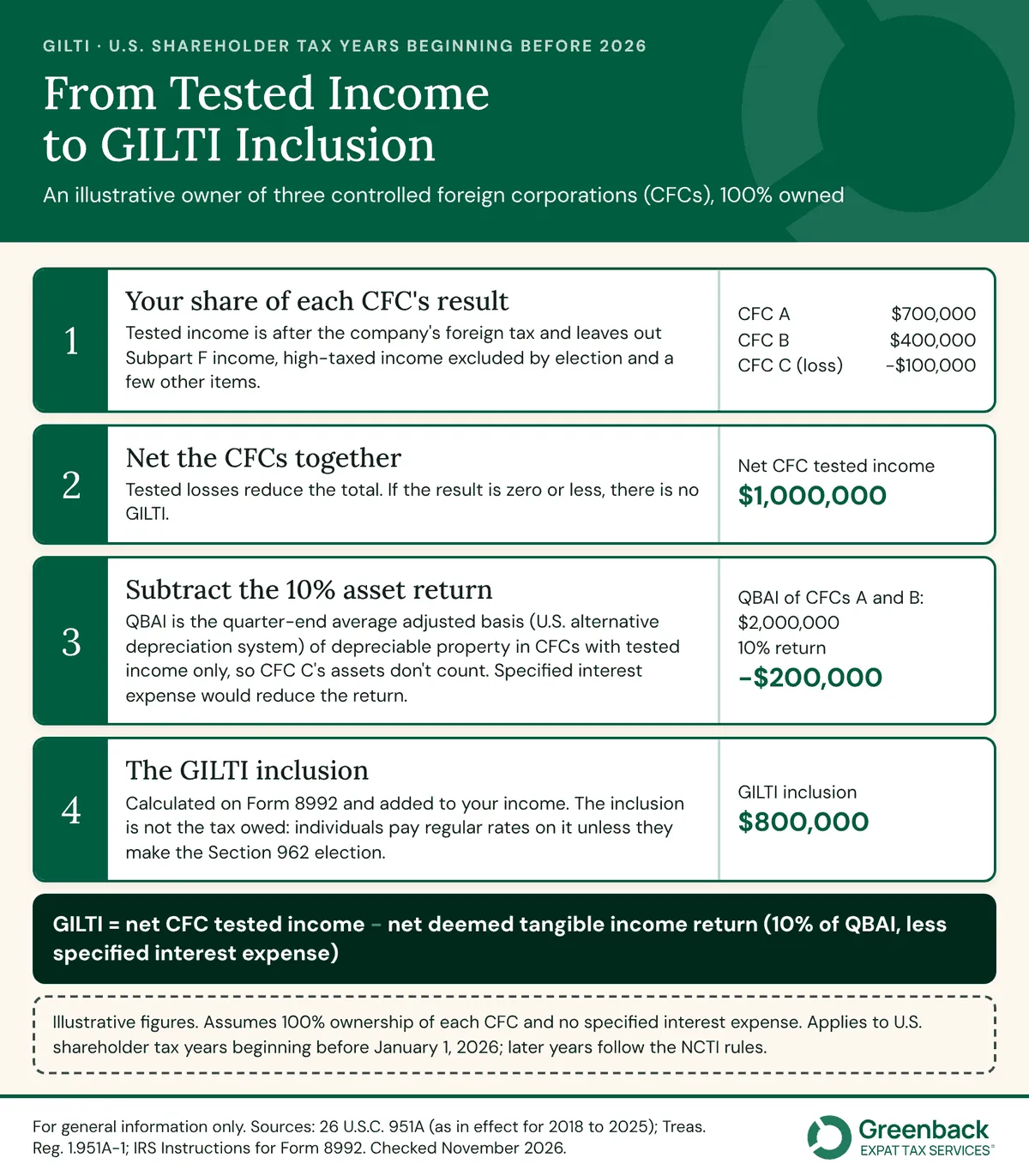
The GILTI formula was net CFC tested income minus a 10% return on your share of the companies’ tangible business assets. The result: your GILTI inclusion was added to your U.S. income, combining all CFCs you owned.
1. Take Your Share of Each CFC’s Tested Income or Loss
Tested income was the company’s gross income minus certain categories, minus the deductions that belonged to it, including the company’s own foreign income tax. The categories left out were Subpart F income, income excluded under the GILTI high-tax exception, income effectively connected with a U.S. business, dividends from related persons, and foreign oil and gas extraction income. Each company’s figure came from its Form 5471, Schedule I-1.
2. Combine Them Into Net CFC Tested Income
Your shares of tested income from every CFC were added together, and your shares of any tested losses were subtracted, giving your net CFC tested income. If the total was zero or less, there was no GILTI for the year, though the company still had to be reported. Our FAQ on reporting a foreign business that runs at a loss covers that case.
3. Subtract a 10% Return on Your Share of Tangible Assets
The formula then subtracted 10% of your share of qualified business asset investment (QBAI): the quarter-end average adjusted basis of the depreciable tangible property each CFC used to earn tested income, calculated using the U.S. alternative depreciation system. Only CFCs with tested income are counted. This 10% return, reduced by certain specified interest expense, is called the net deemed tangible income return, the term used in section 951A of the U.S. Code.
4. What Remains Is Your GILTI Inclusion
Your GILTI inclusion was calculated on Form 8992 and added to your income for the year. The inclusion is not the tax itself; the tax depends on who owns the company.
What Was the GILTI Tax Rate?
An individual owner paid GILTI tax at regular income tax rates, up to 37%. A U.S. C corporation, or an individual who made the Section 962 election, paid about 10.5% before credits and could credit part of the company’s foreign tax.
| Individual, no election | Corporation or Section 962 elector | |
|---|---|---|
| Tax on the GILTI inclusion | Regular rates, up to 37% | About 10.5% (21% after a 50% deduction) |
| Credit for the company’s foreign tax | None | 80% of the foreign tax tied to the inclusion |
| Foreign tax rate that roughly offsets the U.S. tax | None | About 13.125%, on profit before foreign tax and before expense allocation |
An Individual’s Effective GILTI Rate Depended on Their Bracket
For an individual without the election, the inclusion was stacked on top of the owner’s other income, so the effective GILTI tax rate depended on filing status and total income, with no single figure. In the small-company example on this page, it comes to about 25.4% of the inclusion.
How Did Foreign Tax Credits Work With GILTI?
Only a U.S. C corporation or a Section 962 elector could credit the foreign tax a CFC paid on its tested income. The credit was 80% of the foreign tax tied to the GILTI inclusion, and that share was set by the inclusion percentage. The credit was claimed on Form 1118, and its own foreign tax credit category kept it apart from credits on other income.
The 80% Credit Followed the Inclusion Percentage
The GILTI inclusion percentage was GILTI divided by the total tested income of CFCs with tested income. Both the 10% asset return and tested losses from other CFCs lowered it, and foreign tax paid by a CFC with a tested loss was never creditable. The full matching tax, before the 80% cut, was also added to income (the section 78 gross-up), so the 80% credit offset the 10.5% U.S. tax at a foreign rate of about 13.125% (10.5% divided by 80%).
GILTI Credits Could Not Be Carried to Other Years
Unused GILTI credits could not be carried back 1 year or forward 10 years, the way most unused foreign tax credits can under the foreign tax credit carryover rules. Anything left unused in a GILTI year was lost.
What Does a GILTI Calculation Look Like for a Small Company?
A small service company with little equipment could have almost all of its tested income counted as GILTI. Take a single U.S. citizen who owns 100% of a consulting company on the Dubai mainland in the United Arab Emirates, for 2025.
The company is treated as a corporation for U.S. tax purposes (a Form 8832 election can change how some foreign companies are classified, and this example assumes none was made). Its revenue is above AED 3 million, so the Small Business Relief offered by the UAE government does not apply. She takes no salary, so the Foreign Earned Income Exclusion does not apply. She has no other U.S. taxable income, and the example covers only U.S. federal tax.
| Step | Amount |
|---|---|
| Company profit before UAE tax | $420,000 |
| UAE corporate tax: 9% on taxable income above AED 375,000 (about $102,110) | $28,610 |
| Tested income | $391,390 |
| 10% return on QBAI of $150,000 (no interest expense) | $15,000 |
| GILTI inclusion | $376,390 |
Without the Section 962 election, her U.S. tax comes to about 25.4% of the inclusion: $95,771.25 on taxable income of $360,640 after the $15,750 standard deduction, using the 2025 brackets published by the IRS. About 96% of her tested income is GILTI because the company’s laptops and office fit-out provide only $15,000 of shelter, and the $28,610 the company pays in UAE tax gives her no credit.
How Could Owners Reduce or Avoid GILTI Tax?
Two elections could lower the tax on GILTI: the Section 962 election and the high-tax exception. The Section 962 election changed how the inclusion was taxed. The high-tax exception removed high-taxed income from the calculation. Neither applied automatically, and each had its own costs and filing rules. A reasonable salary paid by the company also lowered tested income, because wages are a deductible expense.
1. The Section 962 Election Applied Corporate Rules to the Inclusion
With the election, the inclusion was taxed at the 21% corporate rate after the Section 250 deduction of 50%, claimed on Form 8993, with 80% of the company’s matching foreign tax credited. The election also changed how later dividends from that profit are taxed. The Section 962 guide runs the same kind of company through both routes.
2. The High-Tax Exception Helped Only in Higher-Tax Countries
The high-tax exception, also called the high-tax exclusion, let owners exclude from tested income any income taxed abroad at an effective rate above 18.9% (90% of the 21% U.S. corporate rate), measured under U.S. tax principles. The controlling U.S. shareholders made the election, and it applied across the related CFCs under Treasury regulations. It did nothing in a low-tax country such as the UAE. The GILTI high-tax exception guide explains the test.
Do GILTI Rules Still Apply to Your Return in 2027?
GILTI ended for U.S. shareholder tax years beginning after December 31, 2025, but it still applies to 2025 and earlier returns, including any you file late or amend. Public Law 119-21 (July 4, 2025) replaced GILTI with NCTI, and a proposal from Treasury ties that start date to the shareholder’s tax year.
The Final GILTI Return for Most Filers
The 2025 GILTI inclusion is calculated on Form 8992 and reported on line 8o of the 2025 Schedule 1. A shareholder with a fiscal tax year that began during 2025 also uses GILTI for that year.
Unreported GILTI Years Can Still Be Brought Current
If a year’s return was never filed, the late return reports the inclusion on that year’s Form 8992 and on the other income line of that year’s Schedule 1, along with the missing Form 5471. If the return was filed without GILTI, a corrected Form 8992 goes with an amended return, as the IRS instructions for Form 8992 describe.
When a Form 5471 is not filed, the IRS’s time to assess tax for that year does not close until at least 3 years after the form is filed. The high-tax exception belonged on a timely original return; on an amended return, it is allowed only within 24 months of the original return’s unextended due date. Missing Forms 5471 can carry penalties of their own, so the filing route matters. The late tax filing guide and the guide to late business tax returns cover the relief options. Greenback’s prior-year U.S. tax returns service covers catching up on past years.
Frequently Asked Questions about GILTI Tax
No. The Foreign Earned Income Exclusion covers pay for personal services, and a GILTI inclusion is a share of a company’s profit. When an owner also excludes a salary, the GILTI inclusion is taxed at the rates that would apply if the excluded salary were still counted.
Generally no. Profit already taxed to a U.S. shareholder as GILTI is treated as previously taxed earnings, so a later distribution of that profit is generally excluded from regular income tax. For an owner who made the Section 962 election, a later distribution is taxed to the extent it exceeds the U.S. tax already paid on that income.
No. The transition tax under section 965 was a one-time tax that U.S. shareholders paid on the untaxed foreign earnings of certain foreign corporations, measured for those corporations’ last tax year beginning before January 1, 2018. GILTI was a yearly tax that began with the foreign corporation tax years that followed and applied to each year’s profit.
A Small Service Company Had Little to Shelter It from GILTI
GILTI was described as a tax on intangible income, but for a small company with few physical assets it could reach nearly every dollar of profit, because the 10% return on tangible assets was small. For an individual owner, the GILTI cost depended mostly on whether the Section 962 election applied to that year’s return.
If you’re an American who owns a business abroad, an accountant who knows Form 5471 and Form 8992 can help you report GILTI for each year and keep your company filings current. Learn more about tax help for American business owners abroad.

One Team for Your Company Filings and Your Return
This article is for general information only and covers U.S. federal tax rules for GILTI, which apply to U.S. shareholder tax years beginning before January 1, 2026. The rules for later years, including the start date under proposed Treasury regulations, may change when the regulations are finalized. Every situation is different, so speak with a qualified tax professional about your own returns.



Featured In


