Foreign Tax Credit: Who Qualifies and How Much U.S. Tax It Offsets

- What Is the Foreign Tax Credit?
- Who Can Claim the Foreign Tax Credit?
- Which Foreign Taxes Qualify for the Foreign Tax Credit?
- How Much Foreign Tax Credit Can You Claim?
- What Happens to Foreign Tax Credit You Can't Use?
- How Do You Claim the Foreign Tax Credit?
- How Do Tax Treaties Affect the Foreign Tax Credit?
- What Doesn't the Foreign Tax Credit Cover?
- Can You Still Claim a Foreign Tax Credit You Missed?
- Frequently Asked Questions about the Foreign Tax Credit
- Your Limit Decides How Much the Foreign Tax Credit Saves


The foreign tax credit (FTC) is a U.S. tax credit that reduces your U.S. income tax dollar for dollar by the income tax you paid or accrued to another country. It is also called the international tax credit. U.S. citizens and resident aliens can claim it on foreign income that is taxed both abroad and by the United States. The credit is limited to the U.S. tax on your foreign income, so it can reduce that tax to zero but cannot create a refund. It helps keep you from being taxed twice on the same income.
You can carry unused credit back for 1 year and forward for up to 10 years. Most people claim the credit on Form 1116, though you may skip the form if your foreign tax is $300 or less ($600 if married filing jointly), comes only from passive income such as dividends, and is reported to you on a statement such as Form 1099-DIV. You can choose to deduct foreign taxes instead, but the credit usually saves more. If you live and work abroad, the Foreign Earned Income Exclusion is the other way to avoid double taxation. This guide covers who qualifies, which taxes count, how the limit is calculated on your 2026 tax return, filed in 2027, and how to claim the credit.
What Is the Foreign Tax Credit?
The foreign tax credit is a credit that subtracts qualifying foreign income tax from your U.S. income tax. The United States taxes its citizens and resident aliens on worldwide income, wherever they live. The credit exists so that income already taxed by another country is not fully taxed again by the IRS. It applies only to income tax and is limited to the U.S. tax on the same foreign income.
The credit works alongside the other rules that help U.S. citizens abroad avoid being taxed twice. You can choose to deduct foreign income taxes on Schedule A instead. That choice is made each year and covers all of your qualifying foreign taxes for that year. Our FAQ on tax credits vs. tax deductions for expats compares the two.
The foreign tax credit is nonrefundable. It can bring your U.S. income tax on foreign income down to zero, and any foreign tax above that amount becomes a carryover instead of a payment. Our FAQ on whether the foreign tax credit is refundable covers the details.
A Credit Lowers U.S. Tax Dollar for Dollar
A deduction lowers the income your tax is calculated on, so its value depends on your tax bracket. A credit is applied to the tax itself. If you owe $5,000 of U.S. tax on foreign income and paid $5,000 or more in foreign income tax on it, the credit can reduce that $5,000 to zero. A $5,000 deduction in the 22% bracket would save about $1,100, and only if you itemize on Schedule A instead of taking the $16,100 standard deduction for single filers.

Who Can Claim the Foreign Tax Credit?
U.S. citizens and resident aliens who paid or accrued qualifying foreign income tax during the year can claim the foreign tax credit. Residency for this purpose follows the green card test or the substantial presence test, so green card holders and many visa holders living in the United States qualify too. You do not need to live abroad: a U.S. resident with foreign dividends or a foreign rental property can claim the credit as well.
According to IRS Publication 514, a nonresident alien generally cannot claim the credit. The exceptions are narrow:
- Puerto Rico residents: You were a bona fide resident of Puerto Rico for the entire tax year.
- Effectively connected income: You paid foreign tax on foreign-source income that is effectively connected with a trade or business in the United States.
You Cannot Credit and Deduct the Same Year’s Foreign Taxes
The credit and the deduction are an either-or choice each year, so you cannot take both for the same year’s foreign taxes. If you choose the deduction for a year, all of your qualifying foreign taxes for that year are deducted on Schedule A.
Which Foreign Taxes Qualify for the Foreign Tax Credit?
A qualifying foreign tax is an income tax: taxes on wages, interest, dividends, rent, and business profits qualify, while consumption taxes such as VAT do not. Social security taxes paid to a country with a U.S. totalization agreement also do not qualify. The tax must also be your own legal liability. Taxes paid to a U.S. territory such as Puerto Rico or Guam count as foreign taxes for the credit.
A Foreign Tax Must Pass Four IRS Tests
IRS Publication 514 sets out four tests. A foreign tax qualifies only if it meets all of them:
- The tax is imposed on you by a foreign country or U.S. territory.
- You paid or accrued the tax during the year.
- The tax is your legal and actual liability. Foreign tax you could have had refunded, such as treaty-reduced withholding you overpaid, does not count.
- The tax is an income tax or a tax paid in lieu of an income tax.
Withheld, Employer-Paid, and Dividend Taxes Can Count
Foreign tax does not have to be paid with a return to qualify. Income tax your foreign employer withholds from your pay counts only once, as your final liability, which our FAQ on foreign employer withholding and the foreign tax credit covers. Tax your employer pays on your behalf can also qualify, as our FAQ on employer-paid foreign tax describes.
Foreign tax withheld on dividends from international funds is a common way U.S. residents come across the credit. Your broker reports it on Form 1099-DIV. Our FAQ on the foreign tax credit and Form 1099-DIV walks through where to find the figure.
Some Foreign Taxes Never Qualify
| Foreign tax | Creditable? | Why |
|---|---|---|
| VAT, GST, and sales taxes | No | Consumption taxes, not income taxes |
| Social security taxes covered by a totalization agreement | No | The agreement assigns coverage to one country |
| Property and wealth taxes | No | Not income taxes |
| Tax on income you excluded | No | The income is not taxed on your U.S. return |
| Tax paid to a sanctioned country (Section 901(j)) | No | Credits for these countries are disallowed |
| “Soak-up” taxes | No | Owed only because a U.S. credit is available |
Our FAQ on foreign taxes that do not qualify for the foreign tax credit covers more cases.
How Much Foreign Tax Credit Can You Claim?
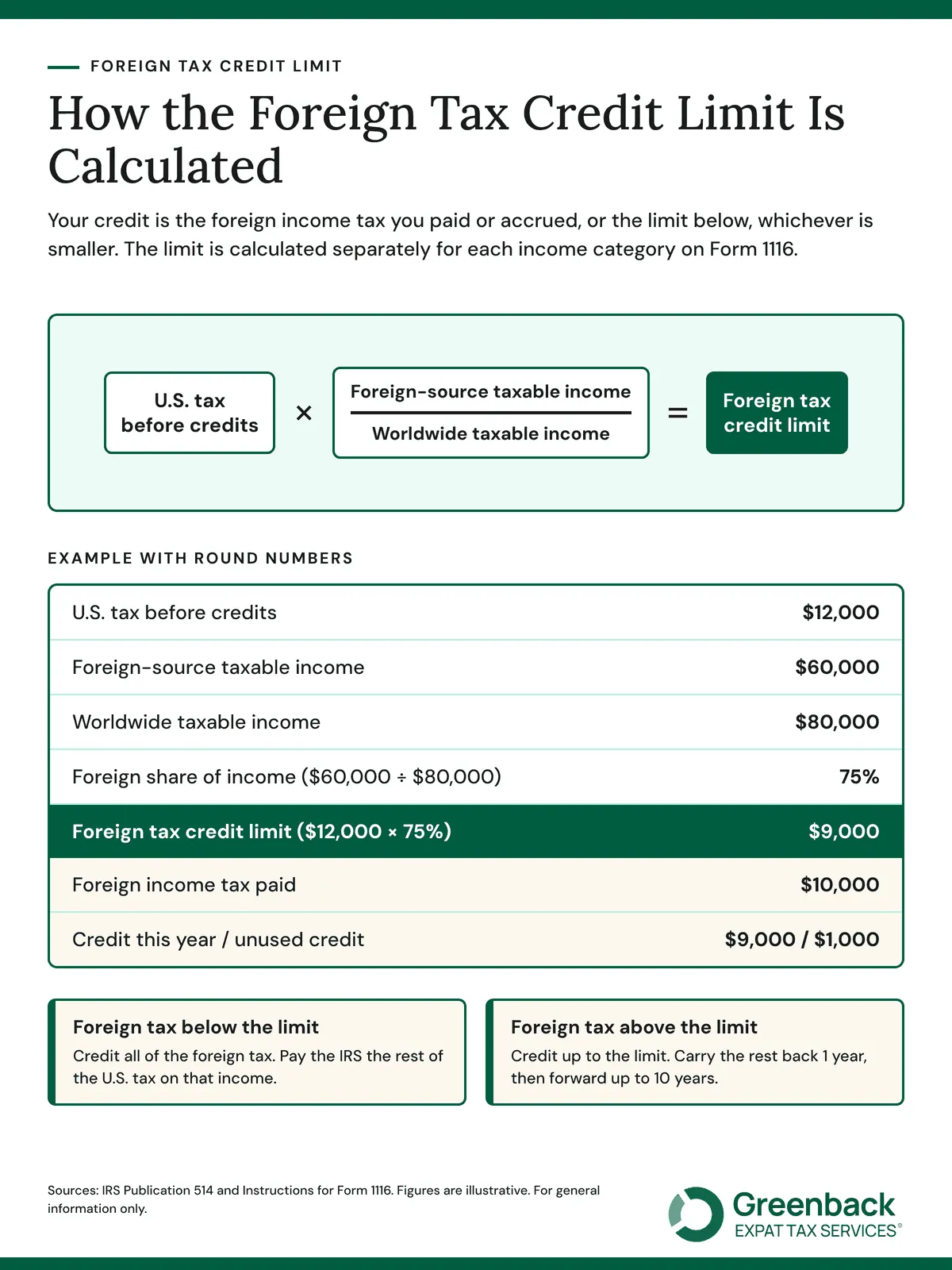
Your foreign tax credit is the foreign income tax you paid or accrued, or the foreign tax credit limit if that is smaller. The limit is your U.S. tax multiplied by the share of your taxable income that comes from foreign sources. The credit can reduce the U.S. tax on your foreign income to zero, while U.S. tax on U.S.-source income stays in place.
The Limit Formula Apportions Your U.S. Tax
The IRS formula is:
U.S. tax before credits × (foreign-source taxable income ÷ worldwide taxable income) = foreign tax credit limit
Foreign-source taxable income is your foreign gross income minus the deductions that relate to it. Deductions that are not tied to any income, such as the standard deduction, are spread between U.S. and foreign income in proportion to your gross income. If 80% of your gross income is foreign, 80% of your standard deduction reduces your foreign income in the formula.
Example: A Single Filer in Canada
John is single and lives in Canada. On his 2026 tax return, filed in 2027, he reports a $100,000 Canadian salary and $20,000 of interest from a U.S. bank account. He paid $22,000 in Canadian income tax on his salary (this example excludes any Canadian tax on the interest). Using the 2026 standard deduction of $16,100 for single filers:
| Step | Amount |
|---|---|
| Worldwide gross income ($100,000 salary + $20,000 interest) | $120,000 |
| Worldwide taxable income (after the $16,100 standard deduction) | $103,900 |
| U.S. tax before credits (2026 single rates) | $17,570 |
| Foreign-source taxable income ($100,000 minus 100/120 of the deduction) | $86,583 |
| Foreign tax credit limit ($17,570 × $86,583 ÷ $103,900) | $14,642 |
| Canadian tax paid | $22,000 |
| Credit used this year | $14,642 |
| Unused credit to carry back or forward | $7,358 |
| U.S. tax still owed (the tax on his U.S. interest) | $2,928 |
John’s U.S. tax on his Canadian salary is fully covered, and he has $7,358 of unused credit for other years. The $2,928 he still owes is U.S. tax on U.S. interest, which the credit was never designed to cover. If John lived in a country with lower tax rates than the United States, the result would flip: he would credit all of his foreign tax and owe the difference to the IRS. The U.S. expat taxes in Canada guide covers how Canadian and U.S. tax returns interact.
Each Income Category Has Its Own Limit
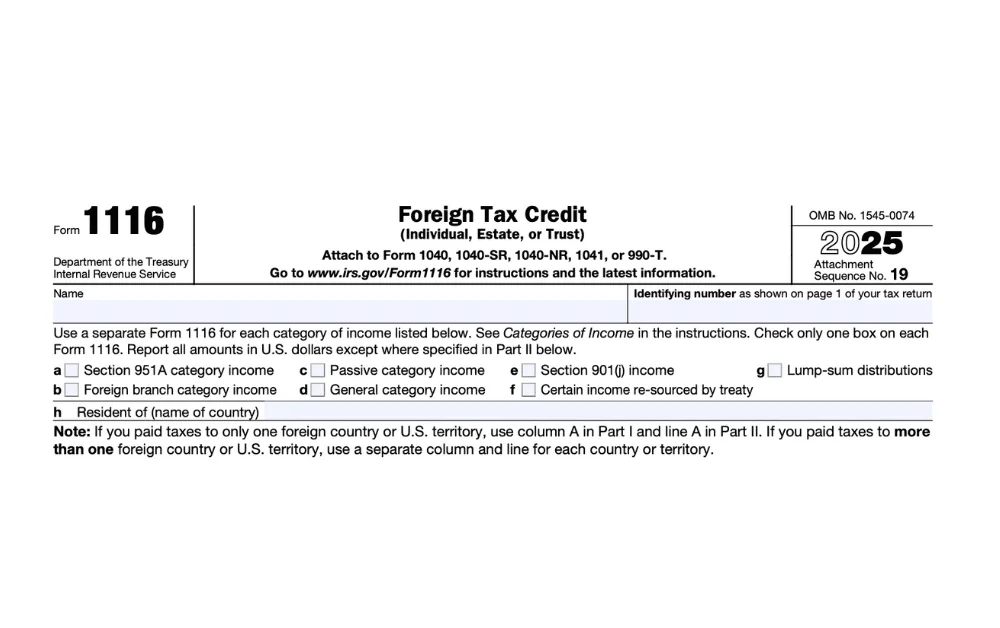
You calculate a separate limit for each category of income, so excess credit from one category cannot cover U.S. tax in another. The categories on Form 1116 are Section 951A income, foreign branch income, passive income, general income, Section 901(j) income, income re-sourced by treaty, and lump-sum distributions. For most individuals, two matter:
- General category: Wages, salaries, and most self-employment and active business income.
- Passive category: Dividends, interest, rents, and royalties not earned in an active business.
Passive income taxed abroad at a high rate can move into the general category under the high-tax kickout. Our FAQs on active vs. passive income on Form 1116 and what HTKO means on Form 1116 go deeper.
Foreign Tax on Excluded Income Cannot Be Credited
If you claim the Foreign Earned Income Exclusion, the foreign tax on the wages you excluded drops out of the credit. The rule prevents a double benefit on the same income. You can still use the credit for foreign tax on income above the exclusion, and on income the exclusion never covers, such as foreign dividends or rent. Our FAQ on claiming both the Foreign Tax Credit and the FEIE explains how the two appear on a single return, and our FEIE vs. FTC guide compares them.
What Happens to Foreign Tax Credit You Can’t Use?
Foreign tax above your limit becomes an unused credit that you can carry back for 1 year and then forward for up to 10 years.
In John’s case, the $7,358 he could not use in 2026 can be carried back to his prior-year return if he had room under that year’s limit, and then carried forward through 2036. A carryover only helps in a year when your foreign tax falls below your limit, such as a year you have more foreign income taxed on your U.S. return or a year your foreign tax drops after a move. The carryover stays in the same income category it came from, so a general category carryover cannot be used under the passive category limit.
Our foreign tax credit carryover guide covers the order of use, how to track carryovers on Schedule B of Form 1116, and when a carryback means amending a prior return.
How Do You Claim the Foreign Tax Credit?
You claim the foreign tax credit on Form 1116 attached to your Form 1040. The form is where the limit is calculated, one category at a time.
1. Check Whether You Can Skip Form 1116
You can claim the credit directly on Schedule 3 without Form 1116 if all of these apply:
- Passive income only: All of your foreign-source income is passive, such as dividends and interest.
- Reported to you: The income and foreign tax are shown on a payee statement such as Form 1099-DIV or 1099-INT.
- Small amount: Your creditable foreign tax is $300 or less, or $600 or less if married filing jointly.
The trade-off is that you cannot carry any unused credit to or from a year you use this election. If you have carryovers from other years or expect unused credit, filing Form 1116 keeps them available.
2. Complete Form 1116 for Each Category
You file a separate Form 1116 for each category of income, so an expat with a foreign salary and foreign investment income often files two Forms 1116. The form records your foreign income, the deductions apportioned to it, the foreign tax paid, and the limit. Report foreign tax in U.S. dollars: convert tax you paid at the exchange rate on the payment date. Some situations, such as a foreign tax refund or an adjustment by the foreign country, also call for a Form 1116 explanation statement.
3. Choose When to Claim: Paid or Accrued
Most individuals use the cash method, which means you claim the credit in the year you pay the foreign tax. You can elect to claim it in the year the tax accrues instead, which usually lines the credit up with the year the income was earned. The accrual election applies to all later years once you make it, so it is a long-term choice. It is often useful for Americans in countries whose tax year ends in a different month than the U.S. year. Accrued tax paid within 24 months after the end of the tax year generally converts at the average exchange rate for that year, unless the currency is inflationary, and you can elect to use the payment-date rate instead.
4. Carry the Credit to Schedule 3
The total credit from your Forms 1116 goes on Schedule 3 of Form 1040, where it reduces your income tax. Keep your foreign tax returns, withholding statements, and payment records with your tax records, because the IRS can ask you to support the foreign tax you claimed.

How Do Tax Treaties Affect the Foreign Tax Credit?
Most U.S. tax treaties include a saving clause that lets the United States tax its citizens as if the treaty did not exist, so the foreign tax credit and the Foreign Earned Income Exclusion remain the main ways Americans abroad avoid double taxation. Treaties still matter. They can lower foreign withholding rates on dividends and interest, and some contain special rules that change the source of income.
Treaty Re-Sourcing Has Its Own Category
When a U.S. tax treaty treats U.S.-source income as foreign-source so that a credit can be claimed, that income goes in its own Form 1116 category, “certain income re-sourced by treaty.” Our guide to Form 8833, the treaty-based return position disclosure, covers when a treaty position must be reported on your return.
You Can Claim the Credit Without a Treaty
The foreign tax credit is part of the Internal Revenue Code, so you can claim it for income tax paid to a country with no U.S. tax treaty. Our FAQ on claiming the foreign tax credit without a tax treaty covers this, and the foreign tax credit and treaty relief Q&A library collects more questions on both.
What Doesn’t the Foreign Tax Credit Cover?
The foreign tax credit offsets only U.S. income tax, so it does not reduce self-employment tax, the Net Investment Income Tax, or U.S. state income tax. It also has no effect on your foreign reporting requirements.
Self-Employment Tax Is Separate From the Credit
If you are self-employed abroad, the 15.3% self-employment tax for Social Security and Medicare is a separate tax that the credit cannot reduce. A totalization agreement can remove it if you pay into your host country’s system instead. Our guide to self-employment tax for expats covers when it applies.
The Credit Cannot Offset the Net Investment Income Tax
The foreign tax credit cannot reduce the 3.8% Net Investment Income Tax (NIIT). Treasury Regulation 1.1411-1(e) does not allow the foreign tax credit against the NIIT. On August 31, 2026, in Christensen (U.S.-France treaty) and Bruyea (U.S.-Canada treaty), the U.S. Court of Appeals for the Federal Circuit held that neither treaty allows the credit against the NIIT. Our guide to the Net Investment Income Tax and our FAQ on Form 8960 for expats cover how the tax is calculated and when it applies.
State Returns and Foreign Account Reporting Stay Separate
The federal credit does not carry over to state returns, and only some states offer their own credit for foreign tax, as our FAQ on U.S. state tax and the foreign tax credit explains. Our guide to state taxes for expats covers which states still tax you after a move abroad. Claiming the credit also does not replace the FBAR or FATCA reporting of foreign accounts, which are separate filings.
Can You Still Claim a Foreign Tax Credit You Missed?
Yes, you generally have 10 years to claim a refund for a foreign tax credit you did not claim, starting on the day after the regular due date of the return for the year in which the foreign tax was paid or accrued. That window is much longer than the general three-year window for most amended returns. You claim it by filing an amended return on Form 1040-X with Form 1116 attached.
Past-Due Returns Can Include the Credit Too
If you have not filed U.S. returns for some years, the credit can be claimed on those late returns as well. Americans abroad who did not know they had to file often use the Streamlined Filing Compliance Procedures, which cover three years of returns and six years of FBARs. The credit can reduce or eliminate the U.S. tax due on those back returns.
Frequently Asked Questions about the Foreign Tax Credit
The foreign tax credit limit is the most foreign tax you can credit in a year. It equals your U.S. tax before credits multiplied by your foreign-source taxable income divided by your worldwide taxable income. The limit is calculated separately for each income category on Form 1116, and foreign tax above the limit can be carried back for 1 year and then forward for up to 10 years.
Yes. “International tax credit” is another name for the U.S. foreign tax credit. Both refer to the credit that lets U.S. citizens and resident aliens subtract qualifying foreign income tax from their U.S. income tax, claimed on Form 1116 or directly on Schedule 3 for small amounts of passive income.
Most people need Form 1116 to claim the foreign tax credit. You can skip it only if all of your foreign income is passive, it is reported to you on a payee statement such as Form 1099-DIV, and your creditable foreign tax is $300 or less ($600 or less if married filing jointly). Using that shortcut means no carryover to or from that year.
If your foreign tax rate is lower than the U.S. rate, you can credit all of the foreign tax you paid, and you owe the IRS the difference between the U.S. tax on that income and the credit. For example, if the U.S. tax on your foreign salary is $12,000 and you paid $8,000 in foreign tax, you would owe $4,000 to the IRS.
No. The foreign tax credit reduces only U.S. income tax. Self-employment tax for Social Security and Medicare is a separate tax that the credit cannot offset. A totalization agreement between the United States and your host country may exempt you from U.S. self-employment tax if you pay into the foreign system.
Yes. You generally have 10 years from the day after the regular due date of the return for the year in which the foreign tax was paid or accrued to claim a refund under the foreign tax credit. You file an amended return on Form 1040-X with Form 1116 attached for that year.
The foreign tax credit amount is calculated by comparing the foreign income tax you paid or accrued to your foreign tax credit limit, and taking the smaller of the two. For example, if you paid $10,000 in foreign income tax and your limit is $9,000, your credit is $9,000, and the remaining $1,000 carries over.
If your foreign tax year does not match the U.S. calendar year, the foreign tax credit follows your accounting method. Under the cash method, you claim the credit in the U.S. tax year in which you pay the foreign tax. If you elect the accrual method, the foreign tax generally accrues on the last day of the foreign tax year, and you claim it in the U.S. year that includes that date.
Your Limit Decides How Much the Foreign Tax Credit Saves
How much U.S. tax the foreign tax credit removes depends on your limit and your carryovers: the categories your income falls into, how your deductions are apportioned, and any unused credit you carry from other years. When you pay income tax in a country with rates close to or above U.S. rates, the credit can cover much or all of the U.S. tax on your foreign income. What remains is usually U.S. tax on U.S.-source income, self-employment tax, or the Net Investment Income Tax.
Greenback’s U.S. expat tax accountants have deep expertise in Form 1116, carryovers, and treaty positions as part of our federal tax return preparation, and an expat tax consultation can help you decide how to handle a complex year. If you’re a U.S. citizen living abroad who pays taxes in two countries, we can help you claim the credit correctly each year. If you’re a corporate expat with employer-paid or withheld foreign tax, or one of the self-employed expats or digital nomads paying tax abroad, learn more about how we help people in your situation.

Let Us Handle Your Foreign Tax Credit
This article is for general information and does not cover every situation. Tax rules change, and the right approach depends on your income, residency, and filing history. Speak with a qualified tax professional with expertise in U.S. expat taxes before making decisions about your return.

Featured In


