Standard Deduction and Tax Brackets: Amounts by Filing Status

- What Is the Standard Deduction?
- How Much Is the Standard Deduction for Each Filing Status?
- Can Everyone Take the Standard Deduction?
- What Are the Federal Income Tax Brackets?
- Which Tax Bracket Is Your Salary In?
- How Do Tax Brackets Work?
- How Do the Standard Deduction and Brackets Apply When You Live Abroad?
- What Lowers the Tax Bracket Your Income Falls Into?
- When Do the Standard Deduction and Tax Brackets Change?
- Frequently Asked Questions About the Standard Deduction and Tax Brackets
- Your Filing Status Sets Both Numbers


The 2026 standard deduction is $16,100 for single filers, $32,200 for married couples filing jointly, and $24,150 for heads of household, on returns filed in 2027 by Americans at home and abroad. It is a fixed amount that lowers your taxable income before the tax brackets apply. Filers who are 65 or older add $2,050 if unmarried, or $1,650 for each spouse 65 or older if married. The 2026 federal income tax brackets have seven rates, from 10% to 37%. Each rate applies only to the income within its bracket. For a single filer, the 22% rate starts above $50,400 of taxable income.
These same figures apply when you live abroad. The Foreign Earned Income Exclusion comes off your income first, and the standard deduction applies to what remains. Any income you exclude still decides which tax brackets apply to the rest, and the Foreign Tax Credit is then applied against the tax these brackets produce. You will find the amounts by filing status, the salary at which each bracket starts, what lowers your bracket, and how both apply on a Form 1040 filed from abroad.
What Is the Standard Deduction?
The standard deduction is a fixed dollar amount that reduces your taxable income, based on your filing status. You take it instead of listing individual expenses, and the IRS adjusts it for inflation each year.
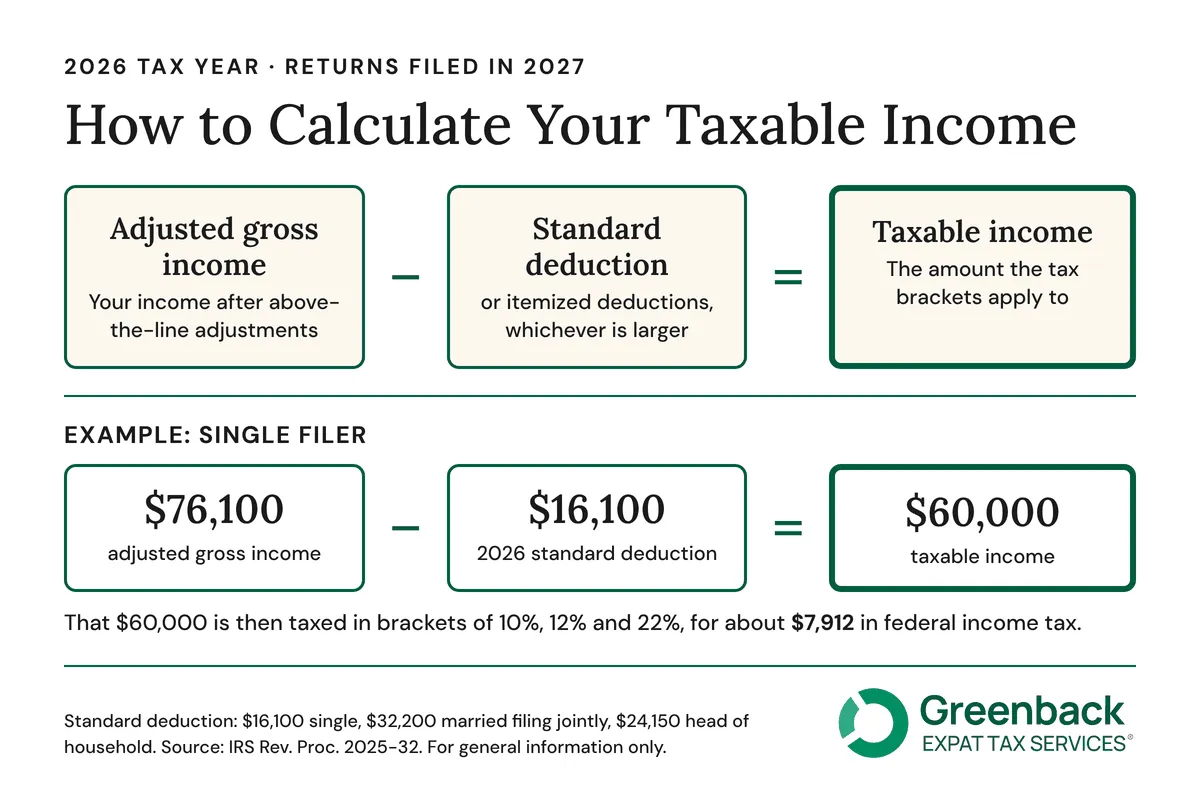
Your taxable income is your adjusted gross income minus either the standard deduction or your itemized deductions, whichever you choose. A larger deduction means less income is subject to the tax brackets.
Itemizing Helps Only When Your Deductions Add Up to More
You can itemize deductions on Schedule A when your deductible expenses, such as mortgage interest, state and local taxes, and charitable gifts, add up to more than your standard deduction. If your itemized total is lower, the standard deduction gives you the larger reduction.
A few rules matter for Americans abroad. Property taxes you pay on real estate in another country cannot be deducted on Schedule A. Gifts made directly to foreign charities generally are not deductible either, except for certain Canadian, Israeli, and Mexican charities under tax treaties, with limits set by each treaty. Foreign income taxes can be deducted, though the IRS notes you may want to take a credit for them instead. Our FAQ on the difference between a tax credit and a tax deduction explains how each one lowers your tax.

How Much Is the Standard Deduction for Each Filing Status?
For 2026 tax returns, filed in 2027, the standard deduction is $32,200 for married couples filing jointly and qualifying surviving spouses, $24,150 for heads of household, and $16,100 for single filers and married couples filing separately. Filers who are 65 or older or who are blind pay an additional amount on top.
2026 standard deduction (returns filed in 2027)
| Filing status | Standard deduction | Extra amount if 65+ or blind |
|---|---|---|
| Married filing jointly | $32,200 | $1,650 per person, per condition |
| Qualifying surviving spouse | $32,200 | $1,650 per condition |
| Head of household | $24,150 | $2,050 per condition |
| Single | $16,100 | $2,050 per condition |
| Married filing separately | $16,100 | $1,650 per condition |
A single filer who is 65 or older has a standard deduction of $18,150. A married couple filing jointly, with both spouses 65 or older, has a standard deduction of $35,500. Our guide to Form 1040-SR covers the senior version of the return.
Dependents Get a Smaller Standard Deduction
If someone else can claim you as a dependent, your standard deduction is the greater of $1,350 or your earned income plus $450, but no more than the regular amount for your filing status. A student with $5,000 of wages from a summer job, for example, has a standard deduction of $5,450.
Seniors Can Claim a Separate $6,000 Deduction on Top
For tax years 2025 through 2028, taxpayers age 65 or older can claim an enhanced deduction for seniors of up to $6,000 each, or $12,000 for a married couple filing jointly when both qualify. It is a separate deduction claimed on Schedule 1-A, so you can take it whether you use the standard deduction or itemize.
The deduction is reduced by 6% of your modified adjusted gross income above $75,000 ($150,000 for married couples filing jointly), and it phases out completely at $175,000 for single, head of household, and qualifying surviving spouse filers and at $250,000 for joint filers. A single filer age 65 with modified adjusted gross income of $95,000, for example, loses $1,200 (6% of the $20,000 above $75,000) and can deduct $4,800.
If you claim the FEIE, the income you exclude and any housing deduction on Form 2555 are added back when you calculate that limit. You need a valid Social Security number, and married taxpayers must file a joint return to claim it, so a married expat who files separately is not eligible. Our article on the new OBBB deductions for expats explains how the senior deduction compares with the tips and overtime deductions.
Can Everyone Take the Standard Deduction?
U.S. citizens and resident aliens, including those living abroad, can generally take the standard deduction. It drops to zero in three situations: you file married filing separately and your spouse itemizes, you file a return for a short tax year because your accounting period changed, or you were a nonresident or dual-status alien during the year.
Nonresident and Dual-Status Filers Generally Get No Standard Deduction
A nonresident alien or a dual-status alien generally cannot claim the standard deduction. The exception is a nonresident married to a U.S. citizen or resident who chooses to be treated as a U.S. resident, covered next.
Expats Married to a Nonresident Have Three Possible Filing Statuses
With a nonresident spouse, you can choose among three filing statuses, each with its own standard deduction and brackets.
| Filing status | 2026 standard deduction | What it requires |
|---|---|---|
| Married filing separately | $16,100 | No election; your spouse’s income stays off your return |
| Married filing jointly | $32,200 | Choosing to treat your spouse as a U.S. resident, which brings their worldwide income onto the return |
| Head of household | $24,150 | No resident election, a qualifying person other than your spouse, such as a child who lives with you, and the other head of household tests |
With a nonresident spouse, you are considered unmarried for head of household purposes, but your spouse cannot be the qualifying person. Our guide to filing with a foreign spouse compares the three routes in detail.
What Are the Federal Income Tax Brackets?
Federal income tax brackets for 2026 run from 10% to 37%, and the income ranges depend on your filing status. The 10% bracket covers the first $12,400 of taxable income for single filers and the first $24,800 for married couples filing jointly. The 37% rate starts above $640,600 for single filers and $768,700 for joint filers.
2026 federal income tax brackets (returns filed in 2027)
| Tax rate | Single | Married filing jointly | Head of household |
|---|---|---|---|
| 10% | Up to $12,400 | Up to $24,800 | Up to $17,700 |
| 12% | $12,401 to $50,400 | $24,801 to $100,800 | $17,701 to $67,450 |
| 22% | $50,401 to $105,700 | $100,801 to $211,400 | $67,451 to $105,700 |
| 24% | $105,701 to $201,775 | $211,401 to $403,550 | $105,701 to $201,750 |
| 32% | $201,776 to $256,225 | $403,551 to $512,450 | $201,751 to $256,200 |
| 35% | $256,226 to $640,600 | $512,451 to $768,700 | $256,201 to $640,600 |
| 37% | Over $640,600 | Over $768,700 | Over $640,600 |
Married couples filing separately use the single brackets up to the 32% rate. For them, the 35% bracket ends at $384,350, and the 37% rate applies above that. A qualifying surviving spouse uses the married filing jointly brackets.
Long-term capital gains and qualified dividends use their own 0%, 15%, and 20% rates. For 2026, the 0% rate applies to taxable income up to $49,450 for single filers and married couples filing separately, $66,200 for heads of household, and $98,900 for married couples filing jointly. Our guide to capital gains for expats covers those rates in full.
Which Tax Bracket Is Your Salary In?
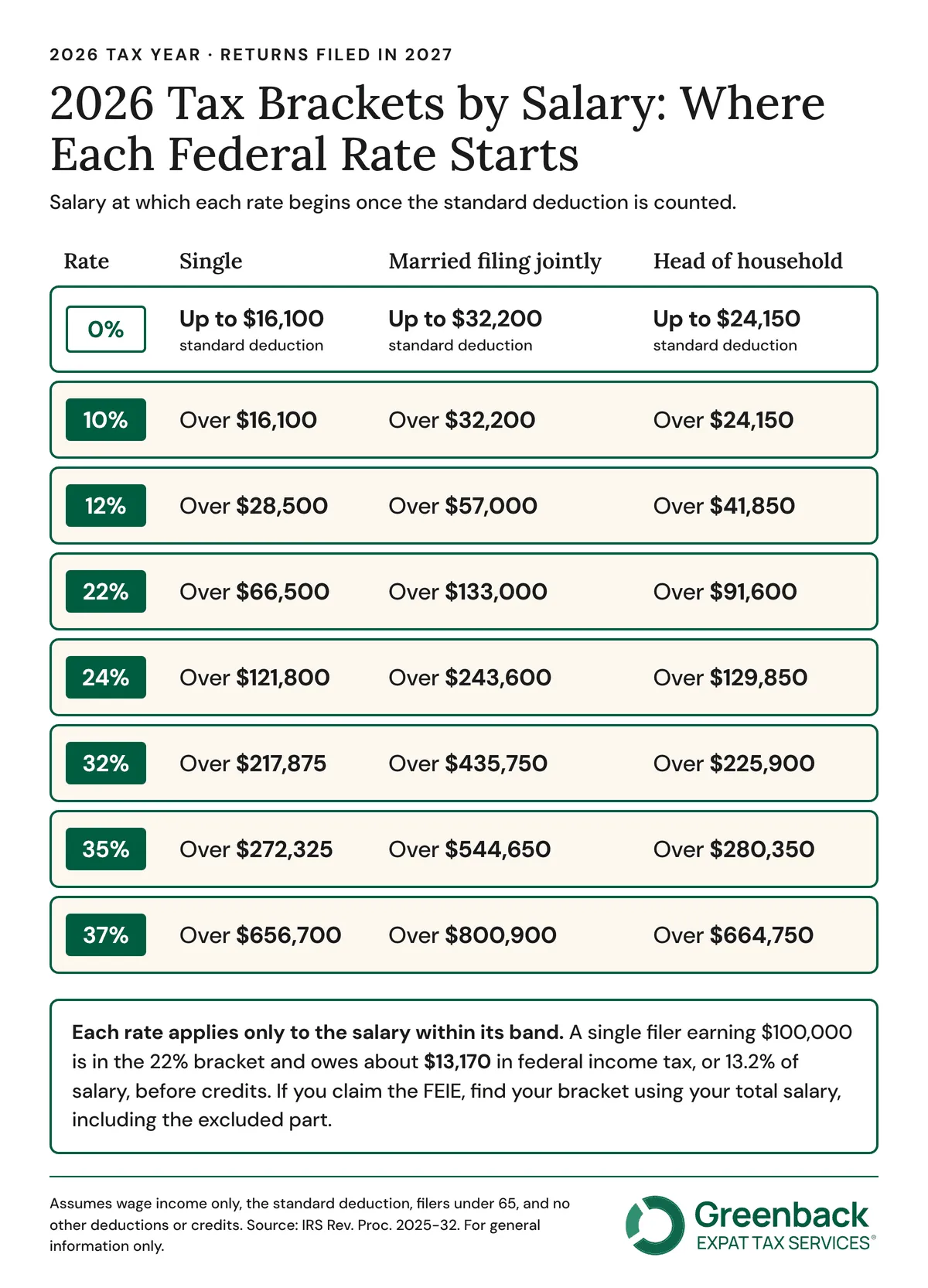
To find your bracket from your salary, add your standard deduction to the income ranges above. For a single filer with only wage income, the 12% rate starts above $28,500 of salary, the 22% rate above $66,500, and the 24% rate above $121,800. For a married couple filing jointly, the 22% rate starts above $133,000 of combined salary, and for a head of household, above $91,600.
Federal Income Tax on Common Salaries
These 2026 figures assume wage income only, the standard deduction, filers under 65, and no credits. Each cell shows the tax, then the top bracket and the effective rate (the total tax as a share of salary). Amounts are calculated from the brackets, and the IRS Tax Table can differ by a few dollars.
| Salary | Single | Married filing jointly | Head of household |
|---|---|---|---|
| $50,000 | $3,820 (12%, 7.6%) | $1,780 (10%, 3.6%) | $2,748 (12%, 5.5%) |
| $75,000 | $7,670 (22%, 10.2%) | $4,640 (12%, 6.2%) | $5,748 (12%, 7.7%) |
| $100,000 | $13,170 (22%, 13.2%) | $7,640 (12%, 7.6%) | $9,588 (22%, 9.6%) |
| $150,000 | $24,734 (24%, 16.5%) | $15,340 (22%, 10.2%) | $20,991 (24%, 14.0%) |
| $200,000 | $36,734 (24%, 18.4%) | $26,340 (22%, 13.2%) | $32,991 (24%, 16.5%) |
| $300,000 | $68,134 (35%, 22.7%) | $49,468 (24%, 16.5%) | $63,509 (35%, 21.2%) |
Credits such as the child tax credit and the Foreign Tax Credit then reduce these amounts.
How Do Tax Brackets Work?
Tax brackets are marginal, meaning each rate applies only to the portion of taxable income within that bracket. Once your income passes the 10% bracket, your overall tax rate is lower than your top bracket rate.
Your Marginal Rate Is the Rate on Your Next Dollar
Your marginal tax rate is the rate of the highest bracket your taxable income reaches. Take a single filer with $60,000 of taxable income, after the standard deduction, on a 2026 return:
- 10% bracket: 10% of the first $12,400 is $1,240.
- 12% bracket: 12% of the next $38,000 (from $12,400 to $50,400) is $4,560.
- 22% bracket: 22% of the last $9,600 (from $50,400 to $60,000) is $2,112.
The total federal income tax is about $7,912, and the marginal rate is 22%.
Your Effective Rate Is Your Total Tax as a Share of Income
Your effective tax rate divides your total tax by your income. In the example above, $7,912 is about 13.2% of the $60,000 of taxable income, well below the 22% marginal rate. The salary table above divides tax by salary instead, so its rates are lower. Our FAQ on marginal vs. effective tax rates for expats explains the difference for Americans abroad.
A Raise Into a Higher Bracket Only Taxes the Extra Income at the New Rate
Moving into a higher bracket does not raise the tax on the income you already had. If the single filer above earns another $1,000, only that $1,000 is taxed at 22%, adding $220. The first $60,000 is taxed exactly as before.
How Do the Standard Deduction and Brackets Apply When You Live Abroad?
U.S. citizens and green card holders living abroad use the same standard deduction and tax brackets as filers in the United States. What changes is how excluded income affects the rate on the rest.
The Standard Deduction Comes After the FEIE
When you claim the Foreign Earned Income Exclusion on Form 2555, up to $132,900 of foreign earned income comes off your 2026 income. You still receive the full standard deduction for your filing status on the income that remains.
Excluded Income Still Decides Your Tax Rate
Your tax on the remaining income is figured at the rates that would apply if the excluded income were still included. This is done on the Foreign Earned Income Tax Worksheet in the Form 1040 instructions, and our FAQ on how the FEIE affects your tax bracket walks through it.
Take a single filer with a $150,000 foreign salary on a 2026 return:
- Salary: $150,000
- FEIE: $132,900 excluded, leaving $17,100
- Standard deduction: $16,100, leaving $1,000 of taxable income
On its own, $1,000 would be taxed at 10%, for $100 in tax. Because the excluded $132,900 sits beneath it, the $1,000 is taxed at 24%, for $240: the tax on $133,900 minus the tax on $132,900. To find your bracket for the salary figures above when you claim the FEIE, start with your total salary, including the excluded portion. The tax amounts in the common-salaries table do not apply in that case.
The Foreign Tax Credit, claimed on Form 1116, can then reduce that tax by foreign income tax paid on the same income.
What Lowers the Tax Bracket Your Income Falls Into?
Only a lower taxable income moves you into a lower bracket, so the changes that help are the ones that reduce taxable income. The main ones are pre-tax contributions and itemized deductions when they exceed your standard deduction.
Pre-Tax Retirement and HSA Contributions Reduce Taxable Income
Contributions to a traditional 401(k) through a U.S. employer, a deductible traditional IRA, or, if you are eligible, a health savings account, are deducted from your income before the brackets apply. IRA contributions require taxable compensation, and wages you exclude under the FEIE do not count, so an expat who excludes all of their earned income generally cannot contribute for that year. Our guide to retirement accounts for expats covers the rules.
For Expats, the FEIE Does Not Lower Your Bracket
As the $150,000 example shows, income left after the FEIE is taxed at the rate set by your total income, so the choice that matters more abroad is between the exclusion and the credit. Our guide to the FEIE vs. FTC shows which one often fits your situation.
When Do the Standard Deduction and Tax Brackets Change?
The IRS adjusts the standard deduction and tax brackets for inflation each year, usually announcing the next year’s figures in the fall. The 2026 amounts on this page are based on Revenue Procedure 2025-32, which the IRS announced on October 9, 2025. They apply to 2026 tax returns, filed in 2027.
If your taxable income is under $100,000, you look up your tax in the Tax Table that the IRS publishes in the instructions for Form 1040, which is built from these same brackets. At $100,000 or more, you calculate it with the Tax Computation Worksheet in the same instructions.
Frequently Asked Questions About the Standard Deduction and Tax Brackets
Generally, the income level that requires a federal tax return matches the standard deduction for your filing status, plus the extra amount for age 65 or older. There are exceptions. You must file if you have net self-employment earnings of $400 or more, and a married person filing separately must file with as little as $5 of gross income. Americans living abroad count income they exclude under the Foreign Earned Income Exclusion when deciding whether they have to file.
No. Claiming the Foreign Earned Income Exclusion does not reduce the standard deduction, and U.S. citizens and green card holders abroad receive the same amount as filers in the United States. It applies to the income left after the exclusion. It drops to zero in a few cases, such as when you file married filing separately and your spouse itemizes, or when you were a nonresident or dual-status alien during the year.
The standard deduction is set per return, based on filing status. A married couple filing jointly receives one standard deduction of $32,200 for 2026. The extra amount for age 65 or older or blindness is figured per person, so a joint return where both spouses are 65 or older adds $1,650 for each spouse.
The figures for the tax year in which you earned the income apply to your return. Income earned in 2026 uses the 2026 brackets and standard deduction on the return filed in 2027.
Your Filing Status Sets Both Numbers
Your filing status decides the size of your standard deduction and the income ranges for each tax bracket, so it is the first thing to settle before you look up either figure. For Americans abroad, the income you exclude still counts toward the bracket you land in. Running the numbers carefully is especially useful when you are married to a nonresident, when you are 65 or older with income near the senior deduction limits, or when you became a U.S. resident during the year.
Greenback’s U.S. expat tax accountants have deep expertise in applying the standard deduction, the FEIE, and the Foreign Tax Credit on a single return through our federal tax return preparation. If you’re one of the U.S. citizens living abroad working out what you owe, we can help you apply each figure to your return. Retirees abroad weighing the senior deduction can work through it with us as well.

Get Your Return Done Right.
This article is for general information and does not cover every situation. Tax figures change each year, and the right approach depends on your income, residency, and family. Speak with a qualified tax professional with expertise in U.S. expat taxes before making decisions about your return.



Featured In


