Form 5471 for Expats Explained: Filing Requirements and $10,000+ Penalties

- Do I Need to File Form 5471? (Quick Decision Guide)
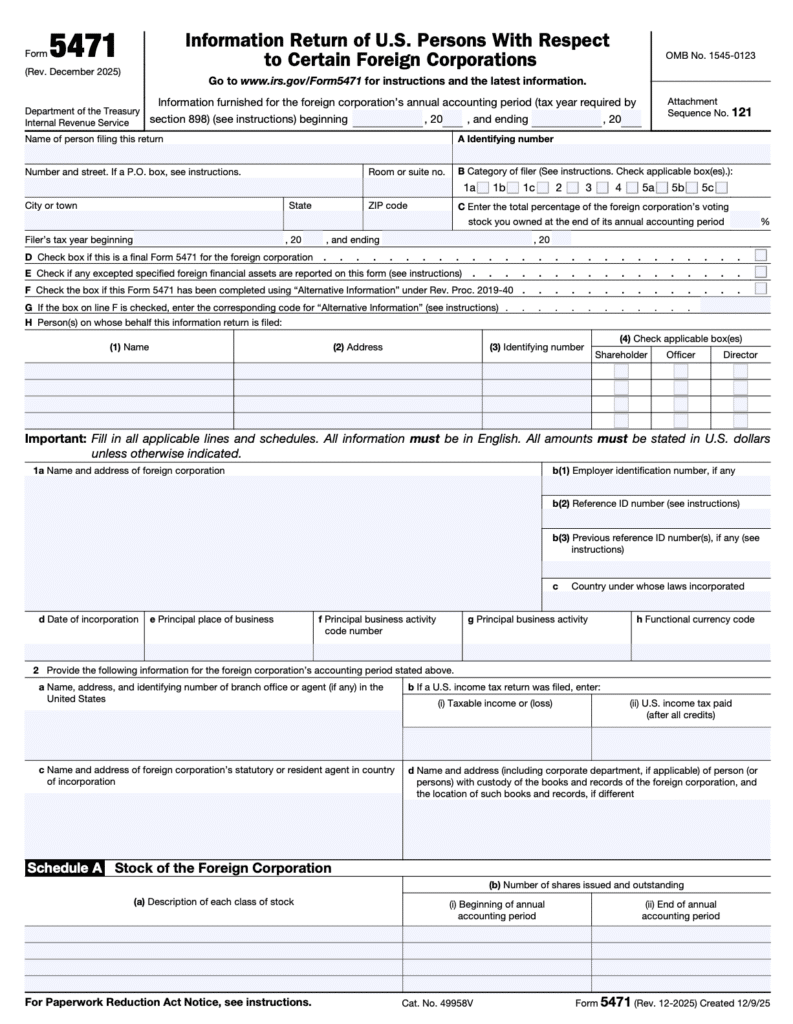
- What Is Form 5471?
- What's New in Form 5471 for the 2025 Tax Year (Filed in 2026)
- Who Must File Form 5471? (All 5 Categories Explained)
- What Is a Controlled Foreign Corporation (CFC)?
- Form 5471 vs. Form 5472 vs. Form 8858: What's the Difference?
- How Form 5471 Connects to GILTI (Form 8992)
- Form 5471 and Your U.S. Tax Liability
- Form 5471 Schedules: What Each One Does
- Form 5471 Penalties: What You Need to Know
- How to File Form 5471: Step-by-Step Instructions
- Common Form 5471 Mistakes to Avoid
- Can I File Form 5471 Myself?
- What Happens If I Just Ignore Form 5471?
- Form 5471 FAQs
- Need Help Filing Form 5471 for Your Foreign Corporation?


Form 5471 (Information Return of U.S. Persons with Respect to Certain Foreign Corporations) is required when a U.S. citizen, green card holder, or resident alien is an officer, director, or shareholder of certain foreign corporations. According to the IRS, you must file if you own 10% or more of a foreign corporation, or if you’re an officer/director of a controlled foreign corporation (CFC). The penalty for not filing is $10,000 per form per year, with no statute of limitations.
Most Americans with small foreign businesses owe little to no U.S. taxes when they file correctly, thanks to the Foreign Earned Income Exclusion (up to $130,000 for 2025) and Foreign Tax Credit. However, the reporting requirement remains mandatory regardless of whether you owe taxes.
This guide explains exactly who must file Form 5471, which schedules you need, how it connects to GILTI reporting on Form 8992, and how to avoid costly penalties.
Do I Need to File Form 5471? (Quick Decision Guide)
Use this decision tree to determine if you must file:
Step 1: Is it a corporation?
- ✅ Yes, it’s a foreign corporation → Continue to Step 2
- ❌ No, it’s an LLC, partnership, or sole proprietorship → You likely need Form 8858 or Form 8865 instead
Step 2: Is it a Controlled Foreign Corporation (CFC)?
- Add up all U.S. shareholders who own 10% or more
- If combined ownership exceeds 50% → It’s a CFC → Continue to Step 3
- If combined ownership is 50% or less → You likely don’t need Form 5471
Step 3: What’s your role and ownership?
- You own 10% or more → File Form 5471 (Category 5)
- You’re an officer or director (any ownership) → File Form 5471 (Category 2)
- You acquired or disposed of 10%+ this year → File Form 5471 (Category 3)
- You own more than 50% yourself → File Form 5471 (Category 4)
You do NOT need Form 5471 if:
- You own less than 10% and are not an officer/director
- The foreign corporation is NOT a CFC (U.S. ownership is 50% or less)
- You own a disregarded entity like a single-member LLC (use Form 8858 instead)

Just realized you need to file Form 5471?
What Is Form 5471?
Form 5471 is an information return that U.S. persons must file to report their ownership or control in certain foreign corporations. The IRS uses this form to:
- Track foreign corporate ownership by U.S. taxpayers
- Prevent offshore tax evasion through controlled foreign corporations
- Calculate income inclusions like GILTI (Global Intangible Low-Taxed Income) and Subpart F income
- Monitor related-party transactions between U.S. and foreign entities
Form 5471 is filed as an attachment to your Form 1040 tax return and is due by the same deadline (June 15 for Americans living abroad, or October 15 with an extension).
What’s New in Form 5471 for the 2025 Tax Year (Filed in 2026)
The IRS released significant updates to Form 5471 in December 2025:
New Lines 20a and 20b: Top-Up Tax Reporting
Form 5471 now requires reporting of Pillar Two global minimum taxes:
- Line 20a: Did the foreign corporation pay or accrue any Top-up Tax?
- Line 20b: Enter amounts for Income Inclusion Rule (IIR) or similar taxes
This reflects the OECD’s global minimum tax framework affecting large multinational corporations.
New Schedule H-1: Corporate Alternative Minimum Tax (CAMT)
A new standalone Schedule H-1 replaced the previous Worksheet H-1 to report:
- CFC’s adjusted net income or loss for CAMT purposes
- Required for corporations subject to the 15% corporate alternative minimum tax
Schedule Q Updates
- Line 4, column (xv) is now unshaded
- Allows entry of loss allocations for subpart F excluded groups
Section 987 QBU Reporting (New for 2025)
Form 5471, Schedule G, Question 3b now requires:
- Disclosure of qualified business units (QBUs) with different functional currencies
- Number of Form 8964 filings attached for each QBU
- Significant compliance change for multi-currency operations
Who Must File Form 5471? (All 5 Categories Explained)
There are five main categories of filers, each with different reporting requirements:
Category 1: Section 965 Transition Tax Filers
Who qualifies:
- U.S. shareholders subject to the one-time transition tax under Section 965
- This category is now primarily historical (applied to 2017-2018 tax years)
What to file: Limited schedules related to Section 965 transition tax calculations
Category 2: Officers and Directors
Who qualifies:
- You’re a U.S. citizen or resident who is an officer OR director of a foreign corporation
- Any U.S. person acquires 10% or more of the corporation’s stock
- You must report information about the acquiring shareholder
Key point: You file even if you own 0% of the corporation yourself
What to file:
- Form 5471 (basic information)
- Schedule A (stock ownership information)
- Schedule O (organization/reorganization)
Example: Maria is a U.S. citizen and CEO of UK Ltd. She owns no shares herself. When John (a U.S. person) acquires 12% of UK Ltd, Maria must file Form 5471 Category 2 to report John’s acquisition.
Category 3: Stock Acquisition or Disposition
Who qualifies:
- You acquire 10% or more ownership of a foreign corporation
- You dispose of enough stock to reduce your ownership below 10%
- Applies to any U.S. person, even if the corporation is not a CFC
What to file:
- Form 5471 (basic information)
- Schedule O (acquisition or disposition details)
Key point: File only in the year of acquisition or disposition, not annually
Example: David acquires 15% of German GmbH in 2025. He files Form 5471 Category 3 for tax year 2025. If he maintains that 15% ownership in 2026 with no changes, he won’t file Category 3 again (but may file Category 5 if it’s a CFC).
Category 4: 50%+ Ownership (Non-CFC)
Who qualifies:
- You own more than 50% of a foreign corporation yourself
- The corporation is NOT a CFC (this is a special case where you’re the sole significant U.S. shareholder)
What to file:
- Form 5471 (basic information)
- Schedule E (Income taxes paid)
- Schedule F (Balance sheet)
- Schedule H (Current earnings and profits)
Example: Jennifer owns 60% of French SARL. The remaining 40% is owned by French citizens. Jennifer files Category 4 because she alone owns more than 50%.
Category 5: CFC Shareholders (Most Common)
Who qualifies:
- You’re a U.S. person who owns 10% or more of a controlled foreign corporation (CFC)
- This is the category most expat business owners fall into
What to file:
- Form 5471 (basic information)
- Schedule C (Income statement)
- Schedule E (Income taxes paid)
- Schedule F (Balance sheet)
- Schedule G (Other information)
- Schedule H (Current earnings and profits)
- Schedule I (Summary of shareholder’s income)
- Schedule I-1 (GILTI calculations)
- Schedule J (Accumulated earnings and profits)
- Schedule M (Related-party transactions)
- Schedule P (Previously taxed earnings)
- Schedule Q (CFC income by group)
- Schedule R (Distributions)
Can multiple categories apply? Yes. You may need to file under multiple categories simultaneously. For instance, if you’re a Category 5 filer (10%+ shareholder of a CFC) and you also acquire additional stock during the year, you’re also a Category 3 filer.
What Is a Controlled Foreign Corporation (CFC)?
A controlled foreign corporation is a foreign corporation where U.S. shareholders collectively own more than 50% of the corporation, counting only U.S. shareholders who each own 10% or more.
How to Calculate CFC Status:
- Step 1: Identify all U.S. shareholders (citizens, green card holders, resident aliens)
- Step 2: Count only those who own 10% or more individually
- Step 3: Add up their combined ownership
- Step 4: If the total exceeds 50%, it’s a CFC
CFC Examples:
✅ Example 1: CFC
- U.S. shareholder A: 30%
- U.S. shareholder B: 25%
- Foreign shareholder C: 45%
- Result: 55% U.S. ownership (30% + 25%) → CFC
❌ Example 2: Not a CFC
- U.S. shareholder A: 9%
- U.S. shareholder B: 9%
- U.S. shareholder C: 9%
- U.S. shareholder D: 9%
- U.S. shareholder E: 9%
- Foreign shareholders: 55%
- Result: 0% counted (none reached 10% threshold) → Not a CFC
✅ Example 3: CFC
- Five U.S. shareholders each own 11%
- Combined: 55% U.S. ownership
- Result: Each owns 10%+ and total exceeds 50% → CFC
❌ Example 4: Not a CFC
- U.S. shareholder A: 49%
- U.S. shareholder B: 6%
- Foreign shareholders: 45%
- Result: Only 49% counted (B is below 10%) → Not a CFC
Just realized you own a CFC? You’re not alone. We specialize in helping American business owners abroad navigate complex Form 5471 filing requirements, GILTI calculations, and international tax compliance. Our CPAs understand both U.S. tax law and the practical realities of running a business overseas.
Constructive Ownership Rules (Attribution)
You may be considered to own stock you don’t directly hold through attribution rules:
Family Attribution
You’re treated as owning stock owned by:
- Your spouse
- Your children (under 21)
- Your parents
- Your grandchildren
Example: You directly own 6% of a foreign corporation. Your spouse owns 5%. Under attribution rules, you’re treated as owning 11% → filing requirement triggered.
Entity Attribution
Stock owned by corporations, partnerships, or trusts is attributed to their owners proportionally.
Example: You own 50% of a U.S. LLC. The LLC owns 20% of a foreign corporation. You’re attributed 10% (50% of 20%) → filing requirement triggered.
Form 5471 vs. Form 5472 vs. Form 8858: What’s the Difference?
| Feature | Form 5471 | Form 5472 | Form 8858 |
|---|---|---|---|
| Entity Type | Foreign corporation | Foreign-owned U.S. corporation OR foreign corp engaged in U.S. trade/business | Foreign disregarded entity (LLC, branch) |
| Who Files | U.S. shareholders/officers | U.S. corporation with foreign owner | U.S. owner of foreign LLC or branch |
| Purpose | Report foreign corp ownership | Report related-party transactions | Report foreign disregarded entity |
| Common Example | U.S. person owns UK Ltd | UK Ltd owns U.S. Corp | U.S. owner of a foreign LLC or branch |
| Penalty | $10,000 per form | $25,000 per form | $10,000 per form |
Key Distinction: Corporation vs. Disregarded Entity
- If your foreign entity is a corporation (S.A., Ltd, AG, GmbH with multiple members) → Form 5471
- If your foreign entity is a single-member LLC or branch → Form 8858
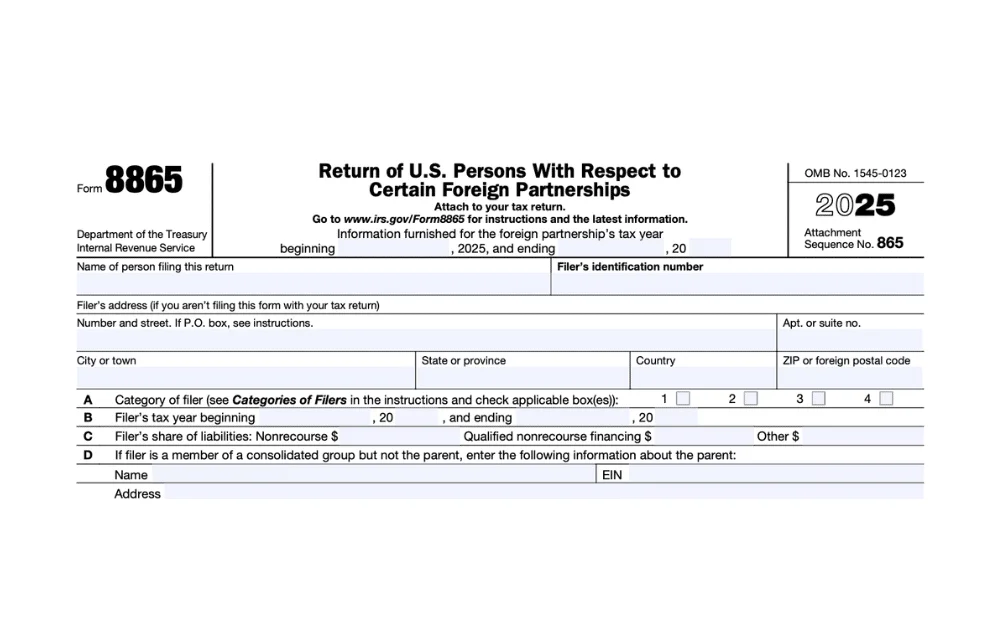
- If you have a foreign partnership → Form 8865
Per Se Corporations: Entities That Cannot Elect Disregarded Status
Certain foreign entities are automatically treated as corporations regardless of check-the-box elections:
Common Per Se Corporations:
- France: Société Anonyme (SA), Société à Responsabilité Limitée (SARL)
- Germany: Aktiengesellschaft (AG), Gesellschaft mit beschränkter Haftung (GmbH)
- UK: Public Limited Company (PLC), Limited Company (Ltd)
- Mexico: Sociedad Anónima (SA)
- Spain: Sociedad Anónima (SA), Sociedad de Responsabilidad Limitada (SL)
- Netherlands: Naamloze Vennootschap (NV), Besloten Vennootschap (BV)
These entities MUST file Form 5471 if thresholds are met. You cannot elect to treat them as disregarded entities.
How Form 5471 Connects to GILTI (Form 8992)
If you’re a Category 5 filer (10%+ shareholder of a CFC), you must also report Global Intangible Low-Taxed Income (GILTI) on Form 8992.
The Form 5471 → Form 8992 Connection:
- Form 5471 Schedule I-1 calculates your share of the CFC’s tested income
- Form 8992 uses that data to calculate your GILTI inclusion
- Form 1040 reports the GILTI income (with potential deductions and credits)
GILTI Example with Form 5471:
Scenario: Sarah owns 20% of Singapore Pte Ltd (CFC). The company earned $200,000 in profit for 2025.
Step 1: Form 5471 Calculation
- Singapore corporate tax paid: $34,000 (17% rate)
- Sarah’s share of tested income: $40,000 (20% of $200,000)
- Foreign tax allocated to Sarah: $6,800
Step 2: Form 8992 GILTI Calculation
- Tested income: $40,000
- Minus QBAI deduction: $2,000
- Net tested income: $38,000
- GILTI inclusion: $38,000
Step 3: Form 1040 Tax Impact
- Section 250 deduction (50%): $19,000
- Taxable GILTI: $19,000
- Foreign tax credit available: ~$6,800
- Net U.S. tax on GILTI: ~$1,180 (after credits)
Result: Sarah reports foreign corporate income but owes minimal U.S. tax due to foreign taxes paid and Section 250 deduction.
Related: Learn more about GILTI calculations and Form 8992
Overwhelmed by GILTI calculations? Form 5471 and Form 8992 work together in complex ways. Our foreign business owner specialists handle the entire reporting chain—from Form 5471 schedules through GILTI calculations to final tax optimization. We’ll find every credit and deduction you’re entitled to.
Form 5471 and Your U.S. Tax Liability
Does Filing Form 5471 Mean I Owe Taxes?
Not necessarily. Form 5471 is an information return, not a tax return. However, the information reported can trigger tax liability through:
1. Subpart F Income
Passive income (dividends, interest, rents) from a CFC may be taxed currently, even if not distributed.
2. GILTI (Global Intangible Low-Taxed Income)
Active business income from a CFC is taxed currently with:
- 50% Section 250 deduction (reducing effective rate)
- Foreign tax credit for foreign taxes paid
- Often results in $0 U.S. tax if foreign tax rate is 13.125% or higher
3. Dividends Received
Actual distributions from the CFC are taxable, but may be offset by:
- Foreign Tax Credit
- Previously taxed earnings (PTEP) that were already taxed under GILTI or Subpart F
How Most Expat Business Owners Owe $0
Example: Active Business in High-Tax Country
- Own 100% of UK Ltd (CFC)
- UK Ltd earns £100,000 ($130,000) in consulting income
- UK corporate tax: £19,000 ($24,700) at 19% rate
- U.S. Tax Calculation:
- GILTI inclusion: $130,000
- Section 250 deduction: $65,000
- Taxable amount: $65,000
- U.S. tax before credits: ~$14,300
- Foreign tax credit: ~$14,300
- Net U.S. tax: $0
Example: Active Business in a Low-Tax Country
- Own 50% of UAE LLC (CFC)
- UAE LLC earns $200,000 in trading income
- UAE corporate tax: $0 (0% rate until recently)
- U.S. Tax Calculation:
- GILTI inclusion: $100,000 (your 50% share)
- Section 250 deduction: $50,000
- Taxable amount: $50,000
- U.S. tax: ~$11,000
- Foreign tax credit: $0
- Net U.S. tax: ~$11,000 owed
Form 5471 Schedules: What Each One Does
Form 5471 has 13 separate schedules. Which ones you file depends on your category:
| Schedule | Purpose | Category 2 | Category 3 | Category 4 | Category 5 |
|---|---|---|---|---|---|
| A | Stock ownership summary | ✓ | ✓ | ||
| B | U.S. shareholders | ✓ | ✓ | ||
| C | Income statement | ✓ | ✓ | ||
| E | Foreign taxes paid | ✓ | ✓ | ||
| E-1 | Foreign tax detail | ✓ | ✓ | ||
| F | Balance sheet | ✓ | ✓ | ||
| G | Other information | ✓ | |||
| H | Current E&P | ✓ | ✓ | ||
| H-1 | CAMT adjusted income (new 2025) | ✓ | ✓ | ||
| I | Shareholder income summary | ✓ | |||
| I-1 | GILTI calculations | ✓ | |||
| J | Accumulated E&P | ✓ | |||
| M | Related-party transactions | ✓ | |||
| O | Organizational changes | ✓ | ✓ | ||
| P | Previously taxed E&P | ✓ | |||
| Q | Income by CFC group | ✓ | |||
| R | Distributions | ✓ |
Schedule Highlights:
Schedule C (Income Statement):
- Report revenue, expenses, and net income
- Must reconcile to the local tax return
- Convert from functional currency to USD
Schedule I-1 (GILTI):
- Calculate the tested income
- Determine QBAI (qualified business asset investment)
- Feed data to Form 8992
Schedule M (Related-Party Transactions):
- Report all transactions with U.S. shareholders
- Include loans, sales, services, and rents
- Critical for transfer pricing compliance
Schedule J (Accumulated E&P):
- Track cumulative earnings and profits
- Determine PTEP (previously taxed earnings)
- Calculate available dividend capacity
Looking at this schedule list, feeling overwhelmed? You’re not alone. Category 5 filers (the most common) must complete 13+ schedules with complex currency conversions, tax calculations, and international accounting rules. Our expat business specialists handle everything from start to finish—you provide your foreign corporation’s financials, and we deliver a complete, accurate Form 5471 with all required schedules.
Form 5471 Deadline and Extensions
Standard Deadline
Form 5471 is filed with your income tax return:
- For individuals: June 15 (automatic 2-month extension for Americans abroad)
- With Form 4868 extension: October 15
- For corporations: March 15 (calendar year) or 15th day of the 3rd month after the fiscal year end
How to Request an Extension
For Individual Filers (Form 1040):
- File Form 4868 by June 15 (or April 15 if in the U.S.)
- Your Form 5471 automatically extends to October 15
- You do NOT file a separate extension for Form 5471
For Corporate Filers:
- File Form 7004 by the original due date
- Form 5471 is filed with the tax return
An extension to file is NOT an extension to pay. If you owe taxes, pay by the original deadline to avoid interest and penalties.
Form 5471 Penalties: What You Need to Know
$10,000 Automatic Penalty
If you fail to file Form 5471 when required:
- First offense: $10,000 per form per year
- After IRS notice: Additional $10,000 per month (up to $50,000 total per form)
- Multiple corporations: Penalty applies to each Form 5471 separately
Example of Stacking Penalties: You own 25% of UK Ltd and 30% of German GmbH (both CFCs). You fail to file for 3 years.
- 2 corporations × 3 years = 6 forms
- 6 forms × $10,000 = $60,000 in penalties
No Statute of Limitations
Unlike most tax issues, there is no statute of limitations for failing to file Form 5471. The IRS can:
- Audit your entire tax return from any year you failed to file
- Assess penalties decades later
- Keep your tax year open indefinitely
Criminal Penalties
Willful failure to file can result in:
- Criminal prosecution
- Fines up to $100,000
- Prison time up to 3 years
Worried about past unfiled Form 5471s? The $10,000 penalty sounds scary, but there are solutions. We help expat business owners catch up on years of missing filings through Streamlined Procedures—often with penalties waived entirely. The key is addressing it before the IRS contacts you.
Reasonable Cause and Penalty Relief
You may avoid penalties if you can demonstrate reasonable cause for failure to file:
What Qualifies as Reasonable Cause
✅ Strong reasonable cause arguments:
- You were unaware of the filing requirement and had no reason to know (first-time filer)
- You reasonably relied on professional advice
- Serious illness or family emergency prevented filing
- Natural disaster destroyed records
- The foreign corporation was dormant with no activity
❌ Weak reasonable cause arguments:
- “I didn’t know” (when you should have known)
- “It’s complicated” (complexity alone is not a reasonable cause)
- “I forgot” (forgetfulness is not a reasonable cause)
- “My accountant didn’t tell me” (you’re responsible for your filings)
How to Request Penalty Relief
Step 1: File all missing Forms 5471 immediately
Step 2: Attach a reasonable cause statement explaining:
- The specific circumstances that prevented timely filing
- When you became aware of the requirement
- Steps you took to comply once aware
- Why was the failure not willful
Step 3: Provide supporting documentation:
- Medical records (if applicable)
- Professional advice received
- Timeline of events
- Evidence of good faith efforts
Streamlined Filing Procedures for Late Filers
If you’re behind on multiple years of Form 5471 filing, consider the Streamlined Filing Compliance Procedures:
Streamlined Foreign Offshore Procedures:
- File the last 3 years of delinquent tax returns (including Form 5471)
- File the last 6 years of FBAR
- Submit certification of non-willful conduct
- Result: No penalties for non-willful failure
Who qualifies:
- U.S. citizens living outside the United States
- Failure to file was non-willful (you didn’t know or forgot)
- You’re not under IRS examination
Learn more: Streamlined Filing for U.S. Expats
How to File Form 5471: Step-by-Step Instructions
Step 1: Determine Your Filing Category
Use the decision tree at the top of this article to identify which category (or categories) apply to your situation.
Step 2: Gather Required Financial Information
You’ll need from the foreign corporation:
- Financial statements (income statement, balance sheet)
- Ownership structure and shareholder details
- Tax returns filed in the foreign country
- Related-party transaction records
- Earnings and profits calculations
- Foreign tax payment documentation
Step 3: Identify the Functional Currency
The foreign corporation’s functional currency is typically:
- The currency of the country where it operates
- The currency used for its books and records
- May be USD if substantially all transactions are in USD
Important: You must report amounts in both functional currency AND USD on most schedules.
Step 4: Complete Required Schedules
Based on your category, complete all required schedules:
- Convert all amounts from functional currency to USD using appropriate exchange rates
- Use year-end rates for balance sheet items
- Use average rates for income statement items
Step 5: Calculate Tax Inclusions
Determine if you have:
- Subpart F income: Passive income requiring current inclusion
- GILTI: Complete Form 5471 Schedule I-1, then transfer to Form 8992
- Section 956 amounts: U.S. property held by CFC
Step 6: Attach to Your Tax Return
- Form 5471 must be paper-filed and attached to your Form 1040
- Cannot e-file Form 5471 by itself
- If e-filing Form 1040, Form 5471 must still be mailed separately or included in the e-file transmission
Step 7: Keep Records
Maintain for at least 6 years:
- Completed Form 5471 and all schedules
- Foreign corporation financial statements
- Ownership documentation
- Supporting calculations and worksheets
Common Form 5471 Mistakes to Avoid
1. Wrong Form Entirely
- Mistake: Filing Form 5471 for a foreign LLC or partnership
- Correct: Use Form 8858 for disregarded entities or Form 8865 for partnerships
2. Misidentifying Your Category
- Mistake: Filing as Category 4 when you should be Category 5
- Impact: Missing required schedules triggers penalties
- Solution: Carefully review category definitions and file all required schedules
3. Currency Conversion Errors
- Mistake: Reporting everything in USD when the functional currency is required
- Correct: Most schedules require both functional currency AND USD columns
4. Ignoring Constructive Ownership
- Mistake: Reporting only your direct ownership percentage
- Impact: Underreporting ownership can trigger penalties
- Solution: Include family and entity attribution when calculating ownership
5. Missing Related-Party Transactions
- Mistake: Not completing Schedule M for loans or services between you and the CFC
- Impact: Transfer pricing issues and additional penalties
- Solution: Document ALL transactions, even small ones
6. Functional Currency Confusion
- Mistake: Using USD as a functional currency when the business operates in euros
- Correct: Functional currency should match the primary economic environment
7. Not Filing When Ownership Predated U.S. Status
- Mistake: “I owned the company before becoming a U.S. citizen, so I don’t have to report it”
- Correct: You must file starting from the year you became a U.S. person for tax purposes
8. Forgetting GILTI Reporting
- Mistake: Filing Form 5471 but not Form 8992
- Impact: Incomplete return triggers notices and penalties
- Solution: Category 5 filers must also file Form 8992 for GILTI
Recognize yourself in these mistakes? Form 5471 is complex even for tax professionals. Our team has deep expertise in helping Americans who own foreign businesses get it right the first time: correct category, proper schedules, optimized tax strategy, and zero penalties.
What If I Owned the Foreign Corporation Before Becoming a U.S. Citizen?
This is one of the most common misconceptions about Form 5471.
The Rule:
If you owned a foreign corporation before becoming a U.S. person (through citizenship, green card, or substantial presence), you still must file Form 5471 starting from the year you became a U.S. person.
Example:
- 2018: You (French citizen) own 50% of French SARL
- 2022: You become a U.S. citizen
- Filing requirement: Starting with your 2022 U.S. tax return, you must file Form 5471
You may file as Category 2 or 3:
- Category 2: If you’re an officer/director when someone acquires 10%+
- Category 3: Because you “acquired” the ownership from the IRS’s perspective when you became a U.S. person
You continue filing Category 5:
- Every year thereafter, as a 10%+ shareholder of a CFC
Started your business before moving to the U.S.? This is one of the most confusing Form 5471 scenarios. We help foreign-born entrepreneurs who became U.S. citizens or green card holders navigate the transition—determining first-year filing requirements, calculating opening PTEP balances, and ensuring full compliance from day one of U.S. person status.
Can I File Form 5471 Myself?
Technically, yes, but realistically, no.
Form 5471 is one of the most complex IRS forms:
- Requires knowledge of international tax rules
- Involves multi-currency accounting conversions
- Demands understanding of CFC, GILTI, and Subpart F rules
- Mistakes trigger $10,000+ penalties with no statute of limitations
When DIY Makes Sense
You might consider filing yourself if:
- You have a degree in accounting or tax
- The foreign corporation is very simple (one shareholder, minimal transactions)
- You’re willing to invest 20+ hours studying the instructions
- You have tax software that supports Form 5471
When You Need Professional Help
Seek professional help if:
- You’re a first-time filer
- Multiple shareholders or a complex ownership structure
- Significant related-party transactions
- Foreign corporation is profitable (GILTI implications)
- You’re behind on prior-year filings
- The foreign corporation operates in multiple countries
The cost of a mistake:
- Minimum $10,000 penalty per year
- Potential criminal prosecution for willful failure
- No statute of limitations exposure
- Professional fee for Form 5471: typically $1,500-$5,000+
Professional fee vs. penalty: Even expensive professional help is cheaper than a single $10,000 penalty.
Still on the fence about DIY vs. professional help? Consider this: Form 5471 isn’t just about filling out forms—it’s about making strategic tax decisions that affect your business for years. Should you take a salary or dividends? How do you structure operations to minimize GILTI? Can you utilize the high-tax exception? Our business owner specialists don’t just file forms—we optimize your entire international tax strategy. Many clients save far more in taxes than they pay in professional fees.
What Happens If I Just Ignore Form 5471?
Many Americans abroad mistakenly believe the IRS won’t find out about their foreign corporations. Here’s the reality:
How the IRS Finds Out
1. FATCA Reporting: Foreign banks report your accounts to the IRS through FATCA agreements. If you have large account balances, the IRS may investigate their source.
2. FBAR Discrepancies: You report foreign bank accounts on FBAR. If accounts show business activity but no Form 5471 is filed, red flags appear.
3. Foreign Tax Return Matching: Some countries share tax return information with the IRS through tax treaties.
4. Whistleblowers: Former business partners, ex-spouses, or employees may report you to the IRS.
5. Inadvertent Disclosure: Applying for a mortgage, selling property, or other financial transactions may reveal foreign business ownership.
Consequences of Willful Non-Filing
If the IRS determines your failure to file was willful:
- $10,000 penalty becomes just the start
- Civil fraud penalties up to 75% of tax owed
- Criminal prosecution possible
- Prison sentences up to 3 years
- Fines up to $100,000
Your Safest Option: Come Forward Voluntarily
The Streamlined Filing Procedures exist specifically for taxpayers who:
- Didn’t know about filing requirements
- Made honest mistakes
- Want to get compliant before the IRS contacts them
Benefits of coming forward:
- Penalties waived for non-willful conduct
- Clean slate moving forward
- Peace of mind
- Avoid criminal prosecution
Learn more: How to Catch Up on Late Tax Filing
Ready to come clean without getting crushed by penalties? We’ve helped hundreds of business owners abroad catch up on years of unfiled Form 5471s through Streamlined Procedures. We’ll assess your situation, determine if you qualify for penalty relief, and guide you through the entire process. Most clients owe $0 in penalties when done correctly.
Form 5471 FAQs
Do I file one Form 5471 per corporation or per shareholder?
One Form 5471 per corporation per category. If a foreign corporation has three U.S. shareholders who are all Category 5 filers, typically only one Form 5471 is filed with all shareholders listed on Schedule B.
However, each shareholder files their own Form 5471 if they fall into different categories or have different reporting requirements.
Can I e-file Form 5471?
No. Form 5471 must be paper-filed and attached to your tax return, or included if your tax software supports e-filing the complete return with Form 5471.
What if the foreign corporation’s tax year doesn’t match mine?
Use the foreign corporation’s tax year ending with or within your U.S. tax year.
Example:
- Your tax year: January 1, 2025 – December 31, 2025
- Foreign corp’s tax year: April 1, 2024 – March 31, 2025
- Report on your 2025 Form 1040: The corp’s April 2024 – March 2025 year
Do I need Form 5471 for a Canadian corporation?
Yes, if you meet the category thresholds. There is no exemption for Canadian corporations or any other specific country.
What functional currency do I use?
The foreign corporation’s functional currency is generally the currency of its primary economic environment. For most businesses, this is the local currency of the country where they’re organized.
If substantially all transactions are in USD, USD may be the functional currency, even if the entity is organized abroad.
Do I still file Form 5471 if the corporation had no income?
Yes, if you meet category requirements. A dormant or loss-making corporation still requires Form 5471 filing.
How do I report GILTI from Form 5471?
- Complete Form 5471, Schedule I-1, to calculate tested income
- Transfer that information to Form 8992
- Form 8992 calculates your GILTI inclusion
- Report GILTI on Form 1040, Schedule 1
Can I claim the Foreign Earned Income Exclusion against GILTI?
No. The $130,000 Foreign Earned Income Exclusion applies only to wages and self-employment income, not to corporate income inclusions such as GILTI or Subpart F.
However, you can claim Foreign Tax Credits for foreign taxes paid by the corporation.
Confused about FEIE vs. FTC vs. GILTI? These three concepts interact in complex ways for expat business owners. We’ll analyze your entire situation—salary you pay yourself, corporate income, foreign taxes paid—and structure everything to minimize your total U.S. tax liability. Most of our business owner clients are surprised by how little they actually owe.
What if I’m behind on multiple years of Form 5471?
File all missing years immediately, and consider the Streamlined Filing Procedures if:
- You’re 3+ years behind
- The failure was non-willful
- You qualify as a U.S. person abroad
The Streamlined Procedures can waive the $10,000 per year penalties.
Do I need Form 5471 if I sold my foreign corporation?
Yes, for the year of sale. You’ll file as Category 3 (disposition of 10%+ ownership) and potentially other categories depending on your ownership level before the sale.
Can the IRS waive Form 5471 penalties?
Yes, if you can demonstrate reasonable cause for failure to file. However, the IRS is strict about what qualifies. Professional help is strongly recommended for penalty abatement requests.
Is there a simplified filing option for small foreign corporations?
No. Unlike some international forms, Form 5471 has neither a small-business exception nor a simplified filing option. All required schedules must be filed, regardless of the corporation’s size.
What if my foreign corporation is a holding company with no operations?
You still must file Form 5471 if category requirements are met. Holding companies can generate Subpart F income from passive investments, requiring full reporting.
Can I file Form 5471 late without penalty?
Only if you have reasonable cause. Simply filing late after the deadline will trigger the $10,000 penalty unless you can prove reasonable cause prevented timely filing.
How long does it take to prepare Form 5471?
For a simple situation: 10-20 hours if doing it yourself. For a complex CFC with multiple shareholders: 40+ hours. With a professional, they handle the complexity, typically completing it in 2-4 weeks
What records do I need to keep?
Keep for at least 6 years:
- All completed Form 5471 schedules
- Foreign corporation’s financial statements
- Foreign tax returns
- Ownership documentation
- Related-party transaction records
- Currency conversion calculations
Need Help Filing Form 5471 for Your Foreign Corporation?
Form 5471 is one of the most complex international tax forms, with penalties of $10,000+ for mistakes and no statute of limitations. Our team of expert CPAs and Enrolled Agents has deep expertise in helping Americans who own businesses abroad navigate foreign corporation reporting requirements.
We’ve helped over 23,000 expats file more than 71,000 returns, maintaining a 4.9-star average across 1,200+ Trustpilot reviews. Our team spans 14 time zones and understands firsthand the challenges of running a business overseas while remaining compliant with U.S. tax law.
We handle:
- Form 5471 preparation for all five categories
- GILTI calculations and Form 8992
- Controlled foreign corporation compliance
- Late filing and Streamlined Procedures
- Penalty abatement requests
- Multi-year catch-up filings
- International tax strategy optimization
If you’re ready to be matched with a Greenback accountant, click the Get Started button below. For general questions on US expat taxes or working with Greenback, contact our Customer Champions.

Ready to File Form 5471 the Right Way?
This article is for informational purposes only and does not constitute legal or tax advice. Tax laws are complex and subject to change. Every expat’s situation is unique. For advice tailored to your specific circumstances, consult a qualified tax professional specializing in international taxation.
Related Resources
- Form 8992: GILTI Calculations and Tax Impact
- Form 8858: Foreign Disregarded Entities
- Form 8865: Foreign Partnerships
- Controlled Foreign Corporations Explained
- Starting a Business Overseas as a U.S. Citizen
- Foreign Tax Credit Guide
- FBAR Filing Requirements
- FATCA Form 8938 Reporting
- Streamlined Filing for U.S. Expats
- U.S. Expat Taxes Complete Guide


Featured In





