Form 2350 for Expats Explained: Extend Your Deadline to Qualify for the FEIE

- What Is Form 2350 and Why Does It Exist?
- Who Needs to File Form 2350?
- How Much Time Does Form 2350 Give Me?
- How Do I File Form 2350?
- What If I Need Even More Time?
- Does Form 2350 Extend My FBAR Deadline?
- What Happens If My Form 2350 Is Denied?
- Can I Still Claim the FEIE If I Miss the Deadline?
- What Are the Common Form 2350 Mistakes to Avoid?
- Should I File Form 2350 or Form 4868?
- How Does Form 2350 Interact with Other Tax Benefits?
- Special Situations
- What If I'm Behind on My Taxes?
- Get Expert Help with Form 2350
- Related Resources


File Form 2350 if you recently moved abroad and need more time to meet the residency requirements for the Foreign Earned Income Exclusion (FEIE). The IRS grants extensions of up to 30 days after you meet either the bona fide residence test or physical presence test, letting you exclude up to $130,000 of foreign-earned income for the 2025 tax year.
According to IRS data, thousands of Americans living abroad file Form 2350 each year to align their tax deadlines with FEIE qualification requirements. Moving abroad mid-year creates a common challenge for U.S. citizens living abroad. You want to claim the Foreign Earned Income Exclusion to reduce your U.S. tax bill, but you haven’t lived overseas long enough to qualify by the June filing deadline.
Form 2350 solves this timing problem. This specialized IRS form gives you additional time to complete the 330 days abroad or 12-month residence period you need to qualify for the FEIE.
What Is Form 2350 and Why Does It Exist?
Form 2350 (Application for Extension of Time to File U.S. Income Tax Return) is the IRS’s specialized extension for Americans abroad who need extra time to meet Foreign Earned Income Exclusion requirements.
The IRS created Form 2350 specifically for U.S. expats facing a calendar mismatch. Your tax return is due in June, but you won’t qualify for the FEIE until later in the year. Without this form, you’d face a choice between filing without the exclusion (and paying more tax) or filing late and facing penalties.
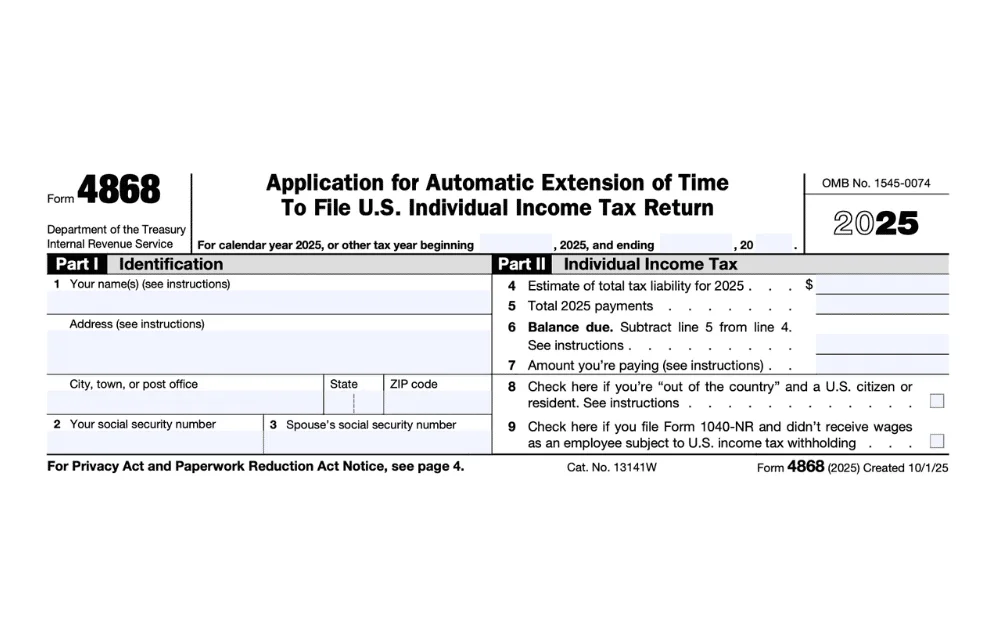
Unlike the standard Form 4868 extension, which gives everyone a six-month extension to October, Form 2350 extends your deadline based on when you’ll meet the FEIE requirements. This could be October, November, or even the following year.

Not Everyone Should File Form 2350—But If You Need It, Timing Is Everything
Who Needs to File Form 2350?
You should file Form 2350 if you meet all three conditions:
1. You Plan to Claim the FEIE or Foreign Housing Exclusion
You’re planning to use Form 2555 to exclude up to $130,000 of foreign-earned income or claim the foreign housing exclusion on your 2025 tax return.
2. You Can’t Meet Residency Tests by the Filing Deadline
By June 15, 2026 (your automatic expat filing deadline), you won’t have completed either:
- Physical Presence Test: 330 full days in a foreign country during any 12-month period
- Bona Fide Residence Test: 12 consecutive months as a bona fide resident of a foreign country
3. You Reasonably Expect to Qualify Soon
You have a legitimate expectation that you’ll meet one of these tests in the foreseeable future.
Common scenarios: You moved abroad in August 2025 and need until June 2026 to complete your 330 days, you started a two-year assignment in November 2025 and will establish bona fide residence by November 2026, or you’re a digital nomad who relocated mid-year.
How Much Time Does Form 2350 Give Me?
The extension runs until 30 days after the date you expect to meet either the physical presence test or bona fide residence test.
Physical Presence Example: Sarah moved to Vietnam on July 1, 2025. Her 330-day qualifying period runs July 1, 2025, to June 26, 2026. She files Form 2350 requesting an extension until July 26, 2026 (30 days after June 26).
Bona Fide Residence Example: James began a three-year assignment in Singapore on October 15, 2025. His bona fide residence period starts on October 15, 2025. He files Form 2350 requesting an extension until November 14, 2026 (30 days after October 15, 2026).
How Do I File Form 2350?
E-Filing Is Now Available
As of the 2025 tax year, you can electronically file Form 2350 through the IRS e-file system.
Filing Steps
- Complete by Deadline: File Form 2350 by June 16, 2026. If you miss this deadline, the IRS won’t approve your extension.
- Provide Required Information: Download the current Form 2350 and include your personal details, which test you’re using, the date you expect to meet the test, your expected filing date, and a detailed explanation.
- Estimate and Pay Taxes: Form 2350 extends your time to file, not pay. Estimate your tax liability and pay by April 15, 2026, using IRS payment options to avoid interest charges. If unsure about your liability after applying the FEIE and Foreign Tax Credit, estimate conservatively.
- Wait for Response: The IRS will mail a response only if your extension is denied. No response means approval.
Be specific in your explanation. Include your move date, current location, and how you’re counting your qualifying period. Our expat tax professionals can help prepare a compelling explanation.
What If I Need Even More Time?
Some expats use both Form 2350 and Form 4868. After using Form 2350, you can request a discretionary extension to December 15 by writing a letter to the IRS explaining why you need additional time (such as waiting for foreign tax assessments or complex foreign business reporting).
Does Form 2350 Extend My FBAR Deadline?
No. Form 2350 only extends your income tax return deadline.
Your FBAR (Foreign Bank Account Report) has its own automatic extension to October 15, 2026. If you have foreign accounts totaling $10,000 or more at any point during the year, you must file your FBAR by October 15.
Form 2350 also doesn’t extend deadlines for FBAR, though it does extend Form 5471 for controlled foreign corporations and Form 8865 for foreign partnerships since these are filed with your tax return.
What Happens If My Form 2350 Is Denied?
The IRS denies requests filed after the June deadline, including those with no reasonable expectation of meeting the FEIE tests, insufficient explanations, or mathematical errors.
If denied:
- File immediately to minimize late-filing penalties (5% of unpaid taxes per month, up to 25%)
- File without FEIE, then amend using Form 1040-X once you meet residency requirements
- Request penalty abatement if you filed in good faith
Can I Still Claim the FEIE If I Miss the Deadline?
Yes. File your tax return by June 16, 2026, without claiming the FEIE, pay any taxes owed, then file an amended return once you meet the physical presence or bona fide residence test. You’ll receive a refund for overpaid taxes.
If you’ve been abroad for multiple years and never filed, you may qualify for the Streamlined Filing Compliance Procedures. Learn more about catching up on unfiled taxes.
What Are the Common Form 2350 Mistakes to Avoid?
- Mistake #1: Confusing it with Form 4868 – Form 2350 is for the timing of FEIE qualification. If you already qualify for FEIE but need more time to prepare, use Form 4868.
- Mistake #2: Not Paying Estimated Taxes – The extension is to file, not pay. Pay by April 15, 2026.
- Mistake #3: Requesting Too Much Time – Only request 30 days beyond when you’ll meet the test.
- Mistake #4: Forgetting State Returns – Form 2350 only extends federal returns. Check state filing obligations separately.
- Mistake #5: Not Tracking Days – Keep meticulous records (passport stamps, flight itineraries, hotel receipts) if using the physical presence test.
- Mistake #6: Miscalculating Days – The physical presence test requires 330 full days (24-hour periods). Departure and arrival days in the U.S. don’t count as full days.
Should I File Form 2350 or Form 4868?
Choose Form 2350 if:
- You recently moved abroad and won’t meet the FEIE residency tests by June 16, 2026
- You need time specifically to complete 330 days or 12 months abroad
- You’re a digital nomad counting days across multiple countries
Choose Form 4868 if:
- You already qualify for FEIE, but need more time to prepare
- You need a standard six-month extension to October
- You’re not claiming FEIE and just need time to calculate Foreign Tax Credits
Use both if:
- You need to extend to October first, then beyond October to meet FEIE requirements
How Does Form 2350 Interact with Other Tax Benefits?
You can use both the Foreign Tax Credit and FEIE, but not on the same income. Many expats apply FEIE to the first $130,000 of earned income, then use the Foreign Tax Credit on income above $130,000. Learn more about choosing between FEIE and FTC.
If you use FEIE to exclude all income, you may lose eligibility for the refundable Child Tax Credit and cannot make IRA contributions from excluded income. Some expat families strategically use the Foreign Tax Credit instead to preserve these benefits.
Special Situations
- Mid-Year Moves: If you moved between foreign countries, you can still use the physical presence test. Your 330 days don’t need to be in the same country.
- Self-Employed Expats: Form 2350 extends your FEIE deadline, but remember the FEIE only exempts income tax, not self-employment tax (15.3%), unless your country has a totalization agreement with the U.S.
- Foreign Business Owners: If you own a foreign corporation or partnership, Form 2350 also extends Form 5471 or Form 8865 deadlines.
- Married Filing Jointly: If both spouses need more time to qualify, both should be listed on Form 2350. Each spouse must file a separate Form 2555 when claiming the FEIE.
- Green Card Holders: Can use Form 2350 and qualify for FEIE using the same tests as U.S. citizens, though extended absences may jeopardize green card status.
What If I’m Behind on My Taxes?
If you’ve missed filing deadlines in previous years, the Streamlined Filing Compliance Procedures allow eligible Americans living abroad to catch up without penalties. According to IRS statistics, approximately 62% of Americans abroad owe $0 in federal taxes after applying FEIE and Foreign Tax Credit.
To qualify: self-certify non-willful failure to file, file the last three delinquent income tax returns, file FBARs for the past six years, and pay any taxes owed.
Don’t wait. If the IRS contacts you before you start the process, you may lose penalty relief privileges.
Get Expert Help with Form 2350
Form 2350 requires careful calculation of qualifying periods and precise timing. A mistake in counting your 330 days or determining bona fide residence can mean losing thousands of dollars in FEIE benefits.
We’ve helped over 23,000 expats file more than 71,000 returns while maintaining a 4.9-star rating across 1,200+ reviews. Our CPAs and Enrolled Agents live in 14 time zones, and many are expats themselves.
We can calculate your optimal qualifying period, determine whether to use physical presence or bona fide residence, prepare Form 2350 with compelling explanations, handle all required expat tax forms, strategize FEIE versus Foreign Tax Credit usage, and file streamlined returns if you’re behind.
No matter how complicated your expat tax situation, we can help. You’ll have peace of mind knowing your Form 2350 was filed correctly and your FEIE was maximized.
If you’re ready to be matched with a Greenback accountant, click the get started button below. For general questions on expat taxes or working with Greenback, contact our Customer Champions.

Not Sure Whether to File Form 2350 or Not File at All?
This article is for informational purposes only and does not constitute tax advice. Tax laws change frequently, and your specific situation may require different strategies. Consult with a qualified expat tax professional for advice tailored to your circumstances.
Related Resources
- Tax Extensions: Form 4868 Guide for Americans Living Abroad
- How to Claim the Foreign Earned Income Exclusion
- Physical Presence Test: How to Count 330 Days
- Bona Fide Residence Test: How to Qualify
- What Are the Tax Year Deadlines for American Expats?
- What Happens If I File My U.S. Expat Taxes Late?
- Everything to Know About Streamlined Filing
- Foreign Tax Credit Guide for U.S. Expats
- Choosing Between FEIE and Foreign Tax Credit
- Digital Nomad Taxes


Featured In