Digital Nomad Jobs and Salaries: A Data Study of 18.5 Million American Remote Workers


There are 18.5 million American digital nomads as of 2025, a 153% increase since 2019, according to the MBO Partners State of Independence report. That means roughly 12% of the entire U.S. workforce now earns a living while moving between countries. The IRS requires all U.S. citizens to file taxes on worldwide income, regardless of where you live or work.
- Software development, project management, and data/AI lead demand and salary rankings
- 83% of digital nomads are self-employed, making self-employment tax the top financial concern
- The FEIE covers up to $130,000 (2025) of foreign earned income, but it does not eliminate self-employment tax
- AI-related freelance skills grew 109% year over year, reshaping every job category on this list
This study breaks down the 10 highest-demand digital nomad careers by salary, growth trajectory, and the specific U.S. tax implications for each one, so you know both the opportunity and the compliance picture before you make your next move.
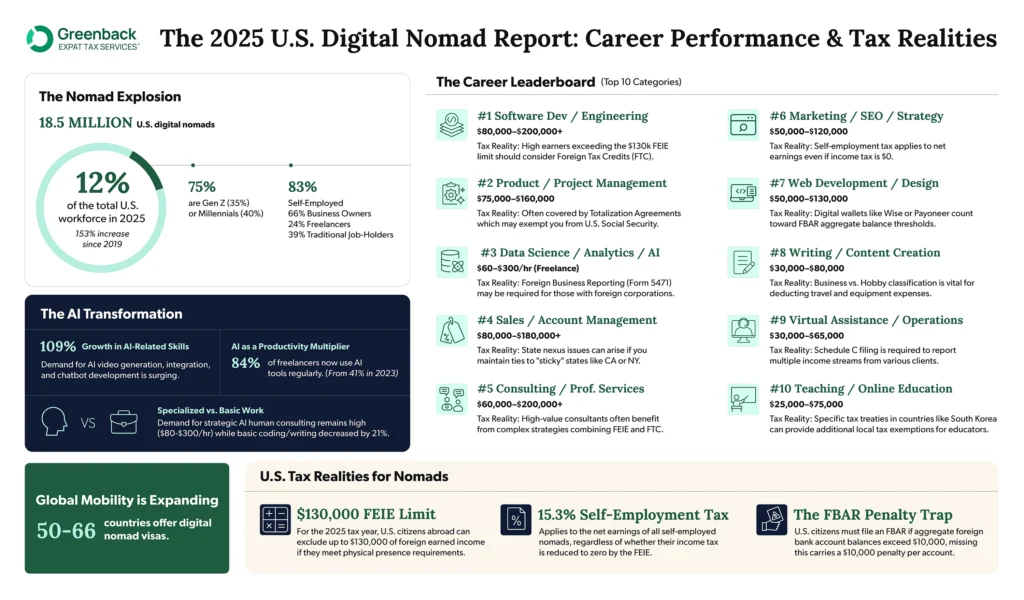
How Fast Is the Digital Nomad Workforce Growing?
The growth curve from 2019 to 2025 tells a clear story. What started as a niche segment of the workforce has become a mainstream professional category, accelerated by the pandemic and sustained by structural changes in how companies hire.
| Year | U.S. Digital Nomad Population | Growth from 2019 |
|---|---|---|
| 2019 | 7.3 million | Baseline |
| 2020 | 10.9 million | +49% |
| 2021 | 15.5 million | +112% |
| 2025 | 18.5 million | +153% |
Source: MBO Partners State of Independence 2025
Globally, the digital nomad population surpassed 40 million in 2025, roughly a 60% increase since 2020. More than 50 countries now offer dedicated digital nomad visas, including new programs launched in Taiwan, the Philippines, and Bulgaria during 2025.
The demographic composition is shifting, too. Gen Z (35%) and Millennials (40%) now make up 75% of all digital nomads. And 36% now travel with a spouse, partner, or children, a figure that has doubled since 2019. This is no longer a solo backpacker movement.
An important distinction: the majority of these 18.5 million Americans are not working remotely from home in the U.S. They are living and working in foreign countries, from Lisbon to Bangkok to Mexico City. That matters because every one of them still has a U.S. tax filing obligation. The IRS taxes U.S. citizens on worldwide income regardless of where you reside, and moving abroad triggers a new set of forms, exclusions, and reporting requirements that do not apply to domestic remote workers. The tax strategies in this study are specifically designed for Americans earning abroad, not those working from home in the U.S.
One structural change worth noting: independent nomads (freelancers and business owners) declined 7% in 2025, from 7.9 million to 7.3 million, driven largely by a drop in Baby Boomer participation. But that decline was more than offset by a rise in traditional W-2 employees working remotely from abroad. The workforce is getting younger and more likely to be employed, which significantly changes the tax picture.
Which Digital Nomad Jobs Pay the Most and Have the Highest Demand?
We ranked 10 job categories across three tiers based on current demand signals from Upwork, FlexJobs, and BLS telework data, combined with salary data and growth trajectories. Each category includes a tax reality check specific to the typical structure of that role.
Tier 1: High-Value Technical and Strategic Roles
These positions command the highest salaries and offer the strongest job security. They also tend to create the most complex tax situations because earnings frequently exceed the FEIE threshold.
1. Software Development and Engineering: $80,000 to $200,000+
Full-stack development is the single most in-demand skill on Upwork’s In-Demand Skills 2026 report, and software engineers rank as the second most in-demand remote job title according to FlexJobs’ fastest-growing remote careers analysis. About 34% of tech-oriented digital nomads work in software development, making it the largest single category.
These roles are highly resilient against AI disruption because they require complex problem-solving and architectural decision-making that automated tools cannot replicate. The flip side: high salaries frequently exceed the FEIE limit, and stock compensation (RSUs, ISOs, ESPPs) adds another layer of complexity.
Tax reality: If you earn $180,000 and exclude $130,000 via the FEIE, the remaining $50,000 is taxed at the rate that would apply to your full $180,000 income. This “stacking” effect pushes the taxable portion into a higher bracket than you might expect. If you live in a high-tax country like the UK or Germany, the Foreign Tax Credit may save you more than the FEIE. The FEIE vs. FTC comparison walks through how to evaluate which approach works better for your situation.
2. Product and Project Management: $75,000 to $160,000
Project management surpassed computer and IT as the number-one remote job category in 2025, with remote postings nearly doubling year over year, per the FlexJobs Remote Work Index. Product managers are the third most in-demand remote title.
Most PMs work as W-2 employees of U.S. companies with global offices, which changes the tax dynamics compared to freelancers. If your employer has you on payroll in a country with a U.S. totalization agreement (there are 30+ such agreements), you may pay into that country’s social security system instead of U.S. FICA.
Tax reality: A project manager earning $120,000 while working from Berlin could exclude the full amount via the FEIE and pay into German social security under the U.S.-Germany totalization agreement, potentially owing zero U.S. income tax and reduced social security costs. But state tax is a separate issue. Some U.S. states, particularly California, New York, and New Jersey, may still claim you owe state income tax even after you leave if you maintain ties there.
3. Data Science, Analytics, and AI: $80 to $300/hr (Freelance)
Data analysis (14.2% of tech freelancers), data science (11.2%), and machine learning (10.3%) are the top three skills prioritized by tech freelancers, according to the Upwork In-Demand Skills 2025 report. AI-related skills demand grew 109% year over year across the platform.
The consulting rates in this category, ranging from $80 to $300 per hour for AI strategy work, put many data professionals well above the FEIE ceiling. Contract work for multiple clients across countries also creates complex income sourcing rules.
Tax reality: A data scientist earning $200,000 freelancing from Thailand could exclude $130,000 via the FEIE, but would still owe 15.3% self-employment tax on the full $200,000 (approximately $30,600), plus federal income tax on the remaining $70,000. If you earn above the FEIE limit, compare the FEIE and the FTC carefully. The wrong choice can cost thousands, and once you elect one method, switching has consequences.
Tier 2: Relationship Management and Growth Roles
These positions have seen year-over-year growth of 20% to 30% in remote job postings. Companies are increasingly willing to hire relationship-heavy roles without requiring a physical office presence.
4. Marketing, SEO, and Content Strategy: $50,000 to $120,000
Product marketing managers rank in the top 10 remote job titles on FlexJobs, and social media marketing expanded more than 30% in fully remote postings. Marketing is also one of the top five work-from-anywhere career fields.
Many marketers operate as freelancers or consultants, which means the 15.3% self-employment tax is the primary financial burden, applying even when the FEIE eliminates your income tax entirely.
Tax reality: A freelance marketing consultant earning $85,000 from Medellin, Colombia, could exclude the full amount via the FEIE (zero income tax), but would still owe approximately $12,000 in self-employment tax. Colombia does not have a totalization agreement with the U.S., so there is no way to reduce that SE tax burden there. If you are freelancing from a country that does have an agreement, you may be exempt from U.S. self-employment tax altogether. Check whether your destination is on the list of countries covered by the totalization agreement before you settle in.
5. Sales and Account Management: $60,000 to $150,000+
Account executives are the single most in-demand remote job title for 2025, according to FlexJobs’ annual analysis. Sales roles grew more than 20% in remote postings, and account management expanded more than 30% in fully remote opportunities.
Commission income qualifies for the FEIE, which is good news. But commissions frequently push total compensation above the $130,000 threshold, and sales professionals face a specific risk around state nexus.
Tax reality: If you are selling to U.S. customers from abroad, some states may argue you still owe state income tax based on where your customers are located. “Sticky” states like California and New York are particularly aggressive. To reduce your state tax exposure, take proactive steps to sever ties: update voter registration, surrender your state driver’s license, and close local bank accounts. Your Physical Presence Test documentation (330 days abroad in a 12-month period) will also support your case.
6. Web Development and Design: $50,000 to $130,000
About 28% of tech-oriented nomads work in web development, and graphic design remains one of the most common nomad professions overall. These roles skew heavily freelance, which means self-employment tax and foreign bank account reporting are the two biggest compliance issues.
Tax reality: Web designers and developers often use international payment platforms such as Wise, Payoneer, and PayPal to receive client payments. If those platforms hold funds in foreign accounts and your aggregate foreign account balances exceed $10,000 at any point during the year, you must file an FBAR (FinCEN Form 114). The penalty for a non-willful failure to file is up to $10,000 per account, per year. If your foreign account balances exceed $200,000 at year-end while living abroad (or $400,000 if married filing jointly), you also need to file Form 8938 for FATCA.

You Built a Career Without Borders. Your Tax Support Should Match.
Tier 3: Accessible Entry Points and the Gig Economy
These roles have lower barriers to entry and provide accessible pathways into the nomad lifestyle. They also face the most direct impact from AI automation, which is shifting the value proposition toward specialization.
7. Writing, Copywriting, and Content Creation: $35,000 to $90,000
Writing and content creation remain among the most common digital nomad professions, but the landscape is changing fast. AI tools have led to a 21% decrease in basic writing and entry-level coding job posts since ChatGPT launched, according to research from the Brookings Institution. The writers who are thriving are strategic storytellers who blend SEO, marketing psychology, and brand voice into a single system, according to Upwork.
Most writers and content creators earn under $130,000, so the FEIE typically covers the full income. The primary tax burden is the self-employment tax.
Tax reality: On $55,000 in net freelance income, self-employment tax is approximately $7,771. That applies even if your income tax is zero after the FEIE. Content creators with mixed income streams (freelance writing, affiliate income, ad revenue, sponsored content) should be aware that all of these are subject to SE tax if earned through a trade or business. Travel bloggers and influencers also face a “hobby vs. business” classification risk. If the IRS determines you are pursuing a hobby rather than a business, you lose the ability to deduct expenses, which can result in a much higher tax bill on gross revenue.
8. Virtual Assistance and Operations: $30,000 to $65,000
Executive assistants rank in the top 10 remote job titles on FlexJobs, and operations is the third-largest remote job category overall. Automation-focused VAs who build workflows in Notion, Airtable, Zapier, and Make are carving out a growing niche with higher rates.
Income in this category falls well under the FEIE limit, so income tax is rarely an issue. The main compliance requirement is proper Schedule C filing if you work with multiple clients as an independent contractor.
Tax reality: A VA earning $40,000 from three clients while living in Costa Rica would have the full amount covered by the FEIE (zero income tax), but would owe approximately $5,652 in self-employment tax. Costa Rica does not have a totalization agreement with the U.S. If you are working with multiple clients, you are clearly an independent contractor, and the IRS expects you to file quarterly estimated tax payments (April 15, June 15, September 15, January 15) even while abroad. Missing these payments triggers penalties even if you are owed a refund at filing time.
9. Teaching and Online Education: $25,000 to $75,000
Online tutoring, teaching English abroad, and course creation remain popular entry points. This category has a unique tax advantage: W-2 ESL teachers employed by a foreign language school are often exempt from both U.S. income tax (via the FEIE) and U.S. self-employment tax (because they are employees, not self-employed). That combination can make teaching abroad one of the most tax-efficient paths for digital nomads.
Tax reality: An English teacher earning $35,000 as a W-2 employee of a language school in South Korea would have the full income covered by the FEIE (zero U.S. income tax), owe no self-employment tax (because they are a W-2 employee), and may also benefit from the U.S.-South Korea tax treaty, which can exempt teachers from Korean income tax for the first two years. Self-employed course creators and coaches do not get this advantage and face the standard 15.3% SE tax on net earnings.
10. Consulting and Professional Services: $60,000 to $200,000+
Finance, legal, HR, and management consulting are increasingly remote. About 28% of skilled knowledge workers now operate as freelancers or independent professionals, collectively generating $1.5 trillion in earnings, according to Upwork.
Consultants are most likely to exceed the FEIE limit and set up foreign business entities, triggering additional reporting requirements.
Tax reality: If you bill through a foreign LLC or corporation, you are required to file Form 5471 (for foreign corporations) or Form 8865 (for foreign partnerships). The penalty for failure to file is $10,000 per form, per year. A management consultant earning $220,000 while living in the UK may find the Foreign Tax Credit more beneficial than the FEIE, because UK income tax rates (40-45% on income above GBP 50,270) exceed U.S. rates. The excess foreign tax credits generated can offset U.S. tax on the full income.
How Is AI Changing Digital Nomad Jobs?
AI is no longer a peripheral tool. It is reshaping the competitive landscape for every job category on this list. The data shows a clear split: professionals who integrate AI into their workflow are seeing a productivity multiplier effect, while those who compete against it are losing ground.
| AI Trend | Data Point | Source |
|---|---|---|
| AI skill demand growth | +109% year over year | Upwork In-Demand Skills 2026 |
| AI video generation demand | +329% | Upwork |
| AI integration demand | +178% | Upwork |
| AI data annotation demand | +154% | Upwork |
| Freelancers using AI tools | 84% (up from 41% in 2023) | Industry surveys |
| Basic writing job posts | -21% since ChatGPT launch | Brookings |
The highest-paying AI freelance specializations include AI strategy consulting ($80 to $300/hr), financial services AI ($120 to $300/hr), healthcare AI ($100 to $250/hr), and machine learning engineering ($60 to $200/hr).
The takeaway is not that AI is eliminating digital nomad jobs. Demand on platforms like Upwork has remained strong even in categories assumed to be most vulnerable to automation, including coding, creative, marketing, and customer support. The shift is toward higher-value, AI-augmented work, and the professionals who adapt are earning more, not less.
For digital nomads working in AI, the tax picture mirrors Tier 1 roles: high hourly rates can quickly push annual income above the FEIE threshold, and contract work across multiple countries creates sourcing complexity. If you are earning $150,000 or more in AI consulting or development, a proactive FEIE vs. FTC strategy is worth evaluating before tax season, not during it.
What Tax Rules Apply to Every Digital Nomad?
Regardless of which job category you fall into, several U.S. tax rules apply to all digital nomads. Here is a quick reference.
| Rule | Details |
|---|---|
| Filing deadline | Automatic 2-month extension to June 15 for U.S. citizens abroad, with an additional extension available to October 15 |
| FEIE (2025) | Exclude up to $130,000 of foreign earned income via Form 2555. Increases to $132,900 for 2026 |
| Tax home requirement | You must have a “tax home” in a foreign country. Nomads who move every few weeks may struggle to establish one |
| Self-employment tax | 15.3% (12.4% Social Security + 2.9% Medicare). The FEIE does not eliminate this. Only totalization agreements or W-2 employment with a foreign company can |
| FBAR | Required if aggregate foreign bank accounts exceed $10,000 at any point during the year. Due April 15 with automatic extension to October 15 |
| FATCA (Form 8938) | Required if foreign financial assets exceed $200,000 at year-end while abroad ($400,000 if married filing jointly) |
| Quarterly estimated taxes | Required for self-employed nomads. Missing payments triggers penalties even if you are owed a refund |
| State taxes | Some states (CA, NY, NJ, VA, NM, SC) may claim you owe state tax even after moving abroad |
For a full walkthrough of how these rules apply to your situation, see our digital nomad tax guide.

Digital Nomads Have Specific Tax Challenges. We Know Them Well.
Where Do Most American Digital Nomads Live?
Location choice directly affects your tax strategy. According to the Savills Executive Nomad Index 2025 and Nomad List data, the most popular destinations for digital nomads are concentrated in Western Europe, Southeast Asia, and Latin America.
Spain leads multiple indices, with Malaga, Palma, and Barcelona all ranking in the global top 10. Portugal (Lisbon in particular), Thailand (Bangkok and Chiang Mai), and Mexico (Mexico City and Playa del Carmen) round out the top destinations. Japan and South Korea saw the fastest year-over-year growth in nomad arrivals, driven by improved visa pathways and strong infrastructure.
The tax implications vary significantly by destination:
- Countries with U.S. totalization agreements (UK, Germany, Canada, South Korea, Japan, and 25+ others): If you are self-employed in one of these countries, you may pay into their social security system instead of paying U.S. self-employment tax, potentially saving 15.3% on your net earnings.
- Countries without totalization agreements (Thailand, Mexico, Colombia, Costa Rica, Bali/Indonesia, Philippines): You owe U.S. self-employment tax on top of whatever local taxes apply. There is no way to offset or reduce the 15.3% SE tax in these locations.
- Low-tax or no-income-tax countries (UAE, Panama, Paraguay, Georgia): The FEIE typically eliminates your U.S. income tax entirely, and these countries impose little or no local income tax. Self-employment tax remains, but your overall burden is significantly lower.
If you are choosing between destinations and want to understand the tax trade-offs, our digital nomad visa countries guide covers visa requirements and tax considerations for the most popular options.
Who Should You Talk to About Digital Nomad Taxes?
The digital nomad lifestyle has matured from a niche experiment into a structured, high-earning professional path. Return-to-office mandates are being enforced by 37% of companies, but they have largely failed to curb the demand for flexibility. For top-tier talent, the ability to work globally remains a primary draw.
As this workforce continues to grow toward the 20-million-person mark, the intersection of career mobility and tax law will only become more complex. Your job category, employment structure (W-2 vs. freelance), income level, and country of residence all determine which tax strategies will save you the most.
If you are a digital nomad or considering the move, here is how we help digital nomads stay compliant and keep more of what they earn.

Your Career Is Location-Independent. Your Taxes Shouldn’t Be a Guessing Game.
Methodology
This study synthesized data from multiple independent sources to rank digital nomad job categories by demand, salary, and growth trajectory. Job category rankings were determined by cross-referencing three primary demand signals: skill demand frequency on the Upwork Marketplace, remote job posting volume tracked by FlexJobs, and occupation-level telework rates from the U.S. Bureau of Labor Statistics.
Salary ranges reflect a composite of self-reported earnings from the MBO Partners State of Independence 2025 survey, platform-reported rates from Upwork and FlexJobs, and aggregated salary data from DemandSage and Rent Remote. Where sources reported conflicting figures, we noted the range rather than selecting a single estimate.
Workforce population data (18.5 million U.S. digital nomads, 153% growth since 2019) comes from MBO Partners, which conducts an annual nationally representative survey of U.S. adults. Remote work context data was supplemented by the Buffer State of Remote Work report and the BLS Current Population Survey telework supplements.
All tax figures (FEIE limits, self-employment tax rates, FBAR thresholds, penalty amounts) were verified against current IRS publications and Social Security Administration data as of April 2026. Tax examples in this article use simplified calculations for illustration and do not account for all possible deductions, credits, or individual circumstances.
AI disruption data was sourced from the Upwork In-Demand Skills 2026 report and Brookings Institution research on generative AI’s impact on freelance markets.
Data Sources
- MBO Partners State of Independence 2025
- Upwork In-Demand Skills 2026
- Upwork In-Demand Skills 2025
- Upwork Freelancing Stats
- Upwork Knowledge Worker Study
- FlexJobs Fastest-Growing Remote Careers
- FlexJobs Remote Work Index
- FlexJobs Work-From-Anywhere Report
- Buffer State of Remote Work
- U.S. Bureau of Labor Statistics, Telework Data
- BLS Telework Trends Analysis
- Brookings Institution: Is Generative AI a Job Killer?
- DemandSage Digital Nomad Statistics
- Rent Remote Salary Guide
- IRS: Foreign Earned Income Exclusion
- IRS: Self-Employment Tax
- IRS: Report of Foreign Bank and Financial Accounts (FBAR)
- SSA: Totalization Agreements
Fair Use Statement
The data, analysis, and infographic in this study are original work produced by Greenback Expat Tax Services. If you would like to use or share any of the findings, statistics, or visuals from this study, you are welcome to do so with proper attribution. Please link back to this page (https://www.greenbacktaxservices.com/blog/best-jobs-for-digital-nomads/) as the original source. For media inquiries or permission to reproduce the infographic in full, contact [email protected].
Disclaimer
This article is for informational purposes only and does not constitute legal, tax, or financial advice. Tax laws, thresholds, exclusion amounts, and filing requirements change frequently, and the information presented here reflects data available as of April 2026. Your individual tax situation depends on factors such as your income level, country of residence, employment status, filing status, applicable tax treaties, and state tax obligations. The salary ranges, growth projections, and job market data cited in this study are drawn from third-party sources and are subject to revision. Greenback Expat Tax Services does not guarantee the accuracy or completeness of third-party data. The tax examples used throughout this article are simplified illustrations and do not account for all possible deductions, credits, exclusions, or individual circumstances. Nothing in this article should be interpreted as a guarantee of specific tax outcomes or job market results. You should consult a qualified tax professional before making decisions about your U.S. tax obligations, foreign income reporting, self-employment tax strategy, or any other tax matter. For personalized guidance on your situation, get started with Greenback.
Featured In





