Form 4562 for Expats Explained: Depreciation and Section 179 Deductions

- Do I Need to File Form 4562?
- How Does Form 4562 Work for Foreign Rental Properties?
- What About Section 179 for Expats?
- What Is Bonus Depreciation and Can Expats Use It?
- Who Typically Needs Form 4562?
- How Do I Fill Form 4562?
- Common Mistakes Expats Make with Form 4562
- What Records Do I Need to Keep?
- How Does Depreciation Affect Taxes When I Sell?
- Need Help with Form 4562?
- Related Resources


According to IRS data, Form 4562 only applies if you own rental property abroad, run a foreign business, or purchased equipment for your freelance work. If that’s you, Form 4562 helps you claim valuable depreciation deductions that can lower your U.S. tax bill by thousands of dollars each year.
IRS Form 4562, officially titled “Depreciation and Amortization,” is the IRS form you use to deduct the cost of business property over time rather than all at once. For American expats, this form most commonly applies when you own rental property abroad or operate a foreign business. Think of depreciation as the IRS acknowledging that your rental property or business equipment loses value each year due to wear and tear, and allowing you to deduct a portion of that decline.
Whether you’re renting out an apartment in Barcelona, running a consulting business from Thailand, or operating a small manufacturing operation in Mexico, getting depreciation right can save you thousands of dollars each year while keeping you fully compliant.
See If You Need to File Form 4562
Do I Need to File Form 4562?
You must file Form 4562 with your tax return (Form 1040) if you’re claiming any of the following:
- Depreciation on property placed in service during the current tax year. If you bought business equipment, a vehicle for business use, or started renting out property in 2025, you’ll need Form 4562 to claim depreciation for that year.
- Section 179 deduction for qualifying business property. This allows you to immediately expense up to $2,500,000 (for 2025) of qualifying business equipment rather than depreciating it over time. Note: Section 179 does NOT apply to property used primarily outside the United States, so most expats can’t use this deduction for foreign business equipment.
- Depreciation on rental properties abroad. If you own foreign rental property generating income that you report to the IRS, you must use Form 4562 to calculate your annual depreciation deduction.
- Depreciation on vehicles or other “listed property.” Listed property includes cars, computers, and other items that might be used for both business and personal purposes. You must report these on Form 4562 regardless of when you purchased them, as long as you’re claiming business use.
- Amortization of intangible assets. This includes patents, copyrights, business startup costs, or goodwill if you purchased an existing business.
Many of our expat clients at Greenback fall into two main categories: those with foreign rental properties and those running businesses or working as freelancers abroad. Let’s address both situations.
How Does Form 4562 Work for Foreign Rental Properties?
If you own rental property outside the United States, the IRS requires you to use the Alternative Depreciation System (ADS) rather than the standard depreciation method used for U.S. properties. Here’s what that means:
Residential rental properties abroad must be depreciated over 30 years using the straight-line method. This compares to 27.5 years for U.S. residential rentals. Using a 30-year timeline means slightly smaller annual deductions, but you’ll benefit from depreciation over a longer period.
Commercial or non-residential properties abroad must be depreciated over 40 years, compared to 39 years for similar U.S. properties.

You cannot depreciate land; only the building itself can be depreciated. You’ll need to determine the fair market value of the land versus the building when calculating your depreciable basis.
Example: Foreign Rental Property Depreciation
Let’s say you purchased an apartment in Portugal for €300,000 to rent out long-term. The land value is €50,000, leaving €250,000 for the building itself.
- Depreciable basis: €250,000 (converted to USD at the exchange rate when you placed it in service)
- Recovery period: 30 years under ADS
- Annual depreciation: Approximately $8,333 per year (assuming a 1:1 exchange rate for simplicity)
This $8,333 annual deduction reduces your taxable rental income each year. If your annual rental income from the property is $15,000 and you have $3,000 in other expenses, your net taxable rental income would be $3,667 instead of $12,000 without depreciation. Remember, if you deposit rental income into foreign bank accounts, you may need to file an FBAR if the aggregate value of your accounts exceeds $10,000.
How Foreign Tax Credit Interacts with Depreciation
Many expats pay property taxes and income taxes to the country where their rental property is located. The good news is that you can often claim the Foreign Tax Credit for taxes paid to another country, helping prevent double taxation. When calculating your Foreign Tax Credit, you’ll use your net rental income after depreciation, not your gross rental income. This proper calculation ensures you maximize both your depreciation deduction and your foreign tax credit.
What About Section 179 for Expats?
Section 179 allows businesses to immediately expense (rather than depreciate) up to $2,500,000 in qualifying equipment for tax year 2025. This deduction begins to phase out once total equipment purchases exceed $4,000,000.
Critical limitation for expats: Section 179 does NOT apply to property used predominantly (more than 50%) outside the United States. This means if you purchase equipment for your business in Germany, or a laptop for your freelance work in Thailand, you cannot use Section 179 to immediately expense these items. You must depreciate them using regular depreciation methods on Form 4562.
Exception: The Section 179 deduction may apply if you’re a U.S.-based business owner who occasionally works abroad, but your equipment is primarily used in the U.S., or if you’re purchasing equipment that will be used predominantly within U.S. borders.
What Is Bonus Depreciation and Can Expats Use It?
Bonus depreciation allows businesses to deduct 100% of the cost of qualifying property in the first year it’s placed in service (for property acquired after January 19, 2025, thanks to recent tax law changes). Like Section 179, bonus depreciation is generally not available for property used predominantly outside the United States.
Who Typically Needs Form 4562?
Based on our experience helping over 23,000 expats, here are the common situations where American expats need Form 4562:
- Self-employed expats and freelancers who purchase business equipment like computers, cameras, or office furniture. You’ll depreciate these items over their useful life (typically 5-7 years for computers and office equipment) and report them on Schedule C. If you’re a digital nomad, these deductions apply to you as well.
- Foreign rental property owners must complete Form 4562 to claim depreciation on their rental buildings abroad. You’ll attach this to Schedule E, where you report your rental income and expenses.
- Expat business owners operating foreign companies or branches need Form 4562 to depreciate business assets like machinery, equipment, vehicles, and leasehold improvements.
- Remote workers with home office equipment may need Form 4562 if they’re self-employed (1099 contractors) and purchase equipment for their business. Note: Regular W-2 employees cannot deduct home office expenses or depreciation. Learn more about self-employment tax for expats.
How Do I Fill Form 4562?
IRS Form 4562 contains six parts, though you’ll typically only complete the sections relevant to your situation:
- Part I: Section 179 Election – For immediately expensing business property (rarely applicable for expats due to foreign use restriction).
- Part II: Special Depreciation Allowance – For bonus depreciation (also limited for foreign property).
- Part III: MACRS Depreciation – This is where most expats with foreign rental property will report their depreciation using the Alternative Depreciation System (ADS). You’ll list your property, its cost basis (excluding land), the recovery period (30 years for residential, 40 for commercial), and calculate your annual deduction.
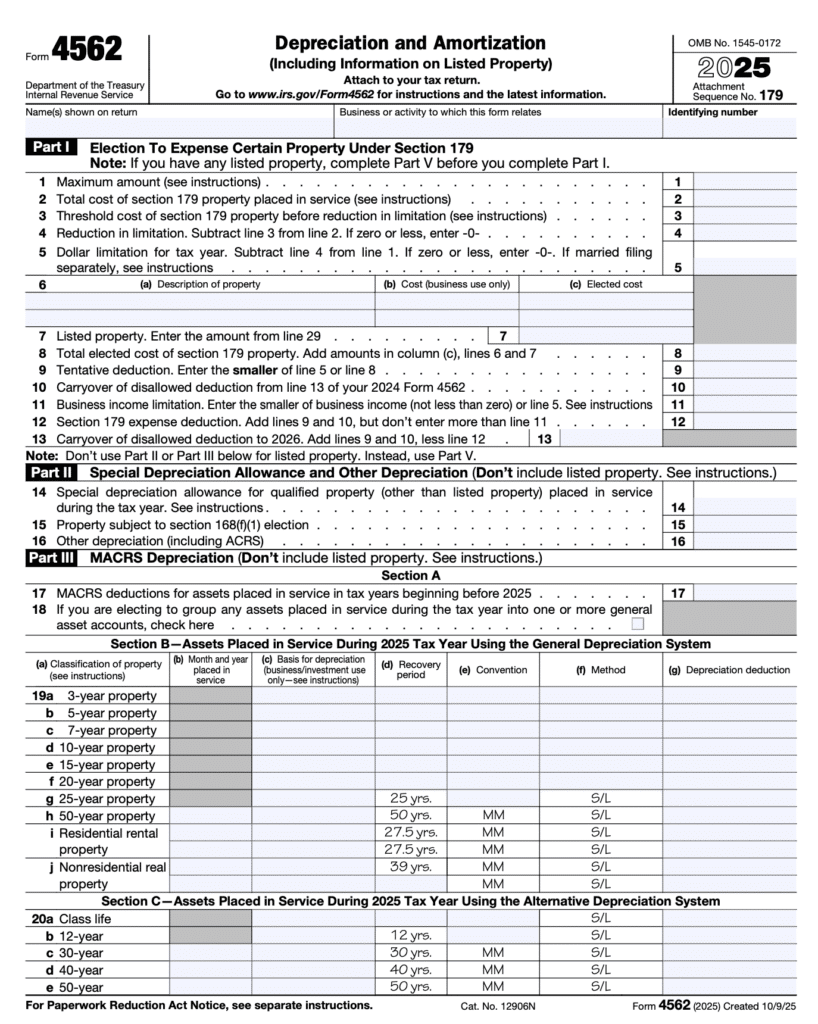
- Part IV: Summary – Totals all depreciation amounts from the form.
- Part V: Listed Property – For vehicles, computers, and other property that might have personal use. You must document the business use percentage.
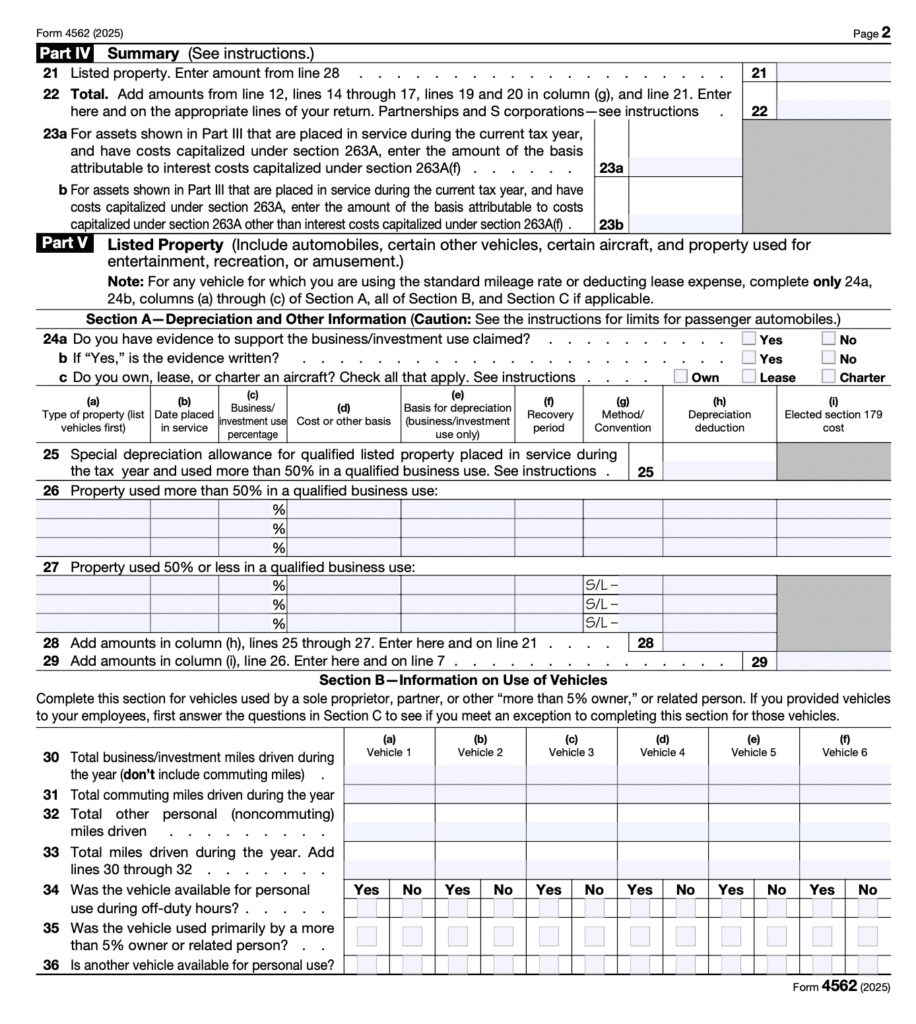
Part VI: Amortization – For intangible assets like patents or business startup costs.

Common Mistakes Expats Make with Form 4562
- Not excluding land value from the depreciable basis. Land never depreciates, so you must separate the building value from the total purchase price when calculating depreciation.
- Using the wrong depreciation system. Foreign rental properties must use ADS with a 30-year (residential) or 40-year (commercial) recovery period, not the General Depreciation System used for U.S. properties.
- Claiming Section 179 on foreign business equipment. Remember, Section 179 doesn’t apply to property used mainly outside the U.S.
- Forgetting currency conversion. All amounts on Form 4562 must be in U.S. dollars. Use a consistent exchange rate (such as the yearly average exchange rate published by the IRS) for recurring items. Learn more about currency conversion for expats.
- Not maintaining proper records. Keep detailed records of purchase dates, costs, business use percentages for listed property, and depreciation schedules. The IRS can audit depreciation claims years later.
What Records Do I Need to Keep?
For Form 4562 and depreciation claims, maintain these records:
- Original purchase invoices and contracts
- Proof of payment
- Date the property was placed in service
- Businesses use logs for vehicles and other listed property
- Documentation of land versus building allocation for rental properties
- Prior year Form 4562 forms and depreciation schedules
- Currency conversion rates used for foreign purchases
The IRS recommends keeping these records for at least three years after filing, though seven years is safer for depreciation-related documents. If you’re behind on filing, learn about the Streamlined Filing Procedures for penalty-free catch-up options.
How Does Depreciation Affect Taxes When I Sell?
When you eventually sell depreciated property, the IRS requires “depreciation recapture,” meaning you’ll owe tax on the depreciation deductions you previously claimed. For rental property, depreciation recapture is taxed as ordinary income up to a maximum rate of 25%, while any remaining capital gain is taxed at capital gains rates.
This doesn’t mean you shouldn’t claim depreciation. The tax deferral benefit usually far outweighs the eventual recapture tax, especially since you’re using today’s dollars to reduce taxes now and paying recapture in future dollars.
Need Help with Form 4562?
Depreciation calculations can become complex, especially when dealing with foreign property, currency conversions, and the determination of proper recovery periods. Small errors can lead to overpayment or underpayment of taxes, with consequences.
Whether you own rental property in Paris, run a business in Singapore, or freelance from Buenos Aires, we can help you handle Form 4562 and maximize your tax savings. Contact us, and one of our Customer Champions will gladly help. If you need very specific advice on your specific tax situation, you can also get a consultation with one of our expat tax experts.
Ready to get your expat taxes done right? If you’re ready to be matched with a Greenback accountant, click the Get Started button below. For general questions on US expat taxes or working with Greenback, contact our Customer Champions.
Get Help Filing Form 4562 Correctly
This article is for informational purposes only and does not constitute tax, legal, or financial advice. Tax rules change frequently, and individual situations vary. Please consult with a qualified tax professional before making any tax-related decisions.
Related Resources
- Foreign Rental Income Tax: How to Report & Reduce Your U.S. Tax Bill
- Schedule C for American Expats: Your Business Tax Filing Guide
- What is Schedule SE? Self-Employment Tax Guide for Expats
- Self-Employment Tax for U.S. Expats: Step-by-Step Guide
- Do Overseas Contractors Pay U.S. Taxes? 2026 Filing Guide
- Renting My House While Living Abroad: U.S. Expat Taxes
- Form 1040 for US Expats: File Correctly & Owe $0
- Digital Nomad Taxes: What U.S. Citizens Working Remotely Abroad Need to Know
- U.S. Citizens Starting a Business Overseas: Money-Saving Tax Tips
- Federal U.S. Tax Return Preparation for Americans Living Abroad



Featured In