Foreign Earned Income Exclusion (FEIE): Who Qualifies and How It Works

- What Is the Foreign Earned Income Exclusion?
- How Much Is the Foreign Earned Income Exclusion?
- Who Qualifies for the Foreign Earned Income Exclusion?
- What Income Counts as Foreign Earned Income?
- How Is the FEIE Calculated?
- What Can You Do If You Earn More Than the FEIE Limit?
- Should You Use the FEIE or the Foreign Tax Credit?
- What Does the FEIE Not Cover?
- How Do You Claim the Foreign Earned Income Exclusion?
- Can You Still Claim the FEIE If You Filed Late?
- Frequently Asked Questions about the Foreign Earned Income Exclusion
- The FEIE Works Best When Your Days, Tax Home, and Paperwork Line Up


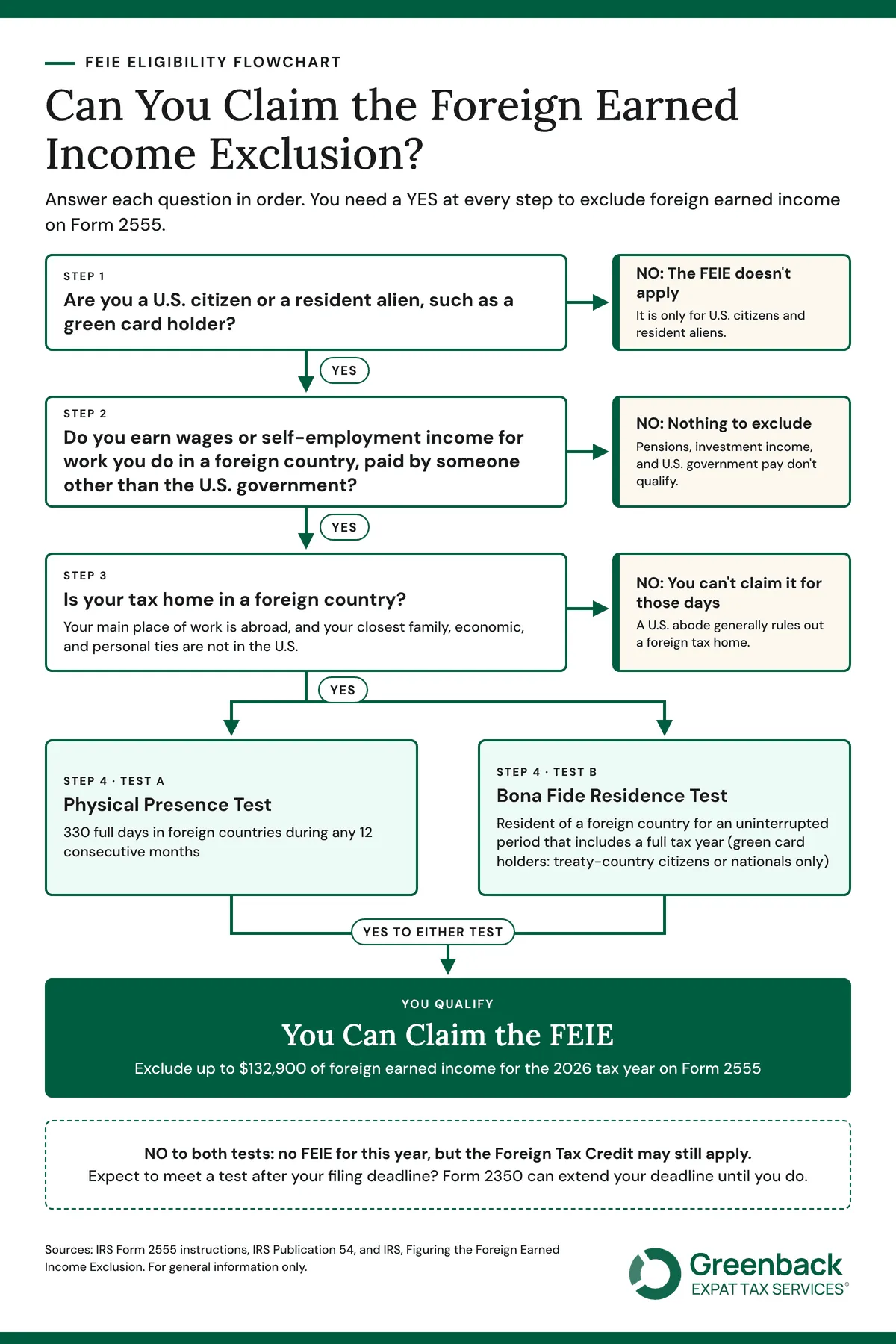
The Foreign Earned Income Exclusion (FEIE) is a U.S. tax rule that allows Americans living and working abroad to exclude part of their foreign salary or self-employment income from their U.S. taxable income. The maximum foreign earned income exclusion for your 2026 tax return, filed in 2027, is $132,900 per person. Each spouse who qualifies claims a separate exclusion, so a married couple can exclude up to $265,800 when both qualify. To qualify, you must be a U.S. citizen or resident alien with foreign earned income and a tax home in a foreign country. You must also pass one of two tests: the Physical Presence Test (330 full days in foreign countries during any 12 consecutive months) or the Bona Fide Residence Test (residence abroad for an uninterrupted period that includes a full tax year).
You claim the FEIE on Form 2555, which you attach to your Form 1040. The foreign earned income exclusion reduces federal income tax only: self-employment tax still applies, and income above the limit is taxed at the higher bracket rates it would have reached without the exclusion. It is one of the main ways U.S. citizens abroad avoid being taxed twice, alongside the Foreign Tax Credit.

What Is the Foreign Earned Income Exclusion?
The foreign earned income exclusion allows qualifying citizens and resident aliens abroad to exclude foreign wages and self-employment income, up to an annual limit, from their U.S. taxable income. It is sometimes called the foreign income exclusion or the expat tax exemption, and it exists because the U.S. taxes its citizens and green card holders on worldwide income. The legal basis is Section 911 of the Internal Revenue Code.
An Exclusion Works Differently From a Tax Credit
A credit reduces the tax you owe after it is calculated. An exclusion removes income from your taxable income before tax is calculated, although the excluded amount still sets the tax rate on any income left over. If you are new to filing from abroad, our guide to U.S. expat taxes covers the rest of your return.
How Much Is the Foreign Earned Income Exclusion?
For your 2026 tax return, filed in 2027, the maximum foreign earned income exclusion is $132,900 per qualifying person. That is how much foreign earned income can be free of U.S. federal income tax. You exclude your actual foreign earned income or $132,900, whichever is less, and the limit is prorated if you qualify for only part of the year.
Three Figures Set Your FEIE and Housing Limits
| Figure | 2026 Tax Year (Filed in 2027) | What It Means |
|---|---|---|
| Maximum FEIE per person | $132,900 | The most foreign earned income one person can exclude |
| Housing base amount | $21,264 | Housing costs above this amount can be excluded or deducted |
| Standard housing cost limit | $39,870 | The cap on housing costs in most locations |
Married Couples Each Get a Separate Exclusion
When you are married filing jointly, and both spouses work abroad and qualify, each spouse excludes up to $132,900 of their own earnings on a separate Form 2555. One spouse cannot use the other’s unused amount: if one earns $160,000 and the other earns $40,000, together they exclude $172,900. See our FAQ on whether both spouses can claim the FEIE, or our guide to filing with a foreign spouse if your spouse is not a U.S. taxpayer.
The Limit Is Prorated in a Partial Year
If you qualify for only part of the year, your limit is qualifying days ÷ 365 × $132,900 (366 in a leap year). If you arrive abroad on March 31, 2026, a 12-month window starting April 1 gives you 275 qualifying days in 2026, so your limit is $100,130, as long as you spend 330 full days abroad by March 31, 2027. A window that starts a few weeks earlier can add days if it still holds 330 full days abroad. Our guide to taxes in the year you move abroad and our FAQ on 330 days spread across two calendar years cover move-year returns.
Past Tax Years Use Their Own Maximum Exclusion
An amended or late return uses the limit for the tax year it covers, so a 2023 return filed today still applies the $120,000 limit.
| Tax Year | Maximum FEIE per Person |
|---|---|
| 2026 | $132,900 |
| 2025 | $130,000 |
| 2024 | $126,500 |
| 2023 | $120,000 |
| 2022 | $112,000 |
| 2021 | $108,700 |
| 2020 | $107,600 |
Who Qualifies for the Foreign Earned Income Exclusion?
You qualify if you are a U.S. citizen or resident alien with foreign earned income, a tax home in a foreign country, and either 330 full days in foreign countries during any 12 consecutive months or bona fide residence abroad for an uninterrupted period that includes a full tax year. Nonresident aliens cannot claim it, and neither can U.S. government employees on their government pay.
Every Claim Must Meet Three Requirements
| Requirement | What It Means | Where to Learn More |
|---|---|---|
| Foreign earned income | Pay for work you physically perform in a foreign country | Covered in the next section |
| Foreign tax home | Your main place of work is abroad, and your home base is not in the U.S. | Foreign tax home without a permanent address |
| One qualifying test | Physical Presence Test or Bona Fide Residence Test | Bona Fide Residence vs. Physical Presence Test |
The Physical Presence Test Counts Your Days
You pass the Physical Presence Test if you are in a foreign country for at least 330 full days during any 12 consecutive months. A full day runs midnight to midnight, so the days you fly into or out of the U.S. usually do not count, and neither does time over international waters. The days do not have to be consecutive, and the window can start on any day. That leaves up to 35 days (36 in a window that includes February 29) outside foreign countries, travel days included (see the 35-day U.S. limit).
Days in any foreign country count, so changing countries mid-year does not reset your total (counting days across multiple countries walks through the math). If you overstay in the U.S. mid-year, you fail this test for that window, but the Bona Fide Residence Test may still work.
The Bona Fide Residence Test Looks at Your Life Abroad
You pass the Bona Fide Residence Test if you are a bona fide resident of a foreign country for an uninterrupted period that includes a full calendar tax year. The IRS weighs why you are there, how long you plan to stay, your housing, your local ties, and whether you pay tax as a resident. If you tell your host country’s tax authority you are not a resident there and it does not tax you as one, you cannot use this test for that period. Short trips to the U.S. do not break your residence if you clearly intend to return. Green card holders can use this test only if they are citizens or nationals of a country with a U.S. income tax treaty; otherwise, they use the Physical Presence Test.
Your Tax Home Must Be Abroad
Your tax home is your regular or main place of business, and it must be in a foreign country for the days you claim. Being abroad is not enough if your abode, meaning your closest family, economic, and personal ties, stays in the U.S. Someone on an 18-month assignment whose spouse and children stay in the family home in Ohio may count 330 days abroad and still fail this requirement. One exception: if you work in a combat zone in support of the U.S. Armed Forces, a U.S. abode does not prevent you from having a foreign tax home for that period, which is how combat zone workers can use the FEIE. If your work moves with you, start with how digital nomads establish a tax home, then check whether you can claim the FEIE with no fixed country of residence.
The IRS Can Waive the Time Requirements After War or Civil Unrest
If you had to leave a foreign country because of war, civil unrest, or similar conditions, the IRS can waive the minimum time requirements of both tests, as long as you could reasonably have expected to meet them. The IRS publishes the qualifying countries and dates each year. Our guide to the FEIE waiver explains how it works, and our news article on the IRS waiving FEIE time requirements in 7 countries shows a recent list.
What Income Counts as Foreign Earned Income?
Foreign earned income is pay for personal services you physically perform in a foreign country, including wages, salaries, bonuses, professional fees, and self-employment income. The IRS sources earned income to the place you do the work, so a U.S. employer or a U.S. bank account does not change the result.
Remote Work for a U.S. Company Counts When the Work Happens Abroad
A software engineer in Barcelona paid by a California company into a U.S. bank account has foreign earned income because the work happens in Spain. This is why remote workers for U.S. companies can qualify, as our guides to working remotely abroad, digital nomad taxes, and taxes for teachers abroad explain.
Wages and Self-Employment Income Qualify for the FEIE
| Income Type | Counts for the FEIE? | Notes |
|---|---|---|
| Wages, salary, and bonuses for work abroad | Yes | Pay for days worked in the U.S. does not count |
| Self-employment and freelance income | Yes | See self-employment and contract income and part-time or side income earned abroad; expenses tied to excluded income are not deductible, and self-employment tax still applies |
| Stock options and RSUs | Depends | The portion tied to work abroad can count; see stock options and RSUs |
| Employer-provided housing and allowances | Yes | May also qualify for the Foreign Housing Exclusion |
| Interest, dividends, capital gains, and rent | No | Passive income (rent in most cases); see passive income, rentals, and Social Security |
| Pensions, annuities, and Social Security | No | Not pay for current work; the Foreign Tax Credit is the relevant rule for foreign tax on it |
| U.S. government pay | No | Not foreign earned income by rule; private military contractors are treated differently |
| Work in U.S. territories such as Puerto Rico or Guam | No | Not a foreign country for the FEIE |
| Pay received after the end of the following year | No | Too late to count as foreign earned income |
Our guide to U.S. vs. foreign source income covers the sourcing rules behind this table.
Days You Work in the U.S. Are Not Excludable
When you work part of the year in the U.S., you split your pay by workdays: total pay × days worked abroad ÷ total workdays. If you earn $120,000 for 230 workdays and spend 20 of them working from your parents’ house in Denver, your foreign earned income is 210/230 × $120,000, or $109,565. The other $10,435 is U.S.-source income and stays taxable.
How Is the FEIE Calculated?
You calculate the exclusion, up to $132,900, on Form 2555, and it reduces your income on Schedule 1. The tax on any remaining income is then calculated at the rates that would have applied without the exclusion. That second step is the stacking rule, and it matters only when you have income left over.
An FEIE Example Under the Limit Excludes the Full Salary
Say you are single, live in Dubai, pass the Physical Presence Test for all of 2026, and earn a $95,000 salary from a local employer. You exclude the full $95,000 on Form 2555, so none of that salary is subject to U.S. income tax. You still file a U.S. return to claim the exclusion, and other income, such as interest from a U.S. savings account, is still taxable.
An FEIE Example Over the Limit Shows the Stacking Rule
Now say you are single and earn $150,000 abroad in 2026. You exclude $132,900, which leaves $17,100, and the $16,100 2026 standard deduction brings your taxable income to $1,000. Without stacking, that $1,000 would be taxed at 10%, for a total of $100. With stacking, the IRS figures the tax as if the excluded $132,900 were still there, so your $1,000 lands in the 24% bracket, which starts at $105,700 for single filers. The tax is $240, figured on the Foreign Earned Income Tax Worksheet in the Form 1040 instructions.
Our FAQ on the FEIE stacking rule covers more cases and explains why your U.S. tax rate can be higher than expected after claiming the FEIE.
Our FEIE Calculator Estimates Your Exclusion
Our free FEIE calculator gives an estimate of how much of your foreign earned income you may be able to exclude for the 2026 tax year and how the stacking rule treats income above the limit. Your actual exclusion depends on your full return.
Who doesn’t love a tax break? Download our easy-to-use excel calculator to get an estimate of how the foreign earned income exclusion can save you money.
"*" indicates required fields

What Can You Do If You Earn More Than the FEIE Limit?
Income above $132,900 stays taxable. Two other rules can cover more of it: the Foreign Housing Exclusion, or a deduction for housing costs above a base amount, and the Foreign Tax Credit for foreign income tax paid on income the FEIE did not cover. You can use all three on the same return.
Housing Costs Above a Base Amount Can Be Excluded or Deducted
Reasonable housing costs above the $21,264 base amount can be excluded (if your employer pays your wages) or deducted (if you are self-employed). Costs can reach $39,870 in most places, so the most you can exclude or deduct is $18,606. Rent, utilities other than phone and TV, renter’s insurance, and parking count; mortgage principal, furniture, and domestic help do not. Expensive cities get higher caps under IRS Notice 2026-25, and the most you can exclude or deduct there is the cap minus the $21,264 base:
| City | 2026 Housing Cost Limit |
|---|---|
| Geneva, Switzerland | $116,900 |
| Hong Kong | $114,300 |
| Singapore | $86,700 |
| Paris area, France | $73,600 |
| London, United Kingdom | $68,600 |
| Tokyo, Japan | $67,300 |
An employer-paid housing allowance is taxable income, and the exclusion can offset part of it (see whether an employer housing allowance is taxable). Our guide to the Foreign Housing Exclusion has the full method, and our foreign housing exclusion calculator estimates your amount.
The Foreign Tax Credit Can Cover Income Above the Limit
If you pay income tax abroad, you can claim the Foreign Tax Credit on Form 1116 for the foreign tax on income the FEIE did not exclude. You cannot take a credit for foreign tax on the income you excluded, so the credit is reduced in proportion, as our FAQ on claiming both the Foreign Tax Credit and the FEIE explains.
Should You Use the FEIE or the Foreign Tax Credit?
The FEIE often fits when you live in a country with low or no income tax, such as the United Arab Emirates. The Foreign Tax Credit often fits when your foreign tax rate is close to or higher than the U.S. rate, as in the United Kingdom. Neither is better in every case: the right choice depends on your country’s tax rate, your income, your children, and your retirement plans.
The Foreign Tax Credit Keeps More Options Open
Using the Foreign Tax Credit instead keeps the refundable Child Tax Credit available, counts your earnings as IRA compensation, and allows unused credits to carry forward to future years. Our guide to the FEIE vs. FTC choice compares the two side by side, and our article on when the FEIE costs you more shows when the exclusion can raise your total tax.
Revoking the FEIE Starts a Five-Year Wait to Claim It Again
If you revoke the FEIE, you cannot claim it again for the next five tax years without IRS approval. Claiming a Foreign Tax Credit for foreign tax on income you excluded can also be treated as revoking the election, so a return that uses both applies each one to different income.
What Does the FEIE Not Cover?
The foreign earned income exclusion lowers federal income tax, but it does not reduce Social Security and Medicare taxes; it does not replace foreign account reporting, and it can limit certain credits, IRA contributions, and student aid. State taxes follow their own rules too.
The FEIE Does Not Reduce Social Security and Medicare Taxes
If you work for yourself, you still owe U.S. self-employment tax on net earnings of $400 or more, even when the FEIE excludes all of the income from income tax. If you work abroad for a U.S. employer, Social Security and Medicare tax generally continues through payroll. A totalization agreement can assign you to one country’s system so you do not pay into both. See our guides to taxes for self-employed expats and self-employment tax for expats, which is calculated on Schedule SE.
Some Credits, IRA Contributions, and Student Aid Change
Claiming the FEIE limits some expat tax deductions and credits and changes how a few programs outside your return see your income:
- Additional Child Tax Credit: You cannot claim the refundable portion of the Child Tax Credit if you claim the FEIE. See our guide to the Child Tax Credit for expats.
- Earned Income Tax Credit: Not available when you claim the FEIE.
- IRA contributions: Excluded income does not count as compensation, so if all your earnings are excluded, you may have nothing left to contribute from. See whether the FEIE eliminates IRA eligibility and contributing to a Roth or traditional IRA with the FEIE.
- Saver’s Match: The upcoming federal retirement match adds FEIE-excluded income back when it tests eligibility, as our article on the Saver’s Match and FEIE income explains.
- Student aid and loans: The FAFSA asks for your excluded amount, and the FEIE can change income-driven student loan payments. See how to report the FEIE on the FAFSA and how the FEIE affects student loan repayment.
State Taxes Follow Their Own Rules
Some states do not follow the FEIE, and a state that still treats you as a resident can tax the income the FEIE excludes. Our FAQ on which states follow the FEIE and our guide to state taxes for expats explain how to check which state applies to you.
FBAR and FATCA Reporting Still Apply
If your foreign accounts total more than $10,000 at any point in the year, you file an FBAR, and higher balances can also require Form 8938 under FATCA, whether or not you claim the FEIE.
How Do You Claim the Foreign Earned Income Exclusion?
You claim the foreign earned income exclusion by completing Form 2555 and attaching it to your Form 1040 every year you use it. Americans whose tax home and abode are outside the U.S. on April 15 get an automatic two-month extension to June 15, but interest runs from April 15 on any tax not paid by then.
1. Track Your Days and Keep Records During the Year
Under the Physical Presence Test, you carry the burden of proving your days, and IRS examiner training material (Practice Unit INT-P-222) focuses on day counts, tax home ties, and whether excluded pay was earned abroad. Keep passport stamps, flight confirmations, an entry and exit log, and payslips or invoices that show where you worked. If you enter and leave the Schengen area as a short-stay visitor, the EU Entry/Exit System now logs your crossings, so your log should match it. U.S. citizens whose employer withholds U.S. income tax on pay they expect to exclude can give the employer Form 673 to reduce that withholding (see how to stop employer withholding on excluded wages).
2. Complete Form 2555
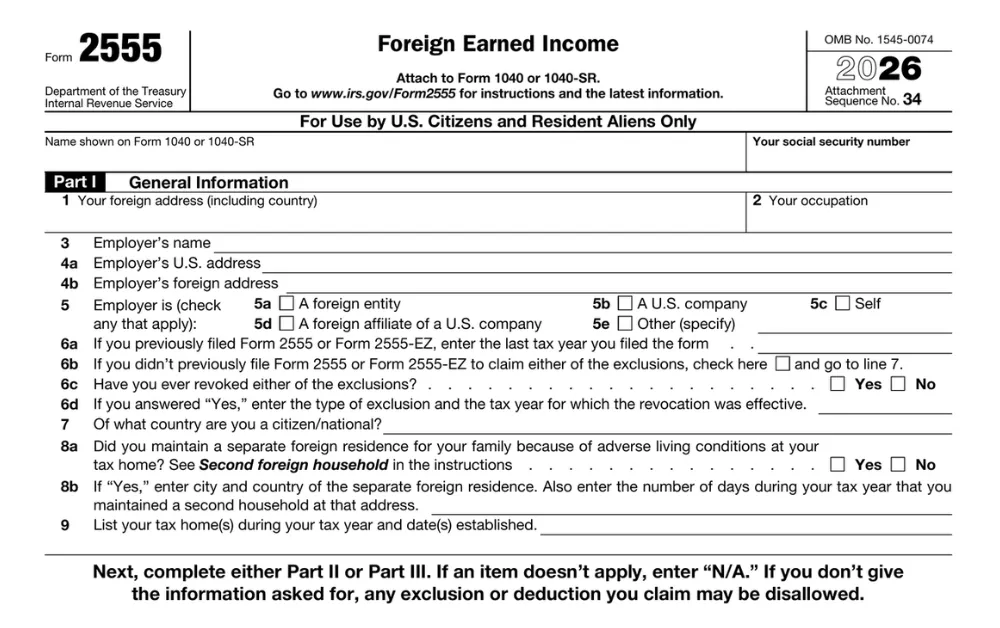
Form 2555 asks for your tax home, your qualifying test and dates, your foreign earned income, and any housing costs, and the exclusion then flows to Schedule 1 as a negative amount. Once you choose the FEIE, it remains in effect for later years unless you revoke it. Our Form 2555 instructions walk through it line by line, and our list of common expat tax forms shows what typically accompanies it.
3. File on Time, or Extend If You Need More Days
A tax return extension can move the filing deadline to October 15. If you have not yet reached 330 days or a full tax year abroad by the deadline but expect to do so, Form 2350 gives you extra time to meet the test before you file. Our tax deadlines for expats guide lists the key dates for the 2027 filing season.
Can You Still Claim the FEIE If You Filed Late?
Yes, in many cases. The IRS accepts the FEIE on a return filed within 1 year of the original due date, on an amended return for a timely-filed year, and on later returns under two narrower conditions. Americans abroad with several missed years can often catch up through the Streamlined Filing Compliance Procedures.
Returns Filed Within One Year, or Amended, Can Still Claim It
A late return that reaches the IRS within one year of its original April due date, not counting extensions, can still qualify for the FEIE, and a return amending a timely-filed return can add it with Form 1040-X. Our FAQ on claiming the FEIE retroactively covers the details.
Later Returns Can Qualify Under Two Conditions
After that year, you can still make the choice if no federal income tax is due on the return after the exclusion, or if you file before the IRS discovers you missed it. The return must carry a statement at the top of page one of Form 1040 citing Treasury Regulation section 1.911-7(a)(2)(i)(D). If tax is due and the IRS contacts you first, the remaining route is a private letter ruling (IRS).
Streamlined Filing Lets Non-Willful Filers Catch Up
If your missed years were non-willful, the Streamlined Filing Compliance Procedures let eligible taxpayers file three years of returns and six years of FBARs, and the FEIE can be claimed on those returns.
Frequently Asked Questions about the Foreign Earned Income Exclusion
The foreign earned income exclusion amount for the 2026 tax year is $132,900 per qualifying person, for returns filed in 2027. A married couple in which both spouses qualify can exclude up to $265,800 in total, with each spouse limited to $132,900 of their own foreign-earned income.
Yes. The foreign earned income exclusion depends on where you physically do the work. Your employer’s location and the account you are paid into do not change that. A remote worker living abroad who has a foreign tax home and meets the Physical Presence Test or the Bona Fide Residence Test can exclude pay for work performed outside the U.S.
Income above the foreign earned income exclusion limit of $132,900 for the 2026 tax year stays subject to U.S. income tax, and the stacking rule taxes it at the bracket it would have reached without the exclusion. The Foreign Housing Exclusion and the Foreign Tax Credit can reduce the tax on that income.
The foreign earned income exclusion does not apply automatically. You choose it by filing Form 2555 with Form 1040, and the choice stays in effect for later years until you revoke it, but you still attach Form 2555 to every year’s return that claims the exclusion. The IRS counts excluded income when deciding whether you must file, so a return is still required once your gross income meets the filing threshold.
Yes. Green card holders are U.S. resident aliens and can claim the foreign earned income exclusion under the Physical Presence Test. They can use the Bona Fide Residence Test only if they are citizens or nationals of a country that has an income tax treaty with the U.S.
It can. Income excluded under the foreign earned income exclusion does not count as compensation for IRA purposes, so an American abroad whose earnings are fully excluded may have no compensation left to support a traditional or Roth IRA contribution. Earnings above the exclusion limit, or using the Foreign Tax Credit instead, can keep IRA contributions available.
Often, yes. The foreign earned income exclusion can be chosen on a return filed within one year of its original due date, and on a later return if no federal income tax is due after the exclusion or if you file before the IRS discovers you did not make the choice. Americans abroad with several non-willful missed years often catch up through the Streamlined Filing Compliance Procedures.
The FEIE Works Best When Your Days, Tax Home, and Paperwork Line Up
The foreign earned income exclusion can remove up to $132,900 of foreign pay from your U.S. taxable income for 2026. How much it saves you depends on a clean day count, a tax home that is clearly abroad, the right split for any U.S. workdays, and a choice that fits your country’s tax rate. For more situations, browse our Foreign Earned Income & Exclusions Q&A.
If you’re a U.S. citizen living abroad or a digital nomad, Greenback can check which test you meet, help you document your days and tax home, and prepare your Form 2555. Learn more about tax help for U.S. citizens living abroad and tax help for digital nomads. If you’re self-employed or on a corporate assignment abroad, Greenback can help you plan around self-employment tax, housing costs, and U.S. workdays. Learn more about tax help for self-employed expats and tax help for corporate expats.

Get Your FEIE Right the First Time.
This article is for general information only and reflects IRS rules and figures for the 2026 tax year, filed in 2027. Tax rules change, and every situation is different. Please consult a qualified tax professional with expertise in U.S. expat taxes before acting on this information.


Featured In


