Do I Have to Pay Taxes on Foreign Inheritance?

- What Counts as a Foreign Inheritance?
- When Do I Need to Report a Foreign Inheritance?
- How Do I File Form 3520?
- Do I Need to Report Foreign Bank Accounts I Inherit?
- Will I Owe Taxes on Income from the Inheritance?
- What Happens if I Don't Report a Foreign Inheritance?
- What if I Already Received a Foreign Inheritance and Didn't Report It?
- Common Scenarios: How This Works in Practice
- Does It Matter Which Country the Inheritance Comes From?
- What's the Difference Between Estate Taxes and Inheritance Taxes?
- What About Inheritances from Covered Expatriates?
- Frequently Asked Questions
- Your Next Steps with Your Foreign Inheritance
- Let Greenback Handle Your Foreign Inheritance Reporting
- Related Resources


No. The IRS does not tax foreign inheritances. Whether you inherit $150,000 from your parents in Germany, property in Italy, or an investment account in Japan, you won’t pay U.S. income tax on the inheritance itself. According to IRS guidance on foreign gifts and bequests, inheritances from foreign persons are tax-free to receive.
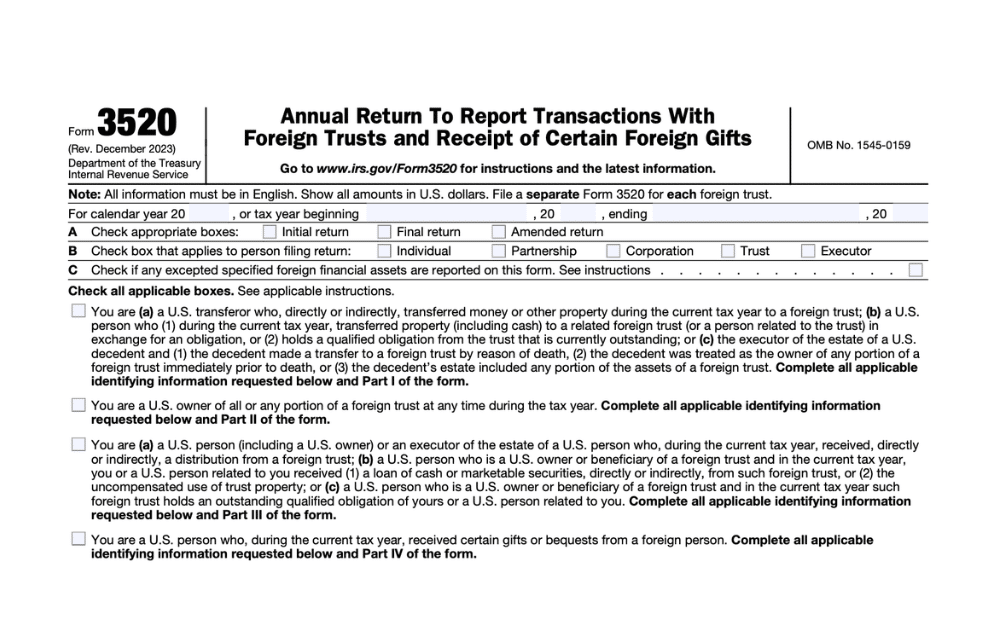
However, you must report inheritances exceeding $100,000 by filing Form 3520 with the IRS. This form is informational only – it generates no tax bill. Here’s what you need to know about reporting requirements, avoiding penalties, and staying compliant.
What Counts as a Foreign Inheritance?
A foreign inheritance (called a “bequest” in tax terminology) is money or property you receive from a foreign estate after someone’s death. This includes:
- Cash from foreign bank accounts
- Real estate located abroad
- Foreign investment accounts or securities
- Personal property (jewelry, art, vehicles)
- Business interests in foreign companies
- Cryptocurrency in foreign exchanges
The location matters: Even if you inherit from a U.S. citizen parent who lived abroad, you must report it if the estate is administered outside the United States. The estate’s location determines the reporting requirements, not the deceased’s citizenship.
Related parties aggregate: If you receive $60,000 from your mother’s estate and $50,000 from your father’s estate in the same year, that’s $110,000 total and triggers Form 3520 reporting.
Do You Owe U.S. Tax on a Foreign Inheritance?
When Do I Need to Report a Foreign Inheritance?
You must file Form 3520 if you receive:
From a foreign person or foreign estate:
- More than $100,000 in aggregate during the tax year
- Multiple inheritances from related persons totaling over $100,000
From a foreign corporation or partnership:
- More than $20,116 for the 2026 tax year (adjusted annually for inflation)
The $100,000 threshold applies to the total value from the same source or related sources during one calendar year.
How Do I File Form 3520?
Form 3520, Annual Return to Report Transactions With Foreign Trusts and Receipt of Certain Foreign Gifts, is filed separately from your tax return.
Filing details:
- Due date: April 15 for the year after you receive the inheritance (June 15 if you live abroad, with extension to October 15)
- Where to mail: IRS Center, P.O. Box 409101, Ogden, UT 84409
- Cannot e-file: Must be mailed
- Complete Part IV: For inheritances, fill out the top section and Part IV (page 6)
What to report:
- Date you received the inheritance (use date of death if uncertain to avoid late penalties)
- Identity of the deceased and relationship to you
- The country where the estate was administered
- Description of what you inherited
- Fair market value in U.S. dollars
Timing matters: Report using the date you became the legal owner. If the death date and actual transfer happen in different tax years, use the date of death to avoid late-filing penalties.
Do I Need to Report Foreign Bank Accounts I Inherit?
Yes, if inherited foreign accounts exceed certain thresholds, you face additional reporting beyond Form 3520.
FBAR (FinCEN Form 114)
If your inherited foreign accounts, combined with any other foreign accounts you own, exceed $10,000 at any point during the year, you must file an FBAR.
Example: Maria inherits €85,000 in her mother’s Italian bank account. Even though she immediately transfers most to her U.S. account, the foreign account exceeded $10,000 during the year, triggering FBAR reporting.
- Deadline: April 15 (automatic extension to October 15)
- Filed separately: Through FinCEN, not with your tax return
Form 8938 (FATCA)
Form 8938 may be required if your total foreign financial assets exceed certain thresholds:
Living abroad:
- Single: $200,000 on December 31 OR $300,000 anytime during the year
- Married filing jointly: $400,000 on December 31 OR $600,000 anytime during the year
Living in the U.S.:
- Single: $50,000 on December 31 OR $75,000 anytime during the year
- Married filing jointly: $100,000 on December 31 OR $150,000 anytime during the year
Form 8938 is filed with your tax return (Form 1040), unlike FBAR, which goes to FinCEN. Learn more about FBAR vs FATCA differences.
Will I Owe Taxes on Income from the Inheritance?
The inheritance itself is tax-free. The income it generates after you receive it is taxable.
Tax-free:
- The $200,000 inheritance your parents left you
- Cash sitting in your foreign account
Taxable income (report on Form 1040):
- Rental income from inherited foreign property
- Interest from inherited foreign bank accounts
- Dividends from inherited foreign stocks
- Capital gains if you sell inherited property
Report ongoing income using the Foreign Tax Credit or Foreign Earned Income Exclusion where applicable.
What Happens if I Don’t Report a Foreign Inheritance?
The IRS imposes steep penalties for failing to report, even though no tax is owed:
Form 3520 penalties:
- 5% of the unreported inheritance per month
- Maximum penalty: 25% of the inheritance value
- Example: Fail to report a $200,000 inheritance for 5+ months = $50,000 penalty
FBAR penalties (non-willful):
- Up to $16,536 per unreported account per year
Form 8938 penalties:
- $10,000 for failure to file
- An additional $10,000 for each month of continued non-filing after IRS notice (up to $50,000 maximum)
Relief available: The IRS can waive penalties if you have reasonable cause for the failure to file and the non-compliance was non-willful.
What if I Already Received a Foreign Inheritance and Didn’t Report It?
If you unintentionally failed to file Form 3520 (or FBAR/Form 8938), you may qualify for penalty-free catch-up through the Streamlined Filing Procedures.
Requirements:
- Your non-compliance was non-willful (you didn’t know about the requirement)
- You haven’t been contacted by the IRS
- You properly reported all income from the inheritance on your tax returns
What you file:
- Three years of amended or delinquent tax returns (including Form 3520 if applicable)
- Six years of FBARs if foreign accounts exceeded $10,000
- Certification explaining why you didn’t file (Form 14653)
Result: Most people owe little to nothing in taxes and pay no penalties when using this program correctly.
Common Scenarios: How This Works in Practice
Cash Inheritance Under $100,000
David (U.S. citizen in California) inherits $75,000 from his uncle in Australia.
Form 3520: Not required | FBAR: Required if account exceeds $10,000 | Form 8938: Not required unless total foreign assets exceed $50,000 | U.S. Tax: $0
Property Inheritance Over $100,000
Jennifer inherits a €200,000 (~$220,000) apartment in Spain from her aunt.
Form 3520: Required | FBAR: Not required if not in a financial account | Form 8938: Depends on total foreign assets and residency | U.S. Tax on inheritance: $0 | Future tax: Capital gains tax if she sells
Multiple Inheritances from Related Persons
Robert receives $60,000 from his father’s estate and $50,000 from his mother’s estate in Germany.
Form 3520: Required (aggregate $110,000 from related sources) | FBAR: Required if in foreign accounts exceeding $10,000 | U.S. Tax: $0
Inheritance Plus Existing Foreign Accounts
Sarah (living in London) inherits £120,000 (~$150,000) and has existing savings of £80,000.
Form 3520: Required | FBAR: Required (total exceeds $10,000) | Form 8938: Required (total exceeds $200,000 for single filer abroad) | U.S. Tax: $0
Does It Matter Which Country the Inheritance Comes From?
The $100,000 reporting threshold applies regardless of country. However:
Tax treaties: The U.S. has estate tax treaties with certain countries (Canada, the UK, Germany, and France) that prevent double taxation on estates. These typically affect the estate itself, not your reporting obligations.
Foreign taxes paid: Many countries impose their own inheritance taxes. You can’t claim a Foreign Tax Credit for foreign inheritance taxes, but your cost basis in inherited property increases by the foreign inheritance tax paid, reducing future U.S. capital gains tax if you sell.
Currency conversion: Report all values on Form 3520 in U.S. dollars using the exchange rate on the date you received the inheritance.
What’s the Difference Between Estate Taxes and Inheritance Taxes?
These are two different taxes that apply at different points and to different people.
Estate tax:
- Paid by the estate before assets are distributed to heirs
- Based on the total value of the deceased person’s estate
- The estate pays, not you as the beneficiary
Inheritance tax:
- Paid by the person receiving the inheritance
- Based on what you receive, not the total estate value
- You pay as the beneficiary
Here’s what matters for you: The U.S. has an estate tax but no federal inheritance tax. As the beneficiary receiving a foreign inheritance, you typically have no U.S. tax to pay – the estate may have already paid taxes before distributing to you.
However, you still have reporting obligations through Form 3520, even though you owe no tax. Think of it as disclosure, not taxation.
If you’re the executor of a foreign estate, Different rules apply. The estate itself may be subject to U.S. estate tax, depending on the deceased’s citizenship, residency, and U.S.-situs assets. Learn more about estate taxes for U.S. citizens living abroad.
Foreign inheritance taxes: Some countries impose inheritance taxes on beneficiaries. If you paid foreign inheritance tax, you cannot claim a Foreign Tax Credit for it. However, paying foreign inheritance tax increases your cost basis in the inherited property, which reduces your U.S. capital gains tax if you later sell the asset.
What About Inheritances from Covered Expatriates?
Inheritances from covered expatriates (people who renounced U.S. citizenship) may be subject to a separate 40% transfer tax under Section 2801. This is different from the Form 3520 reporting requirement.
A covered expatriate is someone who:
- Renounced U.S. citizenship or gave up their green card
- Had a net worth of over $2 million at the time of expatriation
- OR had an average annual income tax liability exceeding certain thresholds for the five years before expatriation
If you inherit from a covered expatriate, consult with a tax professional. You’ll need to file Form 708 in addition to Form 3520.
Frequently Asked Questions
My parent is a U.S. citizen but lives abroad. Do I still need to file Form 3520?
Yes, if the estate is administered outside the United States. The estate’s location determines reporting, not the deceased’s citizenship.
I inherited a house abroad two years ago. Is it too late to file?
No. File the late Form 3520 as soon as possible with a statement explaining the delay. Consider consulting with a tax professional about reasonable cause arguments.
What if I receive multiple smaller inheritances from different relatives?
If they’re related to each other, aggregate them to determine if you exceed $100,000. If they’re unrelated, each source is evaluated separately.
Your Next Steps with Your Foreign Inheritance
If you received a foreign inheritance:
- Calculate the fair market value in U.S. dollars on the date you received it
- File Form 3520 if it exceeds $100,000
- File FBAR if you have over $10,000 in foreign accounts
- File Form 8938 if you exceed FATCA thresholds
- File by April 15 (June 15 for expats abroad) following the year you received the inheritance
If you’re unsure about any step or behind on filing, consult with an expat tax professional.
Let Greenback Handle Your Foreign Inheritance Reporting
Receiving an inheritance from family abroad should bring relief, not stress about IRS compliance. Our team of CPAs and Enrolled Agents has filed thousands of Form 3520s and can guide you through the process with confidence.
Many of our accountants are expats themselves, living in 14 time zones. They understand inheritance scenarios across 190+ countries and have the knowledge and patience to ensure your forms are filed correctly and your penalties are minimized or eliminated.
If you’re ready to be matched with a Greenback accountant, click the Get Started button below. For general questions on US expat taxes or working with Greenback, contact our Customer Champions.
File My Foreign Inheritance the Right Way
This article provides general information about U.S. tax reporting for foreign inheritances. Tax laws are complex and subject to frequent changes, with individual situations varying significantly. For personalized advice based on your specific circumstances, please consult with a qualified tax professional.
Related Resources
- Form 3520 for Americans Living Abroad: The Basics
- Estate Taxes for U.S. Citizens Living Abroad
- U.S. Gift Tax for Americans Abroad: Guide to Giving and Receiving
- FBAR: What It Is, Who Must File & How To Report Foreign Accounts
- Form 8938 Filing Requirements & Foreign Asset Reporting
- FBAR vs FATCA: Which Foreign Account Reporting Do I Need?
- Streamlined Filing for U.S. Expats: Your Penalty-Free Path to Tax Compliance
- Foreign Tax Credit: Complete Guide for U.S. Expats
- Foreign Earned Income Exclusion: Tips and Updates
- U.S. Expat Taxes: The Essential Guide