Form 1118 Explained: Foreign Tax Credit for U.S. Corporations



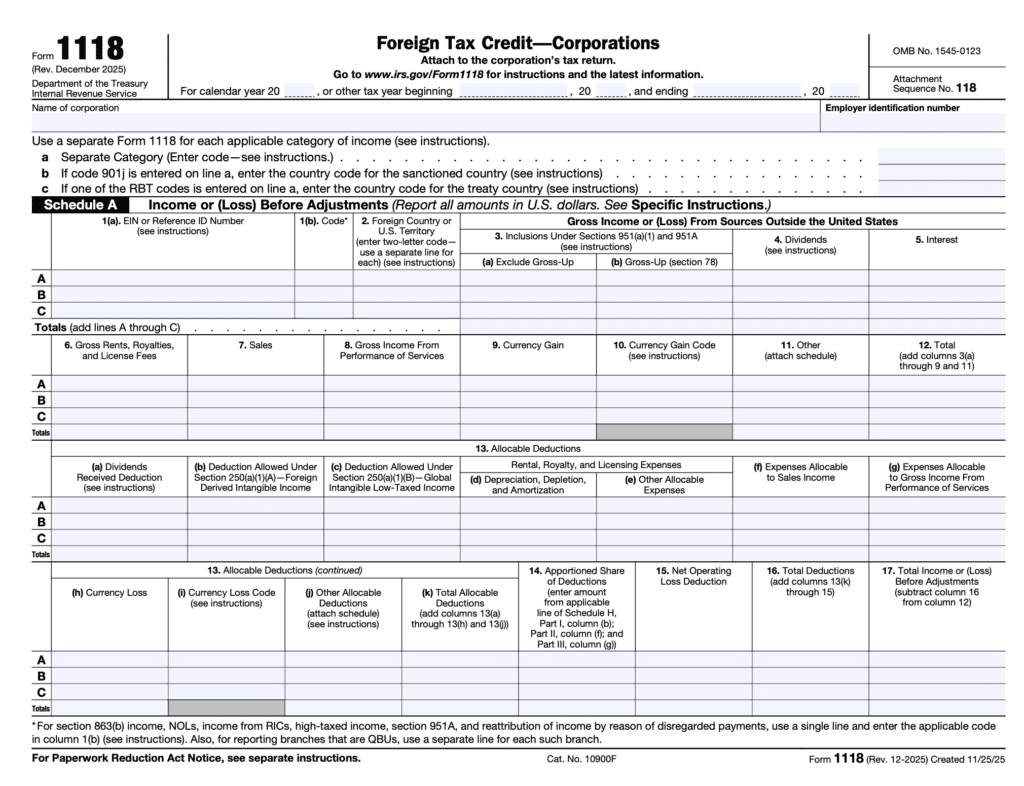
Form 1118 is the IRS form U.S. corporations use to claim the Foreign Tax Credit on income taxes paid to foreign governments. If your corporation operates overseas and pays foreign income taxes, this form can reduce your U.S. corporate tax bill dollar-for-dollar, often eliminating double taxation entirely.
According to the IRS, any corporation that elects the benefits of the Foreign Tax Credit under Section 901 must complete and attach Form 1118 to its income tax return. The most common situations that require Form 1118 include:
- Foreign branch operations (income earned through a permanent establishment abroad)
- Foreign subsidiary dividends (taxes deemed paid on distributions from foreign corporations)
- GILTI inclusions (Global Intangible Low-Taxed Income from controlled foreign corporations)
- Passive foreign income (interest, royalties, and rents from foreign sources)

Not Sure If Your Corporation Needs to File Form 1118?
Here’s what you need to know about Form 1118 and how to make sure your corporation claims every credit it’s entitled to.
How Does the Corporate Foreign Tax Credit Work?
The corporate Foreign Tax Credit prevents your business from being taxed twice on the same income. When your corporation earns income abroad and pays foreign income taxes on that income, Form 1118 lets you claim a credit against your U.S. corporate tax liability for those foreign taxes.
The credit applies only to foreign income taxes. Value-added taxes (VAT), sales taxes, property taxes, and payroll taxes do not qualify, even in countries where VAT functions as a substitute for income tax.

The credit is limited to the amount of U.S. tax that would be owed on the foreign income. If your foreign tax rate exceeds the U.S. corporate rate of 21%, you cannot use the full credit in the current year. However, excess credits can be carried back one year or carried forward up to 10 years, making the credit a valuable long-term planning tool.
Who Should File Form 1118?
Filing Form 1118 is technically elective. No corporation is required to claim the Foreign Tax Credit. But if your corporation pays foreign income taxes and does not file Form 1118, you are voluntarily paying more in U.S. taxes than necessary.
Your corporation likely benefits from Form 1118 if it:
| Your Situation | Form 1118 Needed? | Why |
|---|---|---|
| Operates a foreign branch or office | Yes | Income taxed by both the foreign country and the U.S. |
| Owns 10%+ of a foreign corporation (CFC) | Yes | GILTI and Subpart F income may trigger deemed-paid credits |
| Receives dividends from foreign subsidiaries | Yes | Foreign withholding taxes qualify for the credit |
| Earns passive income from foreign sources | Yes | Foreign taxes on interest, royalties, and rents are creditable |
| Has no foreign operations or foreign-source income | No | No foreign taxes to credit |

Form 1118 applies exclusively to C corporations. If your foreign business is structured as a pass-through entity (partnership, S corporation, or disregarded entity), the Foreign Tax Credit flows through to shareholders, who claim it on their individual returns using Form 1116. Not sure which forms apply to your foreign business? A Greenback CPA can help you sort it out.
Why Is Form 1118 So Complex?
Form 1118 is one of the most time-consuming forms in the tax code. The IRS instructions span dozens of pages, and the form itself includes a main form plus 10 accompanying schedules (Schedules A through K, plus Schedule L for foreign tax redeterminations).
Here’s what makes it challenging:
- Income must be categorized into separate “baskets.” The IRS requires you to separate foreign income into categories such as general, passive, foreign branch, and Section 901(j) (sanctioned countries). Each category may require its own Form 1118.
- Complex limitation calculations. The credit is capped based on the ratio of foreign-source taxable income to total worldwide taxable income. Deductions and expenses must be allocated and apportioned between U.S. and foreign sources.
- Deemed-paid credit rules. If your corporation owns shares in a controlled foreign corporation (CFC), you may be entitled to deemed-paid credits under Section 960, which require additional schedules and calculations.
- Currency conversion requirements. All foreign tax amounts must be reported in U.S. dollars using the correct exchange rates.
- GILTI and Subpart F coordination. Credits related to GILTI income are subject to special rules, including a reduction factor and restrictions on carryovers.
For most corporations with foreign operations, this is not a do-it-yourself form. A single miscategorization or calculation error can mean leaving credits on the table or triggering IRS scrutiny.
When Is Form 1118 Due?
Form 1118 is filed as an attachment to your corporate income tax return (Form 1120). For calendar-year C corporations filing for the 2025 tax year, the deadlines are:
| Deadline | What’s Due |
|---|---|
| April 15, 2026 | Form 1120 with Form 1118 attached (or extension request via Form 7004) |
| October 15, 2026 | Extended filing deadline (if Form 7004 was filed by April 15) |
Filing an extension gives your corporation more time to file the return, but it does not extend the deadline to pay taxes owed. Estimated taxes must still be paid by April 15 to avoid interest and penalties.
What If My Corporation Is Behind on Filing?
If your corporation has foreign operations and has not been claiming the Foreign Tax Credit, you may be paying more than necessary. Depending on the circumstances, it may be possible to amend prior returns to claim missed credits, or to use the carryback and carryforward provisions to recover unused credits.
If you’re behind on your taxes, the sooner you address it, the better. The IRS offers procedures to help bring delinquent filers into compliance, and proactively coming forward generally results in a better outcome than waiting.
Let Greenback Handle Form 1118 for Your Corporation
Form 1118 is complex by design, and getting it right requires specialized expertise in corporate international tax. Greenback’s CPAs and Enrolled Agents work with business owners abroad every day, handling everything from Form 1118 to Form 5471, GILTI calculations, and multi-country tax credit optimization.
No matter how late, messy, or complex your return may be, we can help. You’ll have peace of mind, knowing that your taxes were done right.
If you’re ready to be matched with a Greenback accountant, click the Get Started button below. For general questions on U.S. expat taxes or working with Greenback, contact our Customer Champions.

Corporate Foreign Tax Credits Shouldn’t Be Guesswork
This article is intended for informational purposes only and does not constitute legal or tax advice. While Greenback makes every effort to ensure the information is accurate and up-to-date, every tax situation is unique. For advice tailored to your specific situation, please consult a qualified tax professional.
Related Resources
- Foreign Tax Credit: How Expats Can Reduce U.S. Taxes
- Can I Carry Over Unused Foreign Tax Credits to Future Years?
- Form 1116 Instructions: How to Fill Out the Foreign Tax Credit Form
- What Is a Controlled Foreign Corporation (CFC)?
- What Tax Forms Do I Need to File for My Foreign Business?
- How Do I Start a Business Overseas as a U.S. Citizen?
- FEIE vs. FTC: Which Should You Choose?
- Why Am I Taxed Twice as a U.S. Expat?
- Small Business Tax Return Preparation for U.S. Expats



Featured In