IRS Form 1040: Who It’s For, How It Works and Filing Instructions

- What Is a 1040 Form?
- What Are the Types of Form 1040?
- Who Has to File Form 1040?
- How Do You Get Form 1040?
- How Do You Fill Out Form 1040?
- What Is a Schedule on Form 1040?
- What Are the Form 1040 Schedules?
- What Does a Filled-Out Form 1040 Look Like?
- What Is Changing on the Draft Form 1040 in 2027?
- Where Do You File Form 1040?
- Frequently Asked Questions about IRS Form 1040
- Greenback Helps You File Form 1040 With Confidence From Anywhere


Form 1040 is the U.S. individual income tax return. It is the form U.S. taxpayers use each year to report their income, claim deductions and credits, and figure out whether they are owed a refund or have a balance to pay. Most returns consist of the two-page Form 1040 plus any applicable schedules.
For the 2026 tax year, which you file in 2027, you generally have to file Form 1040 if your gross income is at least $16,100 as a single filer, $32,200 as a married couple filing jointly, or $24,150 as a head of household. You also have to file if you have $400 or more of net self-employment income. These amounts match the 2026 standard deduction and are higher for filers 65 or older, while married couples filing separately must file even if they have just $5 in income. U.S. citizens and green card holders file Form 1040 wherever they live, and U.S. citizens living abroad can reduce or remove the U.S. tax on foreign income with the Foreign Earned Income Exclusion, worth up to $132,900 for 2026, or the Foreign Tax Credit. Both are claimed on Form 1040 itself, so filing matters even when little or no U.S. tax is due.
The IRS updates Form 1040 each year, and the draft 2026 Form 1040 adds a citizenship and work-authorization question and a new charitable deduction line.
What Is a 1040 Form?
Form 1040’s official title is the “U.S. Individual Income Tax Return,” and it is a two-page form the IRS updates each year to reflect inflation adjustments and changes to the tax law. Page 1 covers your personal details and income, and page 2 turns that into your tax and your refund or balance due.
Form 1040 is where you:
- Report your income: Wages, self-employment income, interest, dividends, pensions, Social Security, and capital gains all go on the return, whether you earned them in the United States or abroad.
- Claim your deductions and credits: You subtract either the standard deduction or your itemized deductions, then apply credits such as the child tax credit or the Foreign Tax Credit to lower what you owe.
- Settle your balance: The form compares your total tax with what you have already paid through withholding and estimated payments, and shows either a refund or an amount due.
What Are the Types of Form 1040?
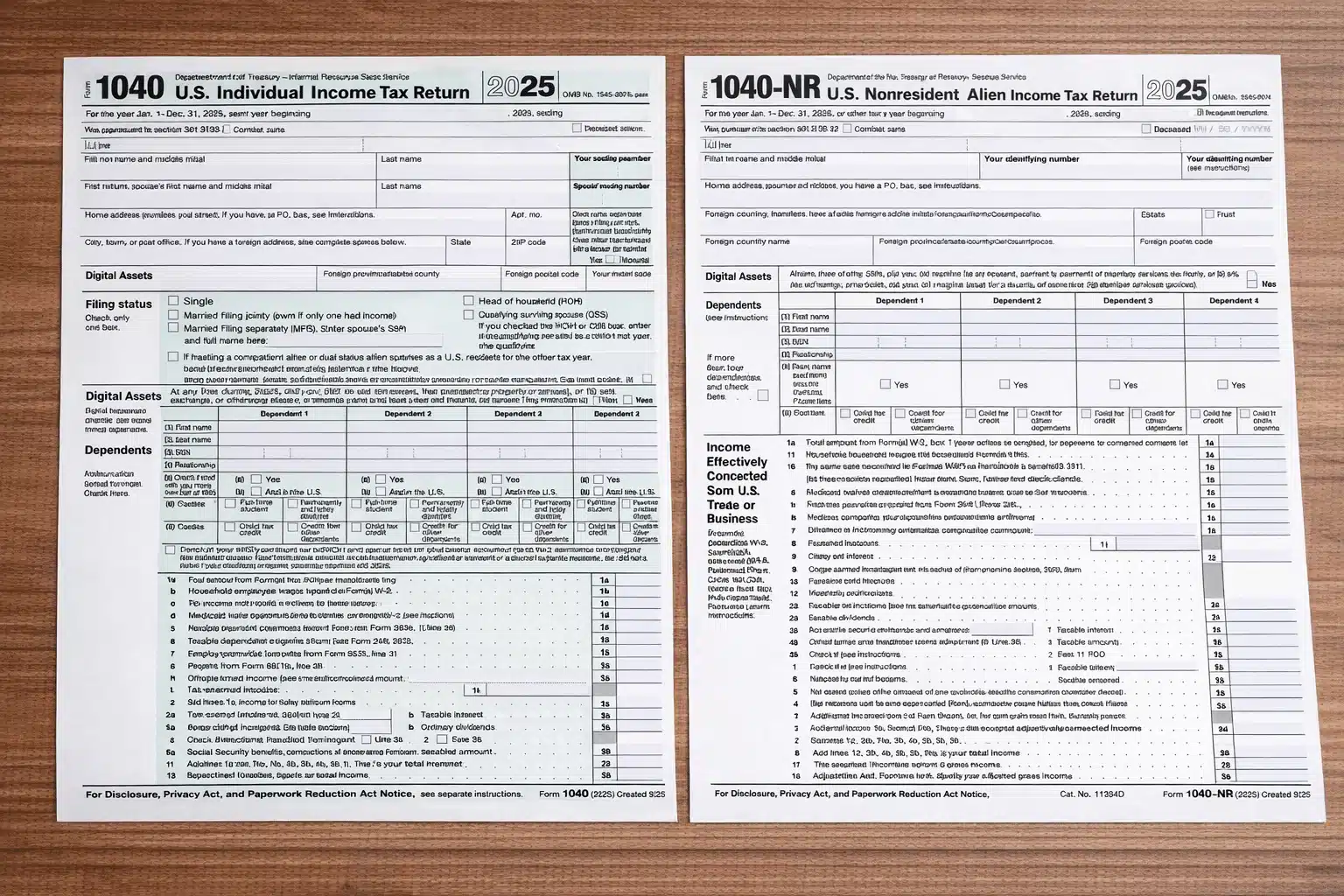
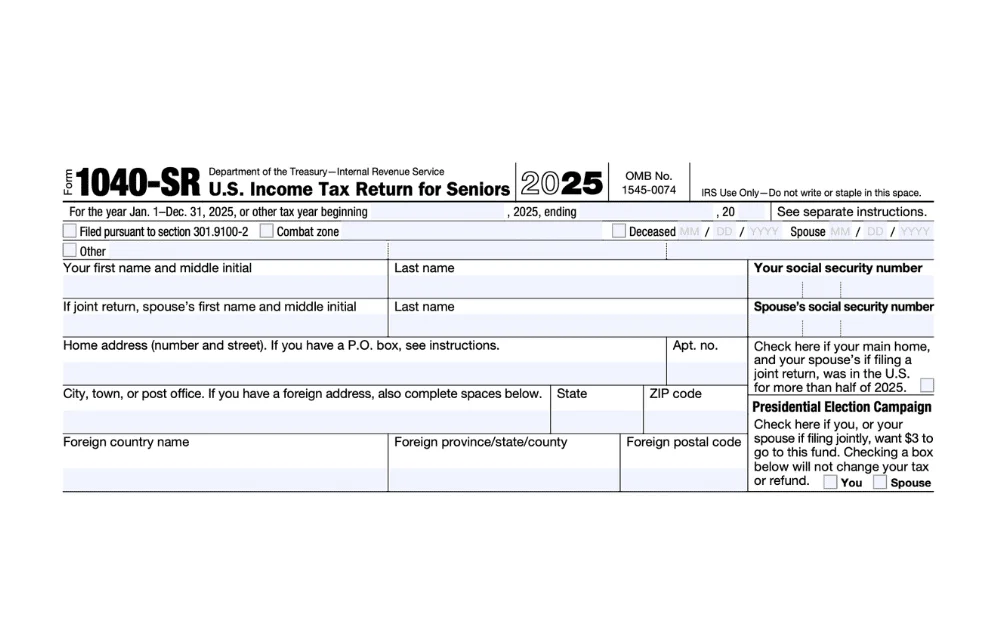
Most people file the standard Form 1040, and a few related forms cover specific situations, such as filing at 65 or older, filing as a nonresident, paying estimated tax, or correcting a return.
| Form | Who uses it | What it is for |
|---|---|---|
| Form 1040 | Most U.S. taxpayers, including citizens and green card holders abroad | The standard annual income tax return |
| Form 1040-SR | Filers age 65 or older | The same return in larger print, with the same schedules and instructions |
| Form 1040-NR | Nonresident aliens | A return for income connected to the United States |
| Form 1040-X | Anyone correcting a filed return | An amended return |
| Form 1040-ES | Anyone paying tax during the year | Estimated tax payment vouchers |
| Form 1040-V | Anyone paying a balance by check | A payment voucher sent with the return |
Forms 1040A and 1040EZ are no longer available. The IRS retired both short forms starting with the 2018 tax year, and anyone who used them now files Form 1040.
Who Has to File Form 1040?
You have to file Form 1040 when your gross income reaches the filing threshold for your filing status and age, or when you have $400 or more of net self-employment income. For the 2026 tax year, which you file in 2027, the threshold for filers under 65 generally equals the standard deduction: $16,100 for single filers, $32,200 for married couples filing jointly, and $24,150 for heads of household, while married couples filing separately need to file once they have just $5 of gross income.
Filers 65 or older have higher thresholds, which the IRS confirms in the 2026 Form 1040 instructions, and the full table by filing status covers every status and age. Living abroad does not change these rules, and gross income counts U.S. and foreign income together, before any exclusion or credit.
Filing below the threshold can still be worth it, because a return claims back withheld tax and refundable credits and starts the clock on how long the IRS has to review that year. If you have missed several years, the streamlined filing procedures are the route back into compliance.
How Do You Get Form 1040?
You can download Form 1040 and its instructions from IRS.gov, or let tax software or a tax professional prepare it for you. Download Form 1040 here. Software and preparers pick the right version and every schedule your return needs, so most people never print a blank form. Each year’s return goes on that year’s form, so anyone catching up on earlier years uses the prior-year versions the IRS keeps online.
How Do You Fill Out Form 1040?
The Form 1040 instructions walk through the return in a fixed order, from your personal details to your refund or balance due. Schedules feed their totals into the main form at set points along the way.
- Enter your personal information: Name, address, Social Security number, filing status and dependents, plus a few yes-or-no questions.
- Report your income: Wages, interest, dividends, pensions, and, through Schedule 1, business and rental income. Foreign income goes in at its full dollar value.
- Subtract adjustments: Items such as half of self-employment tax come off to give your adjusted gross income.
- Take the standard deduction or itemize: subtract the larger amount to get your taxable income.
- Figure the tax and apply credits: Credits such as the child tax credit and the Foreign Tax Credit come off the tax.
- Add other taxes: Self-employment tax and other taxes from Schedule 2 give your total tax.
- Compare with what you paid: Subtract withholding and other payments from your total tax to see your refund or the amount you owe.
Documents to Gather Before You Start
Gathering these first makes the return quicker to complete:
- Personal details: Social Security numbers or ITINs for you, your spouse, and your dependents.
- Income records: Forms W-2 from U.S. employers, Forms 1099 for interest, dividends, retirement distributions, and contract work, and pay statements from any foreign employer.
- Foreign tax and account records: The income tax you paid to another country, and the highest balance of each foreign bank or investment account during the year.
- Deduction and credit records: Mortgage interest, charitable gifts, child care and education costs.
- Exchange rates: One consistent basis for converting foreign amounts to dollars, usually the Treasury yearly average rate.
Where Each Type of Income Goes on Form 1040
Each type of income and each exclusion, credit, or extra tax has one route onto the return. The line numbers below correspond to the draft 2026 Form 1040 and will be confirmed once the IRS releases the final form.
| What you have | Form or schedule it goes on | Where it lands on Form 1040 |
|---|---|---|
| Wages reported on Form W-2 | Form 1040 itself | Line 1a |
| Wages with no Form W-2 | Form 1040 itself | Line 1h |
| Interest and dividends | Schedule B | Lines 2b and 3b |
| Self-employment income | Schedule C | Schedule 1 line 3, then line 8 |
| Rental property income | Schedule E | Schedule 1 line 5, then line 8 |
| Foreign Earned Income Exclusion | Form 2555 | Schedule 1 line 8d, then line 8 |
| Foreign Tax Credit | Form 1116 | Schedule 3 line 1, then line 20 |
| Self-employment tax | Schedule SE | Schedule 2 line 4, then line 23 |
| Tips, overtime, senior and car loan deductions | Schedule 1-A | Line 13a |
Line 1h is easy to miss if you work abroad. Line 1a is reserved for amounts from box 1 of Form W-2, so a salary from a foreign employer that never issues one generally belongs on line 1h, where the form asks you to enter the type and amount. Putting it on line 1a implies a W-2 that does not exist.

What Is a Schedule on Form 1040?
A schedule is an extra page that attaches to Form 1040 to handle one part of your return, such as business income or additional taxes, and carries a single total to a set line on the main form. You only attach the schedules that apply to you, and a simple return may need none at all.
The two pages of Form 1040 are the summary, and the schedules are the worksheets behind it. If you freelance, Schedule C reports your profit; that profit moves to Schedule 1, and the Schedule 1 total appears on line 8 of Form 1040. The main form only sees the final number.
Separate forms are different from schedules. A form such as Form 2555 for the Foreign Earned Income Exclusion or Form 1116 for the Foreign Tax Credit claims one specific tax benefit, and its result is then carried to a schedule, which carries it to Form 1040.
Foreign accounts are reported separately from every schedule. If your foreign accounts together topped $10,000 at any point in the year, you file an FBAR with FinCEN, not with the return, and higher balances can also require Form 8938, which does attach to it.
What Are the Form 1040 Schedules?
Form 1040 is made up of the base form plus three numbered schedules (Schedules 1, 2 and 3) that report extra income, taxes and credits, and a set of supporting schedules that hold the detail for specific types of income, deductions and credits. Most returns use only a few of them, and tax software or a preparer works out which ones yours needs.
Numbered Schedules
The numbered schedules carry totals straight to lines on Form 1040, and two newer ones sit alongside the original three:
- Schedule 1 (Additional Income and Adjustments to Income): Reports income without its own line on Form 1040, such as business and rental income, along with the Foreign Earned Income Exclusion as a negative amount and adjustments like the deduction for half of self-employment tax.
- Schedule 1-A (Additional Deductions): Calculates the deductions for qualified tips, overtime, car loan interest, and the enhanced deduction for filers 65 and older.
- Schedule 2 (Additional Taxes): Reports taxes beyond regular income tax, including self-employment tax and the alternative minimum tax.
- Schedule 3 (Additional Credits and Payments): Reports nonrefundable credits, including the Foreign Tax Credit, along with other payments and refundable credits.
- Schedule 3-A (Federal Public Benefit): A new draft schedule that works out the refunded part of the earned income credit, the additional child tax credit, and the refundable American opportunity and adoption credits, and asks one status question about those credits.
Supporting Schedules
The supporting schedules each hold the detail for one item and pass their result to Form 1040 or a numbered schedule:
- Schedule A (Itemized Deductions): Lists itemized deductions such as mortgage interest, state and local taxes, medical expenses and charitable gifts, which you use only when they add up to more than your standard deduction.
- Schedule B (Interest and Ordinary Dividends): Lists interest and ordinary dividends over $1,500. Its Part III asks about foreign financial accounts, so many Americans abroad file it even when their interest is small.
- Schedule C (Profit or Loss From Business): Reports the income and expenses of a business you run as a sole proprietor or single-member LLC, including freelance and contract work.
- Schedule D (Capital Gains and Losses): Reports sales of capital assets such as stocks, funds and property held as an investment.
- Schedule E (Supplemental Income and Loss): Reports income or loss from rental real estate, royalties, partnerships, S corporations, estates and trusts, including a rental property you own abroad.
- Schedule EIC (Earned Income Credit): Lists information about the qualifying children you claim for the earned income credit. You cannot claim the earned income credit in a year you file Form 2555, and your main home generally has to be in the United States for more than half the year.
- Schedule F (Profit or Loss From Farming): Reports farm income and expenses for farmers and others in agriculture.
- Schedule H (Household Employment Taxes): Reports the Social Security, Medicare, and federal unemployment taxes you owe on wages paid to household employees such as a nanny or housekeeper.
- Schedule J (Income Averaging for Farmers and Fishermen): Lets farmers and fishermen calculate the tax on that income by averaging it over the previous three years, which can lower the tax in a high-income year.
- Schedule R (Credit for the Elderly or the Disabled): Calculates the credit for the elderly or the disabled, available to filers 65 or older and to some younger filers who retired on permanent and total disability.
- Schedule SE (Self-Employment Tax): Calculates the Social Security and Medicare tax on net self-employment earnings, which applies even when the Foreign Earned Income Exclusion removes the income tax, unless a totalization agreement assigns your coverage to the country where you live.
- Schedule 8812 (Credits for Qualifying Children and Other Dependents): Calculates the child tax credit, the credit for other dependents, and the refundable additional child tax credit, all covered in our guide to the child tax credit for expats.
What Does a Filled-Out Form 1040 Look Like?
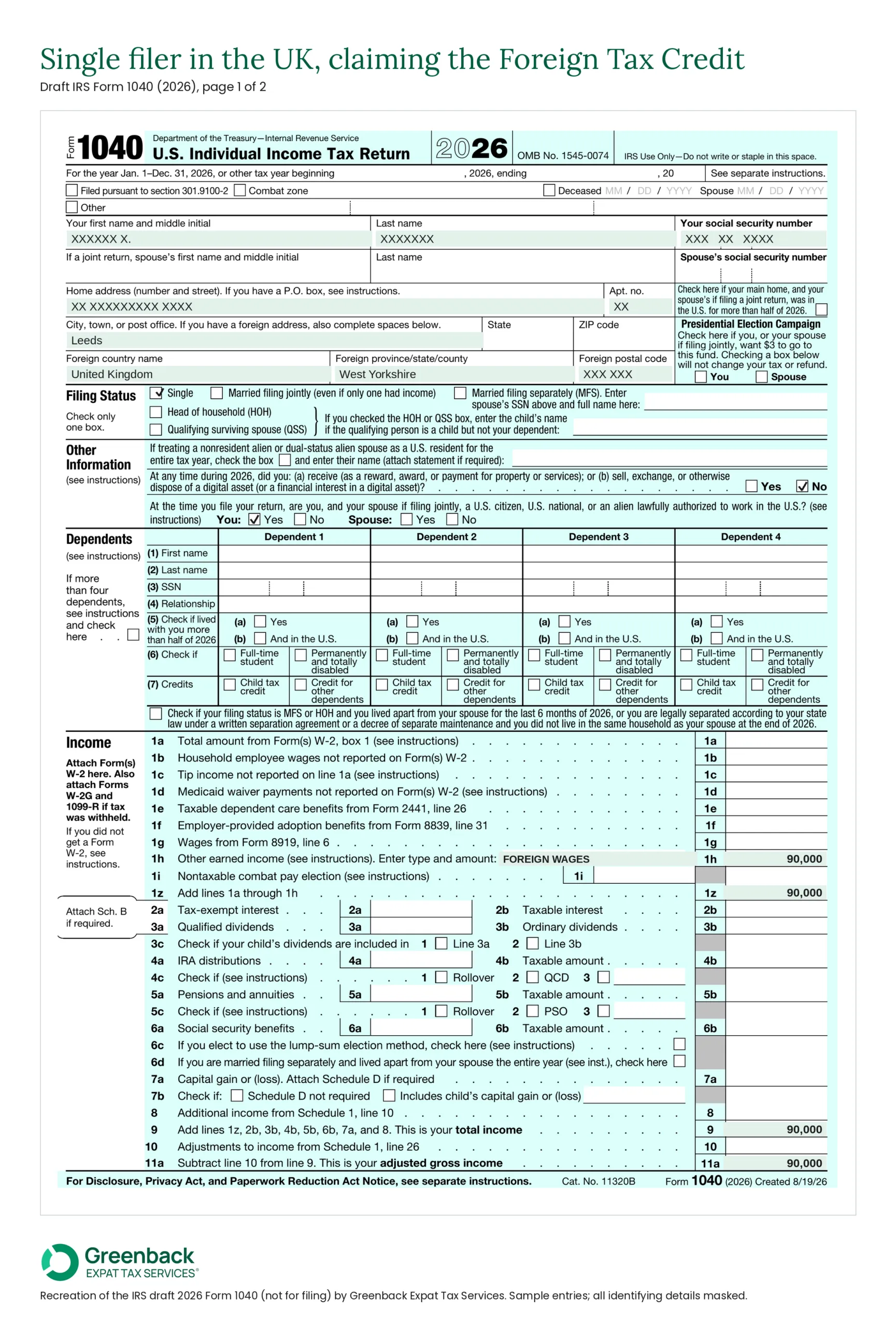
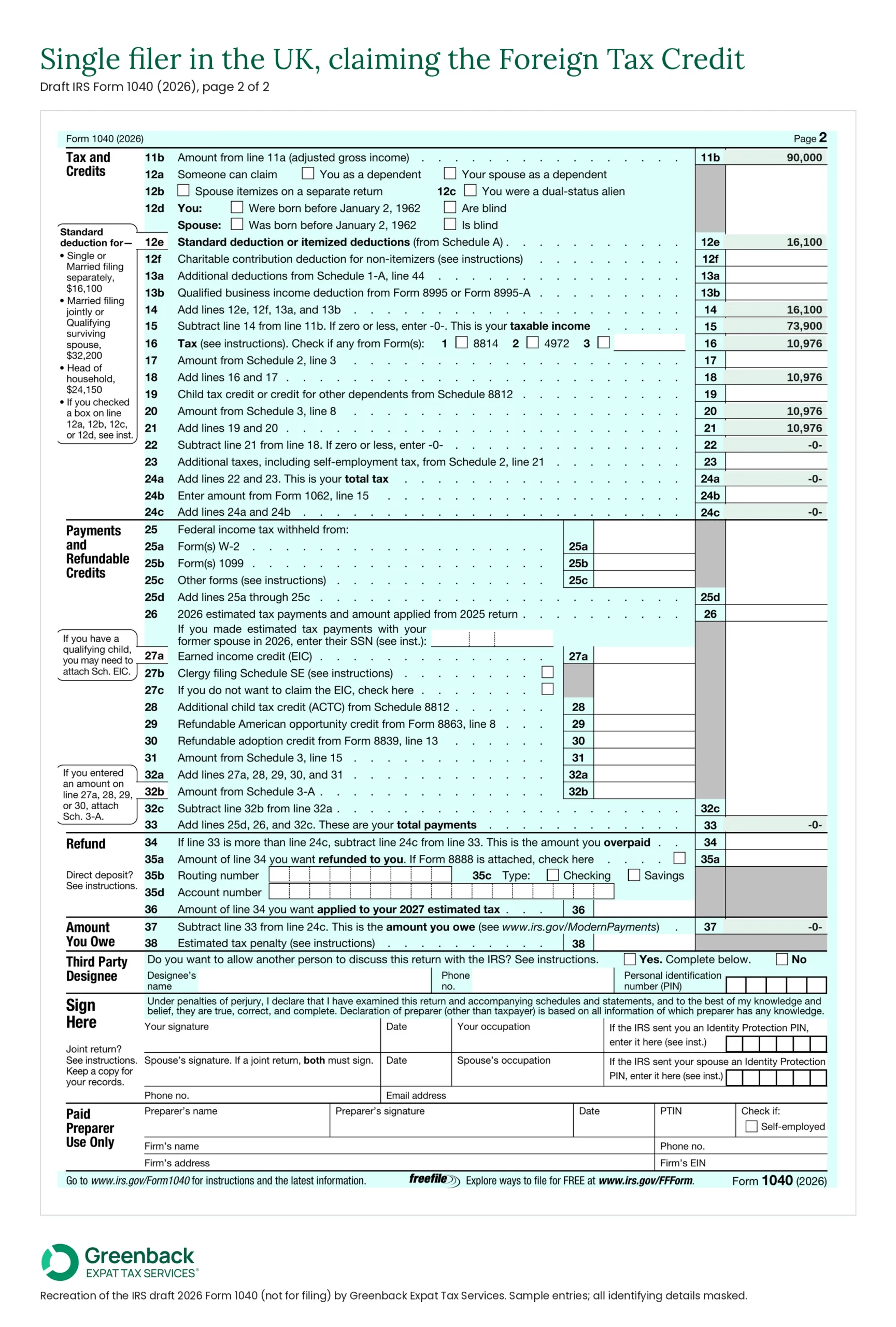
This sample shows the draft 2026 Form 1040 filled out for one filer for the 2026 tax year, which is filed in 2027. She is a single U.S. citizen living in Leeds, England, who earns $90,000 from a UK employer and takes the standard deduction. Her UK income tax is higher than her U.S. tax, so the Foreign Tax Credit brings her U.S. income tax to zero.
1. Page 1 Reports $90,000 of UK Wages
Her foreign address goes in the foreign country, province, and postal code boxes. She checks “Single,” answers “No” to the digital asset question and “Yes” to the citizenship and work authorization question, and leaves the main home checkbox blank because her home was not in the United States.
Her UK employer does not issue a Form W-2, so her $90,000 salary goes on line 1h as foreign wages and carries over to line 1z. With no other income and no adjustments, her total income on line 9 and her adjusted gross income on line 11a are both $90,000.
2. Page 2 Brings Her Income Tax to Zero With the Foreign Tax Credit
The $16,100 standard deduction on line 12e leaves taxable income of $73,900 on line 15, and the tax on that amount at the draft 2026 rates is $10,976 on line 16.
She paid the equivalent of $19,500 in UK income tax on the same salary. The Foreign Tax Credit, claimed on Form 1116, is capped at the U.S. tax on that foreign income, so $10,976 goes on line 20 through Schedule 3, line 8, and her total tax on line 24a comes to zero. UK National Insurance contributions do not count toward the credit, since social security taxes paid to a country with which the United States has a Social Security agreement are not creditable.
With no U.S. withholding, she has no refund and nothing to pay. The Foreign Tax Credit is the better fit for her because UK income tax is higher than U.S. tax: it brings her U.S. income tax to zero and leaves $8,524 of unused UK tax that can generally be carried back one year and forward ten years, which would help in a future year with more U.S. tax due. Excluding the salary with the Foreign Earned Income Exclusion would also bring her tax to zero, but it creates no carryover, and our comparison of the FEIE vs. the Foreign Tax Credit covers when each one works better.
What Is Changing on the Draft Form 1040 in 2027?
The draft 2026 Form 1040, which you file in 2027, was posted by the IRS on September 17, 2026. It keeps the same layout and adds a citizenship and work-authorization question, a charitable deduction line, and a line for the new Schedule 3-A. It is marked not for filing, and the final form is expected later this year.
1. The Citizenship and Work-Authorization Question
Page 1 of the draft asks: “At the time you file your return, are you, and your spouse if filing jointly, a U.S. citizen, U.S. national, or an alien lawfully authorized to work in the U.S.?” You and your spouse each answer “Yes” or “No,” based on your status on the day you file.
U.S. citizens and U.S. nationals answer “Yes,” including Americans living abroad and dual citizens. A valid green card authorizes work in the United States, so green card holders would generally answer “Yes” as well, although the IRS has not yet posted the 2026 instructions for this question or said how it will use the answers. The question is separate from the status question on Schedule 3-A, which applies only to filers claiming certain refundable credits.
2. New and Moved Lines
In the draft, the charitable deduction for people who take the standard deduction appears on new line 12f; Schedule 1-A deductions move to line 13a; total tax appears on line 24a; and the Schedule 3-A amount goes on line 32b. The final instructions will confirm each line.
Where Do You File Form 1040?
Most people file Form 1040 electronically through tax software or a tax professional, and you can also mail a paper return to the IRS. E-filing is faster and works from anywhere, including for Americans e-filing from abroad.
A paper return’s mailing address depends on where you live and whether you include a payment, with a separate address for filers abroad, all listed in our guide to IRS mailing addresses. The return is due on April 15, and Americans whose tax home and abode are outside the United States and Puerto Rico on that date receive an automatic extension to file until June 15.
Frequently Asked Questions about IRS Form 1040
No. A Form W-2 is issued by an employer and reports what they paid you and withheld, while Form 1040 is the tax return you file using those figures.
Yes. Form 1040 is the federal individual income tax return, and a complete return is Form 1040 plus any schedules and forms attached to it, such as Schedule C for a business or Form 2555 for the Foreign Earned Income Exclusion.
No one sends you a Form 1040 the way an employer sends a W-2. Form 1040 is the return you complete and file yourself, on paper, through tax software or through a tax professional, whenever you need to file a federal income tax return.
A Form 1099 is an information return a bank, client, or other payer sends to report income such as interest, dividends, or contract payments, and Form 1040 is the tax return where you report that income. Our guide to 1099s for Americans living abroad covers how they work when you live overseas.
Usually, yes. U.S. citizens and green card holders file Form 1040 when their gross income reaches the filing threshold, even if the Foreign Earned Income Exclusion or the Foreign Tax Credit reduces their U.S. tax to zero, because those benefits are claimed on the return itself.
Form 1040 is due on April 15; Americans living abroad receive an automatic extension to June 15, and Form 4868 extends the filing deadline to October 15. If you file late and owe tax, the failure-to-file penalty is 5% of the unpaid tax for each month or part of a month, up to 25%, so a late return that shows no tax due carries no failure-to-file penalty, although the FBAR and Form 8938 follow their own rules. Our guide to U.S. tax deadlines for expats covers every date.
Greenback Helps You File Form 1040 With Confidence From Anywhere
Form 1040 is the same two pages for every filer. What changes from one return to the next is which schedules and forms go with it, and whether the ones that lower your tax, such as Form 2555 and Form 1116, were filed at all. Greenback’s U.S. expat tax accountants prepare the return and every form it needs, so nothing you qualify for gets left behind, whether you are filing for the first time or catching up.

Start Your Return Today
This article provides general information and should not be considered specific tax advice. The 2026 Form 1040 described here is an IRS draft that is not for filing, and its lines and questions may change before the final form is released. Tax laws are complex and subject to change. Always consult with a qualified tax professional regarding your specific situation.

Featured In