IRS Form 4868: Who It’s For, How It Works & Filing Instructions

- What Is Form 4868?
- Who Should File Form 4868?
- How Do You Fill Out Part I of Form 4868?
- How Do You Fill Out Part II of Form 4868?
- How Do You File Form 4868?
- Where Does a Form 4868 Payment Go on Your Return?
- How Does Form 4868 Work If You're Out of the Country?
- When Is Form 4868 Due, and How Long Is the Extension?
- Frequently Asked Questions about Form 4868
- Form 4868 Gives You Until October 15 to File


Form 4868, Application for Automatic Extension of Time to File U.S. Individual Income Tax Return, gives you six more months to file your Form 1040, which moves the deadline for your 2026 tax return, filed in 2027, to October 15, 2027. It’s automatic when you file on time with a reasonable estimate of your tax, and you don’t need to give a reason.
Form 4868 extends the time to file, while your tax is still due by the original date. For most, that’s April 15, 2027, and interest runs from then on anything unpaid. If you live abroad, you already have until June 15, 2027, to file and pay, with interest still running from April 15. You can also pay electronically and mark it as an extension, with no form needed. Our U.S. tax deadlines guide lists every date.
Anyone filing Form 1040, 1040-SR, 1040-NR, or 1040-SS who needs more time can use Form 4868, including Americans abroad, who check line 8 to extend the due date from June 15 to October 15. Here’s what the form is, who should file it, how it works, and how to complete each line.

What Is Form 4868?
Form 4868 is the IRS form you use to request an automatic six-month extension of time to file your individual income tax return. You file it by your return’s due date, and the IRS will contact you only if it denies the request. It extends the time to file, while the time to pay stays the same.
The same extension also moves the filing deadline for a gift tax return on Form 709, though not the time to pay any gift tax. Information returns you attach to Form 1040, such as Form 8938, follow your return’s extended due date, and Form 3520 (not Form 3520-A) becomes due by October 15 when your income tax return is extended. Your FBAR isn’t part of Form 4868; it has its own automatic extension to October 15.
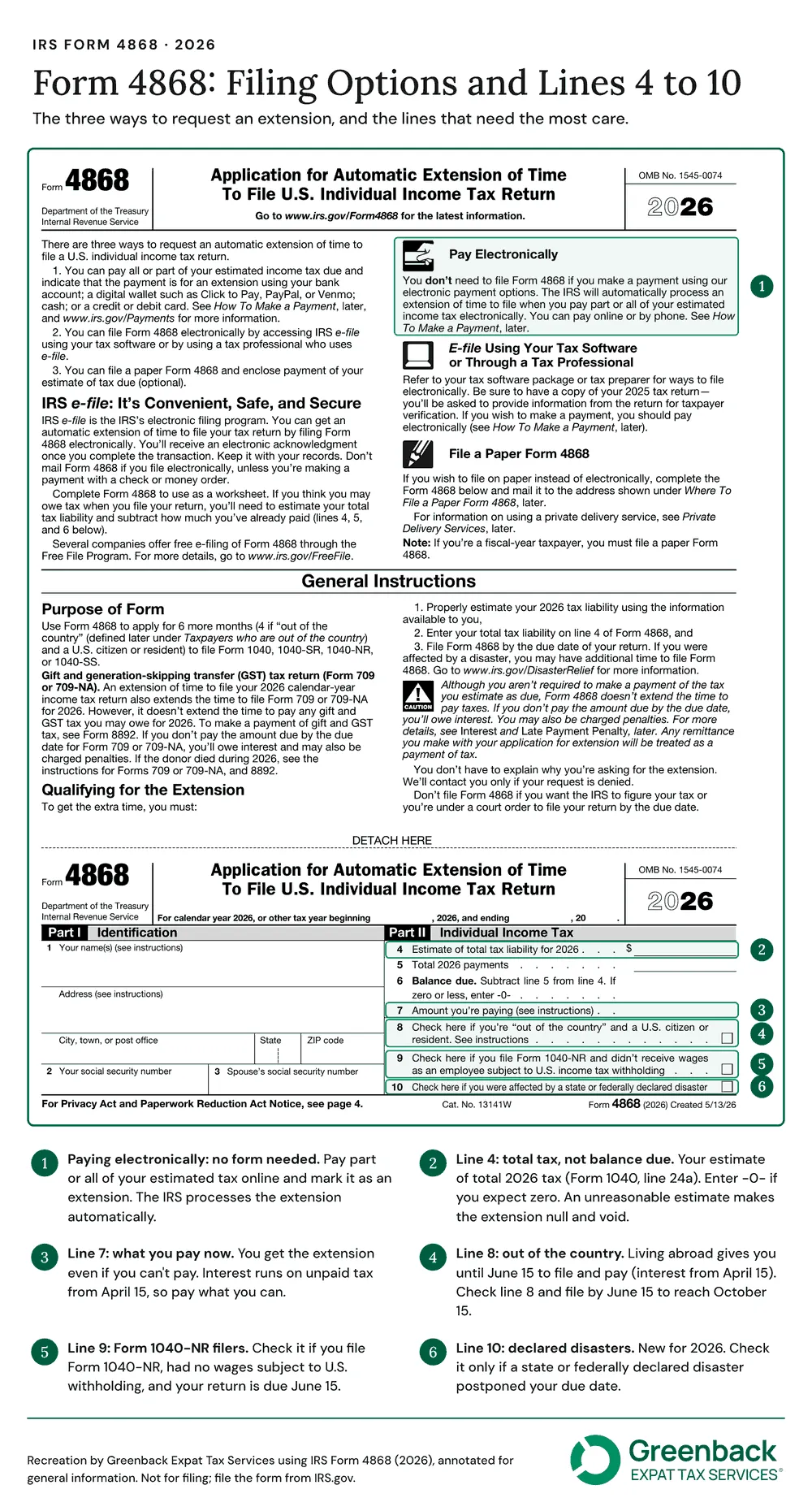
Where to Get a Printable Form 4868
The IRS posts Form 4868 as a printable, fillable PDF on its Form 4868 page on IRS.gov, along with versions for earlier years. Use the version for the tax year you’re extending; the PDF also carries the instructions and the mailing addresses. If you’re outside the U.S., our FAQ on downloading IRS forms from abroad covers the other forms you may need.
When Your Tax Is Due: April 15, or June 15 Abroad
If you live abroad, you have until June 15 “to file your income tax return and pay federal income tax,” as IRS Publication 54 puts it, with interest charged on any tax not paid by April 15. Everyone else pays by April 15, even with Form 4868. Our FAQ on interest during the June 15 extension explains how that interest is calculated.
Who Should File Form 4868?
Anyone who can’t file a complete, accurate return by the due date should consider Form 4868. No one is required to file it, and a valid extension protects you from the late-filing penalty as long as you file your return by October 15. Three situations change whether you need the form:
- Paying electronically instead: if you pay part or all of your estimated tax electronically and mark the payment as an extension, the IRS processes the extension automatically, with no Form 4868.
- Expecting a refund: late-filing and late-payment penalties are a percentage of unpaid tax, so they come to zero when nothing is due, unless your estimate turns out to be low. Forms you attach to your return, such as Form 8938, are still late if your return is. Our guide to tax refunds for Americans abroad covers how refunds are paid.
- Living abroad: you already have until June 15. Form 4868 is only needed if you want to go further, to October 15.
Don’t file Form 4868 if you’re asking the IRS to calculate your tax for you, or if a court order requires you to file by the regular due date.
Form 1040-NR filers use the same form and must file it by their return’s due date. If you didn’t receive wages subject to U.S. income tax withholding, your return is due June 15, 2027, and you check line 9. If you’re not sure which return you file, see Form 1040 vs. Form 1040-NR.
How Do You Fill Out Part I of Form 4868?
Part I identifies you on lines 1 to 3: your name and address, your Social Security number, and your spouse’s number if you’ll file jointly. This table covers every line on the 2026 form, Parts I and II, before the line-by-line detail.
| Line | What you enter | Where it comes from | Note |
|---|---|---|---|
| 1 | Name(s) and address | Your records | Joint request: both names in return order; a foreign address is fine |
| 2 | Your Social Security number | Your SSN or ITIN | Estates and trusts filing Form 1040-NR enter an EIN |
| 3 | Spouse’s Social Security number | Spouse’s SSN or ITIN | Joint requests only |
| 4 | Estimate of total 2026 tax | Form 1040, 1040-SR or 1040-NR line 24a (Form 1040-SS Part I, line 7) | Enter -0- if you expect zero |
| 5 | Total 2026 payments | Form 1040 line 33, excluding Schedule 3, line 10 (Form 1040-SS Part I, line 12c, excluding line 9) | Withholding, estimated payments, credits applied |
| 6 | Balance due | Line 4 minus line 5 | Enter -0- if line 5 is more than line 4 |
| 7 | Amount you’re paying | Your choice | You still get the extension if you can’t pay |
| 8 | Out of the country | Checkbox | U.S. citizens and residents abroad on the due date |
| 9 | Form 1040-NR, no wages subject to withholding | Checkbox | Return due June 15 |
| 10 | Declared disaster | Checkbox | Only if a disaster postponed your due date; new for 2026 |
Line references from the 2026 Form 4868. You can round to whole dollars if you round every amount.
Lines 1 to 3: Names, Address and Social Security Numbers
Enter your name and mailing address on line 1; for a joint request, list both names in the order they’ll appear on your return. A foreign address is fine, and you can name an agent’s address for correspondence. A new address on Form 4868 doesn’t update IRS records, so use Form 8822 to change your address. If you don’t have and can’t get a Social Security number, enter your ITIN, or write “ITIN TO BE REQUESTED.”
How Do You Fill Out Part II of Form 4868?
Part II is your tax estimate and payment on lines 4 to 7, followed by three checkboxes on lines 8 to 10. Line 4 needs the most care, because a reasonable estimate is what keeps your extension valid.
Line 4: Your Estimate of Total Tax
Line 4 asks for the total tax you expect to report on your return, which is line 24a of Form 1040, not your balance due. The form asks you to make the estimate as accurate as you can with the information you have, and says that if the IRS later finds the estimate wasn’t reasonable, the extension will be null and void. If you expect your total tax to be zero, you enter -0-.
If you live abroad, the Foreign Earned Income Exclusion and the Foreign Tax Credit can lower the estimate, as long as you expect to qualify for them on the return. If you won’t meet the FEIE’s residence or physical presence test by your deadline, Form 2350 may be the better option for an extension. A 2026 court ruling on line 4 estimates involved taxpayers whose payments already covered their tax; it doesn’t make every low estimate safe.
If the estimate is the hard part, expat tax return preparation with an accountant who knows foreign income can start with this number.
Lines 5 to 7: Payments, Balance Due and What You Pay
Line 5 is the total you’ve already paid for 2026, line 6 subtracts it from line 4, and line 7 is what you pay now. Line 5 comes from Form 1040, line 33, excluding any payments you make on this form. You can still get the extension if you can’t pay line 6 in full, but paying as much as you can limits the interest, and an IRS installment agreement can spread out the rest.
The form’s 90% rule can protect you from the late-payment penalty during the extension. You’re considered to have reasonable cause if at least 90% of the total tax on your return is paid on or before its due date through withholding, estimated tax payments, or a Form 4868 payment, and you pay the rest with your return. Interest still applies.
Say your line 4 estimate is $6,200 and line 5 shows $4,000 already paid. 90% of $6,200 is $5,580, so you’d pay at least $1,580 with the extension and the remaining $620 with your return. The 90% is measured against the total tax on your final return, so recheck it if that comes in higher than $6,200.
Lines 8 to 10: The Checkboxes
Line 8 is for U.S. citizens and residents who are out of the country on the due date; line 9 is for Form 1040-NR filers with no wages subject to withholding; line 10 applies only if a declared disaster postponed your due date; the IRS lists current postponements on its tax relief in disaster situations page. The rules behind line 8 are in the out-of-the-country section.
How Do You File Form 4868?
You can request the extension three ways: pay electronically and mark it as an extension, e-file Form 4868, or mail a paper form. Paying electronically and IRS Free File cost nothing. If you e-file, you get an electronic acknowledgment; if you file on paper, the IRS contacts you only if it denies the request. You can file your return any time before October 15, and you don’t attach Form 4868 to it. Our guide on how to file a tax extension covers extensions more broadly.
1. Pay Electronically and Mark It as an Extension
When you pay part or all of your estimated tax electronically and choose the extension as the reason, the IRS processes your extension automatically. You can pay through Direct Pay, your IRS online account, EFTPS, a debit or credit card, or a digital wallet such as PayPal or Venmo; card and wallet payments go through processors that may charge a fee. Keep the confirmation number. Our guide on how to pay the IRS from abroad covers fees and foreign bank accounts, and the IRS payments page lists all available options.
2. E-File Through a Tax Professional, Software, or IRS Free File
A tax professional can e-file Form 4868 for you and estimate line 4 at the same time, which helps when foreign income, the FEIE, or foreign tax credits are involved. Tax software built for U.S.-based filers also e-files Form 4868, though it can fall short on expat returns. IRS Free File lets anyone file an extension, with no income limit, so you can file an extension through IRS Free File even if your return doesn’t qualify. Keep a copy of your prior-year return handy, since e-filing asks for it to verify your identity. Our article on e-filing from abroad covers what to expect with a foreign address.
3. Mail a Paper Form 4868: Where to Send It
If you e-file, don’t mail Form 4868 unless you’re paying by check or money order. If you mail it, the address depends on where you live and whether you enclose a payment. If you live abroad, use an APO or FPO address; if you file Form 2555 or 4563; if you are a dual-status alien, file Form 1040-SS, or file most types of Form 1040-NR:
- With a payment: Internal Revenue Service, P.O. Box 1303, Charlotte, NC 28201-1303 USA
- Without a payment: Department of the Treasury, Internal Revenue Service Center, Austin, TX 73301-0215 USA
Every other address depends on your state; our list of Form 4868 mailing addresses by state has them. Private delivery services can’t deliver to P.O. boxes, and fiscal-year filers must file on paper. If you mail it close to the deadline, see our note on USPS postmark rules for paper filers.

Where Does a Form 4868 Payment Go on Your Return?
A payment you make with Form 4868 is reported on Schedule 3, line 10, of Form 1040, 1040-SR, or 1040-NR, or on Part I, line 9, of Form 1040-SS. If you and your spouse each filed a separate Form 4868 but then file jointly, enter the total of both payments. If you filed one joint Form 4868 but then file separately, either of you can claim the full payment, or you can divide it however you agree.
How Does Form 4868 Work If You’re Out of the Country?
You’re “out of the country” if you live outside the U.S. and Puerto Rico and your main place of work is outside them, or if you’re on military duty abroad. You still qualify if you happen to be in the U.S. on the due date. You then have until June 15 to file and pay, with interest from April 15. Checking line 8 on Form 4868 by June 15 adds four more months, bringing the deadline to October 15.
When you use the June 15 extension, attach a statement to your return explaining that you qualify. On a joint return, either spouse can qualify. Late-payment penalties for qualifying filers start June 15.
Form 4868 on its own stops at October 15. A further extension to December 15 is a separate, discretionary request made by letter, covered in our guide to another extension after October 15. If you’re waiting to meet the FEIE tests, Form 2350 can extend your deadline to after you qualify.
When Is Form 4868 Due, and How Long Is the Extension?
Form 4868 is due April 15, 2027, for your 2026 return, or June 15, 2027, if you check line 8, and your extended return is then due October 15, 2027. That’s six months from April 15, or four more months past June 15 if you live abroad. If a declared disaster affected you, you may have extra time. Your state may have its own extension rules, so check them separately, especially if you kept state residency after moving abroad.
Penalties If You Miss the Deadline or Underpay
If you don’t file Form 4868 by April 15 (June 15 if you live abroad) and file your return late, the late-filing penalty usually applies to any tax due. It’s 5% of the tax due for each month or part of a month, up to 25%. Once a return is more than 60 days late, a minimum penalty applies (a set dollar amount or the tax due, whichever is smaller). The late-payment penalty is usually 0.5% a month, up to 25%, and in a month when both apply, the late-filing penalty drops to 4.5%, as the IRS explains.
Interest runs on unpaid tax from the original due date. The 90% rule in Part II can protect you from the late-payment penalty during the extension. If you have a reason for filing or paying late, attach a reasonable cause letter to your return, not to Form 4868, and if your last three years were clean, the IRS’s new automatic exemption from penalty may waive the penalty for you. If you’ve missed more than one year, see our guide to filing taxes late as an expat. Our FAQ on missing a tax deadline abroad covers what to do next.
Frequently Asked Questions about Form 4868
Yes, Form 4868 can be filed online for free. IRS Free File lets anyone file an extension with no income limit, and paying your estimated tax electronically, marked as an extension, gets you the extension without filing Form 4868 at all.
If you e-file Form 4868, you receive an electronic acknowledgment, and if you pay electronically, you receive a confirmation number. For a paper Form 4868, the IRS contacts you only if it denies the request. A reasonable line 4 estimate of total tax keeps it valid.
No, Form 4868 extends only your income tax return. The FBAR (FinCEN Form 114) is filed with FinCEN and has its own automatic extension to October 15, with no request needed.
Form 4868 is optional if you expect a refund, since late-filing and late-payment penalties are a percentage of unpaid tax. It still helps if your estimate is low or if you file forms such as Form 8938 with your return. You generally have three years from the filing date, or two years from the tax payment date if later, to claim a refund.
Not with Form 4868, which extends your filing deadline only to October 15. Americans living abroad can ask the IRS by letter, sent by October 15, for an extension of two more months, to December 15. That extension is discretionary, and the IRS notifies you only if it denies the request.
Form 4868 Gives You Until October 15 to File
Form 4868 moves your filing deadline to October 15, while interest on unpaid tax still runs from April 15. A reasonable line 4 estimate keeps the extension valid, and paying what you can by the due date keeps interest and penalties low.
If you pay tax in two countries and need time to gather foreign tax documents, Form 4868 gives you until October 15 to gather them; our list of tax deadlines by country shows when foreign tax years close. Learn more about how we help U.S. citizens living abroad. If you’re self-employed abroad and estimating line 4 from business income, see how we help self-employed expats. If you’re a visa or green card holder filing Form 1040-NR or a dual-status return, learn more about how we help visa and green card holders and dual-status filers.

File with Confidence, Wherever You Live
This article is for general informational purposes only and does not constitute legal, tax, or financial advice. It’s based on the 2026 Form 4868 and current IRS guidance, which can change. Greenback Expat Tax Services has deep expertise in U.S. tax filing for Americans at home and abroad.



Featured In


