Retiring Abroad as an American: U.S. Tax Rules, Filing Requirements, and Planning Strategies

- Do I Still Need to File U.S. Taxes If I Retire Abroad?
- Is My Social Security Taxed If I Live Abroad?
- What Happens to My 401(k) and IRA When I Retire Overseas?
- Do I Have to Report My Foreign Pension to the IRS?
- Will I Be Taxed Twice on My Retirement Income?
- Do I Need to Report My Foreign Bank Accounts?
- Can I Sell My U.S. Home After Retiring Abroad?
- Should I Renounce My Citizenship to Avoid Taxes?
- Where Should I Retire Abroad for the Best Tax Treatment?
- What If I'm Behind on Filing My Retirement Taxes?
- Retiring Abroad Means Peace of Mind with Greenback
- Frequently Asked Tax Questions for Retirees Abroad
- Related Resources


Americans who retire abroad must continue filing U.S. tax returns on their worldwide income, including Social Security benefits, pension distributions, IRA and 401(k) withdrawals, and investment income. The U.S. taxes based on citizenship, not residence, so moving overseas does not end your filing obligation. However, most retirees abroad owe little or nothing in federal tax after applying the right combination of exclusions, credits, and deductions.
The Foreign Tax Credit is typically the most valuable tool for retirees because it provides a dollar-for-dollar credit for income taxes paid to your host country. The Foreign Earned Income Exclusion ($130,000 for 2025) applies only to earned income, so it generally does not help retirees whose income comes primarily from pensions, Social Security, and investment accounts. The standard deduction for single filers age 65+ is $17,350 for 2025 ($31,500 for married filing jointly, plus $1,600 per spouse age 65+), and many tax treaties reduce or eliminate U.S. tax on specific types of retirement income.
You’ll also need to report foreign bank accounts (FBAR if the aggregate value exceeds $10,000) and foreign assets (Form 8938) if the aggregate value exceeds the reporting threshold. Here’s how each type of retirement income is taxed, what you need to file, and how to build a tax-efficient retirement abroad.
Do I Still Need to File U.S. Taxes If I Retire Abroad?
Yes. The United States taxes its citizens on worldwide income regardless of where they live. You’ll need to file a U.S. federal tax return each year, even if all your income comes from foreign pensions or investments.
However, filing doesn’t mean you have to pay. The IRS provides several protections specifically designed to prevent double taxation for retirees abroad:
- Tax treaties with 60+ countries often reduce or eliminate U.S. tax on foreign pension income
- Foreign Tax Credit gives you a dollar-for-dollar credit for taxes paid to your host country
- Standard deduction ($15,750 for single filers, $31,500 for married filing jointly for the 2025 tax year) reduces taxable income
- Senior bonus deduction of up to $6,000 per qualifying taxpayer age 65+ ($12,000 for qualifying joint filers), available for tax years 2025 through 2028 under the One Big Beautiful Bill Act. This deduction phases out for individuals with modified adjusted gross income over $75,000 ($150,000 for joint filers).
Most retired expats discover they owe little to no additional U.S. taxes once these protections are applied.

You may also need to file a state tax return depending on which state you lived in before moving abroad. States like California, Virginia, and New Mexico are particularly persistent about taxing former residents.

File your retiree expat taxes correctly. Minimize what you owe.
Is My Social Security Taxed If I Live Abroad?
Your Social Security benefits follow the same taxation rules abroad as they would in the U.S. Whether your benefits are taxable depends on your total income:
Single filers:
- Combined income under $25,000: No tax on Social Security
- Combined income $25,000-$34,000: Up to 50% of benefits taxable
- Combined income over $34,000: Up to 85% of benefits taxable
Married filing jointly:
- Combined income under $32,000: No tax on Social Security
- Combined income $32,000-$44,000: Up to 50% of benefits taxable
- Combined income over $44,000: Up to 85% of benefits taxable
Tax treaty benefits:
If you live in certain countries, your Social Security may be exempt from U.S. taxation entirely. Countries with favorable Social Security tax treaties include:
- Canada (taxed only by country of residence)
- Germany (taxed only by the paying country)
- United Kingdom (taxed only by country of residence)
- Ireland (exempt from U.S. tax)
- Israel (exempt from U.S. tax)
Payment restrictions: You can receive Social Security in most countries. However, the Treasury Department prohibits payments to residents of Cuba, North Korea, and several former Soviet republics (Azerbaijan, Belarus, Kazakhstan, Kyrgyzstan, Moldova, Tajikistan, Turkmenistan, Uzbekistan).
What Happens to My 401(k) and IRA When I Retire Overseas?
Your retirement accounts stay with you, and the tax treatment remains essentially the same. Keep them with U.S. institutions and manage them remotely.
Traditional Retirement Accounts
401(k) and Traditional IRA:
- Withdrawals are taxed as ordinary income by the IRS
- Your host country may also tax these withdrawals
- Use the Foreign Tax Credit to offset double taxation
- Required Minimum Distributions (RMDs) still apply at age 73
Example: Sarah retired to Portugal at the age of 68. She takes $40,000 annually from her 401(k). Portugal taxes this at 20% ($8,000). She uses the Foreign Tax Credit on her U.S. return to offset the $8,000, so she owes no additional U.S. tax.
Roth Accounts
Roth IRA:
- Qualified withdrawals remain tax-free for U.S. purposes
- Some countries don’t recognize expat Roth accounts and may tax withdrawals
- Check your host country’s tax treaty provisions

Transferring U.S. retirement accounts to foreign accounts typically triggers immediate U.S. taxation and early withdrawal penalties. Our guide on managing retirement accounts overseas covers how to keep accounts in the U.S. while living abroad.
Do I Have to Report My Foreign Pension to the IRS?
Yes. Foreign pension income must be reported on your U.S. tax return, but tax treaties often provide relief:
Reporting Requirements
- Report all foreign pension income on Form 1040
- Include both employer-sponsored pensions and government pensions
- Report lump-sum distributions in the year received
Tax Treaty Benefits
Many countries have treaties that reduce U.S. taxation on foreign pensions:
- Private pensions: Often taxed only by the country of residence
- Government pensions: Usually taxed only by the paying country
- Social security equivalent payments: Frequently exempt from U.S. tax
Example: John receives a private UK pension of £30,000. Under the U.S.-UK treaty, this pension is only taxable in the UK (where he’s a resident). He still reports it on his U.S. return but claims a treaty benefit on Form 8833, paying no U.S. tax.
Government pensions (from former government employment) have different treaty rules than private pensions. Review the specific treaty provisions applicable to your country.
If you’ll receive pensions from multiple countries, strategic planning becomes critical. Our guide on coordinating U.S. Social Security with foreign pensions explains timing strategies that can increase your lifetime benefits by $50,000 or more.
Will I Be Taxed Twice on My Retirement Income?
It’s possible to owe taxes to both countries, but the U.S. provides strong protection against double taxation through the Foreign Tax Credit.
How the Foreign Tax Credit Works
This gives you a dollar-for-dollar credit for foreign taxes paid. If your host country has higher tax rates than the U.S., the Foreign Tax Credit typically eliminates all U.S. tax liability.
Process:
- Pay your host country’s taxes first
- File your U.S. return and report all income
- Claim Foreign Tax Credit on Form 1116
- Credit reduces your U.S. tax by the amount paid abroad
Real-World Examples
High-tax country: Maria lives in France and has $60,000 in retirement income. France taxes this at 30% ($18,000). Her U.S. tax would be $9,000, but she claims a $9,000 Foreign Tax Credit, reducing her U.S. tax to $0.
Low-tax country: David lives in Panama (no income tax) with $80,000 in retirement income. He pays $0 to Panama, so he’ll owe his full U.S. tax liability since he has no foreign taxes to credit.

Tax treaties with high-tax countries typically mean you’ll owe little to no U.S. tax. Countries with low or no income tax mean you’ll pay the full U.S. amount.
Do I Need to Report My Foreign Bank Accounts?
Yes. Retirees abroad typically need to file additional reporting forms beyond their tax return:
FBAR (Foreign Bank Account Report)
- Required if total foreign accounts exceed $10,000 at any point during the year
- Includes checking, savings, investment accounts, and foreign pensions
- File electronically by April 15 (automatic extension to October 15)
- Penalties for non-filing can be severe
Learn more about FBAR filing requirements
FATCA (Form 8938)
- Required if foreign financial assets exceed thresholds:
- Single/MFS living abroad: $200,000 on the last day OR $300,000 anytime during the year
- MFJ living abroad: $400,000 on the last day OR $600,000 anytime during the year
- Filed with your tax return
- Includes foreign pensions, stocks, and mutual funds
Learn more about FATCA reporting
Example: Robert has $150,000 in a Portuguese bank account earning retirement income. He must file FBAR (exceeds $10,000) but not Form 8938 (under $200,000 as a single filer).

Retiring Abroad Comes With Unique Tax Rules
Can I Sell My U.S. Home After Retiring Abroad?
Yes. Selling your U.S. home while living abroad doesn’t change the tax treatment:
- Primary residence exclusion still applies: Up to $250,000 gain excluded ($500,000 for married couples)
- You must have lived in the home for 2 of the last 5 years
- Report sales on Schedule D and Form 8949
Consider the timing of your sale. If your host country taxes capital gains, you may benefit from selling before establishing tax residence abroad.
Should I Renounce My Citizenship to Avoid Taxes?
For most retirees, renunciation doesn’t make financial sense. Here’s why:
What Renunciation Costs You
- $450 renunciation fee required (reduced from $2,350 effective April 13, 2026)
- Possible exit tax if net worth exceeds $2 million
- All retirement account withdrawals are taxed at a flat 30% for non-residents
- No more treaty benefits once citizenship is renounced
- Cannot claim Foreign Tax Credit as a former citizen
- Ability to live in the U.S. without visa restrictions
- Medicare benefits (requires U.S. presence)
- Social Security benefits continue, but at 30% withholding
- U.S. passport and consular protection
When It Might Make Sense
- Very high net worth individuals in low-tax countries
- Strong ties to another country
- No intention of ever returning to the U.S.
- Complex estate planning needs
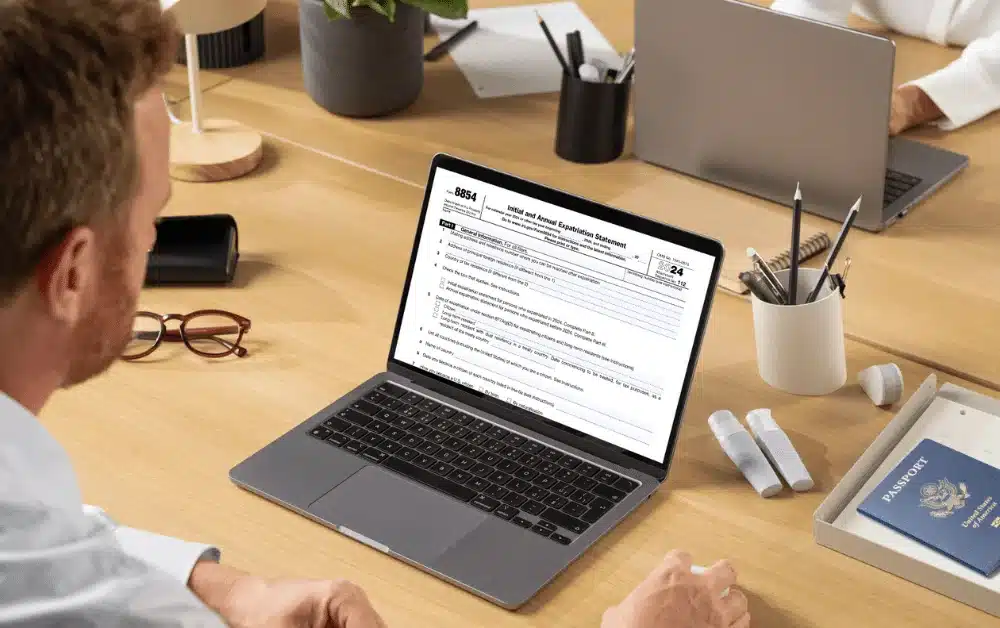
March 2026 Update: The U.S. State Department reduced the fee for renouncing U.S. citizenship from $2,350 to $450, effective April 13, 2026. This 80% reduction ends a six-year legal battle by Americans abroad. The new fee applies to appointments on or after April 13, 2026. All other requirements, including the exit tax, covered expatriate tests, Form 8854, and five-year compliance certification, are unchanged.
Where Should I Retire Abroad for the Best Tax Treatment?
Choosing where to retire abroad depends on your priorities, including the cost of living, healthcare quality, tax rates, climate, and cultural fit. Here’s how popular destinations compare:
Tax-Free and Low-Tax Countries
Our comprehensive guide to 15 tax-free retirement countries covers the best options, including:
- Panama offers territorial taxation (no tax on foreign income) and the Pensionado visa, requiring only $1,000 monthly pension income. Monthly costs range from $2,000 to $3,000. Your Social Security, pensions, and retirement withdrawals remain completely tax-free in Panama. Most retirees owe $0 in U.S. taxes after applying the standard deduction.
- Costa Rica offers the Pensionado Program, which requires a monthly pension income of $1,000. The country doesn’t tax foreign-sourced income, meaning that your Social Security and U.S. pensions are exempt from Costa Rican taxation. Healthcare ranks #1 in Latin America, with the CAJA national system costing $40-$80 monthly. Monthly costs average $2,800 to $3,500.
- Greece established a special tax program, offering a flat 7% tax on all foreign income for a period of 15 years. The program requires a monthly income of € 3,500 and provides one of Europe’s most favorable tax regimes for retirees.
European Retirement Destinations
- Portugal attracts retirees with its D7 Passive Income Visa, mild climate, and safety rankings. The Non-Habitual Resident tax regime can provide significant tax benefits on foreign pension income. Monthly costs range from $2,500 to $3,500.
- Spain offers the Non-Lucrative Visa, which requires an annual income of € 28,800. Cities like Valencia, Alicante, and Málaga offer over 300 days of sunshine, world-class healthcare, and monthly costs ranging from $2,500 to $4,000. The U.S.-Spain tax treaty often eliminates double taxation on retirement income.
- France provides retiree residency options with access to world-class healthcare. The U.S.-France tax treaty stipulates that U.S.-source pensions are taxable only in the U.S., thereby eliminating double taxation. Monthly costs vary widely, ranging from $2,500 in rural areas to over $ 5,000 in Paris.
- Italy offers the Elective Residency Visa, which requires an annual income of € 32,000 (€38,000 for couples). Southern Italy and smaller towns provide exceptional value at $2,000-$3,000 per month, while cities like Rome and Milan tend to be more expensive.
Latin American Retirement Hubs
Mexico remains highly popular for its proximity to the U.S. and affordability. The Temporary Resident Visa is ideal for retirees, with monthly costs ranging from $2,000 to $3,500. Popular retirement areas include San Miguel de Allende, Lake Chapala, Puerto Vallarta, and Mérida. Mexico’s territorial tax system means that foreign-sourced income typically avoids taxation in Mexico.
Canadian Pensions for U.S. Citizens
If you’ve worked in Canada, you may be eligible for the Canada Pension Plan (CPP) and Old Age Security (OAS). The U.S.-Canada treaty specifies that Canadian social security benefits paid to U.S. residents are taxed only in the United States. Learn about Canadian pension taxation and how these coordinate with U.S. tax obligations.
What If I’m Behind on Filing My Retirement Taxes?
Many expat retirees discover their filing obligation years after they have moved abroad. The IRS provides a penalty-free way to catch up:
Streamlined Filing Compliance Procedures
- File the last 3 years of tax returns
- File the previous 6 years of FBARs
- Self-certify your failure to file was non-willful
- Generally, there are no penalties if you qualify
Learn more about streamlined filing
Example: Helen retired to Italy in 2018 and never filed U.S. taxes. In 2026, she discovers her obligation. She uses streamlined procedures to file returns for 2023, 2024, and 2025 (the last three years), as well as FBARs for 2020-2025 (the previous six years). She avoids all penalties.
Don’t wait. The longer you delay, the more complicated it becomes to catch up. Our late tax filing services can help you get back on track.
Retiring Abroad Means Peace of Mind with Greenback
If you are a retiree living abroad or planning to retire overseas, Greenback’s team of CPAs and Enrolled Agents has extensive experience with foreign pensions, Social Security treaty benefits, and retirement account reporting. Learn more about how we help retirees abroad.
If you’re ready to be matched with a Greenback accountant, click the Get Started button below.
Enjoy retirement abroad with confidence in your U.S. taxes.
This article is intended for informational purposes only and does not constitute legal or tax advice. Tax situations vary significantly based on individual circumstances, and it is recommended that you contact our Customer Champions.
Frequently Asked Tax Questions for Retirees Abroad
Possibly. You need U.S.-earned income to contribute, which most retirees don’t have. However, if you work part-time or consult, you may still contribute up to $7,000 ($8,000 if age 50 or older) for the 2025 tax year, or $7,500 ($8,600 if age 50 or older) for 2026.
Report all worldwide income on your U.S. return. Use Form 1116 to claim Foreign Tax Credits for each country’s taxes. Our team at Greenback handles multi-country situations regularly.
Keep them. Your U.S. brokerage accounts, mutual funds, and stocks remain accessible. Report all investment income and pay any required taxes, using the Foreign Tax Credit for taxes paid abroad.
Typically, most treaties reduce withholding taxes on dividends and interest, although rates vary by country. Your CPA can help you claim the correct treaty rates.
Medicare generally doesn’t cover healthcare outside the U.S., except in limited emergency situations near borders. Most retirees maintain Medicare Part A (premium-free if you paid Medicare taxes) and enroll in local healthcare or international insurance. Some return to the U.S. for major procedures to use Medicare benefits.
Yes. There is no restriction on collecting both. The Windfall Elimination Provision (WEP), which previously reduced Social Security benefits for people who also received a pension from work not covered by Social Security, was repealed in January 2025 under the Social Security Fairness Act. As of July 2025, the SSA has completed sending over 3.1 million payments totaling $17 billion to affected beneficiaries. If you previously had your benefits reduced by WEP, your monthly amount should already reflect the increase.
You can return anytime. Your Social Security and U.S. retirement accounts remain accessible. You’ll need to reestablish state residency and may need to update your Medicare status. The transition is straightforward from a tax perspective.
For tax years 2025 through 2028, taxpayers age 65 and older can claim an additional deduction of up to $6,000 per qualifying individual ($12,000 for joint filers where both qualify). The deduction phases out at a rate of 6% for every dollar of modified AGI over $75,000 ($150,000 for joint filers). This is on top of the existing additional standard deduction for seniors.
Related Resources
Core Retirement Tax Guides
- U.S. Expat Taxes: Complete Overview
- Social Security for U.S. Citizens Living Abroad
- Foreign Pension Reporting for U.S. Taxpayers
- Moving Your Retirement Account Overseas
- Foreign Tax Credit: Avoiding Double Taxation
- Coordinating U.S. Social Security and Foreign Pensions
Reporting Requirements
- FBAR Filing: Complete Guide
- FATCA Form 8938: When and How to File
- U.S. Tax Treaties: How They Work
- U.S. State Taxes for Expats
Country-Specific Retirement Guides
- 15 Best Tax-Free Retirement Countries
- Retiring in Panama: Pensionado Visa Guide
- How to Retire in Costa Rica
- Retiring in Portugal: D7 Visa
- Retiring in Spain: Complete Guide
- How to Retire in Italy
- Retiring in France for Americans
- Retire in Mexico: Tax and Visa Guide
Canadian Pension Resources


Featured In





