Value-Added Tax (VAT): What It Means, How It Works and Who Charges It

- What Is VAT and How Does It Work?
- How Is VAT Different From U.S. Sales Tax?
- Which Countries Have VAT?
- Can You Get a VAT Refund as an American Abroad?
- Does Foreign VAT Count on Your U.S. Tax Return?
- Do Freelancers and Businesses Abroad Have to Charge VAT?
- Frequently Asked Questions about VAT
- VAT Raises Prices Abroad but Rarely Changes Your U.S. Return


VAT, which stands for value-added tax, is a consumption tax charged at each stage of production and sale, with the final buyer bearing the cost. 175 countries and territories had a VAT as of July 2024. The United States is the only OECD member country without one. Standard rates among OECD countries run from 5% to 27%.
If you’re an American living, working, or traveling abroad, VAT is built into the price of almost everything you buy. VAT is not an income tax, so it can’t be claimed as a Foreign Tax Credit on your U.S. return, although VAT paid as part of a business expense can be deductible. Freelancers and business owners who sell to customers abroad may also have to register for VAT. This guide covers how VAT works, which countries charge it and what it’s called there, when you can get it refunded, and how it affects your U.S. taxes. For VAT in Britain specifically, see our guide to UK VAT for Americans.
What Is VAT and How Does It Work?
VAT is a tax on the value added at each step of a sale. Each business charges VAT on its sales (output VAT), subtracts the VAT it paid on its purchases (input VAT), and sends the difference to the government. The full tax is reflected in the final price, so consumers bear the cost and businesses act as collectors.
How VAT Is Collected Along a Supply Chain
Take a table made in Portugal, where the mainland standard rate (called IVA) is 23%:
| Stage | Sale price before VAT | VAT charged (23%) | VAT the seller sends to the government |
|---|---|---|---|
| Timber supplier sells wood to a furniture maker | €200 | €46 | €46 |
| Furniture maker sells the table to a shop | €500 | €115 | €69 (€115 minus €46 already paid) |
| Shop sells the table to you | €800 | €184 | €69 (€184 minus €115 already paid) |
| Total sent to the government | €184 |
The government collects €184, which is 23% of the final price of € 800. You pay €984 at the register, and each business recovers the VAT it paid on its own purchases.

Living Abroad? Know What Counts on Your U.S. Return
How Is VAT Different From U.S. Sales Tax?
U.S. sales tax is collected once, at the final retail sale, while VAT is collected at every stage of production and sale. In the U.S., sales taxes are set and collected by states and localities, and there is no federal sales tax or VAT. In the EU, the price you see on the shelf must already include VAT.
| Feature | VAT | U.S. sales tax |
|---|---|---|
| When it’s collected | At every stage of production and sale | Once, at the final retail sale |
| Who sets the rate | Usually the national government | States and localities |
| Shelf price | In the EU, the displayed price includes VAT | Usually added at checkout |
| Typical standard rate | 5% to 27% among OECD countries | Varies by state and locality |
Why the U.S. Has No VAT
The U.S. taxes consumption at the state and local levels rather than nationally. The OECD’s Consumption Tax Trends 2024 report notes that all OECD countries levy VAT except the United States, “where sales taxes are levied at sub-national level.” For a side-by-side look at British VAT and U.S. sales tax, see our UK vs. U.S. taxes comparison.
Which Countries Have VAT?
Most countries have a VAT: 175 countries and territories as of July 2024, according to the OECD. That includes every EU country, the UK, Canada, Mexico, Australia, and Japan. The United States, Hong Kong, Qatar, Bermuda, and Malaysia are among the places without one. These lists cover the countries where Americans most often live and travel.
EU Countries and Their Standard VAT Rates
All 27 EU countries charge VAT, and EU rules set the standard rate at no less than 15%. VAT in Europe tops out in Hungary, where the 27% rate is the highest standard rate in the EU and the OECD. These rates are from the European Commission as of July 2026; lower reduced rates apply to some goods and services.
| Country | Standard rate | Country | Standard rate |
|---|---|---|---|
| Austria | 20% | Italy | 22% |
| Belgium | 21% | Latvia | 21% |
| Bulgaria | 20% | Lithuania | 21% |
| Croatia | 25% | Luxembourg | 17% |
| Cyprus | 19% | Malta | 18% |
| Czechia | 21% | Netherlands | 21% |
| Denmark | 25% | Poland | 23% |
| Estonia | 24% | Portugal (mainland) | 23% |
| Finland | 25.5% | Romania | 21% |
| France | 20% | Slovakia | 23% |
| Germany | 19% | Slovenia | 22% |
| Greece | 24% | Spain | 21% |
| Hungary | 27% | Sweden | 25% |
| Ireland | 23% |
If you live in one of these countries, our country guides for Spain and Portugal cover everything you need to know about living and moving there.
VAT Rates in Other Countries Where Americans Live
Outside the EU, VAT goes by several names, but it works the same way. Each rate comes from that country’s tax authority and was checked in November 2026.
| Country | Standard rate | Country | Standard rate |
|---|---|---|---|
| United Kingdom | 20% | Australia | 10% |
| Switzerland | 8.1% | New Zealand | 15% |
| Norway | 25% | Japan | 10% (8% reduced rate on food) |
| Canada | 5% GST; 13% to 15% combined HST | Singapore | 9% |
| Mexico | 16% | United Arab Emirates | 5% |
| Costa Rica | 13% | Saudi Arabia | 15% |
| Colombia | 19% | South Africa | 15% |
| Chile | 19% |
Some Canadian provinces add their own sales tax to the 5% GST; our Canada vs. U.S. taxes comparison shows how they combine.
What VAT Is Called in Other Countries
GST (goods and services tax) is the same kind of tax as VAT under a different name and is used in Canada, Australia, New Zealand, and Singapore. Spain, Italy, Portugal, Mexico, Costa Rica, Colombia, and Chile call it IVA. France calls it TVA, Germany calls it Umsatzsteuer, the Netherlands calls it btw, Hungary calls it ÁFA, Norway calls it merverdiavgift, and Japan calls it the consumption tax.
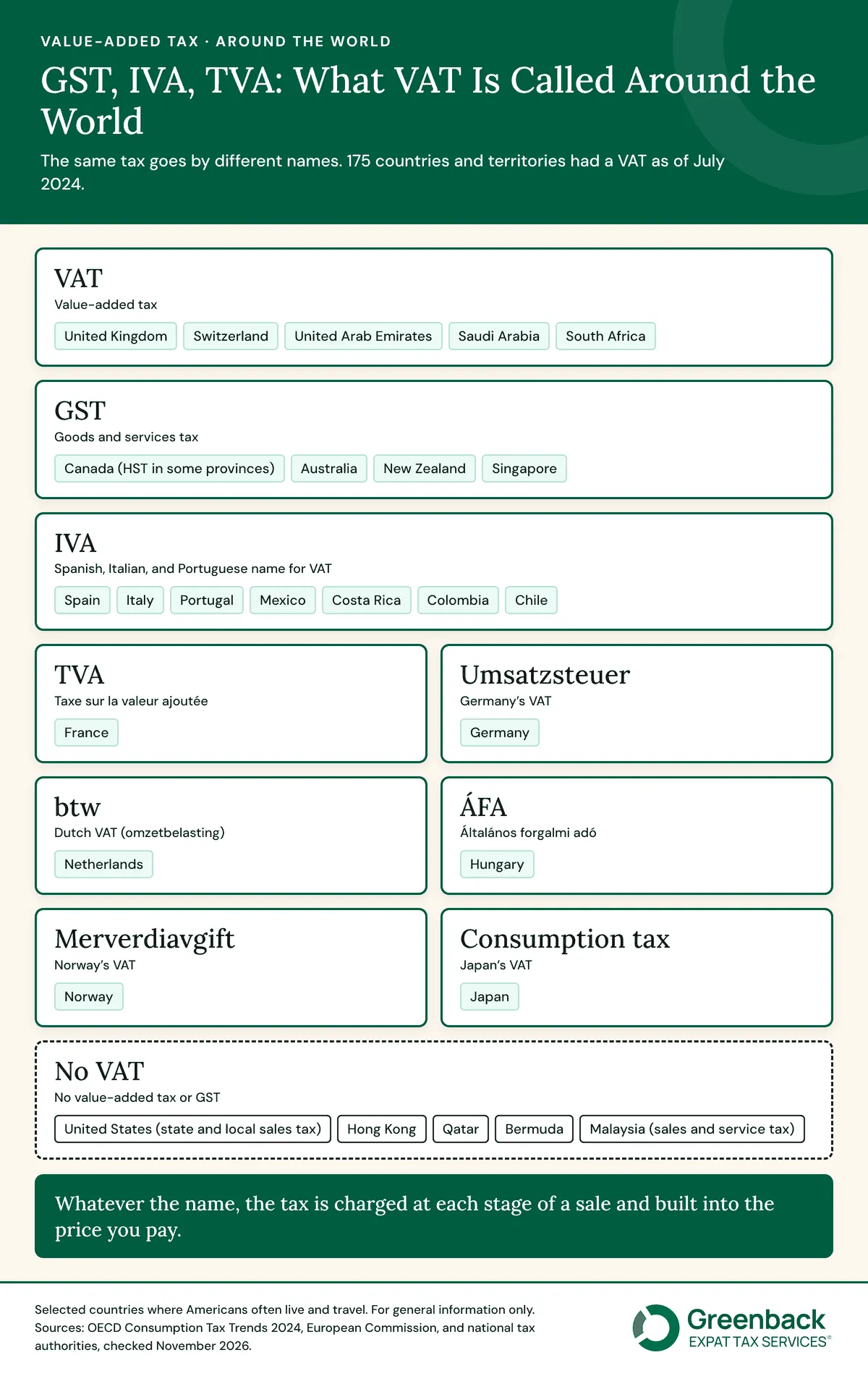
Countries Without VAT
The United States, Hong Kong, Qatar, Bermuda, and Malaysia have no VAT. Some of these places use a different consumption tax.
- United States: No federal VAT; sales taxes are set by states and localities, as the OECD notes.
- Hong Kong: No sales tax or VAT.
- Qatar: The General Tax Authority’s list of Qatar’s taxes includes no VAT; excise tax applies to goods such as tobacco and sweetened drinks.
- Bermuda: The government’s list of Bermuda’s taxes includes payroll tax and land tax, and no VAT.
- Malaysia: No VAT; it uses a single-stage sales tax and a service tax (SST), which replaced its GST.
A country with no income tax can still charge VAT, so it’s worth checking both. See our guide to countries with no income tax and our list of countries with the best tax rates for more options.
Can You Get a VAT Refund as an American Abroad?
Often, if you’re visiting and live elsewhere. VAT refunds for visitors depend on where you live, not on your passport. In the EU, only people who live outside the EU can claim back VAT on goods they take home. If you’re a U.S. citizen living in any EU country, visitor refunds aren’t available to you anywhere in the EU.
How EU VAT Refunds Work for Visitors
Under the EU’s rules, as summarized on the European Commission’s Your Europe site:
- Shop at a participating store and ask for the refund paperwork. Some countries set a minimum purchase amount.
- Take the goods out of the EU within 3 months of buying them.
- Show the goods and the refund documents to customs when you leave the EU, so customs can validate the claim (on paper or digitally).
- Claim the refund through the store or its refund service.
The claim and refund process isn’t harmonized across the EU, so the details vary by country.
Refunds in the UK and Other Countries
Great Britain (England, Scotland, and Wales) no longer offers tax-free shopping for visitors; it ended in 2021. Northern Ireland still runs a refund scheme for overseas visitors, which the UK VAT guide covers. Outside Europe, each country sets its own visitor refund rules, so check with the country’s tax or customs authority before you shop.
Does Foreign VAT Count on Your U.S. Tax Return?
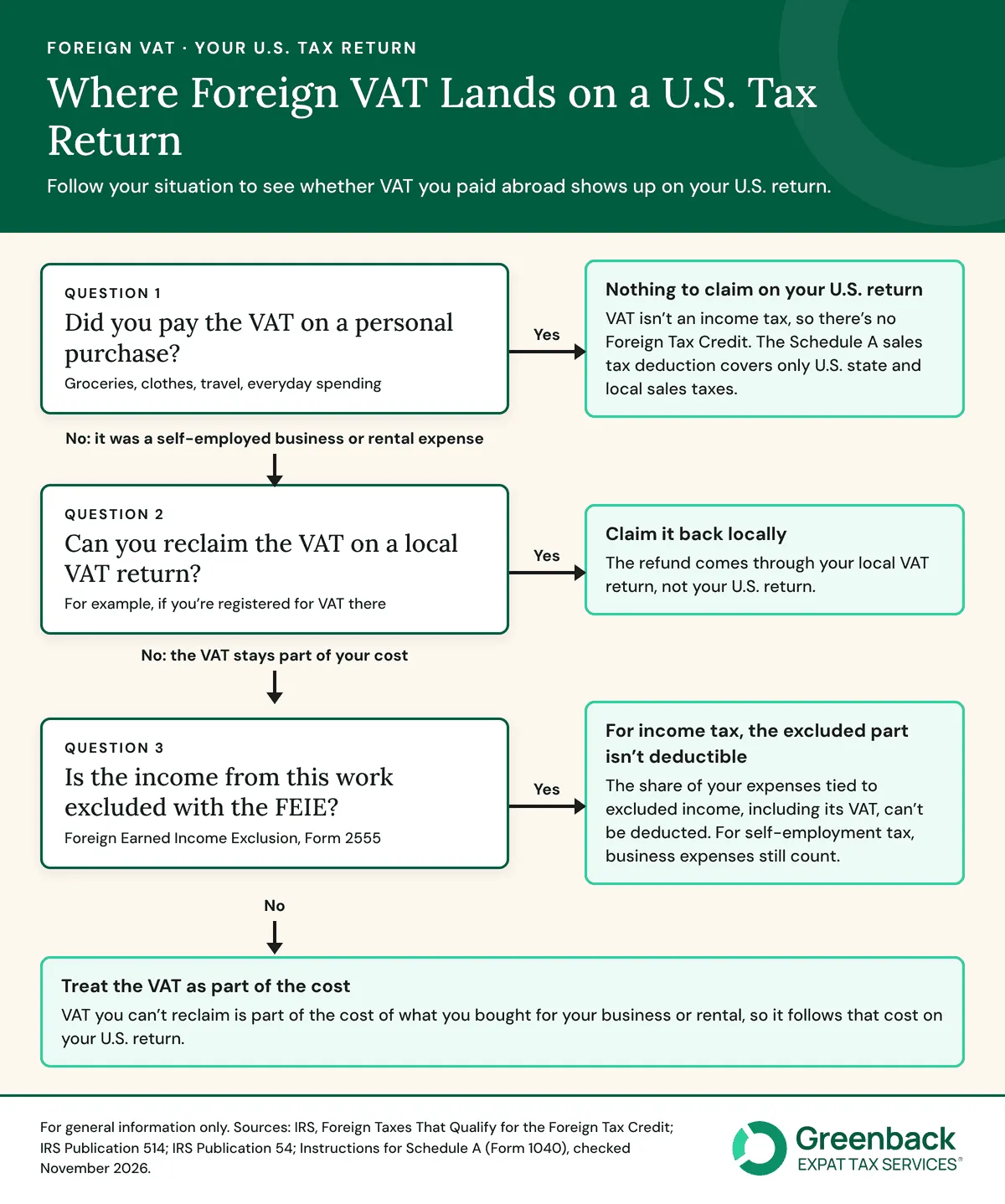
No, foreign VAT on personal purchases doesn’t count on your U.S. return. It isn’t an income tax, so it doesn’t qualify for the Foreign Tax Credit, and the Schedule A sales tax deduction covers only state and local sales taxes. VAT you can’t reclaim on a business or rental expense is different: it’s treated as part of that cost.
VAT on Personal Purchases
Only foreign income taxes qualify for the Foreign Tax Credit. The IRS limits the credit to income, war profits, and excess profits taxes, so VAT on groceries, clothes, or travel doesn’t qualify. The itemized deduction for general sales taxes on Schedule A is limited to state and local sales taxes, which excludes foreign VAT as well.
VAT on Business and Rental Expenses
Foreign taxes that aren’t income taxes can still be deductible when they’re part of a trade or business expense or an expense of producing income, according to Publication 514. So if you’re self-employed abroad and pay VAT on supplies that you can’t reclaim, that VAT is part of the cost of the supplies you deduct. If you’re registered for VAT locally and claim it back on your local VAT return, that refund happens there, outside your U.S. return. Our FAQ on whether foreign business expenses are deductible covers the broader rules.
When You Use the Foreign Earned Income Exclusion
For income tax purposes, the portion of your expenses tied to excluded income can’t be deducted. If you use the Foreign Earned Income Exclusion, Publication 54 bars deductions for items related to the excluded income, including the VAT built into those expenses. Self-employment tax works differently: Publication 54 counts all of your self-employment income, even excluded income, so your business expenses still reduce your net earnings for self-employment tax.
Do Freelancers and Businesses Abroad Have to Charge VAT?
It depends on where you’re based and who your customers are. If you live and freelance in a VAT country, that country’s registration rules apply to you. If you sell to customers in a country where you’re not based, some countries require registration with no threshold. VAT is separate from your U.S. income tax.
Freelancing While Living Abroad
Each country sets its own VAT registration rules for local businesses. Spain and Portugal both call the tax IVA, and each has its own rules for freelancers. For the local side, read our guides to being self-employed in Spain and working in Portugal.
Selling to Customers in Another Country
Businesses not based in a country can be subject to VAT registration there from their first sale. In the UK, the registration threshold doesn’t apply to businesses not established there, though you may not need to register if you sell only to VAT-registered UK businesses that account for the VAT themselves, according to HMRC. In the EU, businesses based outside the EU that sell services to EU consumers can report VAT for every member state through the non-Union One Stop Shop, charging each customer at the local rate.
Greenback prepares U.S. tax returns and UK Self Assessment returns, but not VAT registrations or VAT returns. If you’re a digital nomad with clients in several countries, VAT is handled on a country-by-country basis, and your U.S. return is a separate filing.
There Is No U.S. VAT Number
The U.S. has no VAT, so there is no U.S. VAT number. A VAT number is issued by a country with a VAT to businesses registered there. An EIN (Employer Identification Number) is a different thing: a U.S. federal tax ID from the IRS. If a foreign client or platform asks for your VAT number and you aren’t registered for VAT anywhere, you don’t have one to give.
Frequently Asked Questions about VAT
No, the United States has no value-added tax. It is the only OECD member country without one. Sales taxes in the U.S. are set and collected by states and localities, and there is no federal sales tax.
Yes, GST (goods and services tax) is the same kind of tax as VAT. Countries such as Canada, Australia, New Zealand, and Singapore call their VAT a GST. It is charged at each stage of production and sale and built into the final price.
Among EU and OECD countries, Hungary has the highest standard VAT rate, at 27%. Finland follows at 25.5%, then Croatia, Denmark, Norway, and Sweden at 25%.
The final consumer pays VAT. Businesses charge VAT on their sales and reclaim the VAT on their purchases, so they act as collectors, and the full tax ends up in the price the consumer pays.
Yes, Canada has a VAT-style tax called the Goods and Services Tax (GST). The federal GST is 5%, and some provinces combine it with their provincial tax into a harmonized sales tax (HST) of 13% to 15%.
VAT Raises Prices Abroad but Rarely Changes Your U.S. Return
For most Americans abroad, VAT is simply part of the cost of living and never appears on the U.S. return. It doesn’t qualify for the Foreign Tax Credit or the sales tax deduction. It matters mainly when it’s part of a business or rental expense, or when you sell in a VAT country.
If you’re a digital nomad, Greenback prepares U.S. returns that fit income earned across borders. Learn more about how we help digital nomads.
If you’re a self-employed expat or business owner abroad, Greenback reports your foreign business income and expenses, including the VAT built into them, on your U.S. return. Learn more about how we help self-employed expats and foreign business owners.

Expert Help for Americans Abroad
This article is for general information only. VAT rates and rules change and differ by country, so confirm current rules with the relevant tax authority or a local accountant.


Featured In




