Self-Employed in Spain as an American: Autónomo Registration and Taxes

- Self-Employed in Spain at a Glance
- Can Americans Be Self-Employed in Spain?
- How Do You Become an Autónomo in Spain?
- How Much Does It Cost to Be Self-Employed in Spain?
- How Much Tax Do You Pay as Self-Employed in Spain?
- Do Americans in Spain Still Pay U.S. Self-Employment Tax?
- How Does Spanish Income Tax Show Up on Your U.S. Return?
- What Is Spain's Corporate Tax Rate?
- Frequently Asked Questions About Being Self-Employed in Spain
- How Greenback Helps Self-Employed Americans in Spain

Americans can be self-employed in Spain once their residence status allows it. You register as an autónomo, Spain’s term for a self-employed worker, with the tax agency and with social security, then pay a monthly social security quota of about €206 to €607 at the minimum bases for your income band, or about €89 in your first year. Spanish income tax and IVA (Spanish VAT) are paid through quarterly returns, even if every client is in the U.S.
As an American, you still file a U.S. return each year. The U.S.-Spain totalization agreement puts self-employed residents of Spain in the Spanish system, and a Spanish certificate of coverage keeps you out of the 15.3% U.S. self-employment tax, so you pay social security in one country. For visas, healthcare, and daily life in Spain, start with the living in Spain hub.
Self-Employed in Spain at a Glance
| Question | Answer |
|---|---|
| Can Americans be self-employed in Spain? | Yes, with a residence status that allows self-employment, such as a self-employment authorization or the Digital Nomad Visa. |
| How do you become an autónomo? | Register with the tax agency on Modelo 036 and with social security (RETA) before your first invoice. |
| How much does it cost to be self-employed in Spain? | About €206 to €607 a month in social security at the minimum bases, or about €89 a month in your first year. |
| How much tax do self-employed people pay in Spain? | State plus regional income tax. In Valencia, rates run from 18.3% to 53.85%; on €36,000 of net income, that is about €5,630. |
| Do Americans in Spain still pay U.S. self-employment tax? | No, once a Spanish certificate of coverage is attached to the U.S. return. |
| What is Spain’s corporate tax rate? | 25%, with 19% and 21% for micro companies in 2026, falling to 17% and 20% in 2027. |
Can Americans Be Self-Employed in Spain?
Self-employment is available to Americans in Spain whose residency status permits it, provided they register as autónomos before starting work. An autónomo is anyone in Spain who works for themselves on a regular basis: a freelancer, consultant, sole trader, or contractor who invoices clients directly. A freelancer in Spain is an autónomo under Spanish law, and your obligations begin with your first regular invoice, regardless of where your clients are.
Two things come before registration:
- The right to work for yourself: your residence status has to allow self-employment. Americans usually hold a residence and self-employment authorization, which requires an approved business plan, or the Digital Nomad Visa, which allows freelance work for clients mostly outside Spain. Each visa route should be compared when moving to Spain.
- Tax residency: Spain counts you as a tax resident after more than 183 days in the country in a calendar year, or if Spain is the base of your business and economic interests. Residents pay Spanish income tax on worldwide income.
How Do You Become an Autónomo in Spain?
You become an autónomo by registering in three places before your first invoice, then starting a quarterly filing routine.
1. Get Your NIE
The NIE is your foreigner identification number and your tax number in Spain, and every registration form asks for it. If you do not have one yet, our guide to the NIE number explains how Americans apply for one, either at a U.S. consulate or in Spain.
2. Register With the Tax Agency (Modelo 036)
You file Modelo 036 with the Agencia Tributaria (AEAT) before you start working. The form records your activity code, start date, IVA regime, and how you will calculate income tax, which, for most freelancers, is the simplified direct method. Since February 2025, Modelo 036 is the only form for this step.
3. Join Spanish Social Security (RETA)
Next, you register as an autónomo through Import@ss, the social security portal, in the special scheme for the self-employed, known as RETA. You can do this up to 60 days ahead and no later than the day you start. You give a bank account for the monthly direct debit and your estimated net income, which sets your band. Ask for the tarifa plana, the reduced first-year rate, as part of this registration.
Your First Quarterly Filings
Your first Modelo 130 and Modelo 303 are due by the 20th of the month after your first quarter ends. If you register in March, that means 20 April. Both are filed online, even for a quarter with no income.
How Much Does It Cost to Be Self-Employed in Spain?
Being self-employed in Spain costs about €206 to €607 a month in social security at the minimum bases, or about €89 a month in your first year, before income tax. Autónomos pay 31.5% of a monthly contribution base, and the minimum base rises with your expected net income. You can choose a higher base within your band, which raises your future Spanish pension and sick pay.
| Monthly net income | Minimum monthly quota |
|---|---|
| Up to €670 | €205.88 |
| €1,166.70 to €1,300 | €299.56 |
| €1,700 to €1,850 | €360.29 |
| €2,760 to €3,190 | €452.94 |
| €3,620 to €4,050 | €504.41 |
| Over €6,000 | €607.35 |
Six of Spain’s 15 bands are shown. Spain kept its 2025 bands for 2026 (in the Seguridad Social band table). Spain has not set 2027 bands yet and has carried the same bands forward since 2025, so these figures are a reasonable estimate for 2027 planning.
- The first-year rate: new autónomos pay €80 per month for their first 12 months, plus the 0.9% intergenerational equity surcharge (MEI), for a total of about €89. If your net income in that first year stays below Spain’s annual minimum wage, a second 12-month period at the reduced rate follows. You qualify if you have not been registered as self-employed in the past two years.
- Why €80 still applies in 2026: Spain’s law fixed €80 for 2023 to 2025 and left later years to a national budget. No new budget has passed, and Seguridad Social continues to charge €80, so confirm the amount when you register.
- Net income for your band: your income after business expenses, less a further 7% general deduction.
- Changing bands: you can switch up to six times a year as your income changes.
- The year-end adjustment: once the tax agency has your actual income for the year, Social Security recalculates your contributions and refunds or bills the difference.
- What it covers: public healthcare, sick pay, a Spanish retirement pension, and cese de actividad, the autónomo version of unemployment benefit.
- Returning to work after a child: mothers who return to self-employment within 2 years of having a child receive an 80% reduction in the main contribution for 24 months.
How Much Tax Do You Pay as Self-Employed in Spain?
Self-employed residents of Spain pay income tax (IRPF) on their net profit at a state rate plus a regional rate. In Valencia, the combined rate runs from 18.3% on the first slice of taxable income to 53.85% at the top. On €36,000 of net income, which comes to about €5,630 a year, Emily’s example shows the full calculation. The rates and regional scales are in Spain tax brackets.
The Quarterly and Annual Returns Autónomos File
Income tax is paid in quarterly advances and settled on the annual Renta, and IVA is declared every quarter.
| Filing | What it covers | When |
|---|---|---|
| Modelo 130 | Quarterly income tax advance: 20% of your net profit for the year so far, less earlier payments | 1 to 20 April, July, and October; 1 to 30 January |
| Modelo 303 | Quarterly IVA return | Same dates |
| Modelo 390 | Annual IVA summary return | 1 to 30 January |
| Modelo 100 | Annual income tax return, the Renta | April to 30 June |
- Withholding on Spanish invoices: Spanish business clients withhold 15% income tax from your invoices, or 7% in your first year and the two years after. If at least 70% of your income has had tax withheld, you skip Modelo 130. Clients in the U.S. do not withhold Spanish tax, so most Americans with U.S. clients file Modelo 130 every quarter.
- IVA for clients in different places:
- Spanish clients: You charge 21% on most services.
- Business clients elsewhere in the EU: you invoice without IVA under the reverse charge and report the sale on Modelo 349, the summary of EU sales.
- Business clients outside the EU, including U.S. companies: services are generally outside the scope of Spanish IVA, though a few types, such as services tied to property in Spain, are exceptions.
- A freelancer who bills only U.S. companies often charges no IVA at all but still files Modelo 303.
- Expenses: you deduct business costs such as software, equipment, coworking, and professional fees, plus your social security quotas. Under the simplified method, a further 5% of net income covers costs that are hard to document, up to €2,000 a year.
Do Americans in Spain Still Pay U.S. Self-Employment Tax?
Americans in Spain do not pay U.S. self-employment tax once they hold a Spanish certificate of coverage. The U.S.-Spain totalization agreement assigns self-employed people living in Spain to Spanish social security, and the certificate is the document that proves this to the IRS. The U.S. has similar totalization agreements with 30 other countries.
- How to get the certificate: once you are registered with RETA, write to the provincial office of Spain’s Social Security Treasury (TGSS) in the province where you run your business. The letter provides your personal details, both Social Security numbers, your job, when it runs, and your business address in each country.
- How it shows on your U.S. return: attach a copy of the certificate to Form 1040, skip Schedule SE, and on Schedule 2, line 4, check box 3 and write “Exempt, see attached statement,” as the IRS Schedule SE instructions direct.
- The FEIE does not cover this: the foreign earned income exclusion, $132,900 for 2026, lowers income tax only. Without a certificate, the self-employment tax of 15.3% applies to net earnings of $400 or more, even when you owe no U.S. income tax.
- The first-year rate applies: paying the €80 tarifa plana still counts as membership in RETA, so you can request the certificate in your first year.
- The exception: if you were already self-employed in the U.S. and moved that business to Spain for a stay of up to five years, you remain in the U.S. system and keep paying U.S. self-employment tax. How that plays out in a visa application is outlined on the Digital Nomad Visa page.
How Does Spanish Income Tax Show Up on Your U.S. Return?
Your freelance income is reported on Schedule C in dollars, and the Spanish income tax you pay usually offsets the U.S. income tax on the same profit through the foreign tax credit.
- The credit or the exclusion: you can claim the Spanish IRPF on Form 1116 or exclude up to $132,900 of earnings for 2026 with the FEIE. Spain’s rates are usually higher than U.S. rates, so the credit tends to leave little or no U.S. income tax and carries any extra credit forward. The trade-offs are laid out in the FEIE vs. FTC comparison.
- Deadlines: Spain’s annual return is due 30 June, and the U.S. return for Americans living abroad is automatically extended to June 15, with interest on any tax due from April 15.
- Accounts: Spanish bank accounts used for the business count toward the FBAR and Form 8938 thresholds.
Everything else on the U.S. return, from credits to account reporting, is covered on the U.S. expat taxes in Spain page.
Example: What an American Designer in Valencia Pays
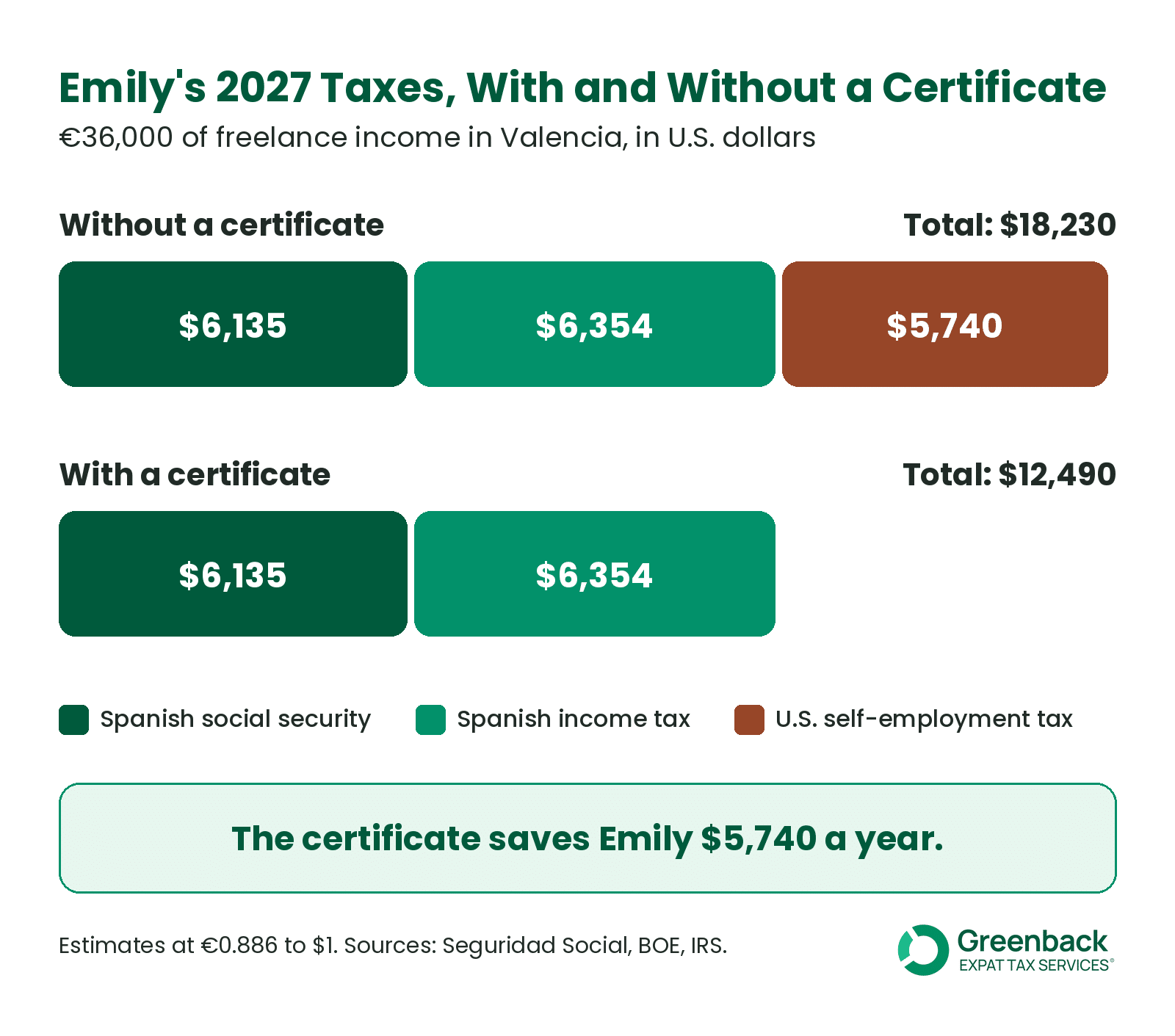
Emily, a graphic designer from Portland, registers as an autónomo in Valencia in January 2026. She bills U.S. agencies and one client in Germany, and expects €36,000 of net income in 2027, her second year.
| 2027 (estimate) | Amount | How it is calculated |
|---|---|---|
| Spanish social security | About €5,435 (about $6,135) | €36,000 less 7% is €2,790 a month, the €2,760 to €3,190 band: €452.94 a month |
| Spanish income tax | About €5,630 (about $6,354) | €36,000 less her quotas and the 5% allowance gives a taxable base of about €29,040, taxed at the state and Valencia scales |
| U.S. income tax | $0 | Her Spanish income tax exceeds the U.S. tax due on that income and is credited on Form 1116 |
| U.S. self-employment tax | $0 | Her Spanish certificate is attached to her return |
| Without the certificate | About $5,740 more | 15.3% U.S. tax on $40,630 of net earnings |
In 2026, her first year, the tarifa plana keeps her social security to about €89 a month, about €1,064 for the year. In 2027, her Spanish total is about €11,065, roughly 31% of her net income, and she pays nothing extra to the U.S. The certificate saves her about $5,740 of U.S. self-employment tax in 2027. The figures assume Spain keeps its current social security bands and 2026 income tax scales (Valencia lowers its scale slightly for 2027). Dollar amounts are illustrative, converted at the IRS’s average exchange rate for 2025 (€0.886 per $1).
What Is Spain’s Corporate Tax Rate?
Spain’s corporate tax rate is 25%, with lower 2026 rates of 19% and 21% for micro companies, 23% for small companies, and 15% for new companies. The rate applies to a Sociedad Limitada (SL), Spain’s limited company, which pays corporate tax on its profit in place of the income tax an autónomo pays personally.
| Company type | 2026 | 2027 |
|---|---|---|
| General rate | 25% | 25% |
| Micro company, turnover under €1 million | 19% on the first €50,000, 21% above | 17% on the first €50,000, 20% above |
| Small company, turnover under €10 million | 23% | 22% |
| New company, first profitable year and the next | 15% | 15% |
Ley 7/2024 already sets the 2027 rates (AEAT corporate tax rates), and the small-company rate falls to 21% in 2028.
Should You Work as an Autónomo or Set Up an SL?
Most freelancers start as autónomos, because there is no company to form, no company accounts to file, and no second set of returns. An SL can make sense when profit grows well beyond what you take out to live on, since retained profit is taxed at the company rate. Dividends you take out are then taxed again in your hands, as savings income at 19% to 30%.
- Social security still applies: an SL owner who controls and runs the company usually stays in RETA as an autónomo societario.
- Limited liability: an SL limits your personal liability for business debts, whereas an autónomo does not.
The U.S. Side of Owning a Spanish SL
A Spanish SL owned by an American is a foreign corporation for U.S. tax purposes by default, and that brings its own filings:
- Form 5471 every year: U.S. persons who own 10% or more of a foreign company generally file Form 5471 with their return. The IRS penalty for failing to file it starts at $10,000 per company per year.
- U.S. tax before you take money out: an SL that is more than 50% owned by U.S. shareholders is a controlled foreign corporation. Its profit can be taxed on your U.S. return each year under the rules formerly called GILTI, now called net CFC tested income, starting in 2026, even if the company pays you nothing.
- The high-tax exclusion: an election can exclude company profits taxed in Spain at an effective rate above 18.9%, which is 90% of the U.S. corporate rate. Spain’s 25% general rate clears that line. The 17% micro rate from 2027 may not, so a small SL can owe U.S. tax that a larger one does not.
- Classification choice: an SL is missing from the IRS list of foreign companies that are always treated as corporations, so you can elect on Form 8832 to have the U.S. treat it differently. That choice changes which forms you file and how the profit is taxed, so make it with your U.S. preparer when you form the company.
Frequently Asked Questions About Being Self-Employed in Spain
The tarifa plana lasts for 12 months from the date of your registration as an autónomo, at €80 per month plus the MEI surcharge. When first-year net income falls below the annual minimum wage (SMI), the reduced rate applies for another 12 months.
Social security is paid in only one country. Under the U.S.-Spain totalization agreement, self-employed residents of Spain pay into RETA, and a Spanish certificate of coverage exempts them from U.S. self-employment tax.
The Digital Nomad Visa allows freelance work, as long as Spanish clients make up no more than 20% of your work. Freelancers on the visa register as autónomos in the same way, and the Digital Nomad Visa guide covers the visa rules.
A gestor, a Spanish accountant and filing agent, is not required. Many autónomos hire one for the quarterly Modelo 130 and 303 returns and the annual Renta, and the U.S. return then works from the same figures.
How Greenback Helps Self-Employed Americans in Spain
Greenback’s tax team files the U.S. side for Americans working for themselves in Spain, from first-year autónomos to owners of a Spanish SL. We report your freelance income on Schedule C, claim the credit for the Spanish income tax you pay, and attach your Spanish certificate so you skip U.S. self-employment tax. For SL owners, we file Form 5471 and plan the U.S. side of the company before its first profits. We do not register autónomos or prepare Spanish returns; those are handled by your gestor. Learn more about how we help self-employed expats.

Registered as an autónomo? Your U.S. return comes next.
This article is for informational purposes only and does not constitute tax or legal advice. Spanish social security bands and income tax scales are those in force for 2026, 2027 figures are estimates, and what you pay depends on your region, your income and how you set up your business. Speak with a qualified professional about your situation.




Featured In





