How Is Working Remotely Abroad for a U.S. Company Taxed?

- Do Americans Have to Pay U.S. Taxes When Working Abroad?
- Can a Non-U.S. Citizen Work Remotely for a U.S. Company From Another Country?
- Where Do I Pay Taxes If I Work Remotely in Another Country?
- How Does My Employer Handle Payroll When I Work From Abroad?
- Do U.S. Citizens Working Abroad Pay Taxes Twice?
- What Forms Do I File as a Remote Worker Abroad?
- Frequently Asked Questions
- How Greenback Can Help

Working remotely abroad for a U.S. company means up to three layers of tax can apply to the same salary: U.S. federal tax always, host country tax usually, and U.S. state tax sometimes. The Foreign Earned Income Exclusion and the Foreign Tax Credit can bring the U.S. federal bill down to nothing, and the return still has to be filed every year, either way.
Where you physically perform the work decides how the income is treated, not where your employer is based or where you are paid. The exclusion covers up to $130,000 for the 2025 tax year and $132,900 for the 2026 tax year.
- U.S. citizen or Green Card holder working remotely abroad for a U.S. company: you file a U.S. return on worldwide income and reduce it with the Foreign Earned Income Exclusion or the Foreign Tax Credit
- Non-U.S. citizen working remotely from another country for a U.S. company: you may owe no U.S. tax at all if all the work is performed outside the United States, though your employer may still have withholding and reporting duties
- Anyone working remotely abroad: you may owe tax to the country you are physically working in
- Anyone who left a U.S. state without severing residency: that state may still be taxing the same salary, and most states do not recognize the Foreign Earned Income Exclusion
Here is how the tax obligations break down for both U.S. and non-U.S. remote workers, what your employer needs to know, and how to avoid paying taxes twice on the same income.
Do Americans Have to Pay U.S. Taxes When Working Abroad?
Yes. U.S. citizens and green card holders must file a federal tax return and report worldwide income every year, even if they live and work entirely outside the United States. This applies whether your employer is a U.S. company or a foreign one.
Two protections that reduce what you owe:
- Foreign Earned Income Exclusion (FEIE): Exclude up to $130,000 of foreign earned income from U.S. federal tax for the 2025 tax year, rising to $132,900 for 2026. To qualify, you must have a tax home in a foreign country and meet either the physical presence test (330 full days abroad in any 12-month period) or the bona fide residence test (genuine resident of a foreign country for a full tax year). Claim this on Form 2555.
- Foreign Tax Credit (FTC): If you pay income tax to the country where you work, you can claim a dollar-for-dollar credit against your U.S. tax using Form 1116. This is especially valuable in high-tax countries like the UK, Germany, or France, where your foreign tax rate may exceed the U.S. rate.
| Your situation | Best protection | Likely U.S. tax owed |
|---|---|---|
| Earning under the exclusion limit in a low-tax country (UAE, Thailand) | FEIE | $0 |
| Earning under the exclusion limit in a high-tax country (UK, Germany) | FTC, often better, or FEIE | $0 |
| Earning over the exclusion limit in a high-tax country | FEIE and FTC combined | Usually $0, the FTC covers the excess |
| Earning over the exclusion limit in a low-tax country | FEIE plus tax on the excess | Some U.S. tax above the limit |
The exclusion limit is $130,000 for the 2025 tax year and $132,900 for the 2026 tax year.
Example: Rachel, a U.S. citizen, works remotely from Berlin for a San Francisco tech company, earning $120,000. She pays approximately $30,000 in German income tax. She can either exclude her entire salary using the FEIE (owing $0 to the U.S.) or use the Foreign Tax Credit ($30,000 credit against roughly $18,000 in U.S. tax, also owing $0). Her Greenback accountant helps her determine which option provides the best long-term benefit.

Working Remotely Abroad for a U.S. Company?
Can a Non-U.S. Citizen Work Remotely for a U.S. Company From Another Country?
Yes, a non-U.S. citizen can work remotely for a U.S. company from another country. The tax implications depend on where the work is performed and whether the worker has any U.S. tax obligations.
If the non-U.S. citizen performs all work outside the United States:
- The income is generally not subject to U.S. federal income tax because it is not U.S.-source income
- The worker is not required to file a U.S. tax return (unless other U.S.-source income exists)
- The worker owes taxes to the country where they physically perform the work, based on that country’s tax rules
If the non-U.S. citizen occasionally works from within the United States:
- Any income earned while physically in the U.S. becomes U.S.-source income
- The worker may need to file Form 1040-NR (U.S. Nonresident Alien Income Tax Return)
- U.S. tax treaties with their home country may reduce or eliminate withholding on U.S.-source income
- The substantial presence test determines whether extended U.S. visits trigger resident alien status and worldwide income reporting
What the U.S. employer needs to consider:
| Employer Obligation | Details |
|---|---|
| Tax withholding | Generally, no U.S. federal income tax withholding is required if the foreign worker performs all services outside the U.S. and provides a valid Form W-8BEN |
| FICA taxes | Social Security and Medicare taxes may still apply if the worker is a U.S. company employee, unless a totalization agreement with the worker’s country eliminates dual coverage |
| Permanent establishment risk | Having an employee working in a foreign country can create a taxable presence (permanent establishment) for the company in that country |
| Local employment law | Many countries require employers to register, withhold local taxes, and provide benefits once a worker spends significant time there |
Hiring non-U.S. citizens as remote workers is common and legal, but the employer’s obligations vary significantly by country. Many U.S. companies use employer-of-record (EOR) services to manage foreign payroll compliance.
Where Do I Pay Taxes If I Work Remotely in Another Country?
You may owe taxes to multiple jurisdictions, and the three stack rather than replace each other. Federal tax applies always, host country tax usually, state tax sometimes, and the Foreign Earned Income Exclusion only touches the first of the three.
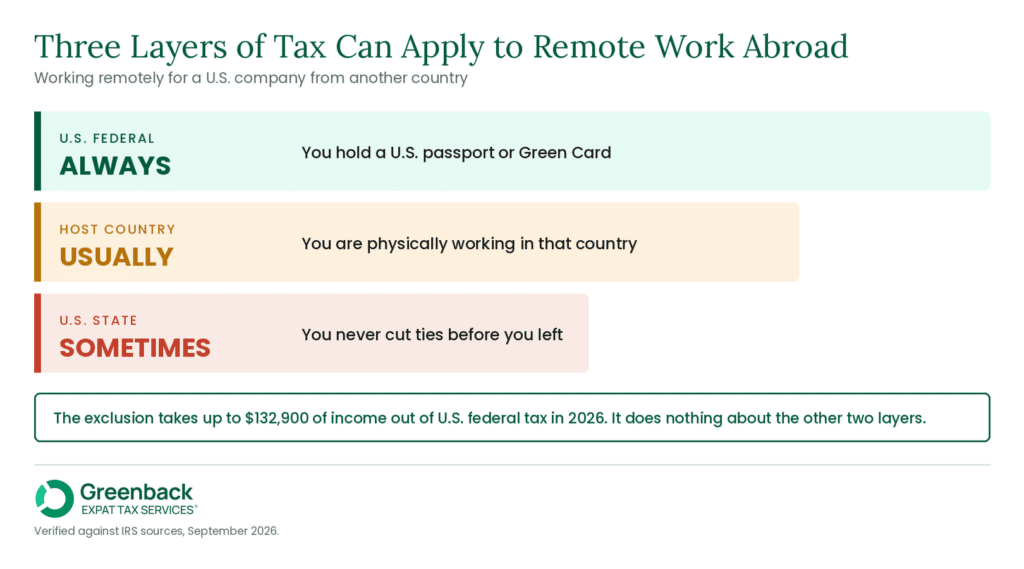
- U.S. federal taxes: If you are a U.S. citizen or green card holder, you owe U.S. taxes on worldwide income regardless of where you work. Use the FEIE or FTC to avoid double taxation.
- Country where you work: Most countries tax income earned within their borders. If you spend more than 183 days in a country, you will almost certainly become a tax resident there and owe local income tax. Some countries with digital nomad visa programs (such as Portugal, Costa Rica, or Thailand) may offer exemptions or reduced rates for remote workers earning foreign-source income.
- State taxes: This is where many remote workers get caught off guard. Moving abroad does not automatically end your state tax obligations. Some states are particularly aggressive about maintaining tax jurisdiction over former residents.
| State Category | Examples | What Happens |
|---|---|---|
| “Sticky” states | California, New York, Virginia, South Carolina, New Mexico | May continue taxing your worldwide income unless you formally sever all ties (sell property, close accounts, surrender driver’s license) |
| States with no income tax | Alaska, Florida, Nevada, South Dakota, Texas, Washington, Wyoming | No state income tax obligation, regardless |
| Other states | Most remaining states | Typically stop being taxed once you establish a genuine residence abroad |
Many remote workers establish residency in a no-income-tax state before moving abroad to create a clean break. If you left California or New York without properly severing ties, you may still owe state taxes on the salary your U.S. employer pays you, even though you live and work overseas.
Most states do not recognize the FEIE. Even if you exclude $130,000 from federal tax, your former state may still tax that full amount if it considers you a resident.
How Does My Employer Handle Payroll When I Work From Abroad?
Your employer’s payroll obligations change when you work from another country, and this affects your tax situation directly.
- U.S. payroll taxes (Social Security and Medicare): As a U.S. employee of a U.S. company, you generally continue to owe FICA taxes (6.2% Social Security + 1.45% Medicare) regardless of where you work. Your employer also pays their matching share. The FEIE does not eliminate these taxes. However, if you work in one of the 31 countries that have a totalization agreement with the United States (including the UK, Canada, Germany, France, Australia, Japan, and South Korea), you may be exempt from U.S. Social Security taxes if you are covered under the foreign country’s social security system. Your employer files a certificate of coverage to claim this exemption.
- Federal income tax withholding: Your employer can stop withholding federal income tax if you expect to qualify for the FEIE. You submit Form 673 to your employer to claim the FEIE withholding exemption. This keeps more money in your paycheck throughout the year rather than waiting for a refund at tax time.
- State income tax withholding: Whether your employer must continue withholding state taxes depends on whether you have properly severed state residency. If you still have ties to a “sticky” state, your employer may continue withholding state taxes until you provide documentation of non-residency.
- Foreign country taxes: Your U.S. employer is generally not set up to withhold taxes for a foreign country. You may need to make estimated tax payments directly to the foreign tax authority, or your employer may need to register with the local tax authority and set up local withholding. This is one of the most operationally complex parts of working remotely abroad for a U.S. company.
Do U.S. Citizens Working Abroad Pay Taxes Twice?
Not in most cases. The U.S. tax system is designed to prevent double taxation through the FEIE, the FTC, and tax treaties with over 60 countries.
Here is how it works in practice for a remote worker:
Scenario: James, a U.S. citizen, works remotely from the UK for his employer in Boston. He earns $100,000 and pays approximately $25,000 in UK income tax.
- Step 1: James reports $100,000 on his U.S. tax return (worldwide income reporting requirement)
- Step 2: He claims the Foreign Tax Credit of $25,000 on Form 1116
- Step 3: His U.S. tax on $100,000 would be approximately $15,000
- Step 4: The $25,000 FTC exceeds his $15,000 U.S. liability, so he owes $0 to the U.S. (The $10,000 excess credit can carry forward for up to 10 years.)
- Result: James pays tax only to the UK. No double taxation.
The FEIE and FTC cannot be used on the same dollar of income, but you can apply each to different types of income. For example, you might use the FEIE on your first $130,000 of salary and the FTC on investment income or salary above the exclusion limit.
What Forms Do I File as a Remote Worker Abroad?
| Form | Who Files | Purpose |
|---|---|---|
| Form 1040 | All U.S. citizens and residents | Annual income tax return reporting worldwide income |
| Form 2555 | Workers claiming the FEIE | Calculates and claims the Foreign Earned Income Exclusion |
| Form 1116 | Workers claiming the Foreign Tax Credit | Calculates credit for foreign taxes paid |
| FBAR (FinCEN 114) | Anyone with foreign accounts exceeding $10,000 aggregate at any point during the year | Reports foreign bank and financial accounts to FinCEN (filed separately from your tax return) |
| Form 8938 | Living abroad and single, with specified foreign assets over $200,000 on the last day of the year or over $300,000 at any point in it. Married filing jointly abroad, over $400,000 at year-end or $600,000 at any point | FATCA reporting of specified foreign financial assets |
| Form 673 | Employees requesting FEIE withholding exemption | Submitted to the employer to stop federal income tax withholding |
Frequently Asked Questions
Your U.S. filing obligation is not affected by how long you stay, because U.S. citizens and Green Card holders report worldwide income every year, regardless of duration. Duration decides two other things. The Foreign Earned Income Exclusion needs either 330 full days abroad in a 12-month period or bona fide residence for a full tax year, so a short stint abroad earns no U.S. relief. And most host countries treat 183 days in their territory as the point at which you become a tax resident there, though some tax work performed within their borders from the first day.
Yes, in practice, because several things only work if your employer knows. Form 673 is submitted to your employer, not to the IRS, and it is what stops federal income tax from being withheld from pay you expect to exclude. State withholding also continues until you give your employer documentation that you are no longer a resident. Separately, an employee working in a foreign country can create a taxable presence for the company there, so employers generally need to know where their people are sitting.
Possibly. A state tax obligation ends when you establish genuine residence elsewhere and document the break, not when you board the plane. Selling property, closing accounts, and surrendering a driver’s license are the kinds of evidence that settle it. Until then, your former state may keep taxing the salary your U.S. employer pays you, and most states do not recognize the Foreign Earned Income Exclusion, so income excluded federally can still be taxed at the state level.
Yes, if you qualify. The exclusion depends on where you live and work, not on who employs you, so a salary paid by a U.S. company counts as foreign earned income when the work is performed abroad. You need a tax home in a foreign country plus either 330 full days abroad in a 12-month period or bona fide residence for a full tax year.
How Greenback Can Help
Working remotely abroad for a U.S. company involves coordinating U.S. federal taxes, potential state taxes, foreign country obligations, and employer payroll considerations. Your Greenback accountant handles all of it.
Greenback helps remote workers abroad with determining whether the FEIE or FTC (or a combination) provides the best tax outcome, filing Form 2555 and Form 1116 correctly, evaluating state tax obligations and documenting non-residency, coordinating with your employer on Form 673 withholding exemptions, and filing FBAR and FATCA reports for foreign financial accounts.
If you are a digital nomad or work remotely for a U.S. company from abroad, we have deep expertise in your exact situation. Learn more about how we help digital nomads.

Make Sure Your Remote Work Taxes Are Done Right
This article is for informational purposes only and does not constitute tax, legal, or accounting advice. Tax obligations for remote workers abroad depend on citizenship, residency, the country where work is performed, and your specific employment arrangement. For guidance on your situation, contact Greenback to speak with a tax specialist.



Featured In