Spanish Citizenship for Americans: Descent, Residence, and Marriage

- Spanish Citizenship at a Glance
- Which Spanish Citizenship Route Fits an American?
- Spanish Citizenship by Descent
- Spanish Citizenship by Residence and Marriage
- What Documents Do Americans Need for Spanish Citizenship?
- How to Apply for Spanish Citizenship by Residence
- Does Spain Allow Dual Citizenship With the U.S.?
- Frequently Asked Questions About Spanish Citizenship
- How Greenback Helps Americans Becoming Spanish Citizens

Americans can obtain Spanish citizenship by descent if a parent was Spanish, or through residence in Spain: 10 years for most U.S. citizens, or 1 year with a Spanish spouse, parent, or grandparent who was born in Spain. The two-year fast track covers Ibero-American and a few other nationalities, not the U.S., and the Democratic Memory route for grandchildren of Spanish exiles closed to new applications on 22 October 2025.
Americans who are Spanish by descent can hold both nationalities, while Americans who naturalize must declare that they renounce U.S. citizenship. The U.S. does not treat the Spanish declaration as a renunciation of U.S. citizenship. Your U.S. return stays due every year either way. How citizenship fits with residence, healthcare, and the rest of daily life is covered in our living in Spain hub.
Spanish Citizenship at a Glance
| Question | Answer |
|---|---|
| Can Americans get Spanish citizenship? | Yes. By descent from a Spanish parent, or after 10 years of legal residence, cut to 1 year with a Spanish spouse or a parent or grandparent born in Spain. |
| Does the two-year rule apply to Americans? | No, unless you also hold the nationality of an Ibero-American country, Andorra, the Philippines, Equatorial Guinea, or Portugal from birth. |
| Can I get Spanish citizenship through my grandparents? | Not by the Democratic Memory route, which closed on 22 October 2025. A grandchild can still apply after 1 year of legal residence in Spain. |
| Is there a language and civics exam? | Yes. Residence applicants pass the CCSE civics test and, unless they are nationals of a Spanish-speaking country, the DELE A2 Spanish exam. |
| Does Spain allow dual citizenship with the U.S.? | Not for Americans who naturalize: Spain requires a declaration renouncing U.S. citizenship, which the U.S. does not treat as a renunciation. Americans who are Spanish by descent can hold both. |
| Do I still file U.S. taxes? | Yes. The U.S. taxes its citizens every year, wherever they live, with or without a Spanish passport. |
Which Spanish Citizenship Route Fits an American?
The Spanish citizenship route open to you depends on your family history and on how long you have lived legally in Spain. A Spanish parent needs no time in Spain at all; a Spanish spouse, a grandparent born Spanish or a birth in Spain cuts the residence clock to one year; and every other American applies after ten years.
| Route | Residence in Spain | Who it fits |
|---|---|---|
| Spanish parent (Spanish from birth) | None | Your mother or father held Spanish nationality when you were born, regardless of where they were born. You are Spanish from birth and registered the birth at a Spanish consulate |
| Parent born in Spain (by option) | None | Your mother or father was born a Spaniard in Spain but had lost Spanish nationality by the time you were born, often by becoming a U.S. citizen. You can claim Spanish nationality by option at any age |
| Grandparent or parent born in Spain | 1 year | You were born outside Spain to a parent or grandparent who was Spanish by origin |
| Married to a Spaniard | 1 year | You have been married for a year when you apply and are not separated |
| Born in Spain | 1 year | You were born on Spanish soil |
| Refugee status | 5 years | You hold refugee status in Spain |
| General rule | 10 years | Every other American with legal, continuous residence |
| Two-year fast track | 2 years | Nationals by origin of a listed country; U.S. nationality alone does not count |
| Democratic Memory route | None | Grandchildren of exiles; closed to new applications on 22 October 2025 |
Before 2003, a Spaniard living in the U.S. who became a U.S. citizen generally lost Spanish nationality. Since then, a Spaniard living abroad who takes another nationality retains Spanish nationality only by declaring, within three years, at a consulate that they wish to keep it.
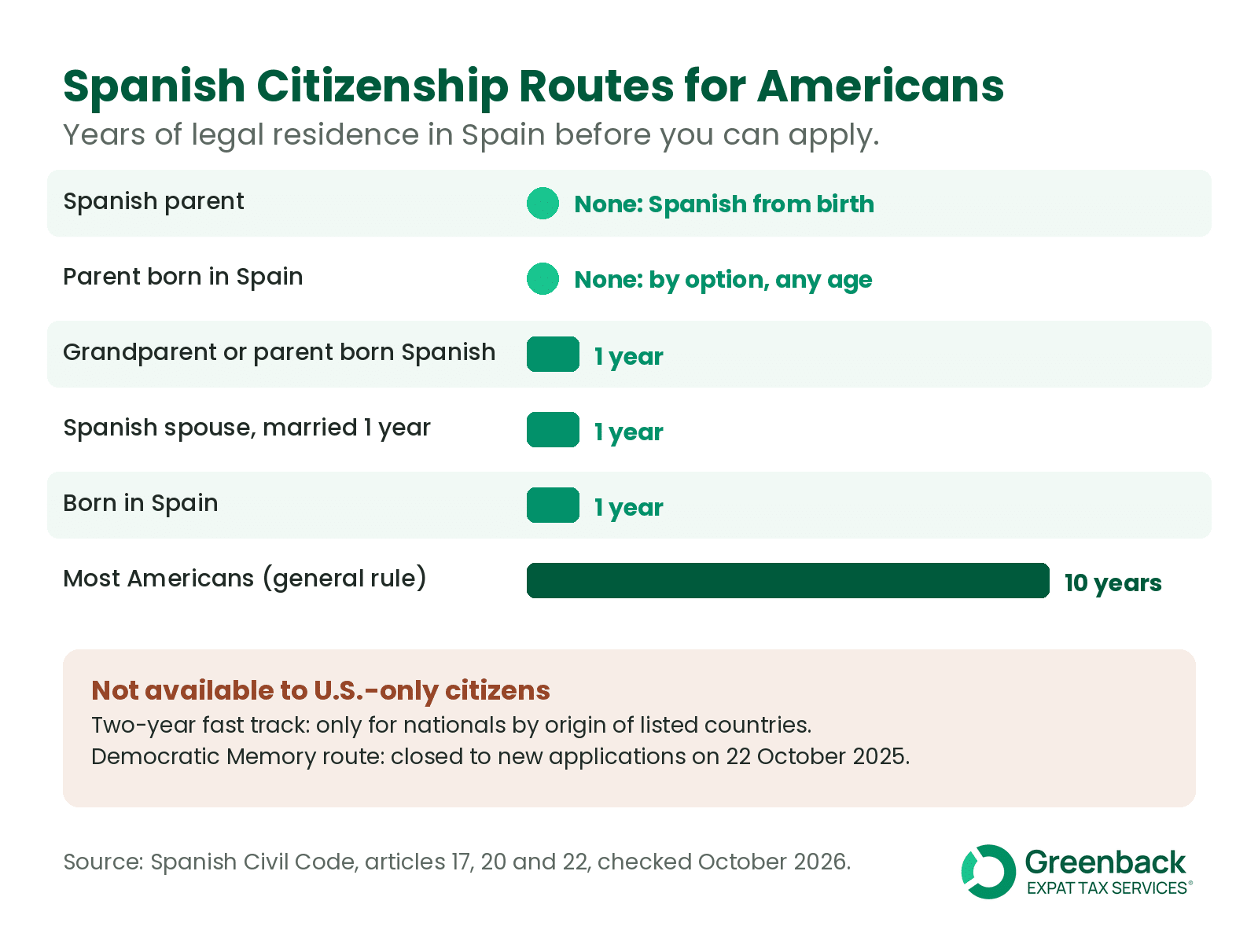
Why Most Americans Are on the 10-Year Clock
The two-year track in article 22 of the Civil Code is reserved for nationals by origin of Ibero-American countries, Andorra, the Philippines, Equatorial Guinea, and Portugal, and for Sephardic Jews. The U.S. is not on that list. An American who was also born a Mexican or Colombian national qualifies for two years through that nationality; an American with U.S. citizenship alone waits ten years unless one of the one-year cases applies.
Spanish Citizenship by Descent
Spanish citizenship by descent is automatic for the child of a Spanish parent, and a choice for the child of a parent who was born in Spain. If your mother or father was Spanish when you were born, you are of Spanish origin and should register your birth with the Spanish consulate in your state. If your parent was of Spanish origin and born in Spain, you can claim Spanish nationality by option at any age, including through a consulate.
Grandchildren have one route left. The Democratic Memory Law, which allowed grandchildren of exiles to apply without having to live in Spain, stopped accepting applications on 22 October 2025, after its single one-year extension. The 2007 Historical Memory route has also closed, and the 2015 Sephardic route stopped taking applications on 1 October 2019. What remains is the one-year residence route for anyone born outside Spain to a parent or grandparent of Spanish origin, which works like the other residence routes.
Spanish Citizenship by Residence and Marriage
Spanish citizenship by residence requires legal, continuous residence immediately before you apply, good civic conduct, and a sufficient degree of integration into Spanish society. Time on a residence permit counts, from the non-lucrative or digital nomad visa to a work permit, as long as there is no gap in your legal status; time on a student stay does not count, as Spain’s National High Court has ruled. Long-term residence, available after five years, lets you stay indefinitely while you remain a foreign national; the step from a visa to long-term residence is covered in our guide to moving to Spain.
Marriage shortens the clock to one year of legal residence, provided you have been married to a Spaniard for a year when you apply and are not separated legally or in fact. The year of marriage and the year of residence can overlap, so a couple who married before moving can apply after one year in Spain.
What Documents Do Americans Need for Spanish Citizenship?
Americans applying through residence need proof of legal residence, two exam certificates, an apostilled FBI record, and apostilled vital records, all valid on the day they apply. The list comes from Orden JUS/1625/2016, and U.S. documents must be apostilled and translated by a sworn translator (traductor jurado).
1. Proof of Legal Residence
Your TIE residence card shows your status and your NIE, and your full, valid U.S. passport must match the nationality on that card.
2. The Language Exam
The DELE at level A2 or higher, administered by the Instituto Cervantes, demonstrates basic Spanish proficiency. Nationals of countries where Spanish is an official language are exempt, as are applicants under 18.
3. The Civics Exam
The CCSE tests knowledge of Spain’s Constitution and society. A pass stays valid for four years, so take it no more than four years before you apply.
4. Criminal Record Certificate
Americans use the FBI Identity History Summary, which costs $18 and can be requested online with fingerprints taken at participating post offices. Because it is a federal document, the State Department’s Office of Authentications issues apostilles for $20 per document by mail. Spain treats it as valid for 6 months from the date of issue, so order it last.
5. Birth and Marriage Records
Order certified copies from the vital records office of the state that issued them, and have them apostilled by that state’s apostille office, usually the Secretary of State. Descent applicants also need each link back to the Spanish parent or grandparent, including that ancestor’s Spanish birth record.
How to Apply for Spanish Citizenship by Residence
You apply for Spanish citizenship by residence online, from Spain, once your residence clock has run and your documents are ready.
- Apply online: file through the Ministry of Justice’s nationality portal and pay the €104.05 fee on form 790, código 026.
- Wait for the decision: the Ministry has one year to decide, and if it has not responded by then, the application is deemed refused, which you can challenge in court. Files queue in practice: the Ministry’s own figures showed that 251,223 residence applications were pending as of 30 June 2026.
- Take the oath: within 180 days of being notified, swear or promise loyalty to the King and obedience to the Constitution at the Registro Civil or before a notary, or the grant lapses. At the same step, most Americans sign a declaration renouncing U.S. citizenship, which does not, under U.S. law, end their U.S. citizenship.
- Register and get your documents: once the nationality is entered in the Civil Registry, you can apply for a Spanish ID card (DNI) and passport.
Example: Maya Applies Through Her Spanish Grandmother
Maya was born in Ohio. Her grandmother was born a Spaniard in Asturias and emigrated to the U.S. in the 1950s. Maya meant to apply under the Democratic Memory Law but missed the October 2025 deadline.
She moves to Spain in early 2026 on the non-lucrative visa, stays put, and applies online in early 2027 after one year of legal residence. Her file carries her DELE A2 and CCSE results, an apostilled FBI record dated within six months of filing, her own birth certificate, and the chain of records linking her to her grandmother’s Spanish birth. When the grant arrives, she swears the oath within 180 days, signs the renunciation declaration, and registers. Under U.S. law, she remains a U.S. citizen, so she uses her Spanish documents in Spain, her U.S. passport for U.S. travel, and files her U.S. return every year as before.
Does Spain Allow Dual Citizenship With the U.S.?
Whether Spain allows dual citizenship with the U.S. depends on how you become a Spanish citizen. If you are Spanish by descent, as the child of a Spanish parent, you can hold both nationalities. If you naturalize by residence, marriage, or option, Spain requires you to declare that you renounce U.S. citizenship, though the U.S. does not treat that declaration as a renunciation.
| How you became Spanish | What Spain requires | What the U.S. sees |
|---|---|---|
| Spanish parent (Spanish from birth) | No renunciation. If you live outside Spain, declare at a consulate within three years of turning 18 that you want to keep Spanish nationality; this is mandatory if your Spanish parent was also born abroad | A U.S. citizen who also holds Spanish nationality |
| Parent born in Spain (by option) | A declaration renouncing U.S. citizenship (from age 14), then use of your Spanish nationality | A U.S. citizen: the Spanish declaration does not end U.S. citizenship |
| Residence or marriage, including the grandparent route | A declaration renouncing U.S. citizenship at the oath (from age 14), then use of your Spanish nationality | A U.S. citizen, on the same terms |
What this means if you naturalize: the U.S. does not treat Spain’s declaration as a renunciation of U.S. citizenship, so you remain American under U.S. law, while Spain treats you as Spanish. If you then use only your U.S. nationality for 3 years, Spain can revoke your Spanish nationality.
If you are Spanish by descent and live in the U.S.
Make the keep-it declaration at a consulate within 3 years of turning 18. Article 24 of the Civil Code makes it mandatory if your Spanish parent was also born abroad, and it also protects you if you would otherwise rely only on your U.S. nationality. If you missed it, you can apply to recover Spanish nationality under Article 26. Living in Spain is not required for emigrants and their children, so if your Spanish parent was also born abroad, ask your consulate whether you qualify.
Spain’s Civil Code exempts only nationals of Ibero-American countries, Andorra, the Philippines, Equatorial Guinea, and Portugal, and Sephardic Jews of Spanish origin, from the renunciation; a 2021 treaty adds France, and Spain has no dual nationality treaty with the U.S. The State Department, for its part, says “A U.S. citizen may naturalize in a foreign state without any risk to their U.S. citizenship,” and presumes you intend to keep it; you lose U.S. citizenship only through a voluntary act meant to give it up, such as a formal statement at a U.S. consulate.
How strictly Spain applies the renunciation is widely debated. Many Americans who naturalize keep their U.S. passport, and the line Spain draws is as follows: rely only on your U.S. nationality for 3 years, wherever you live, and Spain can withdraw your Spanish nationality.
Day to day, holding both nationalities looks like this:
- In Spain and the EU: use your Spanish DNI and passport.
- Entering and leaving the U.S.: Use your U.S. passport, which U.S. law requires of every U.S. citizen.
- Renewals: keep your Spanish DNI and passport current, as well as your U.S. passport.
- Moving back to the U.S.: leaving Spain does not, on its own, end Spanish nationality; 3 years of using only your U.S. nationality can.
A bill tabled in Spain’s Congress in 2025 would drop the renunciation declaration; it has not become law. Holding both nationalities also means holding both sets of obligations: as a dual citizen, you keep filing U.S. taxes, and only formally renouncing U.S. citizenship, which can trigger the exit tax, ends that.
Frequently Asked Questions About Spanish Citizenship
Spanish citizenship by residence takes 10 years for most Americans. It drops to 1 year with a Spanish spouse, if you were born in Spain, or were born abroad to a parent or grandparent who was Spanish by origin, and to 5 years for refugees.
Spanish citizenship can be claimed from the U.S. only by descent, by registering as the child of a Spanish parent, or opting as the child of a parent born in Spain, through your Spanish consulate. Emigrants and their children who lost Spanish nationality can also recover it without living in Spain. Every residence route requires you to live in Spain first.
The Democratic Memory Law’s nationality route closed to new applications on 22 October 2025, after one extension. Applications filed before the deadline continue to be processed under that law.
Spain does not offer citizenship by investment. The golden visa is only ever granted residence, and it is closed to new applicants on 3 April 2025.
How Greenback Helps Americans Becoming Spanish Citizens
A Spanish passport adds a nationality without removing any U.S. filing. Greenback’s tax team prepares U.S. returns, FBARs, and Form 8938 for U.S.-Spanish dual citizens and Americans living in Spain, and plans your U.S. position around Spanish income so you pay no more U.S. tax than you owe. We do not handle nationality applications or prepare Spanish returns, so those stay with your Spanish lawyer or gestor.

Moving to Spain?
General information only, not legal or immigration advice. Spanish nationality rules, fees, and processing figures are sourced from the Civil Code, the Ministry of Justice, and the U.S. State Department, checked in October 2026, and may change. Greenback prepares U.S. tax filings and does not handle nationality applications. Confirm your route with a Spanish consulate or nationality lawyer, and ask a U.S. tax professional about your own filing.




Featured In