U.S. Taxes for Americans Teaching Abroad Explained

- Do I Have to File a U.S. Tax Return While Teaching Abroad?
- How Do I Avoid Paying Taxes in Two Countries?
- Do I Still Owe Social Security and Medicare Taxes?
- Do I Need to File State Taxes While Teaching Abroad?
- What Tax Forms Do I Need to File?
- What About Employer-Provided Benefits?
- Frequently Asked Questions
- Need Help Filing Your Expat Tax Return?
- Related Resources


American teachers working overseas must file a U.S. tax return every year, regardless of where they live or what currency they’re paid in. According to the IRS, the U.S. taxes based on citizenship, so your worldwide income is reportable even if you’re also filing taxes in your host country.
The relief: most teachers abroad owe little or nothing in U.S. federal tax after applying available benefits:
- Foreign Earned Income Exclusion of up to $130,000 for the 2025 tax year ($132,900 for 2026)
- Foreign Tax Credit for income taxes paid to your host country
- Educator Expense Deduction of up to $300 in unreimbursed classroom costs
- Foreign Housing Exclusion for qualifying rent, utilities, and related expenses

Teaching Abroad? Don’t Miss Your U.S. Tax Obligations
Here’s how each benefit applies to teachers, what forms you’ll need, and how to avoid common mistakes.
Do I Have to File a U.S. Tax Return While Teaching Abroad?
Yes. All U.S. citizens must file a federal tax return annually, reporting worldwide income. This applies whether you teach at an international school in Singapore, an English language academy in South Korea, or a public school in Germany. Even if your entire salary is paid in a foreign currency and you file a local tax return in your host country, you still owe the IRS a return.
The U.S. is one of only two countries that taxes based on citizenship rather than residency. Filing a return does not mean you’ll owe tax. It means the IRS requires you to report your income and claim the appropriate exclusions or credits. Most teachers abroad end up owing $0 in U.S. federal income tax after applying the benefits described below.
Key Deadlines for Teachers Abroad
| Deadline | What’s Due |
|---|---|
| April 15, 2026 | Tax payment due (if any). Interest accrues from this date on unpaid amounts. |
| June 15, 2026 | Automatic filing extension for expats. No form required. Attach a statement to your return explaining that you qualify. |
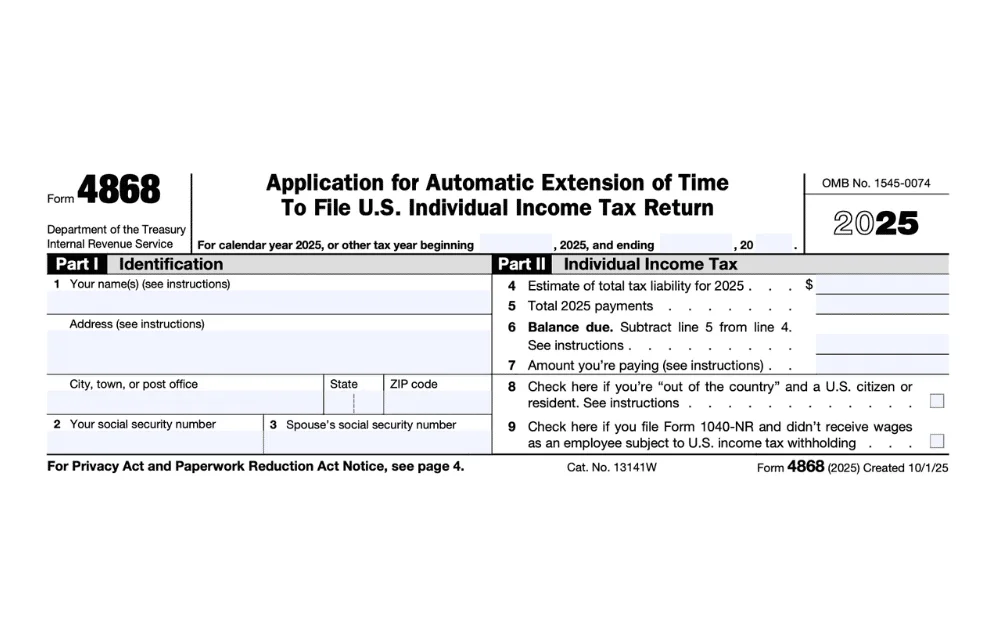
| October 15, 2026 | Extended filing deadline (requires filing Form 4868 before June 15). Also, the final FBAR deadline. |
The June 15 extension is automatic if your tax home and main place of work are outside the U.S. on April 15. You do not need to file any form to use it. For more on deadlines, see our expat tax deadlines page.
How Do I Avoid Paying Taxes in Two Countries?
Because the U.S. taxes worldwide income, Americans teaching abroad could face double taxation: paying income tax to both the U.S. and their host country on the same salary. The IRS provides several benefits to prevent this, and most teachers qualify for at least one.
Foreign Earned Income Exclusion (FEIE)
The FEIE allows you to exclude up to $130,000 of foreign earned income from U.S. federal tax for the 2025 tax year ($132,900 for 2026). For most teachers abroad, this covers the entire salary.
To qualify, you must meet one of two tests:
- Physical Presence Test: Be physically present in a foreign country for at least 330 full days during any 12-month period. A “full day” means midnight to midnight; partial days (like travel days) don’t count.
- Bona Fide Residence Test: Establish genuine residence in a foreign country for an uninterrupted period that includes an entire calendar year. The IRS looks at intent, ties to the foreign country (housing lease, local bank accounts, social connections), and whether you’ve claimed non-resident status there.
The school-year timing issue: Teachers often start in August or September and may return to the U.S. during summer break. If you spend the entire summer at home, you may fall short of the 330-day requirement for the Physical Presence Test. Track your days carefully. A teacher who starts in August 2025 and remains abroad through June 2026 (returning only briefly for holidays) can use the 12-month flexibility of the Physical Presence Test by choosing a period that straddles two tax years. Alternatively, if you’ve established long-term residence abroad, the Bona Fide Residence Test may be more practical, because it doesn’t require counting individual days.
You claim the FEIE by filing Form 2555 with your tax return.
Example: Maria teaches English at an international school in Bangkok. Her annual salary is $65,000. She’s been living in Thailand since 2024 and qualifies under the Bona Fide Residence Test. She excludes her entire $65,000 salary using the FEIE and owes $0 in U.S. federal income tax.
Foreign Tax Credit (FTC)
The Foreign Tax Credit takes a different approach. Instead of excluding income, it gives you a dollar-for-dollar credit against your U.S. tax for income taxes you’ve already paid to a foreign government. You claim it using Form 1116.
The FTC is often the better choice for teachers in high-tax countries (the UK, Germany, France, Japan, and Australia) where the local tax rate exceeds the U.S. rate. In those cases, the foreign taxes paid more than cover your U.S. liability, and you may generate excess credits you can carry forward.
Why do some teachers prefer the FTC over the FEIE?
- It preserves eligibility for the refundable Additional Child Tax Credit (the FEIE can eliminate it)
- It preserves your ability to contribute to IRAs (FEIE-excluded income doesn’t count as taxable earned income for IRA purposes)
- No residency or physical presence test required
You can use both the FEIE and FTC in the same tax year, but not on the same income. For a detailed comparison of when each works best, see FEIE vs. FTC.
Foreign Housing Exclusion
If you qualify for the FEIE, you may also be able to exclude additional amounts for housing expenses through the Foreign Housing Exclusion. This covers reasonable housing costs above a base amount set by the IRS, including:
- Rent
- Utilities (excluding phone and internet in some cases)
- Renter’s or homeowner’s insurance
- Small repairs
Many international schools provide housing as part of a teacher’s compensation package. Employer-provided housing is generally treated as taxable income, but it can be excluded through the Foreign Housing Exclusion if you meet the FEIE requirements.
The housing exclusion limit varies by location. Teachers in high-cost cities (London, Hong Kong, Tokyo) have higher allowable limits than those in lower-cost areas. The IRS publishes location-specific caps annually.
Educator Expense Deduction
The Educator Expense Deduction allows eligible K-12 teachers to deduct up to $300 in unreimbursed classroom expenses ($600 if both spouses are eligible educators filing jointly, with a $300 cap per person). This is an above-the-line deduction, meaning you can claim it even if you take the standard deduction.
Qualified expenses include books, classroom supplies, computer equipment, software, and professional development courses. To qualify, you must work as a K-12 teacher, instructor, counselor, principal, or aide for at least 900 hours during the school year at a school that provides elementary or secondary education as determined under state law.
For teachers abroad: The IRS has not explicitly defined whether foreign schools qualify for this deduction. The requirement is that the school provides “elementary or secondary education as determined under state law.” International schools accredited by U.S.-recognized accreditation bodies may meet this standard, but this is an area where the rules are not entirely clear. Keep receipts for all classroom expenses in case the IRS questions the deduction.
Starting in 2026, the One Big Beautiful Bill Act created a new unlimited itemized deduction for educator expenses, in addition to the existing $300 above-the-line deduction. This new deduction is available for expenses incurred after December 31, 2025, but requires itemizing (rather than taking the standard deduction) to claim.
Do I Still Owe Social Security and Medicare Taxes?
This depends on who employs you and on your host country’s relations with the U.S.
- If you work for a U.S. employer: You and your employer continue paying U.S. Social Security and Medicare taxes (FICA), regardless of where you live. The FEIE does not eliminate these payroll taxes.
- If you work for a foreign employer: You generally do not owe U.S. Social Security or Medicare taxes. However, you will likely pay into your host country’s social security system.
- If you’re self-employed (private tutoring, freelance ESL): You owe U.S. self-employment tax (15.3%) on net earnings above $400, even if you claim the FEIE. The FEIE eliminates income tax but does not eliminate self-employment tax.
Totalization Agreements
The U.S. has Totalization Agreements with over 30 countries to prevent double social security taxation. If your host country has an agreement with the U.S., you’ll pay into only one system, not both. For a list of countries and how the agreements work, see our Totalization Agreements guide.
Do I Need to File State Taxes While Teaching Abroad?
Possibly. Whether you owe state taxes depends on whether your former state still considers you a resident. Some states make it relatively easy to establish non-residency when you move abroad. Others, known as “sticky states” (California, New York, Virginia, South Carolina, New Mexico, among others), maintain residency status and tax obligations even after you leave.
If you established residency in a no-income-tax state (Florida, Texas, Nevada, Washington, Wyoming, South Dakota, Alaska, Tennessee, New Hampshire) before moving abroad, you likely have no state filing obligation.
Review your state’s residency rules before your move, and consider establishing residency in a no-tax state if you have the opportunity.
What Tax Forms Do I Need to File?
| Form | What It’s For | When to File |
|---|---|---|
| Form 1040 | U.S. individual income tax return. Required for all U.S. citizens. | April 15 (June 15 for expats, extendable to October 15) |
| Form 2555 | Claim the Foreign Earned Income Exclusion and/or Foreign Housing Exclusion. | Filed with your Form 1040 |
| Form 1116 | Claim the Foreign Tax Credit. | Filed with your Form 1040 |
| FinCEN Form 114 (FBAR) | Report foreign bank accounts if combined value exceeds $10,000 at any point during the year. Filed separately through BSA E-Filing. | April 15 (automatic extension to October 15) |
| Form 8938 (FATCA) | Report foreign financial assets above certain thresholds ($200,000 at year-end for single expats abroad, $400,000 for joint filers). | Filed with your Form 1040 |
Not every teacher will need all of these forms. If your only foreign financial account is a local checking account with a modest balance, you may only need Form 1040 and Form 2555 (or Form 1116). If your foreign accounts exceed $10,000 at any point during the year, you must file an FBAR.
What About Employer-Provided Benefits?
Many international schools offer compensation packages that go beyond base salary: housing, flights home, tuition for dependents, moving allowances, and health insurance. The tax treatment of each varies:
- Employer-provided housing: Generally taxable income, but can be excluded through the Foreign Housing Exclusion if you qualify for the FEIE.
- Annual flights home: Taxable as compensation unless specifically excluded by a tax treaty provision.
- Tuition waivers for dependents: Generally taxable for K-12 education. However, the value may be excludable as a working condition fringe benefit if the school provided your child’s education regardless of your employment.
- Moving/relocation allowances: The Tax Cuts and Jobs Act suspended the moving expense deduction for tax years 2018 through 2025. Moving allowances from your employer are taxable income. The OBBB made this suspension permanent.
- Health insurance: Employer-paid health insurance premiums are generally excluded from income under U.S. tax rules, as with domestic employment.
The specifics depend on your contract, your host country, and the applicable tax treaty. If your compensation package includes significant non-cash benefits, working with an expat tax professional can help you report them correctly.
Frequently Asked Questions
Not necessarily. The IRS offers the Streamlined Filing Compliance Procedures, a program designed for expats who didn’t know they were required to file. You’ll need to file three years of back tax returns and six years of FBARs. If your failure to file was non-willful (you didn’t know about the requirement), the program typically results in $0 in IRS penalties. Most teachers who catch up through Streamlined discover they owe little or nothing in actual tax after applying the FEIE or FTC retroactively. The key is to come forward before the IRS contacts you.
Yes. If you earn more than $400 in net self-employment income, you owe U.S. self-employment tax of 15.3% (12.4% Social Security + 2.9% Medicare), even if you claim the FEIE and owe $0 in income tax. The FEIE eliminates federal income tax on your earnings but does not eliminate self-employment tax. If your host country has a Totalization Agreement with the U.S. and you’re paying into that country’s social security system, you may be exempt from U.S. self-employment tax. Otherwise, budget for it.
Employer-provided housing is generally considered taxable compensation by the IRS. However, if you qualify for the FEIE, you can use the Foreign Housing Exclusion to exclude the value of your housing up to IRS-published limits for your location. The same applies to cash housing allowances. Keep documentation of the fair market value of the housing provided.
It depends on the length of your trips and which test you’re using. For the Physical Presence Test, you need 330 full days outside the U.S. in any 12-month period. A teacher who leaves in mid-August and returns in late June has roughly 315 days, which falls short. You can fix this by choosing a 12-month period that straddles two calendar years (e.g., September 1 to August 31) or by shortening your summer trips. Alternatively, if you’ve established genuine long-term residency abroad, the Bona Fide Residence Test doesn’t require counting individual days, making it more practical for teachers with annual summer returns.
Generally, no. Most foreign retirement plans (pensions, provident funds, employer savings schemes) are not considered “qualified” plans under U.S. tax law. This means contributions may not be tax-deferred, and the earnings in the plan may be taxable each year on your U.S. return. Some U.S. tax treaties include provisions that allow deferral for specific types of foreign pensions (the U.S.-UK treaty, for example, covers UK workplace pensions), but this is treaty-specific and not universal. If your school offers a foreign retirement plan, consult an expat tax professional to determine how it’s treated on your U.S. return.
Need Help Filing Your Expat Tax Return?
If you’re ready to be matched with a Greenback accountant, get started today. Have questions about the process or next steps? Contact us, and one of our Customer Champions will be happy to help.

Stay Compliant as a Teacher Living Overseas
This article is for informational purposes only and should not be considered tax advice. Individual circumstances vary, and you should consult a qualified tax professional for advice specific to your situation.
Related Resources
- Foreign Earned Income Exclusion
- Foreign Tax Credit
- FEIE vs. FTC: Which Is Right for You?
- Foreign Housing Exclusion
- Physical Presence Test
- Bona Fide Residence Test
- FBAR Filing Requirements
- State Tax Obligations for Expats
- Totalization Agreements and Tax Treaties
- U.S. Tax Filing Deadlines for Americans Living Abroad


Featured In