Moving to Spain from the U.S.: Visas, Steps, Costs, and Taxes

- Moving to Spain at a Glance
- Can Americans Move to Spain?
- What Are the Visa Options for Americans Moving to Spain?
- How Do You Move to Spain From the U.S.?
- What Documents Do You Need to Move to Spain?
- How Much Does It Cost to Move to Spain?
- Shipping Your Belongings, Pets and Car to Spain
- What Happens to Your Taxes the Year You Move to Spain?
- Mistakes to Avoid When Moving to Spain
- Frequently Asked Questions About Moving to Spain
- How Greenback Helps Americans Moving to Spain


Americans can move to Spain on a long-stay visa, most often the non-lucrative visa, which requires €2,400 a month in passive income, or the digital nomad visa, which requires €2,442 a month from remote work. Most moves take 6 to 12 months from the first document request to arrival. You keep filing a U.S. return every year, and the date you arrive decides which year Spain first taxes you in full.
The visa you choose depends on how you will support yourself in Spain, and the documents behind it set your timeline, since the FBI check, its apostille, and the Spanish translations usually take the longest. Official fees are a small part of the cost: the rental deposit, a year of health insurance, and shipping make up most of it. For taxes, two choices matter most: the date you arrive, which decides your first Spanish tax year, and selling any investments or property before you become a Spanish resident, since Spain taxes your gains from then on.
This guide walks through each step in order, and our guide to living in Spain covers daily life once you arrive.
Moving to Spain at a Glance
| Question | Answer |
|---|---|
| Is it hard for a U.S. citizen to move to Spain? | Moderately: one visa, a published income floor, and about ten steps over 6 to 12 months. |
| How much money do you really need to move to Spain? | €2,400 a month in passive income for the non-lucrative visa, or €2,442 a month for the digital nomad visa, plus moving costs. |
| Can you live on $2,000 a month in Spain? | In smaller inland cities, yes, but it falls below the non-lucrative visa’s income floor. |
| Do U.S. citizens need a visa for Spain? | Not for visits of up to 90 days in any 180-day period; living in Spain requires a long-stay visa. |
| Do I pay taxes in both countries the year I move? | You always file a U.S. return. You file in Spain for that year only if you arrive by about 1 July, and credits and exclusions keep the same income from being taxed twice. |
Can Americans Move to Spain?
Yes. For an American with a steady income or savings, moving to Spain is moderately easy: you need a long-stay visa, you have to show a published income floor, and the process takes about 10 steps over 6 to 12 months. The paperwork is what takes the time.
U.S. citizens do not need a visa to visit Spain for up to 90 days in any 180-day period. ETIAS, the EU travel authorization that will apply to short visits, is not yet operational. Living in Spain for more than 90 days requires a long-stay visa, which most routes require you to obtain before you leave the U.S.
What Are the Visa Options for Americans Moving to Spain?
The Spanish visa types available to Americans depend on how you will support yourself: passive income points to the non-lucrative visa, remote work to the digital nomad visa, and a job or business in Spain to a work or self-employment visa. Each route also shapes your U.S. return, which is the column most visa guides leave out.
| Visa | Who it fits and the income floor | Work allowed | First permit | U.S. tax angle |
|---|---|---|---|---|
| Non-lucrative visa | Retirees and people living on savings or investments; €2,400 a month, plus €600 per family member | None | One year, then renewals of two years | Passive income; the Foreign Tax Credit usually covers the U.S. tax |
| Digital nomad visa | Remote employees and freelancers; €2,442 a month, plus €916 for the first family member and €306 for each additional one | Remote work for companies outside Spain; freelancers can take up to 20% Spanish clients | Visa of up to one year, or a permit of up to three years from inside Spain | Earned income, so the exclusion or the credit; self-employed nomads check which country covers their social security |
| Work visa | People with a job offer from a Spanish employer, who sponsors the application | For that employer | Tied to the job offer | Spanish payroll tax, credited on your U.S. return; the Beckham Law may apply |
| Self-employment visa | People starting a business in Spain, with an approved business plan | Your own business | Tied to the business plan | Spanish social security as an autónomo; the totalization agreement usually removes U.S. self-employment tax |
| Student visa | People enrolled in a course in Spain, with proof of funds | Limited part-time work | The length of the course | Usually little Spanish tax; your U.S. return is still due |
| Family reunification | Family of someone already legally resident in Spain | Depends on the permit | Linked to the sponsor’s permit | Follows the family member’s own income |
The Spain golden visa, which granted residence for a property purchase, closed to new applications on 3 April 2025.
Spanish Citizenship by Descent
Spanish ancestry can skip the visa altogether. If one of your parents is Spanish, you are Spanish from birth under the Civil Code, and if a parent was born in Spain as a Spaniard, you can opt for Spanish nationality at any age. The wider route for grandchildren of Spanish exiles under the 2022 Democratic Memory Law closed on 22 October 2025.
From Visa to Permanent Residency
Most long-stay routes can lead to permanent residency in Spain: after five years of continuous legal residence, you can apply for long-term residence, which no longer depends on the visa you arrived on. Spanish citizenship by residence takes ten years for Americans, or one year if you are married to a Spanish citizen.
Moving to Spain With Your Family
Your spouse and children can come on the same application as family members. Each one raises the income you need to show: €600 a month per family member on the non-lucrative visa, and €916 for the first and €306 for each additional family member on the digital nomad visa. Family members on a non-lucrative application cannot work either, so a spouse who plans to keep working usually applies for the digital nomad visa in their own right. School enrollment usually starts with your registration on the padrón.
How Do You Move to Spain From the U.S.?
You move to Spain in two phases: five steps before you leave, and five in the first weeks after you land. The first phase is mostly waiting on documents, and the second is mostly booking appointments.
Before You Leave
1. Choose Your Visa and Your Consulate
You apply to the Spanish consulate that covers your state, and each consulate sets its own document checklist and fees, so the list a friend used in another city may not match yours. The Spanish consulate in Washington, for example, publishes its own non-lucrative visa checklist.
2. Order the Documents With Long Lead Times
The FBI Identity History Summary must be issued within 6 months of your application, apostilled, and translated into Spanish by a sworn translator. The medical certificate must be dated within 90 days of the application. Order the FBI check first: everything else can be arranged while it comes back.
3. Buy Compliant Health Insurance
The visa needs private health insurance from an insurer authorized in Spain that covers everything the public system does, with no co-payments and no coverage limits, for at least a year. Travel insurance does not qualify.
4. Book the Consulate Appointment and Apply
Most consulates use an appointment system, and slots at the busy ones are the part of the timeline you control least. The consulate has up to 3 months to decide. The digital nomad visa can also be requested from inside Spain, after entering as a visitor.
5. Wind Down the U.S. Side
Settle what belongs in your last year as a U.S.-only tax resident, cut the ties your state uses to keep taxing you, and set up the accounts you will run from Spain. The checklist in the tax section below lists each item.
After You Land
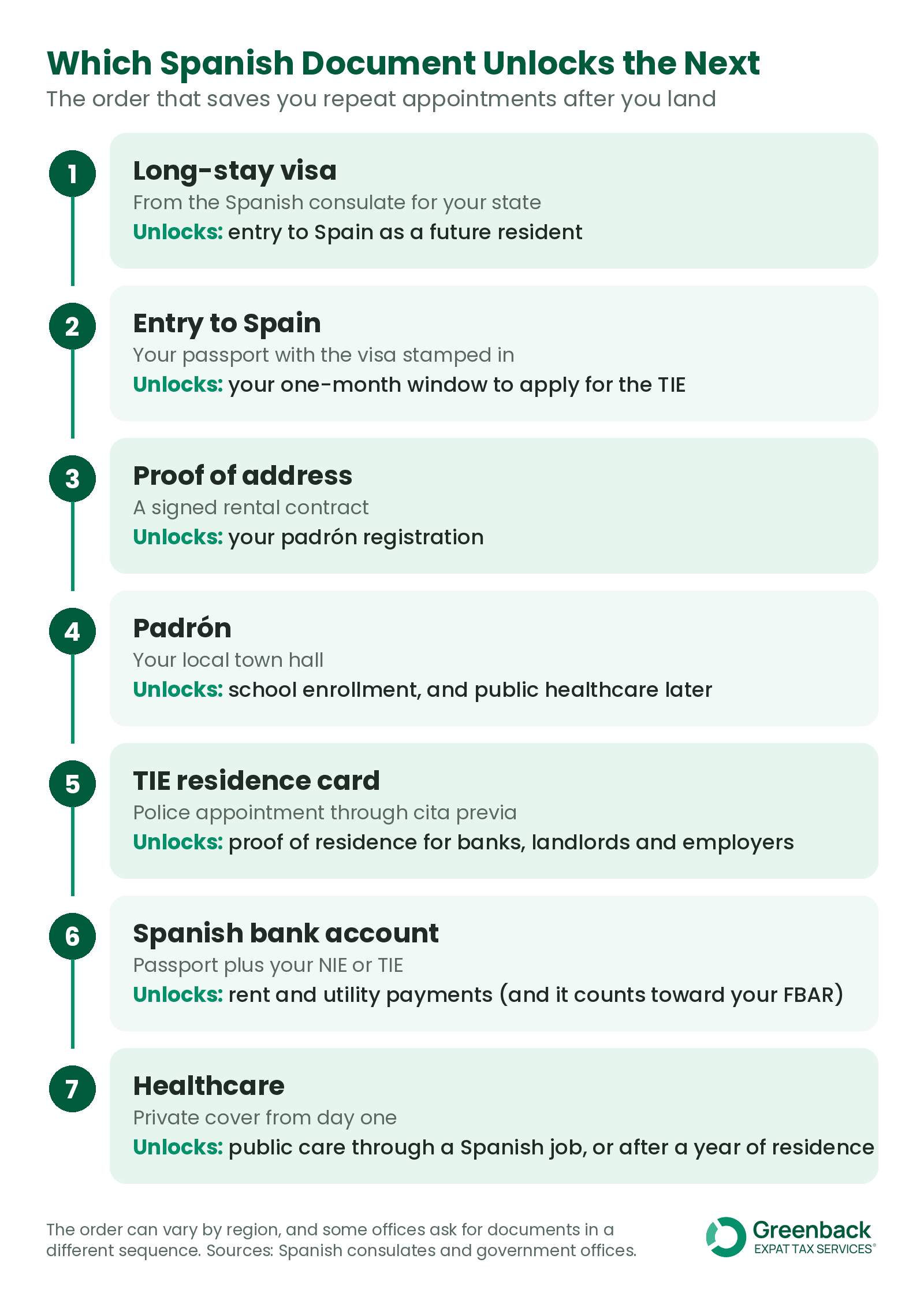
6. Register on the Padrón
The padrón is your registration at the local town hall, and it proves where you live. Many offices require it before issuing other documents, so register as soon as you have a rental contract or another proof of address.
7. Apply for Your TIE Within One Month
The TIE is your physical residence card, and you must apply for it within one month of entering Spain. You book the appointment through the government’s Cita previa portal and pay a small fee on form 790-012.
8. Open a Spanish Bank Account
Rent, utilities, and many services require a Spanish account. The bank will ask U.S. citizens for extra tax paperwork, and the account counts toward your U.S. foreign account reporting from the day it opens.
9. Set Up Healthcare
Your private policy covers you from the moment of arrival. Working in Spain places you in the public system through the Spanish Social Security system, and people who do not work can join it after a year of registered residence.
10. Mark Your First Spanish Tax Year
Note your arrival date and count your days in Spain. It decides when you file your first Spanish return, and it shapes your first U.S. return after the move.
What Documents Do You Need to Move to Spain?
Every long-stay route asks for the same core documents, and each consulate adds its own on top. The FBI check and the medical certificate expire, so their dates determine the order in which you gather everything else.
| Document | Where you get it | Timing and cost |
|---|---|---|
| Passport | U.S. Department of State | Valid for the length of your stay |
| National visa application form | Your Spanish consulate | Fee of $140 plus a $13 residence permit fee (non-lucrative) or $190 (digital nomad) at the Washington consulate |
| FBI Identity History Summary | FBI | $18; issued within 6 months of applying |
| Apostille on the FBI check | U.S. Department of State Office of Authentications | $20 per document |
| Sworn translation into Spanish | A sworn translator | Priced per page |
| Medical certificate | Your doctor | Dated within 90 days of applying |
| Private health insurance | An insurer authorized in Spain | No co-payments, full coverage, at least one year |
| Proof of income or savings | Your bank, pension plan or employer | Enough to meet your visa’s floor |
The route-specific documents, such as proof of your remote employer or clients, are covered in our digital nomad visa guide.
How Much Does It Cost to Move to Spain?
The visa floors set the income levels you must show: €2,400 per month for the non-lucrative visa and €2,442 per month for the digital nomad visa. On top of that comes the one-time cost of the move, where the official fees are small, and the deposits, insurance, and shipping make up most of the bill.
| Moving cost | What to expect |
|---|---|
| Visa fee | $140 plus $13 (non-lucrative) or $190 (digital nomad), paid to the consulate |
| FBI check and apostille | $18 plus $20 per apostilled document |
| Sworn translations | Priced per page by the translator |
| First year of health insurance | Varies with your age and the policy |
| Flights and shipping | Quotes from movers; household goods can enter duty-free |
| Rental deposit | One month’s rent by law, plus up to two months as an extra guarantee |
| Agency and contract fees | Paid by the landlord on a residential lease |
| TIE card | A small government fee on form 790-012 |
| Temporary housing | A few weeks while you search for a lease |
On a residential lease, Spain’s rental law sets the deposit at one month’s rent and puts the agency and contract fees on the landlord (Ley de Arrendamientos Urbanos). Your monthly budget once you arrive depends mostly on the city you’re in. Our guide to retiring in Spain shows what an income buys after tax in Spain.
Moving Money and Showing Your Visa Funds
The consulate measures your income in euros, so a dollar income that clears the floor at today’s exchange rate can fall short if the dollar weakens. Show a margin above the minimum, with statements in your name. Keep at least one U.S. account open for U.S. bills, tax payments, and refunds, and move savings in planned transfers ahead of big payments such as the deposit.
Shipping Your Belongings, Pets and Car to Spain
Your Household Goods
You can bring your belongings into Spain free of customs duty and import VAT as a transfer of residence. You qualify if you lived outside the EU for at least 12 consecutive months and owned the goods for at least 6 months (12 for a car, boat, or caravan). But you must declare them within 12 months of taking up residence, with an itemized list, and you cannot sell, lend, or rent them out for 12 months without notifying customs. Alcohol and tobacco are excluded, according to the Agencia Tributaria.
Your Dog or Cat
Your pet needs an ISO microchip before its rabies vaccination, and at least 21 days must pass after the first vaccination before it travels. An accredited vet issues the EU health certificate; the USDA endorses it within 10 days of your arrival in the EU; and it remains valid for 30 days. Up to five pets can travel with you this way, according to USDA APHIS.
Your Car and License
You can drive on your U.S. license for six months after you become a resident. The U.S. has no license exchange with Spain, so you then sit the Spanish theory and practical tests, as our living in Spain guide explains.
What Happens to Your Taxes the Year You Move to Spain?
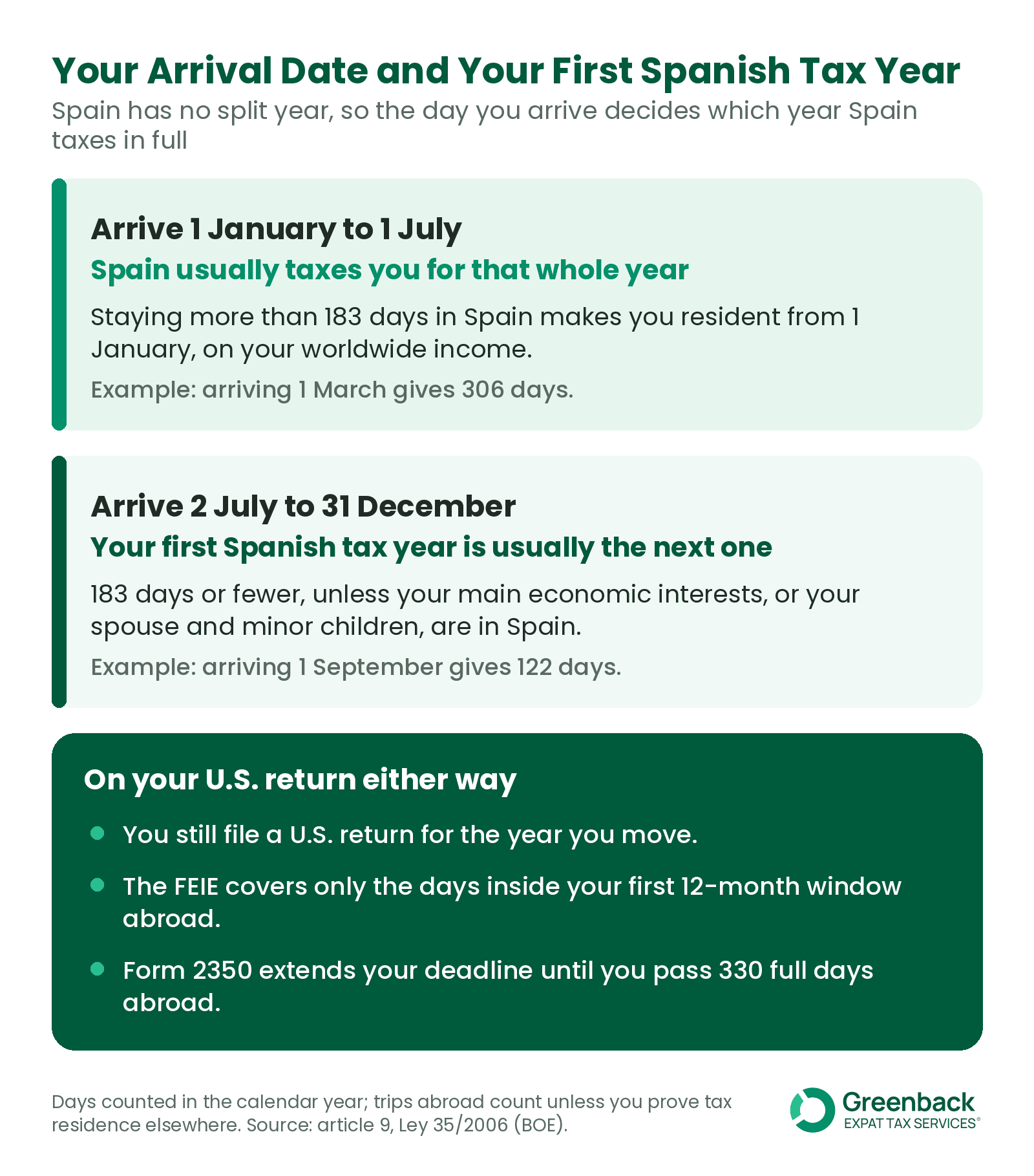
In the year you move, your arrival date decides whether Spain taxes you that year, and the U.S. still taxes you on everything. Spain has no split-year rule, so you are either a Spanish tax resident for the entire calendar year or not at all.
When Spain Starts Taxing You
Spain treats you as a tax resident for the whole year if you spend more than 183 days there in the calendar year, and trips abroad still count toward those days unless you prove tax residence in another country. You are also resident if your main economic interests are in Spain, and Spain presumes you are resident if your spouse and minor children live there, under Article 9 of Spain’s income tax law.
In practice, arriving on or before 1 July and staying usually makes that whole year Spanish-taxable, on your worldwide income from 1 January. Arriving later usually makes the next year your first Spanish tax year.
What Changes on Your U.S. Return
You file a U.S. return for the year you move, as every year. The Foreign Earned Income Exclusion requires 330 full days abroad in a 12-month period under the Physical Presence Test. So, if you move in the middle of the year, it only covers the part of the year within that window, and you usually meet the test after the normal deadline. Form 2350 exists for that purpose: it extends your filing deadline until you qualify.
Once Spain taxes your income, the Foreign Tax Credit usually does more than the exclusion, because Spanish rates are often higher than U.S. ones. How to choose between them in later years is covered in our guide to U.S. expat taxes in Spain. If you move for work, the Beckham Law election has its own deadline, six months from your Spanish Social Security registration.
Example: One Couple, Two Arrival Dates
Emma and Carlos, a U.S. couple working remotely for U.S. clients, move to Valencia on the digital nomad visa.
- If they arrive on 1 March, they spend 306 days in Spain that year, so Spain taxes their worldwide income for the whole year. On their U.S. return, they can claim that Spanish tax as a credit, or use an exclusion limited to about 84% of the year’s maximum, and their first return waits on Form 2350 until they pass 330 days, in late January of the next year.
- If they arrive on 1 September, they will spend 122 days in Spain that year, so their first Spanish tax year will be the next one. Their U.S. exclusion is limited to about a third of the year’s maximum, and they meet the test in late July of the next year.
The September move gives them a year with no Spanish return, and the March move gives them a Spanish year that starts sooner. Either date can be the right one. What matters is choosing it, knowing what it changes.
Your Pre-Move Checklist
| Item | What to do before you leave |
|---|---|
| Arrival date | Choose it with the 183-day count and your first Spanish tax year in mind |
| FEIE test start | Note the first full day abroad; your 12-month window starts there |
| State tax residency | Cut the ties your state uses; our guide to state taxes for expats explains which ones matter |
| Your U.S. home | Decide whether to sell or rent it, and when, before Spain can tax the gain |
| Appreciated investments | Review large gains and Roth conversions while you are a U.S.-only tax resident |
| U.S. brokerage accounts | Ask whether your broker restricts accounts with a foreign address |
| Spanish bank accounts | Plan for the FBAR once your foreign accounts total more than $10,000 |
| Medicare | Decide on Part B before you go; our retiring in Spain guide covers the penalty for dropping it |
| Social Security | Set up direct deposit abroad if you already draw benefits |
| Mail and phone | Keep a U.S. mailing address and a U.S. number for bank verification codes |
Mistakes to Avoid When Moving to Spain
Most problems in a move to Spain come from timing. These are the mistakes that cost Americans the most time or money:
- Applying at the wrong consulate: your application must go to the consulate that covers your state, and each one has its own checklist.
- Letting documents expire: an FBI check older than 6 months or a medical certificate older than 90 days on the application date sends you back to the start.
- Buying the wrong insurance: a policy with co-payments or coverage limits does not meet the visa condition.
- Treating a visit as a move: a 90-day stay does not become residence. When ETIAS starts, it will authorize short visits only, according to the official ETIAS site.
- Missing the TIE window: You have 1 month from the date of entry to apply for your residence card.
- Picking an arrival date by accident: arriving at the end of June instead of in mid-July can add a full Spanish tax year to your worldwide income.
- Selling assets after you become resident: once Spain taxes you, it taxes gains on your investments and property worldwide, and the same sale also goes on your U.S. return.
- Leaving state ties in place: a home, a driver’s license, or a voter registration card can keep your state taxing you after you leave.
- Forgetting the first FBAR: your new Spanish account counts from the day it opens.
Frequently Asked Questions About Moving to Spain
The 2-year rule allows nationals of Ibero-American countries, Andorra, the Philippines, Equatorial Guinea, and Portugal, as well as people of Sephardic origin, to apply for Spanish citizenship after 2 years of legal residence. Americans need 10 years, or 1 year if married to a Spanish citizen, under Article 22 of the Spanish Civil Code. Spanish citizenship does not end your U.S. filing.
Yes. The non-lucrative visa is for people living on savings, pensions, or investment income, requires €2,400 per month, and does not allow any work. If you work remotely for a company outside Spain, the digital nomad visa lets you keep that job.
How Greenback Helps Americans Moving to Spain
Greenback prepares U.S. returns for Americans living in Spain, including the return for the year you move to Spain. We help you plan your arrival date and your last year as a U.S.-only tax resident. We apply the exclusion or the credit where it works best, file the Form 2350 extension when you need it, and report your new Spanish accounts from the first year. For everything else about life in Spain, see our guide to living in Spain.

Moving to Spain This Year?
This article is for informational purposes only and does not constitute tax, legal, or immigration advice. Visa requirements, fees, and income floors change, and consulates set their own checklists; confirm current requirements with the Spanish consulate that serves you, and speak with a qualified professional about your situation.




Featured In