Beckham Law in Spain: Flat Tax Rate, Eligibility, and U.S. Taxes

- Beckham Law at a Glance
- What Is the Beckham Law and How Does It Work?
- Qualification Rules for the Beckham Law
- How Do You Apply for the Beckham Law?
- What Income Is Not Covered by the Beckham Law?
- Beckham Law Savings by Salary
- What Are the Disadvantages of the Beckham Law?
- How Does the Beckham Law Affect Your U.S. Taxes?
- What Happens When the Beckham Law Expires After Six Years?
- Frequently Asked Questions About the Beckham Law
- How Greenback Helps Americans with the Beckham Law


Spain’s Beckham Law lets people who move to Spain for work pay a flat 24% on their employment income up to €600,000, and 47% on amounts above that, for the year they arrive and the next five years. Officially, the special regime for workers relocated to Spain taxes you as a Spanish resident under non-resident rules, so most foreign investment income falls outside Spanish tax. You opt in on Modelo 149 within six months of starting work. For Americans, the regime changes only the Spanish bill: your U.S. return still covers everything you earn.
Whether the regime works for you depends on:
- How you arrived: a job, a remote role on the digital nomad visa, a directorship, or qualifying startup work.
- How much you earn: below about €65,000 in Madrid, the flat rate can cost more than the standard scale.
- What you own abroad: investment income outside Spain is untaxed in Spain but still taxed in the U.S.
- What the U.S. charges: the regime can only bring an American’s total tax down to what the IRS would take anyway.
This guide, part of our living in Spain hub, sets out who qualifies, how to apply, when the regime pays off, and how it fits with your U.S. return.
Beckham Law at a Glance
| Question | Answer |
|---|---|
| Who is eligible to apply for the Beckham Law in Spain? | People who move to Spain for a job, remote employment, a directorship or qualifying startup work, and were not Spanish residents in the prior five years. |
| What is the Beckham Law tax rate? | 24% on employment income up to €600,000, and 47% above. |
| How long does the Beckham Law last? | The year you move plus the five following years. |
| When do you have to apply for the Beckham Law? | Within six months of the start date of your Spanish social security registration. |
| Is foreign income taxed under the Beckham Law? | Foreign investment income is not. Employment income is, wherever you do the work. |
| What are the disadvantages of the Beckham Law? | No personal allowances, no offsetting of losses, no way back in once you leave, and capped savings for Americans earning above about €300,000. |
What Is the Beckham Law and How Does It Work?
The Beckham Law is article 93 of Spain’s income tax law, with the detail set out in articles 116 to 118 of its regulations. It lets you, as a new resident, choose to be taxed under Spain’s non-resident rules for six years while you remain a Spanish tax resident. It took its nickname from David Beckham, one of the first high-profile people to use it after joining Real Madrid in 2003.
Two rules do most of the work: all of your employment income is treated as earned in Spain, and income from outside Spain that is not employment income is not taxed in Spain. Here is how each type of income is treated under the regime and under standard Spanish residency.
| Your income | Under the Beckham Law | Under standard residency |
|---|---|---|
| Salary for work you do in Spain | 24% flat up to €600,000, then 47% | Progressive state and regional scale |
| Salary for work you do abroad | 24% flat, treated as Spanish income | Taxed in Spain, with a credit for foreign tax paid |
| Spanish dividends, interest and capital gains | 19% to 30%, rising with the amount | 19% to 30%, rising with the amount |
| U.S. and other foreign investment income | Not taxed in Spain | Taxed in Spain |
| Personal and family allowances | Not available | Available |
| Wealth tax | Spanish assets only | Worldwide assets |
The same Spanish-assets-only rule applies to Spain’s temporary solidarity tax on large fortunes, and regime taxpayers are generally not required to file Modelo 720, the declaration of assets abroad. The rules for both are covered in our guide to the Spanish wealth tax and Modelo 720.
The regime runs for the year you move, plus the five years after. You cannot use it if you were a Spanish tax resident at any point in the previous five years, and you must apply within six months of your start date on Spanish social security. Leaving early or losing eligibility partway through follows its own rules, covered in the section below on what happens when the Beckham Law expires.
Qualification Rules for the Beckham Law
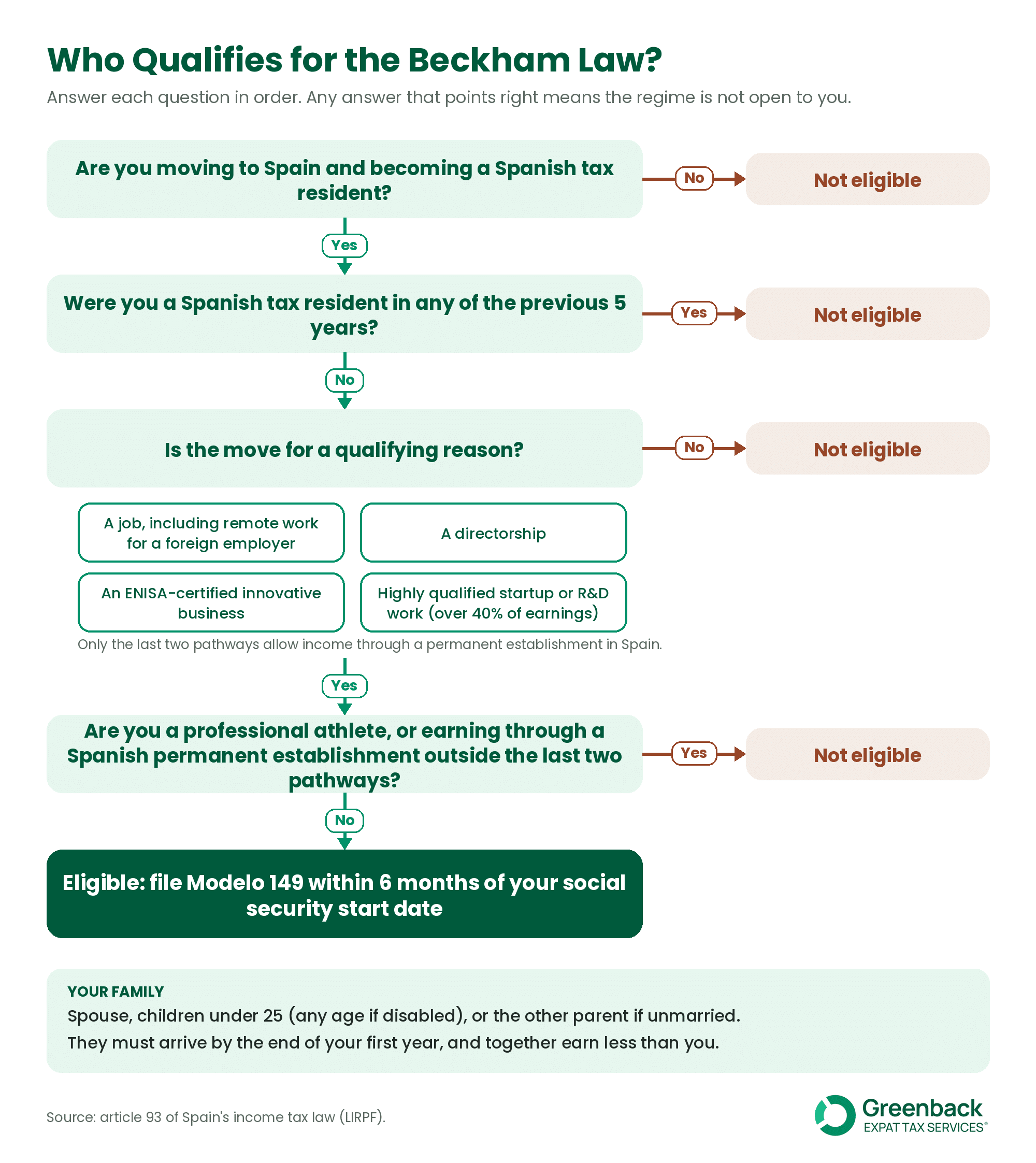
To qualify for Spain’s Beckham Law, you must meet four conditions: you move to Spain and become a Spanish tax resident as a result, you were not a Spanish tax resident in any of the five years before the move, the move is for a job (including remote work), a directorship, an innovative business, or highly qualified startup work, and you earn no income through a permanent establishment in Spain. The last condition does not apply if you qualify through an innovative business or highly qualified startup work.
Qualifying Pathways
- A job: an employment contract with a Spanish employer, a transfer ordered by your employer with an assignment letter, or remote employment for a foreign employer. Employees holding the digital nomad visa are named in the law as qualifying.
- A directorship: becoming a director of a company. If the company mainly manages assets and runs no business activity, you cannot own 25% or more of it.
- An entrepreneurial activity: a business in Spain that ENISA, Spain’s startup agency, certifies as innovative.
- Highly qualified startup or R&D work: professional services to a certified startup, or training, research and innovation work, that make up more than 40% of your total earnings.
Who Is Excluded?
- Professional athletes: those under Spain’s special sports employment regime.
- Most freelancers: self-employed work does not qualify unless it fits the entrepreneurial or highly qualified startup pathway.
- Anyone who has been a resident in Spain in the prior five years: the prior residence test rules you out.
Does My Family Qualify?
Your spouse and your children under 25, or any age if disabled, can join the regime, as can your children’s other parent if you are not married. They must move with you or before the end of your first year on the regime, become Spanish residents, and meet the prior residence test. Their combined taxable income must stay below yours each year. Each family member opts in separately.
How Do You Apply for the Beckham Law?
You apply by filing Modelo 149 with the Agencia Tributaria within six months of the start date shown on your Spanish social security registration, or on the document confirming you stay in your home country’s system.
- Register with Social Security: get your NIE and register in Spain, or obtain a U.S. certificate of coverage if your employer keeps you in the U.S. system. The start date on that document starts the clock.
- Gather proof of your move: your employment contract or assignment letter, company appointment, or startup certification, plus your passport and NIE.
- File Modelo 149: submit it within six months. The Agencia Tributaria’s Modelo 149 page lists the form and the documents.
- Give your employer the confirmation: the Agencia Tributaria issues it, and your employer then withholds at 24%.
- File Modelo 151 every year: it replaces the standard income tax return for as long as the regime applies.
Common Mistakes to Avoid
- Missing the six-month clock: There is no late election.
- Choosing the wrong withholding procedure: Workers who ask their employer for Spain’s special withholding procedure for new residents under Article 89.B of the regulations cannot opt into the regime.
- Not reporting an exclusion: If you no longer meet a condition, you have one month to notify the Agencia Tributaria, and the regime ends for that year.
- Assuming a new job ends it: A change of employer does not end the regime by itself, as long as you still meet the conditions.

What Income Is Not Covered by the Beckham Law?
Income from outside Spain that is not employment income, such as U.S. dividends, interest, rent, and gains on foreign assets, is not taxed in Spain under the regime. Spanish-source savings income is taxed on a separate scale:
| Spanish savings income | Rate |
|---|---|
| Up to €6,000 | 19% |
| €6,000 to €50,000 | 21% |
| €50,000 to €200,000 | 23% |
| €200,000 to €300,000 | 27% |
| Above €300,000 | 30% |
Earning income through a permanent establishment in Spain, such as an office or business of your own, ends the regime, except for the two startup pathways. In 2025, Spain’s Central Economic-Administrative Tribunal was reported to have ruled that regime taxpayers must declare deemed rental income on the home they live in, a charge standard residents do not pay on their main home. Ask your Spanish adviser whether it applies to you, and plan for the charge.
Beckham Law Savings by Salary
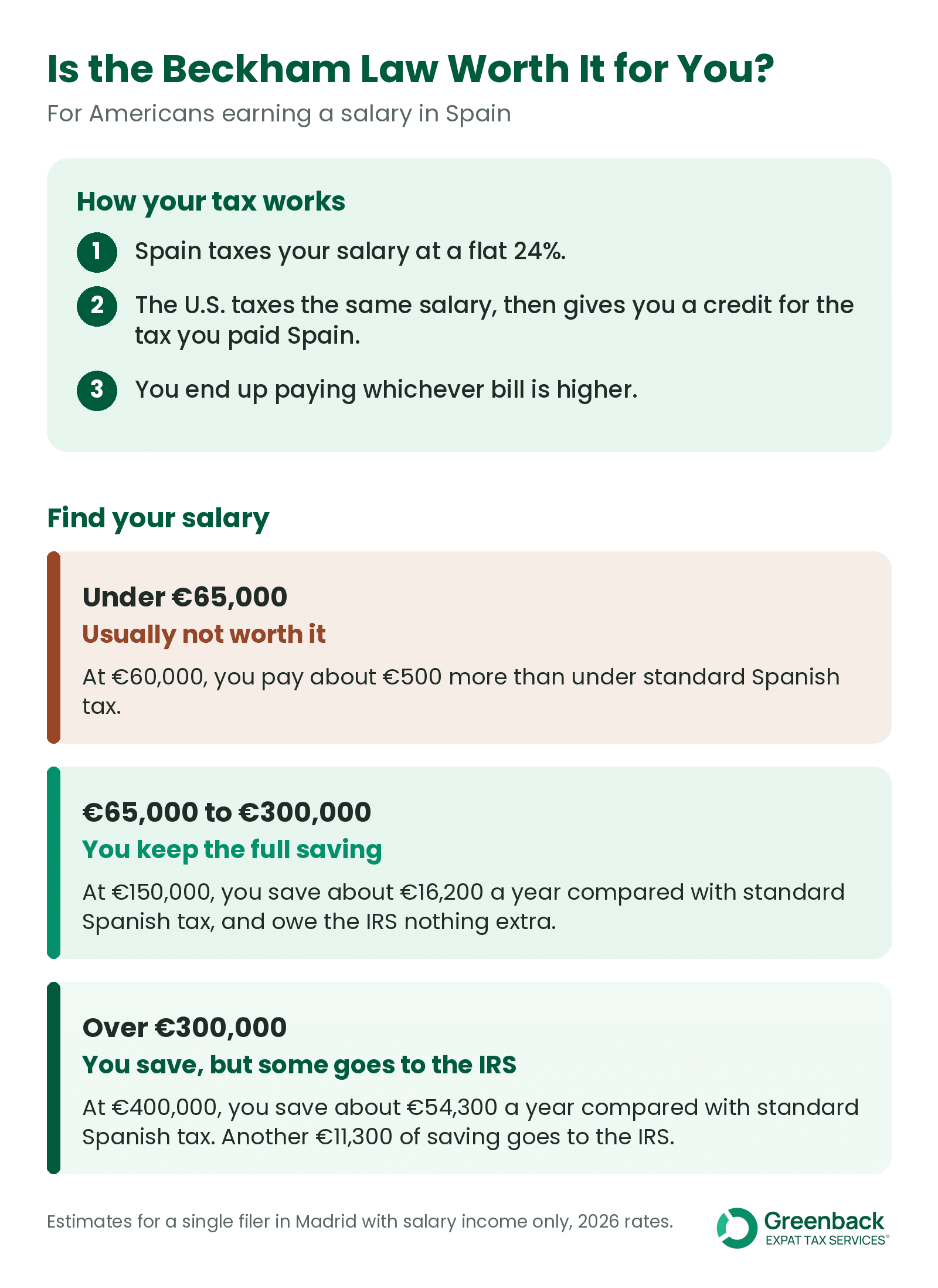
Whether the Beckham Law saves you money depends mainly on your salary. In Madrid, it is usually not worth it below about €65,000, because the regime drops the personal allowances and deductions that lower a standard Spanish tax bill. Between €65,000 and €300,000, Americans keep the full savings: the 24% Spanish tax is higher than the U.S. tax on the same salary, so the Foreign Tax Credit covers the U.S. bill. Above about €300,000, you still save, but some of the savings go to the IRS, because U.S. tax on the salary rises above 24%, and you pay whichever bill is higher.
| Salary | Standard Spanish tax | Beckham Law tax | U.S. tax on the same salary | What an American saves |
|---|---|---|---|---|
| €60,000 | about €13,900 | €14,400 | about €5,400 | None; pays about €500 more |
| €100,000 | about €30,700 | €24,000 | about €14,200 | about €6,700 |
| €150,000 | about €52,200 | €36,000 | about €26,000 | about €16,200 |
| €400,000 | about €161,600 | €96,000 | about €107,300 | about €54,300 |
Estimates for a single filer in Madrid with salary income only, using 2026 Spanish and U.S. rates and the Foreign Tax Credit.
Where you live matters too. The regime replaces both the state and regional scales, so in regions with higher regional rates, such as Catalonia and Valencia, the €65,000 break-even falls lower. The rates and the 24% rule are set out in Article 93 of Spain’s income tax law.
What Are the Disadvantages of the Beckham Law?
The main disadvantages of the Beckham Law are the loss of personal allowances, no offsetting between types of income, a one-way exit, higher tax from year seven, and, for Americans, a savings cap by U.S. tax.
- No allowances or deductions: The personal and family allowances and most deductions do not apply, which is why lower salaries can be lost.
- No offsetting: Each type of income is taxed on its own, so a loss on one Spanish investment cannot reduce tax on another.
- No way back in: If you renounce the regime, you cannot opt in again.
- Higher tax from year seven: From the seventh year, you are taxed on worldwide income at standard rates, including foreign investment income and wealth tax on worldwide assets.
- Deemed rent on your home: if the tribunal’s 2025 reading holds.
- A cap on savings for Americans: If your U.S. tax is higher than the Spanish bill, the IRS collects the difference.
How Does the Beckham Law Affect Your U.S. Taxes?
The Beckham Law changes nothing about what you report to the IRS. You still file a U.S. return on your worldwide income, and the Spanish tax you pay under the regime becomes a Foreign Tax Credit against the U.S. tax on the same salary.
- The credit usually covers U.S. tax on salary below about €300,000 because the 24% rate is higher than the U.S. effective rate for most salaries. Unused credit carries forward for up to 10 years.
- The exclusion is still available: You can use the Foreign Earned Income Exclusion of up to $132,900 for 2026. The Physical Presence Test is the dependable route; the Bona Fide Residence Test is harder to rely on, especially since Spain taxes you under non-resident rules.
- U.S. investment income is taxed only in the U.S.: Spain does not tax your U.S. dividends, interest, or gains under the regime, so there is no Spanish tax to credit. Under standard residency, Spain would tax them as well, so the regime usually leaves you paying less on them. The 3.8% Net Investment Income Tax can apply either way.
- Your U.S. reporting does not change: Spanish accounts over $10,000 still need to be reported on an FBAR.
How the credit and the exclusion compare across other situations is covered in our guide to U.S. expat taxes in Spain.
Example: A Remote Employee Earning €150,000
Lauren, a U.S. software engineer, moves to Madrid in 2026 with her U.S. employer and elects the regime. Her €150,000 salary, about $169,300, is taxed at 24% in Spain, amounting to €36,000, or about $40,630.
- U.S. tax on her salary: about $29,370, after the $16,100 standard deduction.
- Foreign Tax Credit: Her Spanish tax is higher, so the credit wipes out the U.S. tax.
- Carryforward: the unused $11,260 of Spanish tax can be carried forward for up to 10 years.
She pays about €36,000 in total, compared with roughly €52,200 for a standard Madrid resident.
Example: An Executive Earning €400,000
David, a U.S. executive transferred to Madrid, earns €400,000, about $451,470.
- Spanish tax: €96,000, about $108,350.
- U.S. tax on the same salary: about $121,150.
- Residual U.S. tax: the credit covers $108,350, leaving about $12,800 due to the IRS.
His total is about €107,300. Under standard residency, Spain would take about €161,600, and the credit would cover all of his U.S. tax, so the regime still saves him about €54,300 a year.
Stock Options and RSUs for U.S. Tech Employees
Equity compensation needs planning before you move. Spain treats all employment income during the regime as Spanish income, so shares that vest while you are on the regime are generally taxed at 24%, including the part earned before you moved. The U.S. assigns equity income to the places where you did the work during the vesting period, so the part earned in the U.S. is U.S.-source income that the Foreign Tax Credit generally cannot offset. The same grant can then be taxed twice unless you plan the timing and sourcing together.
What Happens When the Beckham Law Expires After Six Years?
When the Beckham Law ends after the year of your move plus five more, you are taxed as a standard Spanish resident from the seventh year, on worldwide income at progressive rates, with wealth tax on worldwide assets. You can also leave earlier by renouncing in November or December, effective the next year, but you cannot opt back in. If you no longer meet a condition, such as by establishing a permanent establishment, you are excluded from that year and must report it within one month. Planning for year seven, including when to sell investments, is easier while the regime still applies.
Frequently Asked Questions About the Beckham Law
Yes. Americans who move to Spain for a qualifying job, remote employment, a directorship or startup work can use the Beckham Law. They still file U.S. returns, and the Spanish tax paid under the regime is credited against U.S. tax on the same salary.
The “David Beckham rule” is the nickname for Spain’s special tax regime for relocated workers, article 93 of the income tax law. It took the name from the footballer, one of its best-known early users, after he joined Real Madrid in 2003. Professional athletes have since been excluded.
Yes. You can renounce the Beckham Law in November or December for the following year by filing Modelo 149. Once you renounce, you cannot opt in again.
Yes, for remote employees of foreign companies, including holders of the digital nomad visa. Self-employed remote workers generally do not qualify. The visa itself is covered in our guide to the Spain digital nomad visa.
How Greenback Helps Americans with the Beckham Law
Greenback prepares U.S. returns for Americans living in Spain, including employees and executives under the Beckham Law. We claim the Foreign Tax Credit for your Spanish tax and track the carryforward. We apply the exclusion where it helps and report your Spanish accounts. We can also help you plan the U.S. side of equity compensation and your move into standard residency in year seven. The rest of life in Spain is covered in our guide to living in Spain.

Beckham Law in Spain, U.S. Taxes Handled
This article is for informational purposes only and does not constitute tax or legal advice. Spanish tax figures are estimates based on 2026 state rates and the latest published regional rates, and your result depends on your region, income mix, and family. Speak with a qualified professional about your situation.




Featured In