Retiring in Spain: Costs, Taxes, and Healthcare for Americans



- Retiring in Spain at a Glance
- Can Americans Retire in Spain?
- Is Spain a Good Place to Retire?
- How Much Income Do You Need to Retire in Spain?
- How Does Spain Tax Your U.S. Retirement Income?
- Does Spain Tax Your U.S. Social Security?
- What Do You Still Have to File Every Year?
- Can Retirees Use the Spanish Public Health System?
- Where Should You Retire in Spain?
- How Do You Retire in Spain From the U.S.?
- How Does Spain Compare With Portugal, Italy, and France?
- Frequently Asked Questions about Retiring in Spain
- The Wealth Tax Is the Regional Decision That Costs Real Money
Americans retire in Spain on the non-lucrative residence visa, which asks you to show €2,400 a month in passive income and is applied for at the Spanish consulate serving your home state. A retired couple, both 65 or over, on a $50,000 household pension keeps about €3,220 a month after Spanish income tax in the Comunitat Valenciana. The Foreign Tax Credit then wipes out the U.S. tax on that pension income at every level in the table below, because Spain has already taxed it at a higher effective rate than the IRS would.
Where you settle in Spain matters far more for wealth tax than for income tax. Across the four communities most American retirees choose, the income tax difference on a €30,000 pension is about €35 a month. At the same time, Cataluña charges wealth tax from €500,000 of net worth, and Madrid reduces its own charge to nothing. Visas, paperwork, and daily life are covered in our guide to living in Spain.
Retiring in Spain at a Glance
| Question | Answer |
|---|---|
| Can an American retire in Spain? | Yes, on the non-lucrative residence visa, applied for at the Spanish consulate serving your home state before you move. |
| How much income do you need? | You must show €2,400 a month for the main applicant, plus €600 a month for each family member. |
| Can you work on that visa? | No, the non-lucrative visa permits no work for any employer, Spanish or foreign. |
| Does Spain tax your U.S. pension? | Yes, Spain taxes a U.S. private pension on its general scale once you are a Spanish tax resident. |
| Does Spain tax your U.S. Social Security? | Often yes, and the treaty then requires Spain to credit the U.S. tax charged on the same benefit. |
| Will you be taxed twice? | No, the Foreign Tax Credit generally covers the U.S. bill on income that Spain has already taxed. |
| Can you use Spanish public healthcare? | Not in your first year, because private insurance is a visa condition and the convenio especial opens after a year of residence. |
| Can you still buy residency in Spain with property? | No, Spain repealed the golden visa with Ley Orgánica 1/2025, which came into force on 3 April 2025. |
Can Americans Retire in Spain?
Yes. A U.S. citizen with no job offer in Spain applies for the non-lucrative residence visa at the Spanish consulate serving their home state, before leaving the United States. The initial authorization runs one year from the date you enter Spain, renews for two years at a time under article 64 of Real Decreto 1155/2024, and five years of legal residence opens the door to long-term residence.
What the Consulate Asks For, and What the Visa Forbids
The visa grants no right to work in Spain or abroad, which is what “non-lucrative” means. Alongside that, the consulate wants:
- Proof of passive income: pension, Social Security, dividends, interest, or rent, with statements behind it.
- Private health insurance: from an insurer authorized in Spain, with no deductible, no co-payment, and no coverage cap.
- A medical certificate: confirming you carry no disease with public health implications under the International Health Regulations.
- An FBI Identity History Summary: apostilled and translated into Spanish.
Consulates set their own document lists and fees by reciprocity, so the Miami list is not the Chicago list. There is no visa called the Spanish retirement visa; the application asks for the non-lucrative route by name.
Part-Time Work Points You at a Different Visa
Keeping a consulting client or a remote contract rules out the non-lucrative visa. Spain’s digital nomad visa allows it, and can bring you inside the Beckham Law regime, which is closed to anyone whose income is entirely passive. Our guide to moving to Spain covers the relocation process.
Buying Property No Longer Buys Residence
Spain’s golden visa, which granted residence in exchange for an investment such as a €500,000 property purchase, was repealed by Ley Orgánica 1/2025, with effect from 3 April 2025. Permits issued before that date continue under transitional rules. For anyone planning now, property and residence are two separate decisions.
Is Spain a Good Place to Retire?
For most American retirees, yes, on one condition: model the tax picture before the move. Spain offers a low-friction residency route, a strong public health system, and a cost of living well below that of most U.S. metros. It offers no special tax break for retirees, which is where the surprises come from.
What Works Well
- Healthcare access: Spain’s public system ranks among the strongest in Europe, and private coverage that would be expensive in the United States costs a fraction as much.
- A car becomes optional: most Spanish cities and coastal towns are built around transit and walkable centers, which removes a line item many retirees treat as fixed.
- Established communities: Alicante, Málaga, Valencia, and the Costa del Sol have long-standing English-speaking networks.
The Trade-Offs Worth Knowing First
- No retiree tax regime: Portugal once had one, and Italy still offers a 7% option in some small southern towns. Spain has nothing equivalent for people living on a pension, and the Beckham Law is for people who move to work.
- The wealth tax: Spain is one of the few European countries that still levies an annual net-worth tax, and whether you pay depends entirely on the region.
- Winter housing: older Spanish homes are built to stay cool in summer and often lack insulation or central heating, so indoor temperatures in January are cold.
- Two reporting regimes: Spain requires Modelo 720 for foreign assets, and the United States requires FBAR and Form 8938. One filing never covers the other, so the first year takes proper setup.
Our U.S. expat tax guide for Americans living in Spain covers the wider Spanish tax picture.
How Much Income Do You Need to Retire in Spain?
A retired couple, both 65 or over, on a $50,000 household pension keeps about €3,220 a month after Spanish income tax in the Comunitat Valenciana. The visa asks for less than that: the consulate sets the threshold against IPREM, Spain’s public income benchmark, at 400% of it per month for the main applicant and 100% for each family member. IPREM stayed at €600 per month for 2026, which puts the floor at €2,400 per month for one applicant and €600 per dependent.
| Who is applying | Monthly income to show | The consulate’s annual figure | Basis |
|---|---|---|---|
| Main applicant | €2,400 | €28,800 | 400% of IPREM |
| Each family member | €600 | €7,200 | 100% of IPREM |
| Couple applying together | €3,000 | €36,000 | 400% plus 100% |
€2,400 a Month Is the Visa Minimum, Measured Before Tax
Spanish consulates publish the requirement as €28,800 a year, which is the same number annualized. It is a minimum, measured before any tax. Pensions and Social Security count toward it, as do dividends, interest, and rent, with supporting statements. Savings can stand in for income at the same annual level. Employment income does not count at all, because the visa forbids work.
What a U.S. Retirement Income Looks Like After Spanish Tax
The number that matters is what lands in the account after Spain has taken its share. The table below takes four household incomes for a retired couple, both aged 65 or over, resident in the Comunitat Valenciana, and shows each one in two ways.
Whose name the income sits in changes the bill more than most retirees expect. Spain taxes each spouse individually and attributes income to whoever holds the asset, so a couple with a pension each is taxed twice on the lower half of the scale, while a couple living on one spouse’s 401(k) is taxed once on the higher half of the scale. A single account cannot be split between two returns.
| Household gross | Whose name the income is in | Spanish income tax | Net a month |
|---|---|---|---|
| $50,000, or €44,300 | Split evenly | €5,662, or 13% | €3,220 |
| $50,000, or €44,300 | One spouse | €9,835, or 22% | €2,872 |
| $70,000, or €62,020 | Split evenly | €10,797, or 17% | €4,269 |
| $70,000, or €62,020 | One spouse | €16,753, or 27% | €3,772 |
| $95,000, or €84,170 | Split evenly | €18,084, or 21% | €5,507 |
| $95,000, or €84,170 | One spouse | €27,264, or 32% | €4,742 |
| $130,000, or €115,180 | Split evenly | €29,924, or 26% | €7,105 |
| $130,000, or €115,180 | One spouse | €42,500, or 37% | €6,057 |
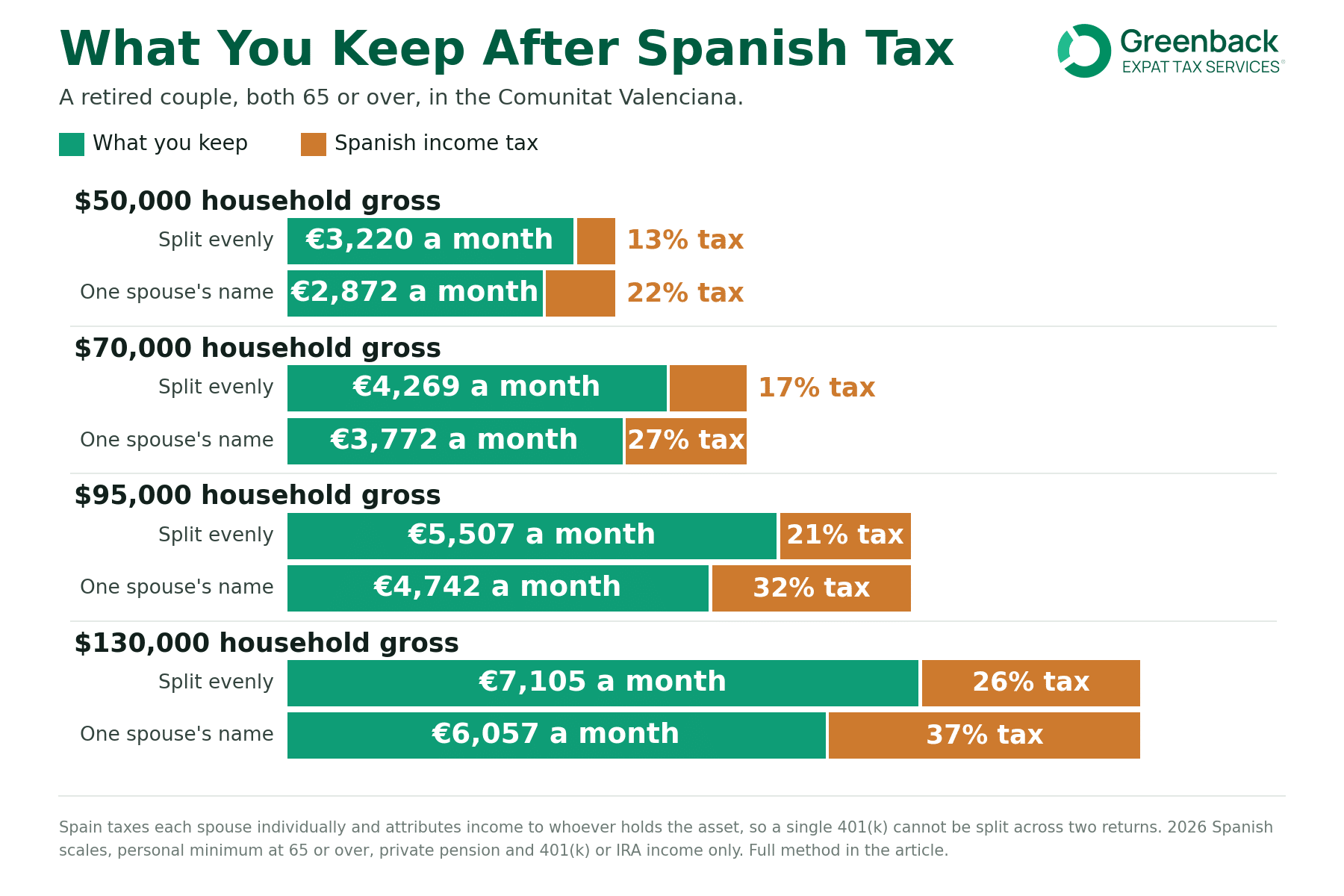
U.S. tax after the Foreign Tax Credit is nil in every row above, because the Spanish tax on that income exceeds what the IRS would charge on it. A further Spanish deduction applies to household pension income below about €43,500 when it is split evenly, and it reaches pensions because Spain classes them as work income, so the real bill just under the $50,000 line is lower than a straight-line reading suggests. Both cases use the 2026 Spanish scales, the personal minimum for a taxpayer aged 65 or over, and the IRS’s yearly average exchange rate for 2025 of 0.886 euros per dollar.
What $2,000 a Month Buys in Spain
$2,000 a month is about €1,772 at that rate, which is below the €2,400 required by the consulate, so it will not support a non-lucrative application unless savings make up the difference. As a living budget, it works in inland Andalucía, Extremadura, and Castilla y León, and is thin in Madrid, Barcelona, San Sebastián, or on the Balearic Islands.
Want the after-tax number before you commit to a region? Greenback helps Americans model the first Spanish tax year and the first U.S. return after the move, so you can compare places with real figures instead of estimates.
How Does Spain Tax Your U.S. Retirement Income?
Spain taxes a resident on worldwide income and sorts it into two bases. Pensions, Social Security, annuities, and withdrawals from a 401(k) or IRA are included in the general base under the progressive scale. In contrast, interest, dividends, and capital gains are included in the savings base, taxed at combined rates ranging from 19% to 30%. Our guide to capital gains tax in Spain covers the savings base in detail.
| Income type | How Spain treats it | How the U.S. treats it | Where the relief comes from |
|---|---|---|---|
| Private pension, 401(k) or IRA withdrawal | General base, progressive | Ordinary income | Treaty article 20(1)(a) gives Spain the exclusive treaty claim; the saving clause lets the U.S. tax its citizens anyway, and article 24(3) allocates the income so the U.S. allows the credit |
| U.S. Social Security | Spain may tax it as resident income | Up to 85% of the benefit is taxable | Article 24(1)(a) requires Spain to credit the U.S. tax on the benefit |
| U.S. government-service pension | Generally outside Spain’s reach | Taxable in the United States | Treaty article 21 keeps it with the paying State |
| Roth IRA distributions | No settled position | Qualified distributions are tax-free | Treaty article 20(5) covers build-up inside the fund; the payout needs a case-by-case view |
| Interest, dividends and gains | Savings base, 19% to 30% | Ordinary, qualified or capital gains rates | Foreign Tax Credit, with treaty re-sourcing on U.S.-source income |
| Rent from a U.S. property | General base, after Spanish deductions | Reported on Schedule E | Article 24(1)(a) credit in Spain |
Why Both Countries Tax the Same Pension
Article 20(1)(a) of the U.S.-Spain tax treaty says a private pension is taxable only in the country you live in, which is Spain. The treaty’s saving clause then lets the United States tax its own citizens anyway, so the 1040 still has to be filed, and article 24(3) allocates that income to Spain, so the U.S. allows a credit for the Spanish tax. On the U.S. return the credit goes on Form 1116 in the category called certain income re-sourced by treaty.
The Foreign Tax Credit Is the Relief a Retiree Uses
The Foreign Tax Credit offsets U.S. tax against the Spanish tax already paid on the same income, and at Spanish effective rates in the teens and twenties, it typically covers the U.S. liability in full. On the other hand, the Foreign Earned Income Exclusion, which shelters $130,000 of earned income for tax year 2025 and $132,900 for 2026, applies only to wages and self-employment income. A pension, a benefit, an IRA withdrawal, and a dividend all sit outside it, which is why the credit, not the exclusion, is the retiree’s tool. Our guide to tax planning before you retire abroad sequences the two.
Your Roth IRA Is the Open Question
A qualified Roth distribution is tax-free in the United States once the account has met the 5-year period and you are 59 and a half or older. Spain has no equivalent account and no published position treating a Roth payout as tax-free because of its U.S. character. Treaty article 20(5) defers Spanish tax on growth inside a pension fund, and a Roth can fall within that definition, but the treatment at payout is unsettled. The order and timing of Roth withdrawals, therefore, matter more after a move to Spain than before, and a large conversion is usually better done while you are still a U.S. tax resident.

Does Spain Tax Your U.S. Social Security?
Often yes. Spain can tax your Social Security as part of your worldwide income once you are a Spanish tax resident. Article 20(1)(b) of the treaty says the benefit may be taxed by the United States, which is permission and not an exclusive right, so both countries can reach it. Article 24(1)(a) then requires Spain to credit the U.S. tax charged on the same benefit.
How Much of the Benefit Does the IRS Tax?
The U.S. calculation compares half your benefit plus all your other income against base amounts of $25,000 for a single filer and $32,000 for a married couple filing jointly. Above $34,000 and $44,000, respectively, up to 85% of the benefit becomes taxable. Those base amounts have never been indexed for inflation, so a pension sitting on top of Social Security usually pushes a retiree into the 85% band.
Contributions and Benefits Are Separate Questions
The U.S.-Spain totalization agreement decides which country’s social security system you pay into, and says nothing about how the benefit is taxed once it arrives. The credit is capped at the Spanish tax on that income, so it is worth setting the treaty position in your first Spanish filing year, when it is easiest to get on the record.
What Do You Still Have to File Every Year?
Two calendars run in parallel once you are resident in Spain. The U.S. side is an annual return plus foreign account reporting, and the Spanish side is an annual income tax return and, above a threshold, a foreign asset report. Retirees aged 65 or over can use Form 1040-SR, which carries the same rules as Form 1040 in larger type.
| Filing | Filed with | What triggers it | When it is due |
|---|---|---|---|
| Form 1040 | IRS | Income above $17,750 single 65 or over, or $34,700 married filing jointly both 65 or over | 15 June automatically from abroad, 15 October with Form 4868 |
| FBAR, FinCEN 114 | FinCEN | $10,000 combined maximum value across all foreign accounts at any point in the year | 15 April, automatic extension to 15 October |
| Form 8938 | IRS | $200,000 at year end or $300,000 at any point, single abroad; $400,000 or $600,000 married filing jointly | With the return |
| Modelo 100 | Agencia Tributaria | Spanish tax residence | Renta campaign, early April to 30 June |
| Modelo 720 | Agencia Tributaria | €50,000 in any one of the three categories of foreign assets | 1 January to 31 March |
| Modelo 721 | Agencia Tributaria | €50,000 in foreign-held crypto assets | 1 January to 31 March |
These settle into a routine. The first year takes the work, because the thresholds differ on each side, and nothing filed in one country counts toward the other. After that, it is the same short set of forms every spring.
A U.S. Return Follows You for as Long as You Hold the Passport
The United States taxes on citizenship, not residence, so a Form 1040 is due every year your income clears the filing threshold, wherever you live. Being abroad on the filing deadline gives you an automatic two-month extension, so a tax year 2025 return falls due 15 June 2026 instead of 15 April. Form 4868 moves it to 15 October, and filers abroad can request a further discretionary extension to 15 December. Interest on anything owed runs from 15 April, whichever extension you hold, which is the one reason to estimate and pay early. The full calendar is on our tax deadlines page.
The Account Your Pension Lands In Is Reportable
The Spanish account your pension arrives in is a foreign account the day it opens. FBAR adds the highest balance each foreign account you own or can sign for reached during the year, so $10,000 spread across three Spanish accounts still triggers it. Form 8938 sits above that with higher thresholds for people living abroad, and the two overlap without replacing each other.
Your IRA Goes on Modelo 720, and Your 401(k) Needs Checking
Spain’s own tax agency says that consolidated rights in a foreign pension plan fall into none of the three asset categories reported in Modelo 720, in a published answer updated in February 2025. Two situations change that: where the plan’s terms allow a rescue right in the manner of a life insurance policy, and once a covered contingency has occurred, such as reaching retirement and starting to draw.
For IRAs, Spain’s tax ministry has issued a binding ruling: in V1291-22 of June 2022, an American resident’s traditional and Roth IRAs had to be reported on Modelo 720 because the funds can be withdrawn at any time and they count toward the wealth tax without the pension plan exemption. No ruling names a 401(k), so check how yours is classified with a Spanish adviser in your first year of filing.
The IRS Has a Route for Retirees Who Filed Late
Retirees who moved years ago and learned about the filing requirement later are common, and the IRS built a route for exactly that. The Streamlined Filing Compliance Procedures require three years of returns and six years of FBARs, plus a non-willfulness statement, and carry no penalty when the conditions are met. We work with retirees who file late every season.
Can Retirees Use the Spanish Public Health System?
Not in the first year. The non-lucrative visa requires private health insurance with no deductible, no copay, and no coverage cap. After a year of registered residence, you can join the public system through the convenio especial for €60 a month under 65 or €157 at 65 and over. The convenio covers doctors, specialists, and hospital care, though it usually does not cover prescription medications, and Medicare will not pay for care in Spain. Our guide to healthcare in Spain covers who qualifies, private insurance costs, and waiting times by region.
Already in Spain and behind on U.S. filing? Greenback helps retirees catch up through the Streamlined Procedures from start to finish, and there is no penalty when you qualify.
Where Should You Retire in Spain?
Every autonomous community sets half the income tax scale and its own wealth tax position, so the same pension produces a different bill in Valencia than in Barcelona. The four communities below are where most American retirees settle. All four use the same case: a single retiree under 65 with a €30,000 U.S. private pension, so the allowance is smaller than in the couple table above.
| Community | Tax on a €30,000 pension | Effective rate | Wealth tax position |
|---|---|---|---|
| Madrid | €5,140 | 17.1% | Reduced to nothing below €3 million |
| Comunitat Valenciana | €5,320 | 17.7% | Charge starts above €1 million |
| Andalucía | €5,447 | 18.2% | Reduced to nothing below €3 million |
| Cataluña | €5,563 | 18.5% | Charge starts above €500,000 |
The Income Tax Gap Between Regions Is Smaller Than It Looks
The spread across those four communities is €423 per year, about €35 per month, for that €30,000 single-retiree case. The gap widens with income and narrows below it, and at every level it stays well short of what a move between two towns does to rent. Anyone choosing a region based on income tax alone is optimizing the wrong number.
The Wealth Tax Gap Is Where the Region Really Bites
On the wealth tax, the same four communities differ on whether the tax applies to you at all. A retiree who sold a U.S. house and holds €900,000 pays nothing in Madrid or Andalucía, both of which reduce their own charge to nothing below €3 million, and pays in Cataluña, where the charge starts at €500,000. On wealth tax, the region decides whether you pay. A national solidarity tax still reaches net worth above €3 million wherever you live.
The Region Also Decides What Your Heirs Pay
Succession and gift tax work the same way: the state sets the structure, and each community sets its own reductions. Madrid and Andalucía remove most of the bill for a surviving spouse or a child, while other communities do not. It is worth talking with an adviser before you buy property in a given region.
How Do You Retire in Spain From the U.S.?
The order matters more than the speed. Money and tax decisions come before the consulate appointment, because some of them cannot be undone once you are a Spanish tax resident.
- Model the after-tax number first: run your pension, Social Security, and withdrawal mix through the Spanish scale for the region you are considering, and carry it through to the U.S. return and the credit.
- Settle anything that belongs in your last U.S.-resident year: a house sale, a large Roth conversion, or a concentrated stock position is cheaper to handle before the move.
- Pick the region, then the town: the community sets the tax position, and the town sets the rent and how far you are from a hospital and an airport.
- Buy compliant private health insurance: it must come from an insurer authorized in Spain, with no deductible, no co-payment, and no coverage cap, and must cover the whole authorization period.
- Assemble the consular file: FBI Identity History Summary, apostilles, medical certificate, proof of income, and the policy, to your own consulate’s list.
- Book the consular appointment and submit in person: most consulates require the main applicant to appear, and slots at busy consulates are part of the timeline you control least.
- Time the move deliberately: arriving after early July usually leaves you a Spanish non-resident for that calendar year, which can be worth arranging.
- Register within a month of landing: You must apply for your TIE residence card within one month of entering Spain, and registering on the municipal padrón is what starts the clock on the convenio especial.
- Open a Spanish bank account: rent, utilities, and the health system all expect one, and the account becomes FBAR-reportable the moment it exists.
- File both first returns together: the first Spanish Modelo 100 and the first U.S. return after the move decide where the credit lands, and getting them out of step is an avoidable cost.
How Does Spain Compare With Portugal, Italy, and France?
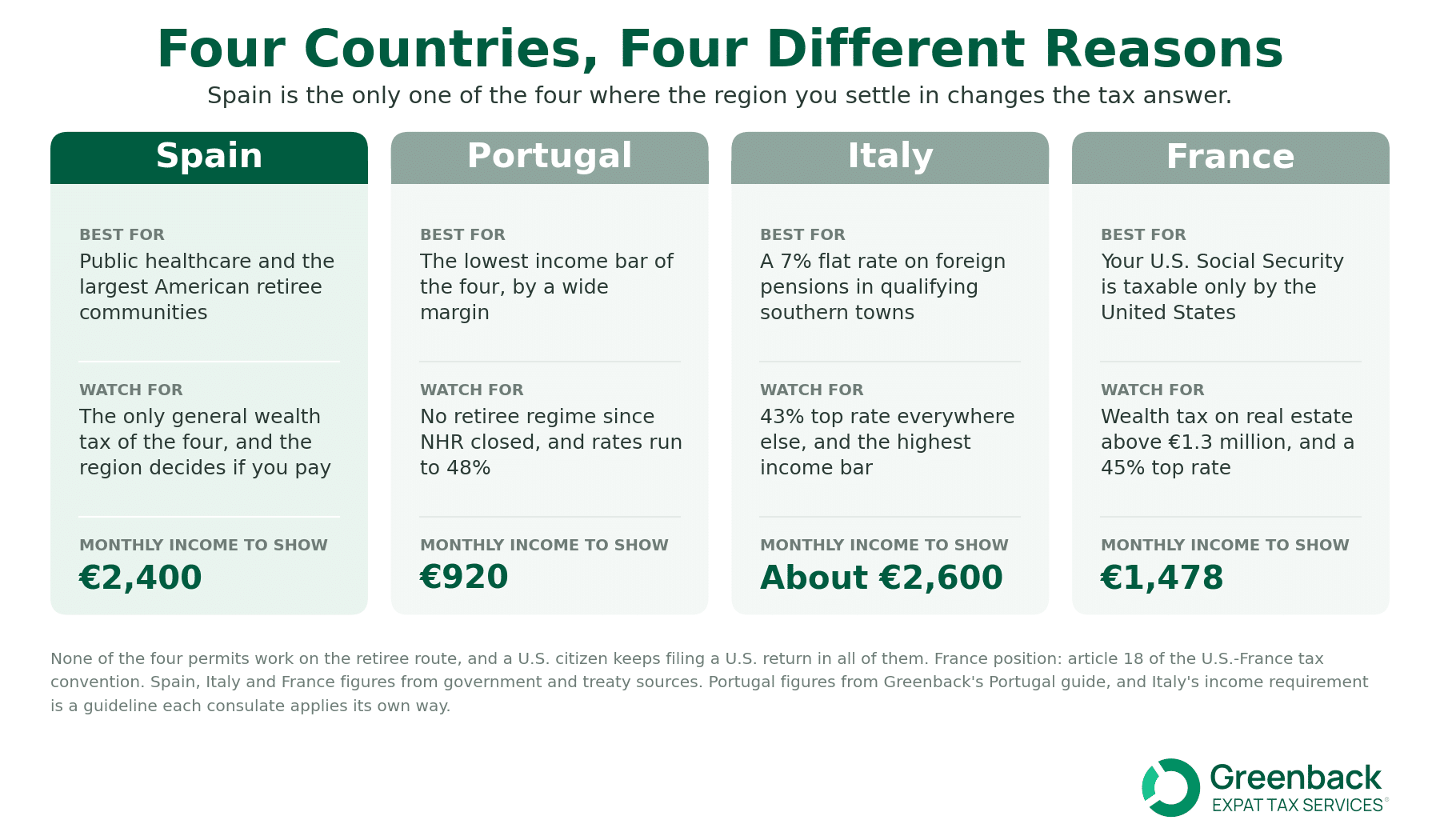
Spain sits in the middle of the group Americans choose between, asking €2,400 a month to qualify, compared with Portugal’s €920 and France’s €1,478, with Italy higher at about €2,600. On tax alone, Spain does not win: it is the only one of the four that levies a general wealth tax, and under Article 18 of its own treaty, France cannot tax your U.S. Social Security at all. What Spain has that the other three do not is a regional dial: the community you settle in determines whether the wealth tax applies to you, which makes the choice of region the biggest tax decision of the move.
Frequently Asked Questions about Retiring in Spain
After 183 days in Spain in a calendar year, or sooner if your main base of economic interests is in Spain. Spanish tax residence is assessed on the calendar year as a whole with no split-year treatment, so the date you arrive decides which country taxes your whole year.
Yes. Real Decreto 1155/2024 replaced Real Decreto 557/2011 on 20 May 2025, so any checklist older than that cites a repealed regulation. Renewals run two years at a time under Article 64, not the four years still quoted in some places.
Savings can stand in for income on a non-lucrative application at the same annual level, so €28,800 for one applicant and €7,200 for each family member, for each year of the authorization applied for. Consulates want the funds held in your name and liquid.
Spain’s own state pension age does not apply to an American retiring there on a non-lucrative visa. The visa has no minimum age requirement; it only asks that your income be passive and sufficient. If you draw a Spanish state pension from Spanish contributions, that has its own age rules, which the totalization agreement coordinates with U.S. credits.
Andalucía is inexpensive and has reduced its wealth tax to zero, while some cheaper regions sit within communities with higher income tax scales. Our guide to the best places to live in Spain compares cities by cost, climate and community.
The Wealth Tax Is the Regional Decision That Costs Real Money
The visa imposes the same income requirements on everyone, and the treaty works the same way in Cádiz as in Bilbao, so the region you register in is the only lever left. On income tax, it is worth about €35 a month. On wealth tax, it determines whether you are taxed on your savings at all: the same €900,000 is taxable from €500,000 in Cataluña, from €1 million in the Comunitat Valenciana, and is effectively not taxable at all in Madrid or Andalucía.
The U.S. return for the year you move is where the credit has to land correctly, and it is the one worth getting right first.

More Than 200 Americans in Spain File With Us
This article is for general information and is not tax or legal advice. Tax treatment depends on your own circumstances, and Spanish rules vary from one autonomous community to the next. Greenback Expat Tax Services is a U.S. accounting firm with expertise in U.S. tax returns for Americans living abroad. Speak to a qualified accountant about your own position before acting on anything here.




Featured In