The Costs, Requirements, Implications, and Process of Renouncing U.S. Citizenship

- How Much Does It Cost to Renounce U.S. Citizenship?
- Should I Renounce My American Citizenship?
- Can I Change My Mind After Renouncing My Citizenship?
- What are the Alternatives to Renouncing if I Already Live Abroad?
- How Do I Give Up My American Citizenship?
- Special Considerations for Green Card Holders
- Get Expert Guidance on Your Renunciation Decision


Renouncing U.S. citizenship means giving up your American citizenship by taking an oath before a U.S. consular officer at an embassy or consulate abroad. The process involves two interviews, a $450 State Department fee, and the filing of Form 8854 with your U.S. tax return for the year you renounce. Once the State Department approves it, the decision is permanent.
Beyond the $450 fee, the government charges nothing more unless you’re a covered expatriate, which is what brings in the exit tax. You’re a covered expatriate if, for example, your net worth is $2 million or more or you can’t certify five years of U.S. tax compliance.
We’ve helped over 27,000 expats file more than 90,000 returns in 218 countries, and we know that renunciation isn’t right for everyone. Sometimes, getting compliant and staying a citizen is simpler and less expensive than you think. By the end of this guide, you’ll have a much clearer idea of whether renouncing U.S. citizenship is right for you.
How Much Does It Cost to Renounce U.S. Citizenship?
The U.S. Department of State charges a flat $450 Renunciation Fee, and an Exit Tax based on assets for certain “covered expatriates”. The $450 is officially the “Fee for Administrative Processing of Request for Certificate of Loss of Nationality.” Most tax-compliant expats will not have to pay the exit tax.
Here is a more detailed breakdown of what it costs to renounce American citizenship:
Renunciation costs if you’re NOT a covered expatriate:
- State Department fee: $450
- Professional tax preparation for final returns: $500-$1,500
- Total: Approximately $950-$1,950
Renunciation costs if you ARE a covered expatriate:
- State Department fee: $450
- Exit tax on unrealized gains above $910,000 for 2026
- Professional tax and legal advice: $3,000-$10,000+
- Total: Varies significantly based on your asset values
The exit tax can apply if any one of these is true for you:
- A net worth of $2 million or more and/or
- A high average tax liability
- Adjusted for inflation each year: $211,000 for 2026
- Or incomplete tax compliance
- Meaning, you failed to certify on Form 8854 that you have complied with all U.S. federal tax obligations for the 5 years preceding the date of your expatriation or termination of residency.
Learn more about the Exit Tax for Americans who expatriate.

While this is the easiest test to fail, it’s also the most within your control. Many Americans considering renunciation discover they’re behind on filing simply because they were unaware of their obligations. One uncertified year automatically makes you a covered expatriate, regardless of your net worth or how little tax you may owe.
Speak to an accountant with years of experience advising expats to ensure you have met your tax obligations and will not be charged an exit tax.
The good news is that the IRS offers Streamlined Filing Compliance Procedures for Americans who unintentionally failed to file. This program allows you to catch up on the past three years of tax returns and six years of FBAR filings without penalties, enabling you to either renounce as a non-covered expatriate or become compliant and retain your citizenship.

Not sure whether you’re a covered expatriate? We can help you figure it out.
Should I Renounce My American Citizenship?
Ultimately, this is a very personal decision that only you can make. Here are a few things to think about when deciding if you want to give up American citizenship:
Think About Your Long-Term Plans
Relinquishing citizenship affects more than just taxes. Once expatriated, you lose:
- The right to live and work in the U.S. without immigration restrictions
- Consular protection when traveling
- The ability to pass U.S. citizenship to future children born abroad
- Access to certain U.S. government benefits and Social Security (depending on circumstances)
Can I Change My Mind After Renouncing My Citizenship?
No. Once you give up your U.S. citizenship and the State Department issues your Certificate of Loss of Nationality, you cannot simply reclaim it.
The only exception is that Individuals who renounce before age 18 have a 6-month window after turning 18 to reconsider their decision. For adults, the decision is final.
Regaining U.S. citizenship after renunciation requires completing the entire naturalization process as if you were a foreign national applying for citizenship for the first time. This process takes years, costs thousands of dollars, and carries no guarantee of approval. You’ll need to establish eligibility for a green card first, maintain permanent resident status for several years, and then apply for naturalization.
This permanence is why we strongly encourage Americans considering renunciation to explore their alternatives first. Many discover that while the U.S. uses citizenship-based taxation, which requires you to file returns regardless of where you live, most expats owe absolutely nothing in U.S. taxes after applying the Foreign Earned Income Exclusion and the Foreign Tax Credit.
What are the Alternatives to Renouncing if I Already Live Abroad?
Before making the irreversible decision to renounce your U.S. citizenship, consider this alternative:
Get Tax Compliant and Stay a U.S. Citizen
Staying a citizen means filing every year, but the tax breaks built for U.S. expats often reduce what you owe substantially. The Foreign Earned Income Exclusion lets you exclude up to $132,900 for the 2026 tax year. The Foreign Tax Credit offsets your U.S. tax with foreign income tax you’ve already paid, which helps prevent double taxation.
If you’re behind on filing, Streamlined Filing Procedures let you catch up on three years of returns and six years of FBARs without penalties if your failure to file was non-willful. Many Americans who thought renunciation was their only option discover that becoming compliant is simpler and less expensive.
Our flat-fee Streamlined Filing Package ($1,750) includes everything you need to get caught up penalty-free.
How Do I Give Up My American Citizenship?
Renouncing U.S. citizenship takes five steps, and most of them run through a U.S. embassy or consulate abroad. You get current on your tax filings, attend two interviews with a consular officer (at least one in person), take the oath and pay the $450 fee, receive your Certificate of Loss of Nationality, then file Form 8854 with that year’s tax return.
Step 1: Get Current on Your U.S. Tax Filings
Make sure you’ve filed every required U.S. tax return for the five years before you renounce. Form 8854 asks you to certify that five-year compliance, so this step decides whether the exit tax can apply to you. If you’re behind, Streamlined Filing Procedures let you catch up before your appointment. Streamlined covers three years of returns, so your five-year window may need more, and an accountant can confirm what yours requires.
Step 2: Request a Renunciation Appointment
Contact the American Citizen Services unit at a U.S. embassy or consulate abroad. The oath itself has to be taken in person at a post outside the United States, so it can’t be done by mail, online, or through someone acting for you. Availability varies by location, and some posts have waiting lists of several months.
Step 3: Attend Your Interviews and Take the Oath
At your interviews, a consular officer confirms that you understand the consequences and are acting voluntarily. You then:
- Complete the required State Department forms
- Take the oath of renunciation
- Pay the $450 fee
- Surrender your U.S. passport
Parents cannot renounce on a child’s behalf, and the State Department suggests that minors generally wait until they turn 18.
Step 4: Receive Your Certificate of Loss of Nationality
The State Department in Washington reviews your case and, once approved, issues a Certificate of Loss of Nationality (CLN). For tax purposes, your expatriation date is the day you took the oath, as long as the CLN later confirms it. You report income as a U.S. citizen up to that date.
Step 5: File Form 8854 With That Year’s Tax Return
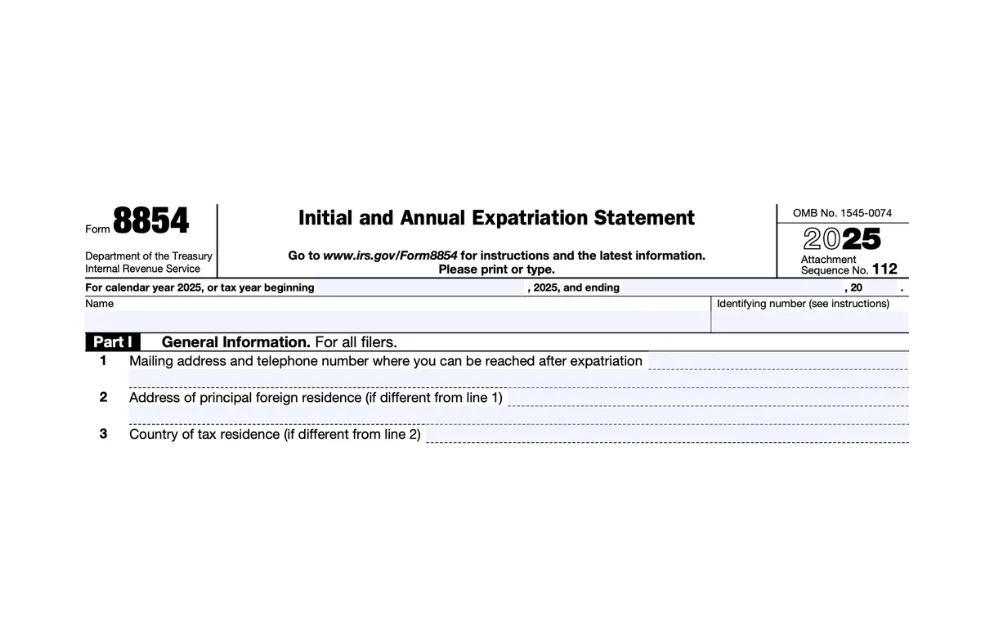
Attach Form 8854, the Initial and Annual Expatriation Statement, to your U.S. tax return for the year that includes your expatriation date. It’s due with that return, including extensions. If you’re a covered expatriate, Form 8854 also includes the asset schedules used to calculate any exit tax.
The IRS may charge a $10,000 penalty if Form 8854 isn’t filed when required. An accountant can review your five-year certification with you before you file, so it’s right the first time.
Special Considerations for Green Card Holders
What If I’m a Green Card Holder Considering Giving Up My Status?
Green card holders face the same exit tax rules as U.S. citizens, but with a critical timing consideration: If you’ve held your green card in 8 of the past 15 years, surrendering it counts as expatriation and may trigger the exit tax.
Important timing rule: You’re considered to have “lived in” the U.S. for an entire year if you were present even one day during that calendar year. For example, if you were in the U.S. on December 31 of year one, lived continuously during years two through seven, and were present on January 1 of year eight, you’re deemed to have lived in the U.S. for eight years.
Treaty Election Trap: Making a tax treaty election before meeting the “8 of 15 years” rule stops the clock, which sounds helpful. However, if you’ve already been a resident for 8 years, making a treaty election is itself an act of expatriation that could trigger the exit tax, even if you don’t surrender your green card.
Green card holders should consult with an expat tax specialist before making treaty elections or planning to surrender their status. The timing can make a substantial difference in your tax consequences. Learn more about the tax implications for green card holders.
Get Expert Guidance on Your Renunciation Decision
Renouncing U.S. citizenship is permanent, and the tax implications can be substantial if you’re classified as a covered expatriate. Before making this irreversible decision, you need to understand all your options and their long-term consequences.
Many Americans considering renunciation discover they can achieve their goals through compliance strategies that cost far less and preserve their citizenship rights. Whether you’re an accidental American who recently discovered your filing obligations, a long-time expat overwhelmed by compliance requirements, or someone with genuine reasons to renounce, you deserve clear guidance based on your specific situation.
Considering renunciation or need to get compliant first? Contact us, and one of our Customer Champions will help you understand your options. If you’re ready to be matched with a Greenback accountant, click the get started button below.

Ready to make an informed decision about renunciation?
This article provides general information and should not be considered specific tax or legal advice. Renunciation and exit tax rules are complex and subject to change. Always consult with qualified tax and legal professionals regarding your specific situation before making any decisions about renouncing U.S. citizenship.


Featured In