Foreign Business Tax Reporting for U.S. Expats: Required Forms and Filing Rules

- Which Form Do I Need for My Foreign Corporation?
- What Do I File for My Foreign Partnership?
- How Do I Report My Foreign LLC?
- What If I Have a Foreign Trust?
- Do I Need to File FBAR for My Business Accounts?
- What Penalties Could I Face for Not Filing?
- Can I Get Penalty Relief?
- How Do Tax Protections Apply to My Foreign Business Income?
- Why Is My Foreign Business Classification Confusing?
- What Are My Next Steps?
- Related Resources


U.S. citizens and resident aliens who own, control, or have a significant interest in a foreign business entity must file additional IRS information returns alongside their Form 1040. The specific form depends on the entity’s structure: Form 5471 for foreign corporations, Form 8865 for foreign partnerships, and Form 8858 for foreign disregarded entities. Penalties for failing to file any of these forms start at $10,000 per form, per year, and can increase to $60,000 for continued non-filing after IRS notice.
Beyond the information returns, foreign business owners may also owe U.S. tax on their company’s profits through GILTI (Global Intangible Low-Taxed Income) or Subpart F income rules, even if no distributions are taken. According to the IRS, the reporting obligation is triggered by ownership percentage and the type of entity, not by the amount of income the business earns.
The filing requirements vary significantly based on your ownership stake, the entity classification, and whether the entity is treated as a corporation, partnership, or disregarded entity for U.S. tax purposes. Here’s which forms apply to your situation, what triggers each requirement, and how to avoid the steep penalties for non-filing.
Own a foreign business and not sure which U.S. forms you need to file?
Which Form Do I Need for My Foreign Corporation?
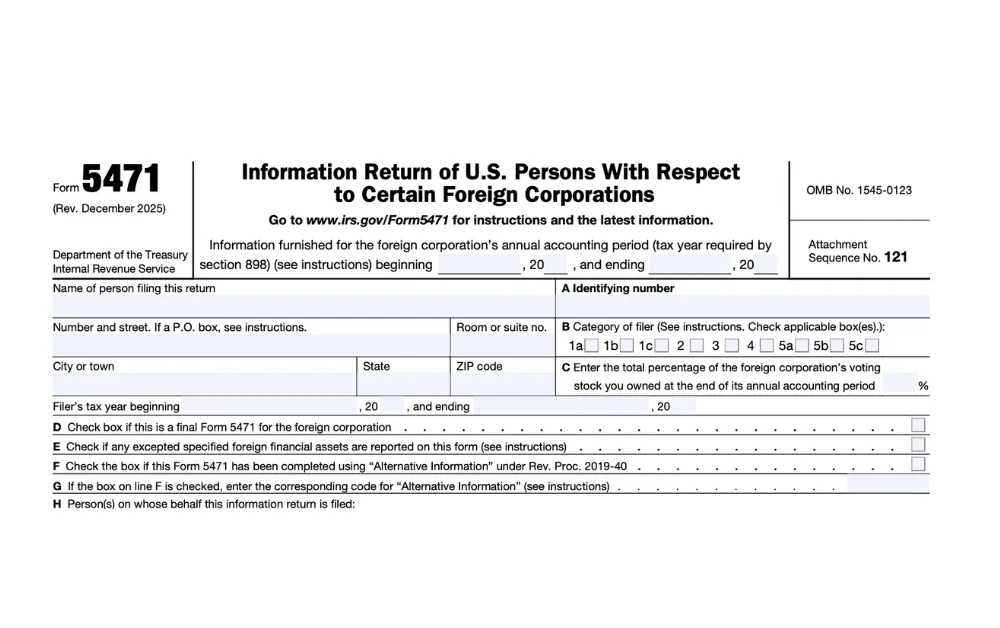
If you own shares in a foreign corporation, you’ll likely need to file Form 5471. This is the primary reporting form for U.S. persons with interests in foreign corporations.
You Need to File Form 5471 If You Are:
- A U.S. shareholder who owns 10% or more of a controlled foreign corporation (CFC)
- An officer or director of a foreign corporation where a U.S. person acquired 10% or more of the stock
- A U.S. person who controls a foreign corporation (more than 50% ownership)
- A U.S. person who acquired or disposed of stock that brought their ownership to 10% or more
Example: Sarah owns 65% of a German GmbH (corporation). She’s a Category 4 filer because she controls more than 50% of the foreign corporation. She must file Form 5471 with her annual tax return.
Another example: Three American expats each own 15% of a Hong Kong limited company, totaling 45% U.S. ownership. Since U.S. persons collectively own less than 50%, it’s not a CFC, and Form 5471 isn’t required for these shareholders.
Do I Also Need Form 926?
If you transfer property to your foreign corporation, you’ll also need to file Form 926. This includes:
- Cash transfers of $100,000 or more within a 12-month period
- Any transfer that results in you holding at least 10% of the corporation’s stock
Form 5471 and Form 926 are both filed with your U.S. income tax return by the standard deadline.
What Do I File for My Foreign Partnership?
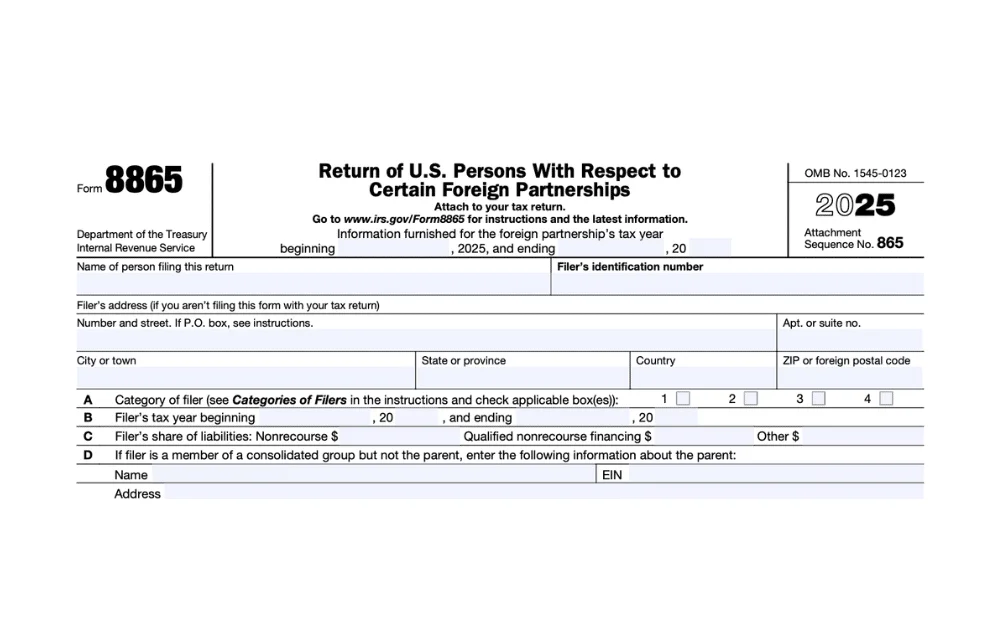
For foreign partnerships, you’ll file Form 8865 instead of Form 5471.
You Must File Form 8865 If You:
- Control a foreign partnership (own more than 50%)
- Own a 10% or greater interest while U.S. persons control the partnership
- Contributed property worth more than $100,000 to the partnership within 12 months
- Had a reportable event (acquisition, disposition, or change in ownership)

If you file Form 8865, you must also include Schedule K-2 and K-3. The IRS introduced Schedule K-2 and K-3 in 2021 to improve foreign income reporting on K-1s. All partnerships reported on Form 8865 are considered foreign and have foreign income on the K-1 by default. Therefore, every time you file Form 8865, you must include Schedule K-2 and K-3.
Form 8865 is due at the same time as your individual income tax return.
How Do I Report My Foreign LLC?
Foreign LLCs require special attention because you get to choose how they’re classified for U.S. tax purposes using Form 8832.
Your Foreign LLC Can Elect to Be Treated As:
- A corporation (files Form 5471 and potentially Form 926)
- A partnership if multi-member (files Form 8865)
- A disregarded entity if single-member (files Form 8858)
Form 8858 for Disregarded Entities
If your foreign LLC is treated as a disregarded entity (meaning it’s ignored for tax purposes and income flows through to your personal return), you’ll need to file Form 8858.
Example: James owns 100% of a UK limited company structured as a disregarded entity. He reports the business income directly on his Schedule C and files Form 8858 to provide information about the entity to the IRS. The LLC itself doesn’t file a separate tax return.
What If I Have a Foreign Trust?
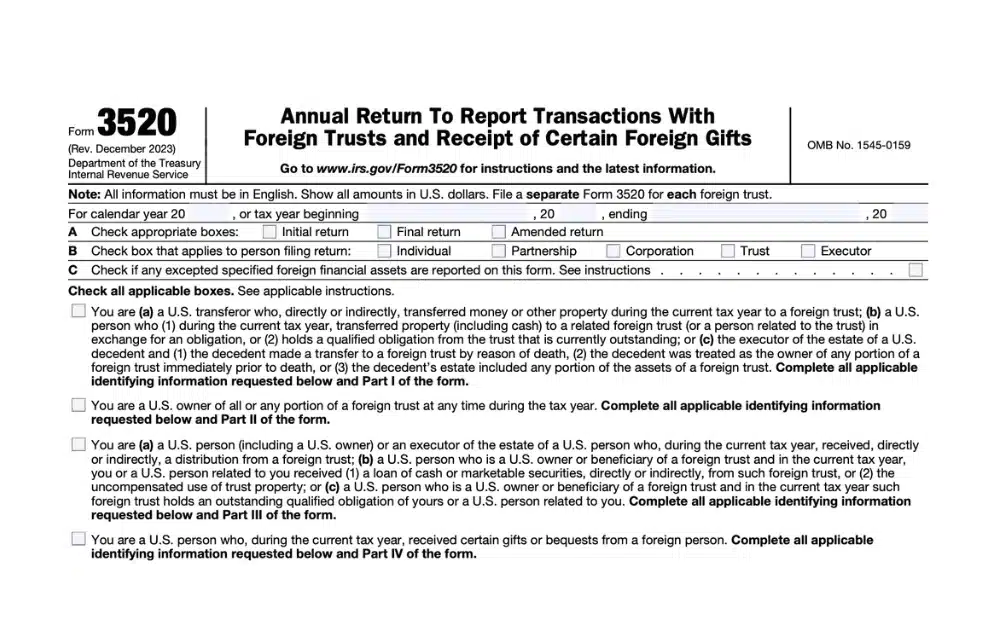
Foreign trusts trigger different reporting requirements with Form 3520 and Form 3520-A.
You Must File Form 3520 When You:
- Create a foreign trust
- Transfer money or property to a foreign trust
- Are treated as the owner of any part of a foreign trust under the grantor trust rules
- Receive a distribution from a foreign trust
Form 3520 is due on the 15th day of the fourth month following the end of your tax year (typically April 15, or June 15 for expats).
Form 3520-A: The Trust’s Responsibility
The foreign trust itself must file Form 3520-A if it has a U.S. owner. However, if the foreign trust won’t file it, you’re responsible for filing a substitute Form 3520-A. This form is due by the 15th day of the third month following the end of the trust’s tax year.
Do I Need to File FBAR for My Business Accounts?
Yes. FBAR (Report of Foreign Bank and Financial Accounts) applies to business accounts, too.
You must file an FBAR if you have signature authority or a financial interest in foreign financial accounts with an aggregate value exceeding $10,000 at any time during the calendar year.
This includes:
- Foreign corporation bank accounts you control
- Foreign partnership accounts where you have authority
- Foreign trust accounts
- Foreign LLC accounts
The FBAR deadline is April 15, with an automatic extension to October 15. File electronically through FinCEN’s BSA E-Filing System.
What Penalties Could I Face for Not Filing?
The penalties for missing business reporting forms are substantial, but you should know that reasonable cause exceptions exist.
Form 5471 Penalties
Failure to file Form 5471 or filing an incomplete form triggers a $10,000 penalty per form, per year. The penalties can escalate quickly. If the form isn’t properly submitted within 90 days of an IRS notice, additional $10,000 penalties apply for each subsequent 30-day period, up to $50,000 per form.
Form 8865 Penalties
Failure to timely file Form 8865 is generally subject to a $10,000 penalty per information return, plus an additional $10,000 for each month the failure continues, beginning 90 days after the IRS notifies you of the failure, up to a maximum of $60,000 per return.
Form 8858 Penalties
Penalties for Form 8858 follow the same structure: $10,000 initial penalty with continuation penalties up to $50,000.
Form 3520 and 3520-A Penalties
Form 3520 penalties can equal the greater of $10,000 or 35% of the value of property transferred to a foreign trust, 35% of distributions received, or 5% of trust assets you’re treated as owning. Form 3520-A penalties start at $10,000 or 5% of the gross value of trust assets.
FBAR Penalties
For non-willful violations, FBAR penalties are capped at $16,536 per report (not per account). For willful violations, penalties reach $165,353 or 50% of the account balance per violation, whichever is greater.
Can I Get Penalty Relief?
Yes. If you missed filing these forms because you weren’t aware of the requirements, not because you were trying to hide anything, you may qualify for relief.
The Streamlined Filing Compliance Procedures help expats catch up on unfiled returns and international information forms with minimal or no penalties. The IRS will not impose a penalty for failure to file delinquent FBARs if you properly reported and paid all tax on the income from the foreign financial accounts, and you have not previously been contacted regarding an income tax examination.
For late international information returns like Forms 5471, 8865, and 8858, the Delinquent International Information Return Submission Procedures offer another path to compliance if you can demonstrate reasonable cause.
How Do Tax Protections Apply to My Foreign Business Income?
Here’s more good news: even if you operate a foreign business, you still have access to the same protections other expats use.
Foreign Earned Income Exclusion (FEIE)
If you earn a salary from your foreign business, you can exclude up to $130,000 from U.S. taxation using the Foreign Earned Income Exclusion.
The FEIE only applies to earned income (salaries and wages), not to passive income like dividends or interest from your business investments.
Foreign Tax Credit (FTC)
The Foreign Tax Credit is often more valuable for business owners. You can claim a dollar-for-dollar credit for foreign taxes paid on your business income, which often eliminates your U.S. tax liability completely.
Example: Miguel owns a consulting business in Spain structured as a foreign corporation. He pays 25% corporate tax in Spain on €80,000 in profit. When he takes distributions, he can claim the Foreign Tax Credit for the Spanish taxes already paid, potentially eliminating any additional U.S. tax.
Why Is My Foreign Business Classification Confusing?
The terminology can be tricky because each country uses different names for business entities. The IRS has specific classifications for how foreign entities are treated for U.S. tax purposes.
For example:
- A Public Limited Company in Australia = Corporation for U.S. tax purposes (Form 5471)
- A Sociedade Anonima in Brazil = Corporation (Form 5471)
- An Aktiengesellschaft in Germany = Corporation (Form 5471)
- A Kabushiki Kaisha in Japan = Corporation (Form 5471)
If you’re unsure how your specific foreign business entity is classified, it’s worth getting expert guidance. The wrong classification can lead to filing the wrong forms and triggering unnecessary penalties.
What Are My Next Steps?
If you’re behind on filing these forms or unsure which ones apply to your situation, here’s what you should do:
- Identify your foreign business structure: Corporation, partnership, LLC, or trust?
- Determine your ownership level: Do you control the entity? Do you own 10% or more?
- Gather your business financial information: You’ll need balance sheets, income statements, and transaction details
- Check if you qualify for relief programs: If you’re catching up, the Streamlined Procedures or Delinquent Information Return Procedures might apply
The most important thing to know is this: complexity doesn’t mean impossibility. At Greenback, we work with hundreds of expat business owners every year who successfully file these requirements.
We’re an American company founded in 2009 by U.S. expats for expats. We’ve helped over 23,000 expats file more than 71,000 returns, and many of our CPAs and Enrolled Agents are expats themselves living in 14 time zones. They have the knowledge and patience to help you sort through foreign business reporting requirements and file everything correctly.
No matter how messy, complex, or late your business return may be, we can help. You’ll have peace of mind, knowing that your taxes were done right.
If you’re ready to be matched with a Greenback accountant, click the get started button below. For general questions on expat taxes or working with Greenback, contact our Customer Champions.
Running a business abroad is complex enough without worrying about U.S. filings.
This article is provided for general informational purposes and shouldn’t be considered legal or tax advice. Tax laws change frequently, and individual situations vary. Please consult with a qualified tax professional about your specific circumstances.
Related Resources
Core Foreign Business Forms:
- Form 5471: Filing Requirements with Your Expat Taxes
- Form 5471 vs Form 5472: Which One Do I Need to File?
- Form 926: Step-by-Step Guide for Accurate Filing
- 5 Things You Should Know About IRS Form 8865
- IRS Form 8858: Filing Requirements and Instructions
- Understanding Form 8832: Entity Classification Election
- Form 3520 for Americans Living Abroad: The Basics
Entity Type Guides:
- What Are the US Tax Requirements for Foreign Partnerships?
- Foreign Trust Reporting: A Tax Guide for Expats
- What Is a Controlled Foreign Corporation (CFC)?
Business-Specific Reporting:
General Compliance: