Foreign Housing Exclusion: How Expats Exclude Housing Costs Beyond the FEIE

- What Is the Foreign Housing Exclusion?
- Who Qualifies for the Foreign Housing Exclusion?
- How Much Can I Exclude for Housing Costs?
- What Housing Expenses Qualify?
- How Do I Calculate My Foreign Housing Exclusion?
- What Is the Difference Between the Housing Exclusion and Deduction?
- Can Married Couples Both Claim the Housing Exclusion?
- How Do I Claim the Foreign Housing Exclusion on My Tax Return?
- What Mistakes Should I Avoid With the Housing Exclusion?
- Should I Use the Housing Exclusion or the Foreign Tax Credit?
- What If I Missed Claiming the Housing Exclusion on Past Returns?
- Frequently Asked Questions on Foreign Housing Exclusion
- How Can Greenback Help With the Foreign Housing Exclusion?
- Related Resources


The Foreign Housing Exclusion (also called the foreign housing allowance) allows Americans living abroad to exclude qualifying housing costs from their U.S. taxable income, along with the Foreign Earned Income Exclusion (FEIE). For the 2025 tax year, the standard exclusion cap is $39,000; for 2026, it rises to $39,870 under IRS Notice 2026-25. If you live in a high-cost city like Hong Kong, Geneva, Dubai, or Singapore, your limit could be significantly higher.
- Claimed on Form 2555 alongside the FEIE, with no extra forms required
- Reduces taxable income beyond what the FEIE alone covers
- Location-specific limits for 137 foreign cities, updated annually by the IRS
- Retroactive option available: If a 2026 city limit is higher than 2025, you can apply the 2026 figure on your 2025 return

Paying High Rent Abroad? You May Be Able to Exclude It.
This guide walks you through eligibility, calculation steps, city-specific limits for both tax years, and practical strategies to maximize your exclusion. If you want to run the numbers for your situation, try the foreign housing exclusion calculator.
What Is the Foreign Housing Exclusion?
The foreign housing exclusion is a tax benefit under IRC Section 911 that lets qualifying U.S. taxpayers living abroad exclude certain housing expenses from their federal taxable income. It is separate from the FEIE but claimed on the same form, Form 2555. The FEIE excludes your foreign earned income (up to $130,000 for 2025 or $132,900 for 2026). The housing exclusion then excludes additional qualifying housing costs, such as rent, utilities, and renters’ insurance, from that amount.
To use the exclusion, your housing expenses must exceed a base housing amount equal to 16% of the FEIE limit: $20,800 for 2025 and $21,264 for 2026. The IRS caps the exclusion at 30% of the FEIE limit for most locations ($39,000 for 2025, $39,870 for 2026), but publishes higher caps for 137 high-cost cities, such as Hong Kong, Singapore, London, and Dubai, each year.
There are two versions of this benefit:
- Foreign Housing Exclusion (for employees): reported on Part VI of Form 2555, reduces gross income directly
- Foreign Housing Deduction (for self-employed): reported on Part IX of Form 2555, appears as an adjustment on Schedule 1
If you already qualify for the FEIE, no extra forms are needed. Both benefits are calculated and claimed within Form 2555.
Who Qualifies for the Foreign Housing Exclusion?
You qualify for the Foreign Housing Exclusion if you meet the same tests required for the FEIE.
Pass one of two residency tests:
- Physical Presence Test: Be physically present in a foreign country for at least 330 full days during any 12-month period.
- Bona Fide Residence Test: Establish genuine residence in a foreign country for an entire calendar year (January 1 through December 31).
For detailed guidance on each test, see the Physical Presence Test requirements and the Bona Fide Residence Test guide.
Additional requirements:
- Your qualifying housing expenses must exceed the base housing amount ($20,800 for 2025 or $21,264 for 2026)
- You must have foreign earned income from work performed abroad (salaries, wages, self-employment income)
- Passive income, such as investment dividends or rental income, does not count
How Much Can I Exclude for Housing Costs?
The IRS sets a standard cap and then publishes higher limits for expensive cities each year. Here are the key thresholds for both current tax years:
| 2025 Tax Year | 2026 Tax Year | |
|---|---|---|
| FEIE Maximum | $130,000 | $132,900 |
| Base Housing Amount (16% of FEIE) | $20,800 | $21,264 |
| Standard Housing Cap (30% of FEIE) | $39,000 | $39,870 |
| IRS Notice | Notice 2025-16 | Notice 2026-25 |
What Are the High-Cost City Limits?
The IRS adjusts the housing cap upward for 137 foreign locations where housing costs exceed U.S. norms. Here are the limits for some of the most common expat destinations:
| City | 2025 Limit | 2026 Limit | Change |
|---|---|---|---|
| Hong Kong | $114,300 | $114,300 | No change |
| Geneva | $102,600 | $116,900 | +$14,300 |
| Sydney | $114,300 | $114,300 | No change |
| Bermuda | $90,000 | $90,000 | No change |
| Singapore | $82,900 | $86,700 | +$3,800 |
| Tokyo | $67,700 | $67,700 | No change |
| London | $67,000 | $67,000 | No change |
| Zurich | $39,219 | $67,218 | +$27,999 |
| Paris | $65,700 | $65,700 | No change |
The IRS also publishes adjusted limits for Dubai, Abu Dhabi, Kuwait City, Doha, and dozens of other locations. Those limits remained unchanged from 2025 to 2026, per IRS Notice 2026-25. Check the IRS Form 2555 instructions for the complete list of all 137 locations.
Can I Use the Higher 2026 Limits on My 2025 Return?
Yes. IRS Notice 2026-25 includes a retroactive provision: for any foreign location where the 2026 housing limit is higher than the 2025 limit, you may apply the 2026 figure when filing your 2025 return. This applies to 60 of the 137 listed locations, including Geneva, Zurich, and Singapore.
If you have not yet filed your 2025 return, review the 2026 limits for your city before completing Form 2555. If you already filed using the lower 2025 amount, you may be able to amend your return to claim the higher exclusion.
What Housing Expenses Qualify?
The IRS allows specific housing costs tied to your principal foreign residence. Not everything related to your home counts.
Qualified expenses:
- Rent for your principal foreign residence
- Utilities (electricity, gas, water, heating oil)
- Real and personal property insurance
- Occupancy taxes are not deductible elsewhere on your return
- Nonrefundable fees paid to secure a lease
- Rental of furniture and accessories
- Residential parking fees
Expenses that do not qualify:
- Mortgage principal or interest payments
- Purchased furniture or home improvements
- Domestic labor (maids, housekeepers, gardeners)
- Television, internet, or telephone charges
- Costs deemed lavish or extravagant for your location
How Do I Calculate My Foreign Housing Exclusion?
Follow these four steps to determine your exclusion amount. You can also use the foreign housing exclusion calculator to run the numbers for your specific city and situation.
- Step 1: Total your qualifying housing expenses: Add up all eligible costs for the portion of the year you lived abroad.
- Step 2: Subtract the base housing amount: For a full year, that is $20,800 (2025) or $21,264 (2026). If you qualified for only part of the year, prorate: (Annual Base / 365) x Qualifying Days.
- Step 3: Compare to your location’s cap: Your exclusion is the lesser of the amount from Step 2 or your city’s maximum limit ($39,000/$39,870 standard, or the higher city-specific figure). Prorate the cap if you qualified for fewer than 365 days.
- Step 4: Apply the exclusion: The result from Step 3 reduces your taxable income in addition to the FEIE.
Quick Example
An expat in Berlin paying $32,040 in qualifying housing costs for 2025 would subtract the $20,800 base amount, yielding an $11,240 housing exclusion in addition to the FEIE. In a high-cost city like Geneva (2026 cap: $116,900), the exclusion can be significantly larger. For partial-year residents, both the base and the cap must be prorated based on the number of qualifying days.
To see exactly how the math works for your city and situation, use the foreign housing exclusion calculator.
What Is the Difference Between the Housing Exclusion and Deduction?
The Foreign Housing Exclusion and the Foreign Housing Deduction serve the same purpose but apply to different types of income.
- If you are an employee, claim the Foreign Housing Exclusion on Part VI of Form 2555. This reduces your gross income directly.
- If you are self-employed, claim the Foreign Housing Deduction on Part IX of Form 2555. This appears as an adjustment to income on Schedule 1. One important note: the deduction does not reduce self-employment tax (15.3%).
- If you earned both W-2 and self-employment income, you can claim both, allocating housing expenses proportionally between the exclusion and the deduction.
Can Married Couples Both Claim the Housing Exclusion?
If you are married and live in the same household, only one spouse can claim the housing exclusion. In most cases, filing jointly with one housing exclusion provides the best tax outcome.
The exception: if you maintain separate foreign households that are not within commuting distance, each spouse can claim their own exclusion on separate returns. However, filing separately often results in higher combined taxes due to less favorable brackets.
How Do I Claim the Foreign Housing Exclusion on My Tax Return?
- Step 1: Qualify for the FEIE by passing either the Physical Presence Test or the Bona Fide Residence Test.
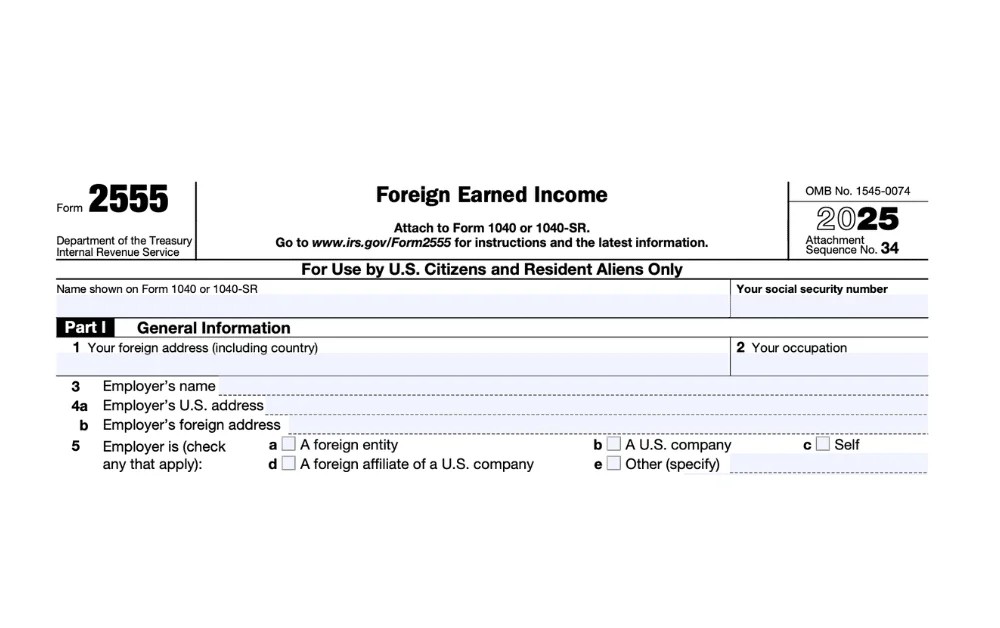
- Step 2: Complete Form 2555. Fill out Parts I through V for the FEIE, then Part VI for the housing exclusion (employees) or Part IX for the housing deduction (self-employed).
- Step 3: Attach Form 2555 to your Form 1040. The exclusion flows through automatically.
- Step 4: Keep receipts and proof of payment for all housing expenses. The IRS can request documentation in an audit.
What Mistakes Should I Avoid With the Housing Exclusion?
- Excluding full rent without subtracting the base amount. You must subtract $20,800 (2025) or $21,264 (2026) from your total housing expenses first.
- Including non-qualifying expenses. Phone, internet, and furniture purchases do not qualify.
- Using outdated figures. The 2025 tax year uses a $130,000 FEIE and $20,800 base. The 2026 tax year uses $132,900 and $21,264. Mixing these figures creates errors.
- Forgetting to prorate. If you qualified for only part of the year, both the base amount and the city cap must be prorated.
- Missing the retroactive option. If you are filing a 2025 return and your city’s 2026 limit is higher, you can use the 2026 figure. Check Notice 2026-25 before filing.
Should I Use the Housing Exclusion or the Foreign Tax Credit?
The housing exclusion works best in combination with the FEIE in low- or no-tax countries like the UAE, Singapore, or Bermuda, where you are not paying significant foreign taxes.
If you live in a high-tax country like Germany, France, the UK, or Canada, the Foreign Tax Credit (FTC) may provide a better result because your foreign taxes likely exceed your U.S. liability.
Many expats strategically combine both: use the FEIE and housing exclusion for earned income, then apply the Foreign Tax Credit for remaining or passive income. For a side-by-side comparison, see FEIE vs. FTC: Which Strategy Saves More?
What If I Missed Claiming the Housing Exclusion on Past Returns?
If you did not claim the Foreign Housing Exclusion on previous returns, you may be owed refunds. The IRS Streamlined Filing Compliance Procedures allow you to file amended returns for prior years without penalties, as long as you come forward voluntarily before the IRS contacts you.
Expats in high-cost cities often discover they overpaid by thousands when they go back and claim the housing exclusion retroactively. The process requires filing three years of amended returns and six years of FBARs.
Frequently Asked Questions on Foreign Housing Exclusion
The foreign housing exclusion is separate from the FEIE, but you claim both on the same form. The FEIE excludes up to $130,000 (2025) or $132,900 (2026) of foreign earned income. The housing exclusion then excludes additional qualifying housing costs from that amount. You must first qualify for the FEIE to be eligible for the housing exclusion, and both are reported on Form 2555.
The housing deduction from Form 2555 is the self-employed version of the foreign housing exclusion. If you are self-employed, you claim the Foreign Housing Deduction on Part IX of Form 2555 instead of the exclusion on Part VI. The calculation is identical, but the deduction appears as an adjustment to income on Schedule 1 of your Form 1040. One key difference: the housing deduction does not reduce your self-employment tax (15.3%), while the exclusion reduces gross income directly.
Yes. The IRS publishes location-specific limits for 137 foreign cities and regions in annual notices. Limits vary significantly: Hong Kong’s cap is $114,300, while cities not on the IRS list default to the standard $39,000 (2025) or $39,870 (2026). The IRS groups locations by country and, within a country, sometimes by city. For example, the UAE has separate limits for Dubai and Abu Dhabi. Check the Form 2555 instructions or IRS Notice 2026-25 for your specific location.
Only certain expenses qualify. Mortgage principal and interest payments are not eligible for the housing exclusion. However, if you own your home, you can still claim qualifying expenses like property insurance, utilities, and occupancy taxes. In practice, renters tend to benefit more from the housing exclusion because rent is typically the largest qualifying expense. If you own your home, you may be able to deduct mortgage interest separately on Schedule A.
No. If you are self-employed and claim the Foreign Housing Deduction (Part IX of Form 2555), it reduces your income tax but not your self-employment tax of 15.3%. This is an important distinction from the housing exclusion available to employees, which reduces gross income directly. Self-employed expats should factor this into their tax planning when comparing strategies.
“Foreign housing allowance” is an informal term used interchangeably with the foreign housing exclusion. The IRS does not use this term in the tax code. The official terms are the “foreign housing exclusion” (for employees) and the “foreign housing deduction” (for self-employed individuals), both defined under IRC Section 911. Employer-provided housing allowances that cover your rent and utilities count as foreign earned income and may be excluded through this provision.
Yes, but not on the same income. You can use the FEIE and housing exclusion to shelter earned income, then apply the Foreign Tax Credit to any remaining taxable income or passive income like investment gains. You cannot claim the FTC on income already excluded through the FEIE or housing exclusion. Many expats in moderate-tax countries use this combined approach strategically. See the FEIE vs. FTC comparison for more details.
If you qualified for the housing exclusion for only part of the year, you must prorate both the base amount and your city’s cap. Divide each annual figure by 365, then multiply by the number of qualifying days. For example, if you qualified for 200 days in 2025, the prorated base is ($20,800 / 365) x 200 = $11,397, and the prorated standard cap is ($39,000 / 365) x 200 = $21,370. Subtract the prorated base from your actual housing expenses, and compare the result to the prorated cap.
If your qualifying housing expenses (minus the base amount) exceed your city’s cap, you can only exclude up to the cap. Any housing costs above the cap are not excludable and remain part of your taxable income. For example, if you live in a city with a $67,000 cap and your net housing expenses total $75,000, you can only exclude $67,000. The remaining $8,000 stays taxable. This is why it is important to check your city-specific limit before filing.
How Can Greenback Help With the Foreign Housing Exclusion?
The foreign housing exclusion involves city-specific limits, prorated calculations, retroactive provisions, and coordination with the FEIE and Foreign Tax Credit. Getting it right can save you thousands, and getting it wrong can trigger IRS notices or leave money on the table.
Greenback’s expat tax accountants handle Form 2555 housing calculations for clients in over 190 countries. Whether you are filing for the first time, catching up on missed years, or deciding between the housing exclusion and the Foreign Tax Credit, your dedicated accountant will identify the best strategy for your situation.

Claim Every Housing Dollar You’re Entitled To
This article is for informational purposes only and does not constitute tax advice. Tax laws are complex and subject to change. Always consult with a qualified tax professional regarding your specific situation.
Related Resources
- Foreign Earned Income Exclusion (FEIE) for Expats
- Form 2555: Line-by-Line Instructions
- Foreign Housing Exclusion Calculator
- Physical Presence Test Requirements
- Bona Fide Residence Test for Expats
- Foreign Tax Credit for Expats
- FEIE vs. FTC: Which Strategy Saves More?
- Streamlined Filing for Expats: Catch Up Penalty-Free
- IRS Tax Inflation Adjustments for 2026
- U.S. Expat Taxes: Filing Guide for Americans Abroad


Featured In