Banks in Spain for Americans: Opening an Account, Documents, and FATCA

- Banks in Spain at a Glance
- What Kind of Bank Account Can Americans Open in Spain?
- Which Spanish Banks Accept American Applicants?
- What Documents Do You Need to Open a Spanish Bank Account?
- How to Open a Bank Account in Spain
- Why Do Spanish Banks Ask Americans About FATCA?
- How Does a Spanish Bank Account Show Up on Your U.S. Return?
- Frequently Asked Questions About Banks in Spain
- How Greenback Helps Americans Banking in Spain

Americans can open a Spanish bank account as non-residents with a passport, or as residents with the TIE card that carries their NIE. If you’re applying from the U.S., expect to finish the process at a branch in Spain. The major banks that let non-residents open online accounts limit it to applicants from Europe and a few other countries, and the U.S. isn’t among them.
Spanish banks ask Americans for their U.S. taxpayer number because Spain shares U.S. customers’ account details with the IRS under FATCA. Your Spanish account is reported on your FBAR when the total across all your non-U.S. accounts exceeds $10,000 on any day of the year. For life in Spain beyond banking, see our guide to living in Spain.
Banks in Spain at a Glance
| Question | Answer |
|---|---|
| Can Americans open a Spanish bank account? | Yes, as a non-resident with a passport, or as a resident with a TIE. |
| Can you open one online from the U.S.? | Not at the major banks we checked. Their online forms omit the U.S., or they direct you to a branch. |
| Do you need an NIE? | Residents show their TIE, which carries the NIE. Non-residents can open accounts with a passport at Santander, CaixaBank, BBVA, and Sabadell. |
| Why do Spanish banks ask about FATCA? | Spain’s FATCA agreement with the U.S. has been in force since December 2013, so banks have been reporting U.S. customers’ accounts. |
| Do you report the account to the IRS? | Yes, on the FBAR, when your foreign accounts together exceed $10,000, Form 8938 applies only at much higher thresholds. |
| Does a Spanish account go on Modelo 720? | No. Modelo 720 lists assets outside Spain, so your U.S. accounts are the ones it can catch. |
What Kind of Bank Account Can Americans Open in Spain?
Where you live decides which account you can open: a non-resident account if you live outside Spain, and a resident account once you hold a TIE. Spain also has a low-cost basic payment account, but only people legally residing in the EU are eligible for one.
| Account | Who it’s for | ID you show | Cost |
|---|---|---|---|
| Non-resident account | Americans living outside Spain | Passport, plus proof of non-resident status if the bank asks | Set by each bank. Santander’s is €0 a month |
| Resident account | Americans living in Spain on a visa | TIE | Set by each bank |
| Basic payment account | Anyone legally living in the EU | TIE | Up to €3 a month, including 120 euro transfers and direct debits a year. Free for people in a vulnerable situation |
The Certificado de No Residente
Some banks ask non-residents for a certificado de no residente, a certificate from the Spanish police that confirms you don’t live in Spain. You apply with form EX-15 and a €7.31 fee at a police station or foreigners’ office in Spain, or through a Spanish consulate if you’re in the U.S.
When You Move to Spain
Tell your bank once you have your TIE, so your account reflects your new status. CaixaBank, for one, says you can switch a non-resident account to a standard one once you’re resident. If you’d like a basic payment account, open it before any other Spanish account, as a bank may refuse to open one if you already hold a current account in Spain. Your first steps after arriving are covered in moving to Spain.
Which Spanish Banks Accept American Applicants?
Santander, CaixaBank, BBVA, Sabadell, and Openbank all offer accounts to people living outside Spain, but four of them don’t offer online account opening for someone living in the U.S., and Sabadell handles applications through an account manager. Here is what each bank’s own page said when we checked in October 2026:
| Bank | Online from the U.S.? | What the bank says |
|---|---|---|
| Santander | No | Its Non-Resident Account has no maintenance fee and pays no interest. Online opening with a passport and video ID works from 27 listed countries, and the U.S. isn’t one of them, so ask at a branch |
| CaixaBank | No | Its HolaBank account opens online for nationals and residents of 18 listed countries, not including the U.S. Every non-resident visits a branch in Spain within six months; until then, international transfers are blocked and cash deposits are capped at €600 a month |
| BBVA | No | People from outside the EU who don’t live in Spain open at one of its 1,800 branches with a valid passport |
| Openbank | No | Online opening with a passport is described for residents of EU countries |
| Sabadell | Not stated | Its Key Account is built for non-residents, and applicants from outside the EU use a passport. You fill in a form, and a manager who speaks your language contacts you to set up and sign the account, so ask how signing works from the U.S. |
Once you live in Spain, the options widen. BBVA lets non-EU residents open with a TIE at a branch or through its app, and CaixaBank’s guide for foreigners says non-EU residents need only their NIE. Bank terms change, so check the bank’s page before you travel.
You’ll likely want to keep a U.S. account open next to your Spanish one for U.S. income and bills. Our guide to the best U.S. banks for Americans living abroad compares the options.
What Documents Do You Need to Open a Spanish Bank Account?
To open a Spanish bank account, you need a passport or TIE, proof of your address, and your U.S. Social Security number for the FATCA form. The rest depends on your status and the bank.
| Document | Non-resident account | Resident account |
|---|---|---|
| Valid passport | Yes | Usually, with your TIE |
| TIE, carrying your NIE | No | Yes |
| Certificado de no residente | If the bank asks | No |
| Proof of address | Your U.S. address | A Spanish utility bill or lease |
| Proof of income or employment | Some banks | Some banks |
| U.S. Social Security number | Yes, for the FATCA form | Yes, for the FATCA form |
| Mobile phone | Some banks, to confirm codes | Some banks, to confirm codes |
The bank can also ask where the money you deposit comes from. Banco de España explains that anti-money-laundering rules allow this at opening or later, and that a bank can freeze an account if you can’t show the source. Keep the records of transfers from your U.S. accounts.
Can You Open a Spanish Bank Account Without an NIE?
You can, as a non-resident, open accounts with Santander, CaixaBank, BBVA, and Sabadell, all of which open non-resident accounts with a passport. Once you live in Spain, you open with your TIE, which already carries your NIE. If you need an NIE before you move, our guide to the NIE number covers how to apply from the U.S.
How to Open a Bank Account in Spain
Opening a Spanish bank account takes five steps, and most of the work happens before you reach the branch:
- Choose the account that matches your status on the day you open, non-resident or resident.
- Gather the documents from the checklist and book a branch appointment.
- Open the account at the branch, or online if you’re a resident with a TIE and the bank offers it.
- Sign the FATCA form confirming your U.S. citizenship and Social Security number.
- Read the pre-contract information and the fee document before you sign. The basic payment account rules cap that account’s fee, but every other account follows the bank’s own fee list.
Why Do Spanish Banks Ask Americans About FATCA?
Spain signed a FATCA agreement with the U.S. that has been in force since 9 December 2013, so Spanish banks identify their U.S. customers and report those accounts to Spain’s tax agency, which passes the details to the IRS. Under the Foreign Account Tax Compliance Act, foreign banks report accounts held by U.S. taxpayers.
- At opening, you sign a form confirming that you’re a U.S. citizen and providing your Social Security number.
- Each year, the bank includes your account on Modelo 290, the tax agency’s annual return on accounts held by U.S. persons.
- For you: the bank’s report doesn’t replace yours. Your own FBAR and Form 8938 are filed separately, and the IRS receives the bank’s details either way.
Outside Spain, some banks avoid this reporting by declining U.S. customers, and our article explains why some foreign banks turn Americans away. If a Spanish bank later writes to ask whether you’re a U.S. person, see what to do about a FATCA letter from your bank.
How Does a Spanish Bank Account Show Up on Your U.S. Return?
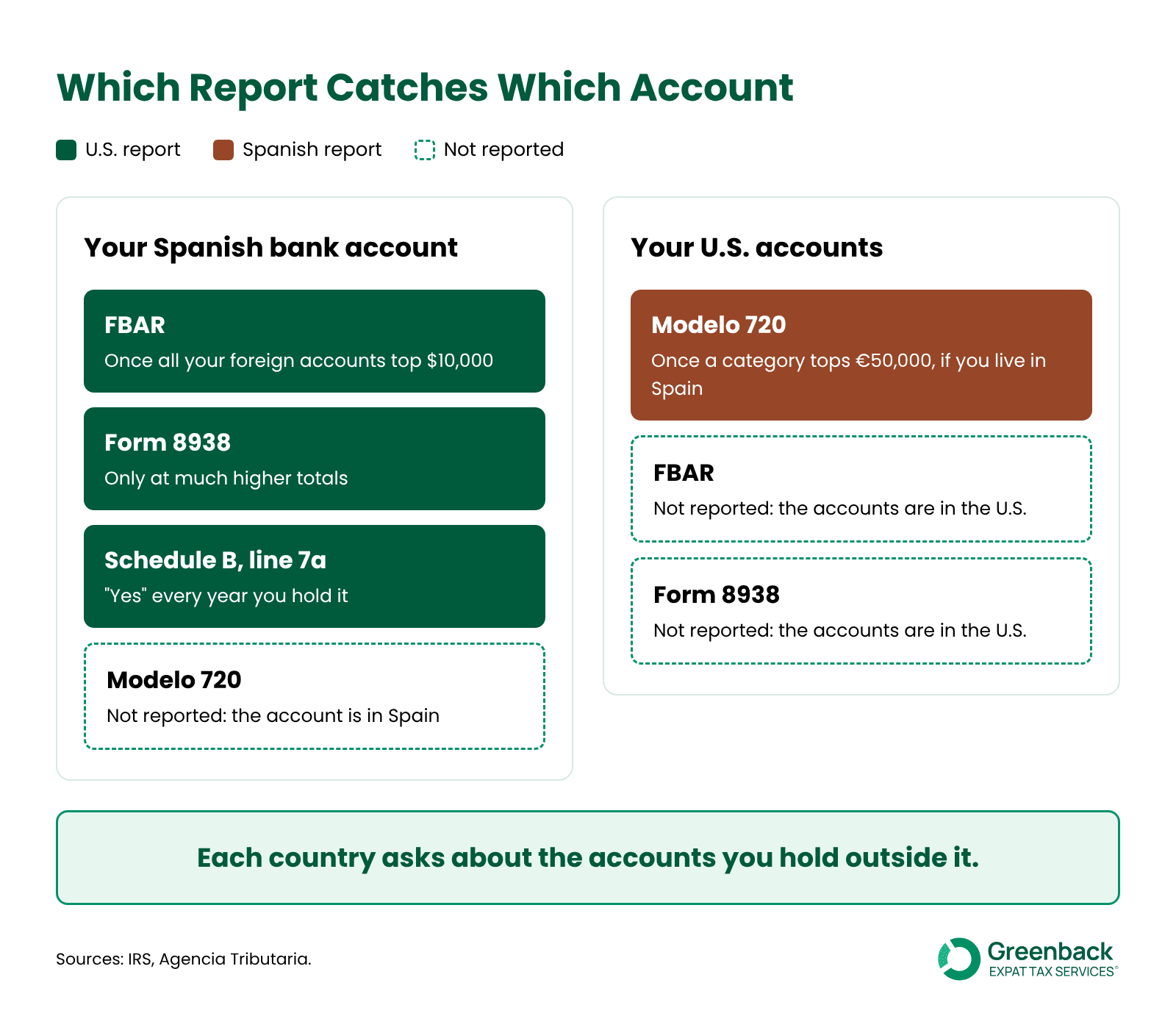
A Spanish bank account goes on your FBAR once all your foreign accounts pass $10,000, on Form 8938 only at much higher totals, and on Schedule B every year you hold it.
- FBAR: You file one when the combined value of all your accounts outside the U.S. passes $10,000 at any time in the year, according to the IRS. It’s due on April 15 and automatically moves to October 15 if you need more time. If every account is held jointly with your spouse, one of you can file for both with Form 114a. More in our FBAR guide.
- Form 8938: if you live abroad, you file it when your foreign financial assets exceed $200,000 at year-end, $300,000 on any day, or $400,000 or $600,000 on a joint return. Until you meet the test for living abroad, the lower U.S. thresholds apply: $50,000 and $75,000, or $100,000 and $150,000 joint. See Form 8938 and how the FBAR and Form 8938 compare.
- Schedule B and interest: any interest is taxable on your U.S. return. The Schedule B instructions say to check “Yes” on line 7a if you had a foreign account at any time in the year, even if you don’t have to file an FBAR. Spain also taxes interest once you’re resident, at the rates on our Spanish tax system page.
- Modelo 720: Spain’s report of assets held outside Spain leaves your Spanish account off. Your U.S. accounts are what it can catch, as explained in our guide to Spanish wealth tax and Modelo 720.
If you hold accounts in other countries as well, our guide to opening a foreign bank account outlines which accounts trigger U.S. filing requirements.
Example: A Retired Couple Moves Their Savings to Spain
Carmen and Ray, a retired couple from Arizona, arrive in Valencia on 1 March 2026 on the non-lucrative visa. Once they have their TIEs, they open a joint resident account at a BBVA branch and transfer $60,000 (about €53,160) from their U.S. bank. Their $250,000 brokerage account stays in the U.S.
| Report | Do they file? | Why |
|---|---|---|
| FBAR for 2026 | Yes, one FBAR for both with Form 114a | The joint account passes $10,000, and it’s their only foreign account |
| Form 8938 for 2026 | No | They arrived in March, so they don’t meet the test for living abroad in 2026. At $60,000, the account is under even the U.S. joint thresholds of $100,000 and $150,000 |
| Schedule B, line 7a | Yes, “Yes” checked | They held a foreign account during 2026 |
| Modelo 720 | Yes, for the brokerage account only | They’re Spanish residents for 2026, and the U.S. account holds more than €50,000. The BBVA account is in Spain, so it stays off |
| FATCA | Nothing for them to file | BBVA reports the account on Modelo 290 |
Their first FBAR is due on 15 April 2027, and it automatically moves to 15 October 2027 if they need more time. They file their first Modelo 720 by 31 March in the first quarter of 2027.
Frequently Asked Questions About Banks in Spain
Spain’s Deposit Guarantee Fund protects deposits up to €100,000 per person at each member bank. Deposits from certain events, such as the sale of a home, are fully protected for three months.
Spain taxes interest once you live there, on its savings scale, which starts at 19%. While you live in the U.S., the U.S.-Spain tax treaty leaves interest taxable only in the U.S.
Bizum, Spain’s instant payment service, runs through your Spanish bank’s app and sends money between accounts with a Spanish IBAN, so it works once your Spanish account is open. Sabadell, for example, offers it in its app.
The non-resident certificate and the NIE both use form EX-15, but they do different jobs. The NIE is your permanent foreigner number, and the certificate confirms that you don’t live in Spain on the day it’s issued.
How Greenback Helps Americans Banking in Spain
Greenback’s tax team handles your Spanish accounts on your U.S. return. We file your FBAR and Form 8938 when they apply, report any interest on your U.S. return, and complete the foreign account questions on Schedule B. If a Spanish account went unreported in earlier years, we can bring you up to date through the Streamlined Filing Compliance Procedures. Spanish returns and Modelo 720 stay with a Spanish adviser. For the full list of U.S. forms, see U.S. expat taxes in Spain, and see how Greenback supports U.S. citizens living abroad.

Banking in Spain, Reporting Done Right
This article is for informational purposes only and does not constitute tax or legal advice. Bank terms come from Santander, CaixaBank, BBVA, Sabadell and Openbank pages checked in October 2026 and can change, and your U.S. reporting depends on the total of all your accounts outside the U.S. Speak with a qualified professional about your situation.




Featured In





