Spain Wealth Tax and Modelo 720: What Americans Owe and Must Report

- Spain Wealth Tax at a Glance
- Who Pays Spanish Wealth Tax, and What Counts?
- How Much Is the Wealth Tax in Spain?
- Who Has to File Modelo 720?
- How to File Modelo 720
- Does the U.S. Tax Your Wealth?
- Modelo 720, FBAR and Form 8938: Which Reports Do You File?
- Frequently Asked Questions About Spanish Wealth Tax
- How Greenback Plans the U.S. Side of Your Spanish Taxes

The Spain wealth tax is an annual tax on a Spanish resident’s worldwide net assets above €700,000 per person, charged at 0.2% to 3.5%, with your main home exempt up to €300,000. Your region sets the real threshold: Cataluña taxes from €500,000, the Comunitat Valenciana from €1 million, and the Illes Balears from €3 million, while Madrid and Andalucía charge nothing under about €3.7 million of net wealth per person, not counting the home; above that, a national solidarity tax applies.
Separate from any tax, Spanish residents file Modelo 720, a yearly report of assets held outside Spain, once accounts, investments, or property abroad pass €50,000 in any one category, between 1 January and 31 March. For Americans, the two countries’ lists mirror each other: Spain wants your U.S. brokerage account and IRA on Modelo 720, and the U.S. wants your Spanish bank account on the FBAR. The rest of settling in, from residence to banking, is mapped in our living in Spain hub.
Spain Wealth Tax at a Glance
| Question | Answer |
|---|---|
| Is there a wealth tax in Spain? | Yes. Spain taxes net wealth every year, on the value you hold on 31 December. |
| Do Americans living in Spain pay wealth tax? | Yes, if they are Spanish tax residents with net assets above their region’s allowance. U.S. accounts and IRAs count; Beckham Law taxpayers pay on Spanish assets only. |
| What is the wealth tax threshold in Spain? | €700,000 per person, plus up to €300,000 for your main home, unless your region sets a different allowance. |
| Does the U.S. have a wealth tax? | No. The U.S. taxes the income and gains your assets produce and gives no credit for the Spanish wealth tax. |
| Where in Spain is there no wealth tax? | Madrid and Andalucía charge nothing for net wealth under about €3.7 million per person, plus a main home up to €300,000. |
| Do I file both FBAR and Modelo 720? | Usually yes. They cover different accounts, and filing one never replaces the other. |
Who Pays Spanish Wealth Tax, and What Counts?
Spanish wealth tax, the Impuesto sobre el Patrimonio, is paid by Spanish tax residents on everything they own worldwide, less their debts, as it stands on 31 December. If you are not a Spanish resident, only your assets in Spain are subject to tax. Whether you count as a resident follows Spain’s income tax tests, explained in our guide to how the Spanish tax system works. New arrivals taxed under the Beckham Law pay on their Spanish assets only.
Each person is taxed on their own share with their own allowance and home exemption, so a couple’s allowances double. Every asset goes in at a set value, converted to euros at the European Central Bank’s official rate on 31 December:
| Asset | How it is valued for wealth tax |
|---|---|
| Bank accounts, in Spain or the U.S. | The higher of the 31 December balance or the average balance from October to December |
| Listed shares | The average trading value from October to December |
| Funds and ETFs | The value per unit on 31 December |
| A home or other property in Spain | The highest of the cadastral value (the official assessed value), any value the tax agency has set for it, or the price you paid |
| A house you still own in the U.S. | The price you paid, in euros |
| Debts, such as a mortgage | Deducted at the amount owed, if you can document it |
These rules come from the national wealth tax law (Ley 19/1991) and the tax agency’s wealth tax manual. Treating a U.S. ETF as a fund is the usual reading; Spain’s tax agency does not name ETFs, so confirm it with your Spanish adviser.
Example: An American Couple in Barcelona
Priya and Marcus, both U.S. citizens, moved to Barcelona in early 2026, so 2026 is their first year as Spanish residents. On 31 December 2026, they own, half each, unless noted:
- Their home: a Barcelona flat valued at €600,000 for wealth tax.
- A U.S. brokerage account: two ETFs worth €500,000 and €400,000, about $1 million together.
- Priya’s IRA: €300,000, about $336,000, in her name alone.
- A Spanish bank account: €60,000, about $67,200.
Dollar amounts assume €1 = $1.12, rounded from the European Central Bank rate of $1.1225 on 2 October 2026, and are illustrative.
Do 401(k)s and IRAs Count Toward Spanish Wealth Tax?
IRAs and Roth IRAs count toward the Spanish wealth tax, according to a binding ruling V1291-22 from Spain’s tax ministry, issued in June 2022 to an American living in Spain. Spain exempts only Spanish pension plans and certain EU plans covered by its pension law (ruling V1735-22), so a U.S. account does not qualify, and Priya’s IRA counts in full. Spain has not said how an IRA is valued, so the example uses its balance. No ruling covers 401(k)s yet, though the same reasoning likely applies, so confirm yours with your Spanish adviser. How Spain taxes withdrawals is covered on our retiring in Spain page.
How Much Is the Wealth Tax in Spain?
Spain’s wealth tax runs from 0.2% to 3.5% of net wealth above your allowance, but the region you live in on 31 December sets the allowance, the rates, and whether you pay at all. These are the positions for 2026, with returns filed in 2027, in the communities Americans most often choose; we found no change to these rules for 2026:
| Community | Allowance per person | What you pay |
|---|---|---|
| Madrid | €700,000 | Nothing under about €3.7 million of net wealth; above that, the amount the solidarity tax would charge |
| Andalucía | €700,000 | Same as Madrid |
| Región de Murcia | €700,000 | Same as Madrid |
| Comunitat Valenciana | €1,000,000 | 0.25% to 3.5% above the allowance |
| Cataluña | €500,000 | 0.21% to 3.48% above the allowance |
| Illes Balears | €3,000,000 | 0.28% to 3.45% above the allowance |
| Galicia | €700,000 | 0.2% to 3.5%, halved by a regional discount, with any solidarity tax taken off the discount |
| Canarias | €700,000 | 0.2% to 3.5%, the national scale |
Madrid, Andalucía, and Murcia reach zero through a bonificación, a regional discount that exempts the tax except for the portion that the national solidarity tax would otherwise collect. Non-residents can choose the rules of the community where most of their Spanish assets are located. The national rules are set out in Ley 19/1991, and each regional figure is taken from the Spanish tax agency’s wealth tax manual.
Two more rules shape the bill:
- The 60% cap: your Spanish income tax and wealth tax together cannot exceed 60% of your taxable income for the year, though the cap can cut the wealth tax by no more than 80%.
- Modelo 714: the wealth tax return. You file it if you owe anything, or if your gross assets exceed €2 million, even when nothing is due, normally between April and 30 June; the 2026 return is due by 30 June 2027.
Priya and Marcus’s Wealth Tax in Barcelona
Each spouse’s €300,000 share of the flat is exempt as their main home. Priya’s taxable assets are €250,000 in ETFs, €30,000 in the bank account, and her €300,000 IRA, for a total of €780,000. After Cataluña’s €500,000 allowance, €280,000 is taxable:
| Slice of Priya’s taxable wealth | Catalan rate | Tax |
|---|---|---|
| First €167,129 | 0.21% | €351 |
| Next €112,871 | 0.315% | €356 |
| Total on €280,000 | €707 |
Marcus holds €480,000 under the allowance, so he owes nothing. Priya files Modelo 714 and pays about €707 for 2026; Marcus does not file. Had they settled in Madrid, the regional discount would remove the tax on Priya’s €80,000 above the €700,000 allowance, and with each spouse’s gross assets under €2 million, neither would file Modelo 714.
What Is Spain’s Solidarity Tax on Large Fortunes?
Spain’s solidarity tax on large fortunes is a national tax on net wealth above about €3.7 million per person: a €700,000 allowance, then 0% on the next €3 million, with the €300,000 home exemption on top. Above that, it charges 1.7%, then rises to 2.1% and 3.5%, and any regional wealth tax you pay is credited against it, so it mainly hits people in regions with low or no wealth tax. It began as a two-year measure in 2022, was extended in 2023 with no end date, and is filed on Modelo 718 in July. The rules are in Article 3 of Ley 38/2022.

Who Has to File Modelo 720?
Modelo 720 is filed by Spanish tax residents who hold more than €50,000 outside Spain in any one of three categories, between 1 January and 31 March of the following year. It lists what you own abroad and what it was worth; any tax on those assets is paid on your other Spanish returns. The three categories are counted separately:
- Accounts abroad: checking, savings, deposit, and credit-line accounts, each at the higher of its 31 December balance or its October to December average.
- Securities, funds, insurance, and annuities abroad: shares, ETFs, and mutual funds, and products such as an IRA.
- Real estate abroad: a house or apartment you still own in the U.S., or rights over one.
Once a category passes €50,000, you report every item in it. An account or investment held jointly counts in full for each owner: both spouses file, each reports the whole value, and each gives their percentage.
After the first year, you refile only if a category grows by more than €20,000 or you sell or close something you reported. Residency counts for the whole year, so if you became resident in 2026, your first Modelo 720 is due between 1 January and 31 March 2027. People taxed under the Beckham regime do not file it. Crypto held on platforms outside Spain has its own return, Modelo 721, with the same €50,000 line and the same dates.
For Priya and Marcus: their investment category is far above €50,000, so both file their first Modelo 720 by 31 March 2027. Each reports both ETFs at full value with a 50% share, and Priya adds her IRA. The flat and the Spanish account are in Spain, so neither goes on it, and they have no accounts or property abroad to report.
How to File Modelo 720
Modelo 720 is filed online only, through the tax agency’s Modelo 720 procedure page, with one record for each asset you report. Many Americans use a Spanish adviser; the steps are the same either way:
- Check each category: add up your accounts, then your investments, then any property, all outside Spain and converted to euros at the 31 December rate. Any category over €50,000 must be filed.
- Collect the details for every item: the institution’s name, address, and country; the account number and BIC, or for funds and shares, the ISIN, the 12-character code on your statement; the date you opened the account or bought the asset; the number of units; and the value on 31 December. For accounts, add the October-December average.
- Get access: you need your NIE, the foreigner identity number that serves as your tax number, plus a digital certificate or Cl@ve, Spain’s online ID system. An adviser authorized to file on your behalf can submit it instead.
- Enter each item as its own record: its asset type, your role as owner, your percentage, and whether it is new, reported before, or closed, as Priya’s records show.
- Validate, preview, sign, and send: keep the receipt, because its 13-digit number is what you quote to correct or replace the return later.
Here is what Priya’s records look like, field by field:
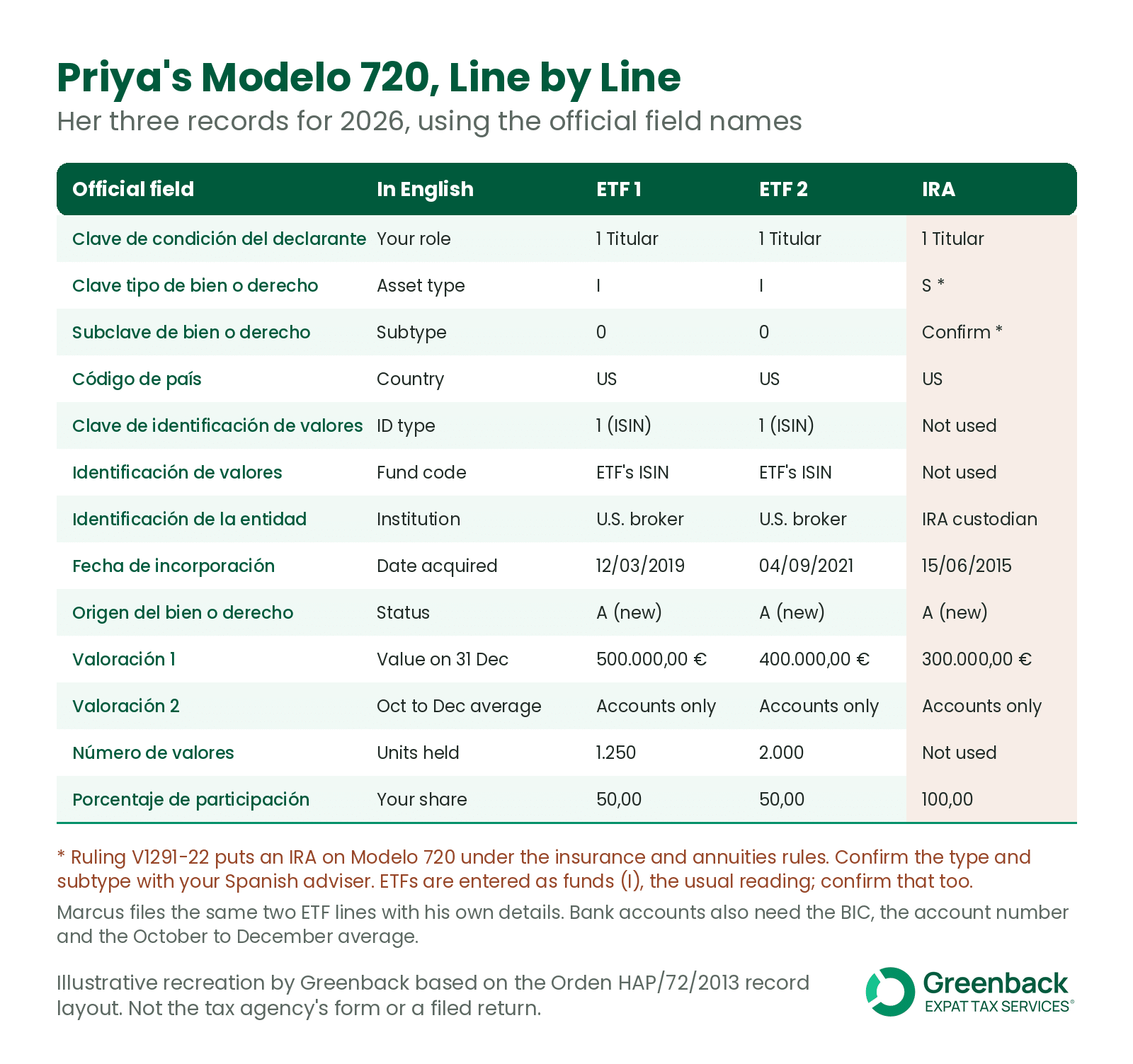
The tax agency’s Modelo 720 questions and answers cover edge cases such as closed accounts and shared ownership.
What Are the Modelo 720 Penalties?
Modelo 720 penalties now follow Spain’s general tax rules: €20 for each item on a return filed late or not at all, from €300 to €20,000, halved if you file before the tax agency contacts you, and €200 for each item reported wrongly or left off a return you filed. The EU Court of Justice struck down the old, far heavier regime on 27 January 2022, and Ley 5/2022 replaced it. Undeclared assets abroad can now be taxed only within the normal limitation period, the window the tax agency has to review a year. If you have missed a year, a Spanish adviser can file the late return for you.
Does the U.S. Tax Your Wealth?
The U.S. has no wealth tax: it taxes the income and gains your assets produce each year, and it taxes transfers at death or by gift only above high limits. Spain taxes the value of what you own as well as the income it earns, so an American living in Spain meets two different systems on the same savings:
| What is taxed | Spain | U.S. |
|---|---|---|
| The value of what you own, every year | Wealth tax, above your region’s allowance | Nothing |
| Interest, dividends and gains | Income tax as a resident | Income tax as a citizen, with a Foreign Tax Credit for Spanish income tax, within limits |
| Transfers at death or by gift | Inheritance and gift tax, set by each region | Estate and gift tax, with a $15 million exclusion per person for 2026 |
| What you report | Modelo 714, 720 and 721 | FBAR and Form 8938 |
The Foreign Tax Credit only offsets foreign income tax, as set out in IRS Publication 514, so the Spanish wealth tax remains a cost of its own with no U.S. relief. For the Spanish income tax on your investment income, the U.S.-Spain tax treaty decides which country taxes each type of income first and which one gives the credit, and the net investment income tax cannot be reduced by the Foreign Tax Credit. The U.S. estate and gift rules are covered in our guide to estate taxes for U.S. citizens living abroad.
For Priya and Marcus: the U.S. never asks what their €1.86 million of assets are worth. It taxes the ETF dividends and any gains when they sell, and the amount of Spanish income tax it credits on that income depends on the treaty’s rules for U.S.-source income.
Modelo 720, FBAR and Form 8938: Which Reports Do You File?
Americans in Spain file Modelo 720 for U.S. assets over €50,000 in a category and the FBAR for Spanish accounts over $10,000, adding Modelo 714 only if they owe wealth tax or hold over €2 million, and Form 8938 only once non-U.S. assets pass $200,000, or $400,000 on a joint return.
| Report | Who files | What it covers | Threshold | Deadline |
|---|---|---|---|---|
| Modelo 714 | Anyone owing the Spanish wealth tax, or with gross assets over €2 million | Net wealth | Regional allowance | 30 June |
| Modelo 720 | Spanish residents | Assets outside Spain | €50,000 per category | 31 March |
| Modelo 721 | Spanish residents | Crypto held outside Spain | €50,000 | 31 March |
| FBAR | U.S. persons | Accounts outside the U.S. | $10,000 combined, at any time in the year | April 15, extended automatically to October 15 |
| Form 8938 | U.S. filers living abroad | Financial assets outside the U.S. | Single: $200,000 on 31 December or $300,000 during the year. Joint: $400,000 or $600,000 | With your U.S. return |
For Priya and Marcus: the Spanish account is over $10,000, so both file an FBAR for it. Form 8938 is not needed: filing jointly, their only foreign financial asset, the Spanish account at about $67,200, is under the $400,000 year-end line, and a home owned directly is outside Form 8938. The brokerage account and the IRA are held in the U.S., so they do not appear on the U.S. report, which is the mirror of their Modelo 720.
The U.S. rules for each report are in our guides to the FBAR, Form 8938, and how the two compare, and every U.S. form an American in Spain may face is listed on our U.S. expat taxes in Spain page.
Frequently Asked Questions About Spanish Wealth Tax
The Spanish wealth tax does not qualify for a U.S. Foreign Tax Credit because the credit applies only to income taxes. Spanish income tax on the same savings may be credited, within the limits set by the U.S.-Spain treaty and IRS rules.
Americans lower Spanish wealth tax mainly through where they settle: Cataluña taxes from €500,000, while Madrid, Andalucía, and Murcia charge nothing under about €3.7 million per person. Joint ownership gives each spouse an allowance and a home exemption, and under the Beckham regime, taxpayers pay only on Spanish assets.
Modelo 720 is due in later years only if a category has grown by more than €20,000 since your last filing, or if you sold or closed something you reported. If nothing has changed, you do not refile.
Spain’s wealth tax is still in force. The solidarity tax, first set for two years, was extended in 2023 with no end date until Spain reforms its regional financing.
How Greenback Plans the U.S. Side of Your Spanish Taxes
Greenback’s accountants prepare your U.S. return based on what you pay in Spain: we set the Spanish income tax you pay against your U.S. tax where the rules allow, plan the U.S. side of sales and withdrawals, and make sure your FBAR and Form 8938 cover the Spanish accounts your Modelo 720 leaves off.
We do not prepare Spanish returns, so we work from the figures your Spanish adviser reports. If you have missed U.S. returns or FBARs since moving, we can help you catch up, including through the Streamlined Filing Compliance Procedures.

Two countries, one clear picture.
This page gives general information only; it is not tax or legal advice. Figures are for the 2026 tax year, and Spanish regional rules and the solidarity tax can change. Greenback prepares U.S. returns and plans the U.S. side of your Spanish taxes; it does not prepare Spanish returns. Confirm your Spanish wealth tax and Modelo 720 position with a Spanish tax adviser, and speak with a qualified U.S. tax professional about your situation.




Featured In