1099 Forms for U.S. Expats Explained: Types, Reporting Rules, and How to File From Abroad
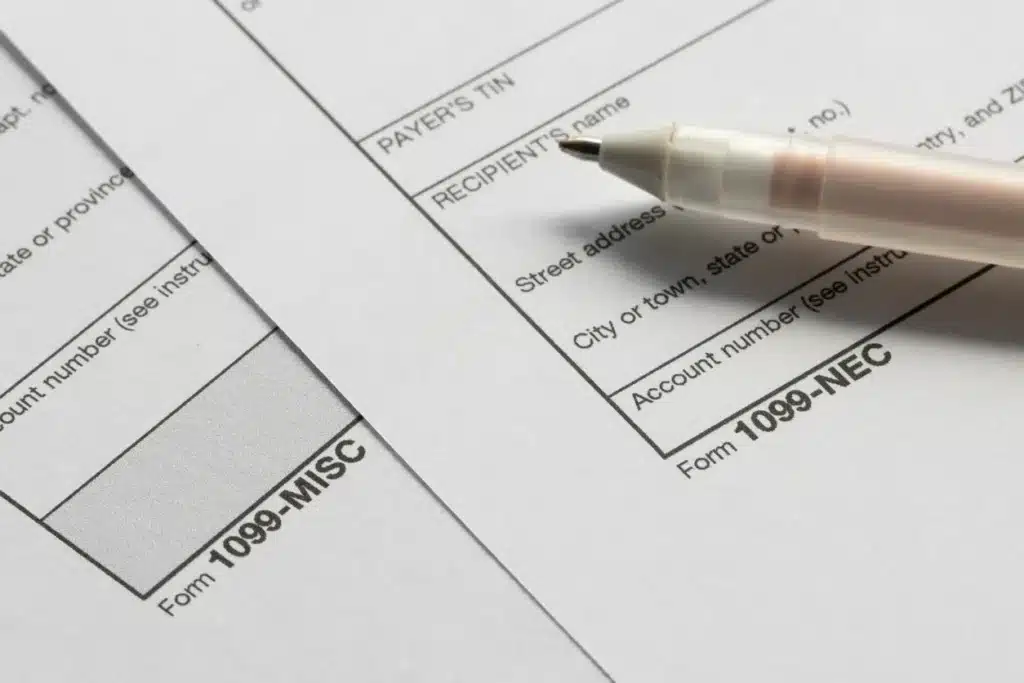
- What Is the Purpose of a 1099 Form?
- When Will I Receive a 1099 Form?
- Who Receives a 1099 Form?
- The 22 Types of 1099 Forms: Which One Will You Get?
- What Should I Do When I Receive a 1099 Form?
- What If I'm Behind on My Expat Taxes?
- 1099 Forms and Self-Employment Tax
- Key 2026 Changes For Form 1099 You Need to Know
- Next Steps for Expats Receiving 1099 Forms
- Related Resources


What is a 1099 form? U.S. expats who earn income from American clients, investments, retirement accounts, or other U.S. sources will receive 1099 forms, and all 1099 income must be reported on your Form 1040, regardless of where you live. The most common types of income expats encounter are 1099-NEC (freelance and contractor income from U.S. clients), 1099-DIV (dividends), 1099-INT (interest), 1099-R (retirement distributions), and 1099-B (investment sales). Starting with the 2025 tax year, the new 1099-DA reports digital asset transactions from centralized exchanges.
The good news: receiving a 1099 doesn’t mean you owe tax. The Foreign Earned Income Exclusion can exclude up to $130,000 of earned income (2025), and the Foreign Tax Credit offsets U.S. tax on income already taxed abroad. However, some 1099 income types (dividends, interest, capital gains) are passive income and cannot be excluded under the FEIE; they can only be offset by the FTC.
If you work for foreign clients who don’t issue 1099s, you’re still required to report that income. The 1099 is a U.S. reporting document, not a prerequisite for reporting income. Here’s which 1099 forms matter most for expats, how each type interacts with expat tax benefits, and what to do if you receive one with errors.

See How a 1099 Affects Your Expat Taxes
What Is the Purpose of a 1099 Form?
Form 1099 serves as a paper trail for the IRS to track income that doesn’t go through traditional employment channels. The IRS calls it an “information return” because it informs both you and the IRS about payments you received during the tax year.
Think of it this way: when you work for an employer, they withhold taxes from each paycheck and report your total earnings on Form W-2. But when you work as a freelancer, earn interest on savings, collect rental income, or receive retirement distributions, there’s often no automatic tax withholding. Form 1099 ensures the IRS knows about this income, even when you haven’t paid taxes on it throughout the year.

Just because the IRS receives a copy of your 1099 doesn’t mean that the income is automatically taxable. Many 1099 forms report payments that may be partially or fully excludable from U.S. taxation when you apply expat tax benefits.
When Will I Receive a 1099 Form?
You should receive your 1099 forms by January 31, 2026, for income earned in 2025. The form comes from whoever paid you: your client, your bank, your brokerage, your retirement plan administrator, or another payer.
Most payers now send 1099 forms electronically, though some still mail paper copies. If you haven’t received your 1099 by mid-February, contact the payer directly to request a copy. Even if you never receive the form, you’re still legally required to report the income on your tax return.
Filing deadlines for payers:
- January 31, 2026: Deadline to send copies to recipients
- February 28, 2026: Deadline for paper filing with IRS (falls on Saturday, so moves to March 2)
- March 31, 2026: Deadline for electronic filing with IRS
Who Receives a 1099 Form?
You’ll receive a 1099 if you:
- Work as an independent contractor or freelancer and earn $600 or more from a single client ($2,000 starting in 2026)
- Earn interest income of $10 or more from banks or financial institutions
- Receive dividend payments of $10 or more from investments
- Collect rental income of $600 or more ($2,000 starting in 2026)
- Take retirement distributions from IRAs, 401(k)s, or pension plans
- Earn income from digital assets like cryptocurrency (new reporting starting 2025)
- Receive payments through payment apps like PayPal or Venmo, exceeding $20,000 and 200 transactions
- Sell stocks, bonds, or other securities through a broker
- Receive unemployment compensation or other government payments
This is not an exhaustive list. The IRS requires 1099 reporting for dozens of different payment types, which is why there are 22 different versions of the form.
The 22 Types of 1099 Forms: Which One Will You Get?
The “1099” isn’t a single form: it’s a family of 22 different forms, each designed for specific types of income. Here are the most common forms you’ll encounter as an American expat:
Form 1099-NEC: Non-Employee Compensation
Most common for expats working abroad. This form reports income you earned as an independent contractor, freelancer, consultant, or self-employed professional. If you earned $600 or more from a U.S. client (or any client who’s required to file), you’ll receive this form.
What’s New for 2025: Starting in 2026, the reporting threshold increases from $600 to $2,000 due to the One Big Beautiful Bill Act. Golden parachute payments (large executive severance packages) must now be reported in Box 3 instead of on Form 1099-MISC.
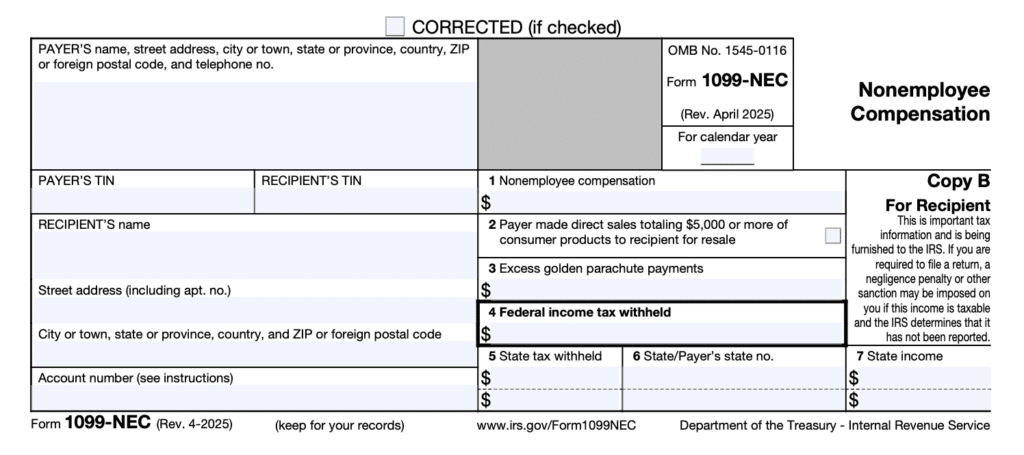
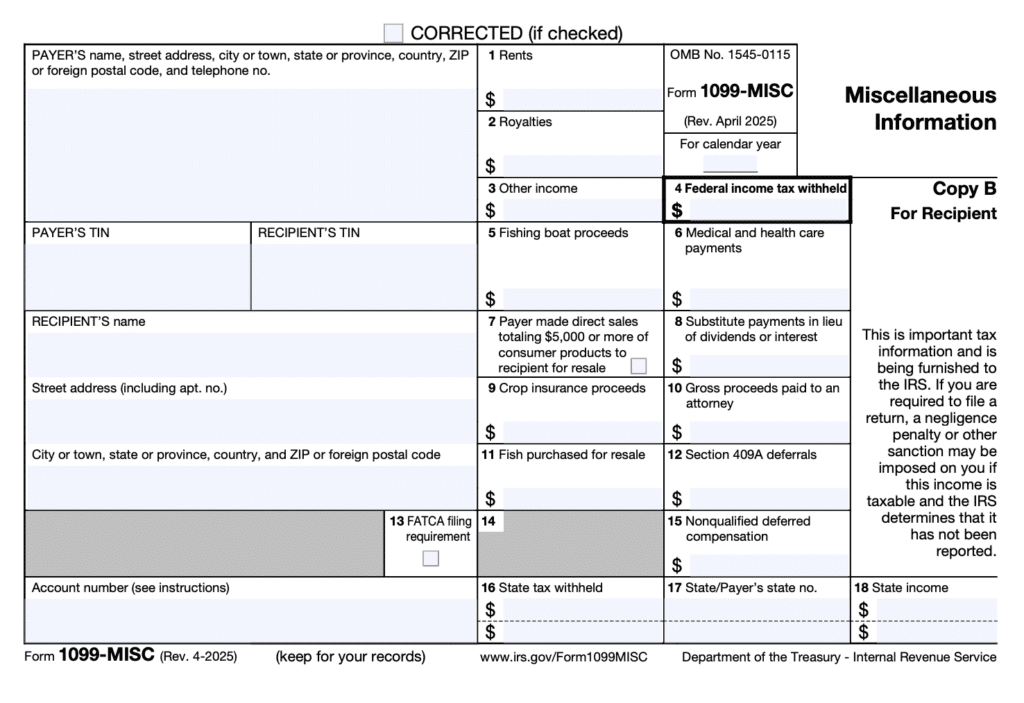
Form 1099-MISC: Miscellaneous Income
Reports various types of income, including:
- Rental income ($600 or more)
- Prizes and awards
- Medical and healthcare payments
- Attorney fees and gross proceeds
- Crop insurance proceeds
What’s New for 2025: Golden parachute payments are no longer reported on this form: they’ve moved to Form 1099-NEC Box 3.
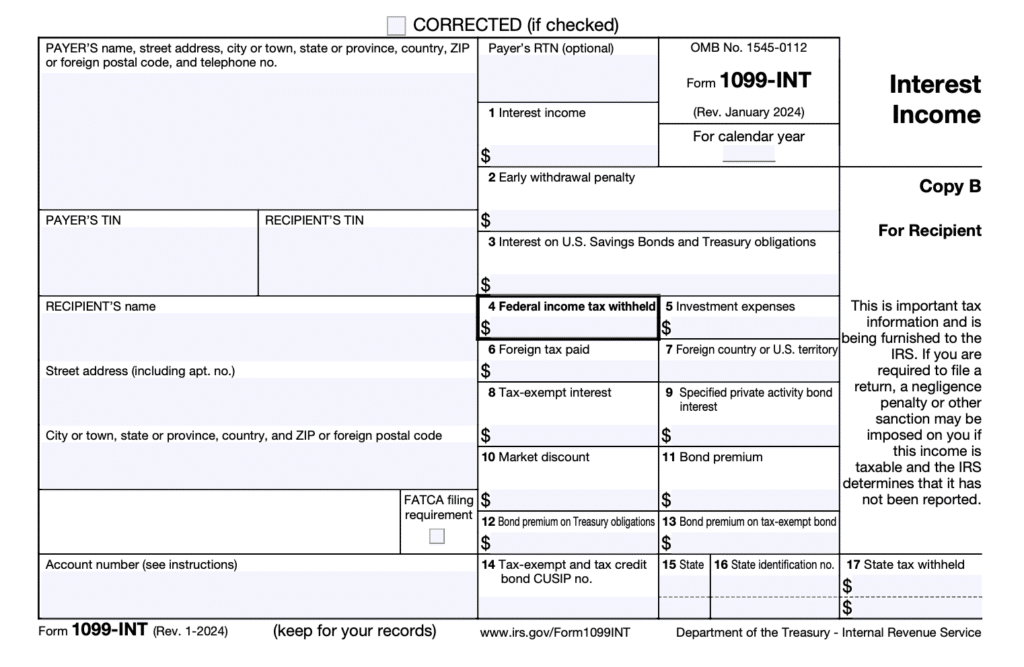
Form 1099-INT: Interest Income
Sent by banks, credit unions, and financial institutions when you earn $10 or more in interest. This includes interest from U.S. savings accounts you maintain while living abroad.
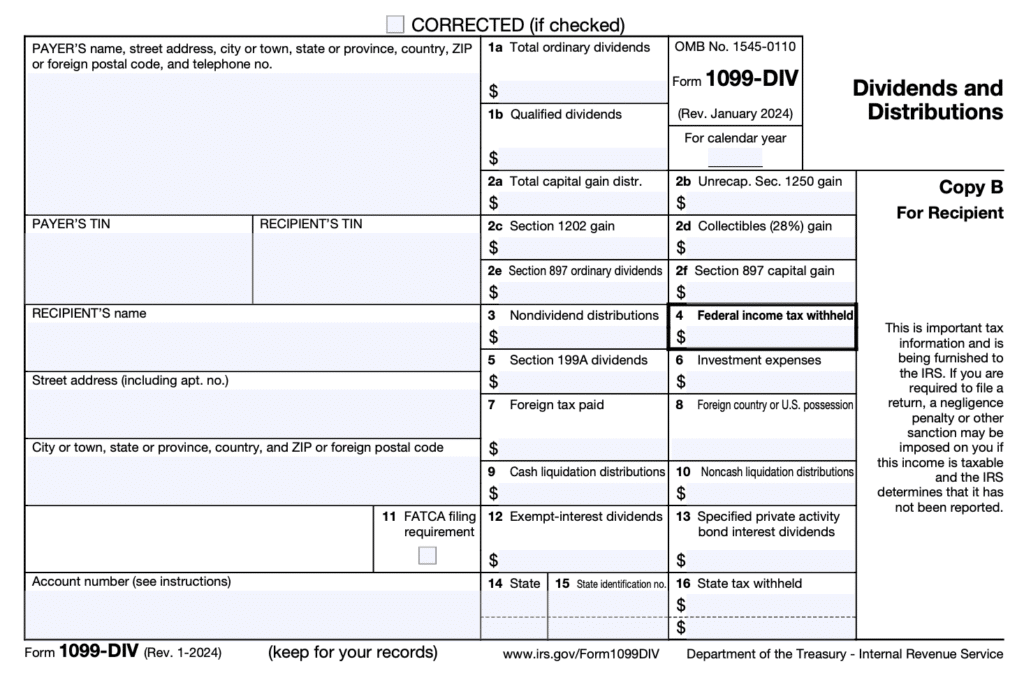
Form 1099-DIV: Dividends and Distributions
Reports dividends from stocks, mutual funds, or other investments. You’ll receive this if you earned $10 or more in dividends during the year.
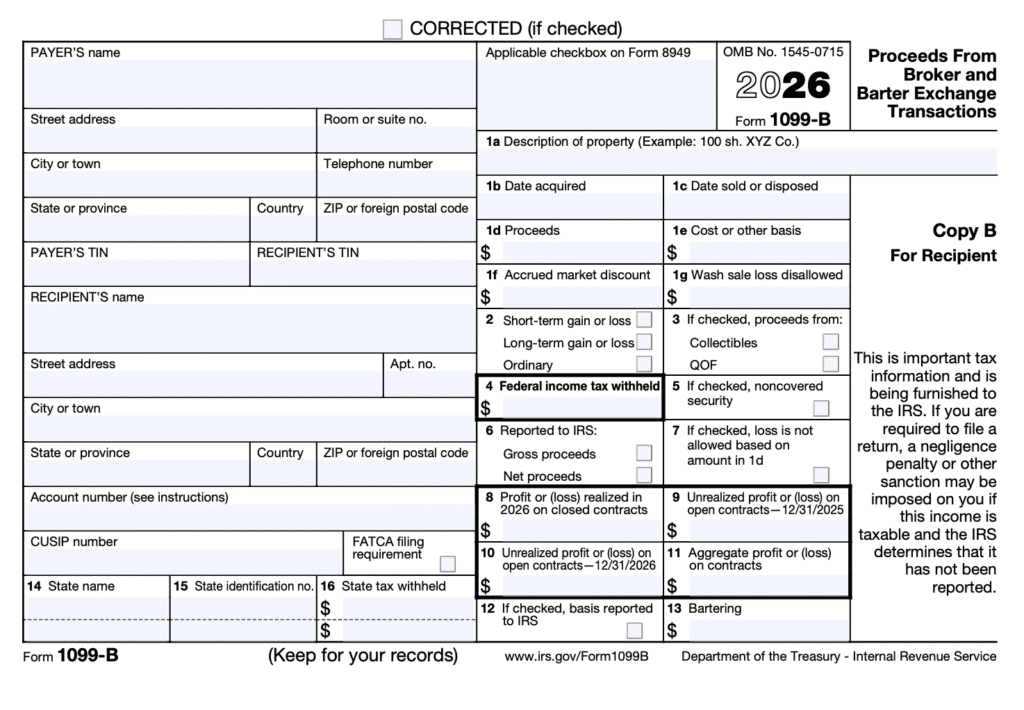
Form 1099-B: Proceeds from Broker Transactions
Issued when you sell stocks, bonds, cryptocurrency, or other securities through a brokerage. Reports the gross proceeds from the sale.
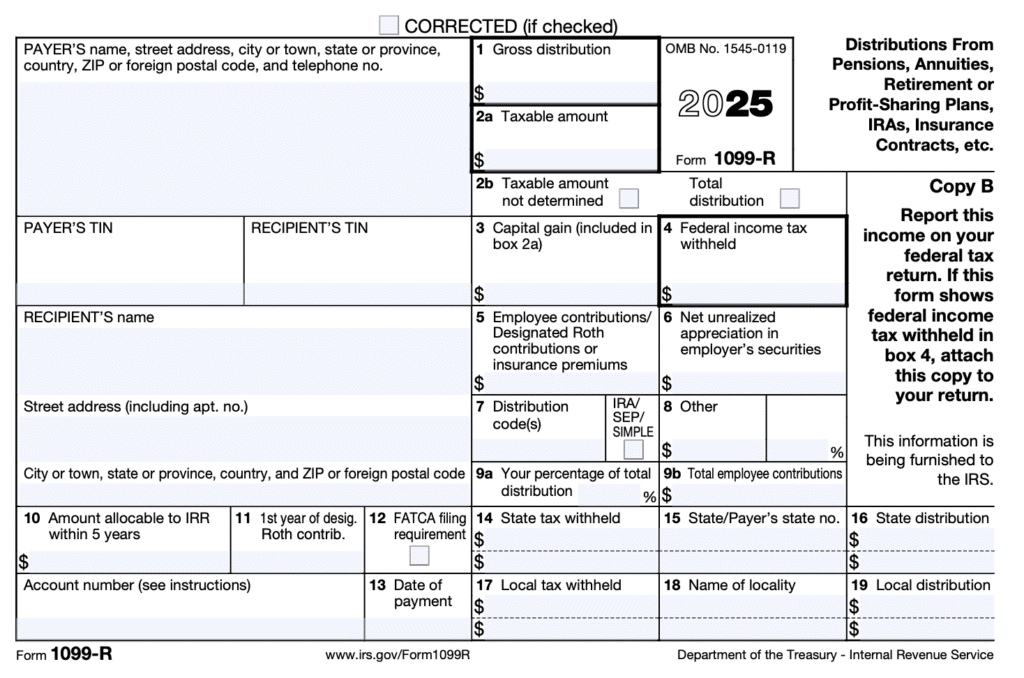
Form 1099-R: Retirement Distributions
Reports distributions from pensions, annuities, IRAs, 401(k)s, and other retirement plans. Especially relevant for expat retirees receiving U.S. retirement income abroad.
What’s New for 2025: New distribution codes for Qualified Charitable Distributions (QCDs) from IRAs. Code Y is optional for 2025 but helps clarify QCD reporting.
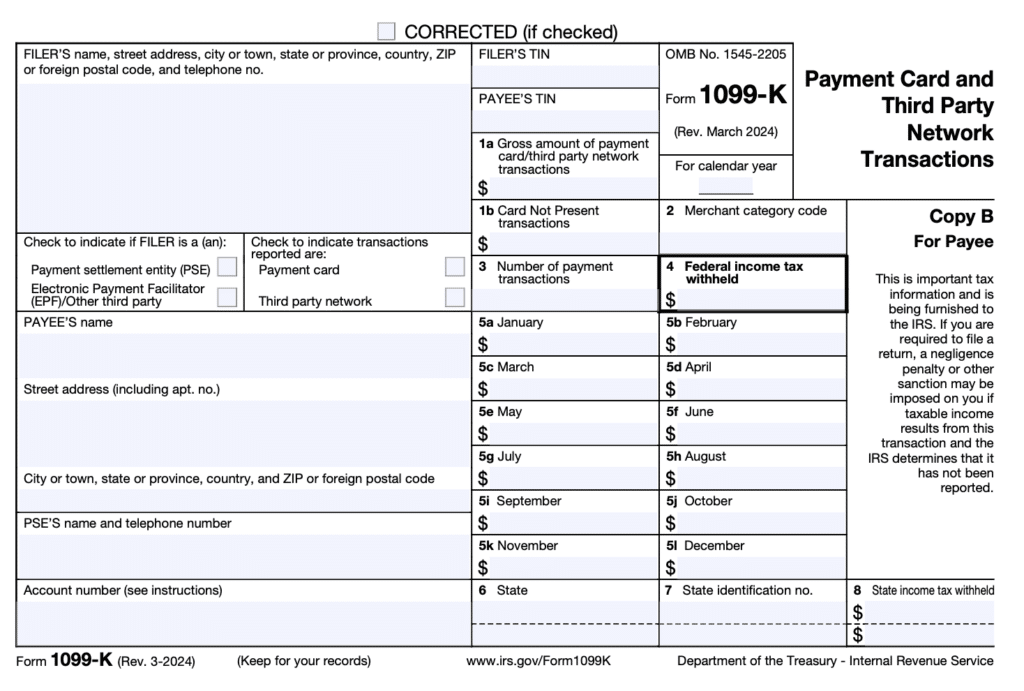
Form 1099-K: Payment Card and Third-Party Network Transactions
Reports payments received through credit cards, debit cards, or third-party payment networks like PayPal, Venmo, or Cash App. You’ll receive this if you exceed $20,000 in gross payments AND have more than 200 transactions.
Current Threshold: The IRS originally planned to lower the threshold to $600, but has delayed implementation. For 2025, the threshold remains $20,000 and 200 transactions.
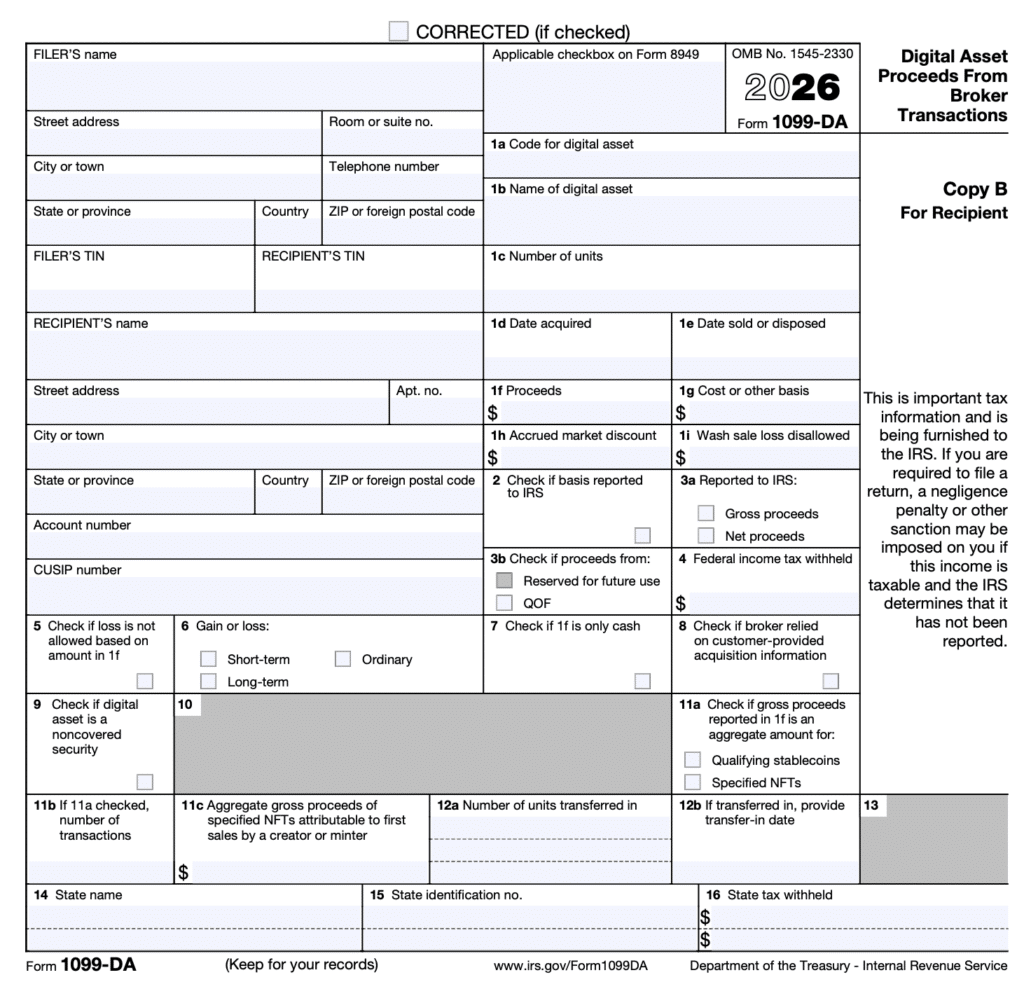
Form 1099-DA: Digital Assets (NEW FOR 2025)
Brand new form starting with the 2025 tax year. Brokers, such as cryptocurrency exchanges, payment processors, and hosted wallet providers, must issue Form 1099-DA to report gross proceeds from digital asset sales or exchanges. Starting in 2026, they’ll also report cost basis and gains/losses.
Form 1099-G: Certain Government Payments
Reports unemployment compensation, state or local tax refunds, and certain government payments. Expats may receive this for unemployment benefits received before moving abroad.

Get Clarity on Your 1099 Income Abroad
Form 1099-C: Cancellation of Debt
If a lender cancels or forgives debt of $600 or more, you’ll receive this form. The IRS generally treats canceled debt as taxable income.
Form 1099-Q: Qualified Education Programs
Reports distributions from 529 college savings plans or Coverdell ESAs.
What’s New for 2025: Form 1099-Q now includes new checkboxes in Box 4 to indicate the type of distribution or rollover, including rollovers to Roth IRAs (when certain requirements are met).
Form 1099-S: Real Estate Transactions
Reports proceeds from real estate sales. You’ll receive this when selling property, including foreign real estate, if the transaction involves a U.S. entity.
Form 1099-SA: HSA, Archer MSA, or Medicare Advantage MSA Distributions
Reports distributions from health savings accounts and medical savings accounts.
Less Common 1099 Forms
- 1099-A: Acquisition or Abandonment of Secured Property (foreclosures)
- 1099-CAP: Changes in Corporate Control and Capital Structure
- 1099-LTC: Long-Term Care and Accelerated Death Benefits
- 1099-OID: Original Issue Discount (bonds purchased at discount)
- 1099-PATR: Taxable Distributions from Cooperatives
- 5498 series: Various retirement account contribution forms
What Should I Do When I Receive a 1099 Form?
Step 1: Verify accuracy
Review every 1099 you receive for errors. Check that your name, Social Security number, and payment amounts are correct. If you find mistakes, contact the payer immediately to request a corrected form.
Step 2: Keep all copies
File your 1099s with your tax documents. You’ll need them when preparing your tax return. The IRS already has a copy, so any income reported on a 1099 must appear on your return.
Step 3: Report the income
When filing your Form 1040, report all 1099 income in the appropriate sections. Different 1099 forms correspond to different lines on your tax return:
- Form 1099-NEC → Schedule C (Self-Employment Income)
- Form 1099-INT → Schedule B (Interest Income)
- Form 1099-DIV → Schedule B (Dividend Income)
- Form 1099-B → Schedule D and Form 8949 (Capital Gains/Losses)
- Form 1099-R → Form 1040 Line 4 or 5 (Retirement Income)
Step 4: Apply expat tax benefits
This is where living abroad becomes an advantage. Even if you have substantial 1099 income, you can often reduce or eliminate your U.S. tax liability by claiming:
- Foreign Earned Income Exclusion (FEIE): Exclude up to $130,000 (2025) or $132,900 (2026) of foreign-earned income from U.S. taxation
- Foreign Tax Credit (FTC): Claim dollar-for-dollar credits for taxes paid to foreign governments
- Foreign Housing Exclusion: Deduct qualifying housing expenses if self-employed abroad
FEIE only applies to “earned income” (work-related income). Investment income reported on Forms 1099-INT, 1099-DIV, and 1099-B doesn’t qualify for FEIE, but you may be able to claim Foreign Tax Credits if you paid foreign taxes on that income.
Learn More: What’s the Difference Between Earned and Unearned Income?
What If I’m Behind on My Expat Taxes?
Many Americans abroad don’t realize they need to file U.S. tax returns or report 1099 income. If you’re behind on filing, the IRS offers an amnesty program called the Streamlined Filing Compliance Procedures specifically for expats.
To catch up, you’ll need to:
- File the last three years of delinquent tax returns
- File six years of FBARs (Foreign Bank Account Reports)
- Self-certify that your failure to file was non-willful (due to ignorance, not intentional tax evasion)
Once you complete these steps, you can come into compliance without facing penalties. Even if you owe taxes, you’ll only pay the tax due plus interest: no additional penalties for late filing.
1099 Forms and Self-Employment Tax
If you receive Form 1099-NEC for freelance or contract work, you’re responsible for paying self-employment tax in addition to regular income tax. Self-employment tax covers your Social Security and Medicare contributions. Normally split between employee and employer, but freelancers pay both halves (15.3% total).
The good news? You can deduct half of your self-employment tax on your Form 1040, reducing your overall tax burden. And if you qualify for FEIE and exclude your income, you may be able to avoid both income tax and self-employment tax on your foreign-earned income.
Key 2026 Changes For Form 1099 You Need to Know
Several important updates affect 1099 reporting for the 2025 tax year (filed in 2026):
- New Form 1099-DA for Digital Assets: Cryptocurrency exchanges and wallet providers now report sales and exchanges
- Reporting Threshold Increase: Starting 2026 (for 2025 payments), the threshold increases from $600 to $2,000 for Forms 1099-NEC and 1099-MISC
- Golden Parachute Payment Changes: Large executive severance packages move from 1099-MISC to 1099-NEC Box 3
- QCD Reporting Codes: New optional codes for Qualified Charitable Distributions from IRAs on Form 1099-R
- 529 Plan Rollover Clarity: Form 1099-Q now clearly identifies rollovers to Roth IRAs
Next Steps for Expats Receiving 1099 Forms
If you’re an American living abroad receiving 1099 income, here’s what to do:
For simple situations:
- File Form 1040 reporting all 1099 income
- Claim FEIE using Form 2555 if you have earned income
- Claim Foreign Tax Credit using Form 1116 if you paid foreign taxes
For complex situations (multiple 1099s, self-employment, or years of unfiled returns):
Contact a qualified expat tax professional who can help you:
- Determine which 1099 income is excludable under FEIE
- Calculate self-employment tax obligations
- Maximize foreign tax credits
- Navigate Streamlined Filing if you’re behind
The key is not to panic when you receive 1099 forms. With proper planning and the right expat tax strategies, you can stay compliant while minimizing your tax liability.
If you realize you’re in over your head and worried you’ll file incorrectly, let us help. No matter how late, messy, or complex your return may be, we can help. You’ll have peace of mind, knowing that your taxes were done right.
Ready to get started? Click the Get Started button below. For general questions on US expat taxes or working with Greenback, contact our Customer Champions.

Get Expert Help Reporting Your 1099 Income
This article is for informational purposes only and does not constitute tax, legal, or financial advice. Tax laws are complex and change frequently. Form 1099 requirements and thresholds can vary based on payment type, payer status, and recipient classification. Always consult with a qualified tax professional about your specific situation.
Related Resources
- Form 1099 for Foreign Contractors: Your Questions Answered
- Do I Need to Pay U.S. Taxes as a Contractor Working Overseas?
- Foreign Earned Income Exclusion: Complete Guide
- Foreign Tax Credit Guide for Americans Abroad
- Self-Employment Tax for Expats: What You Need to Know
- Streamlined Filing Procedures: Everything to Know
- FBAR Filing Requirements for Americans Abroad
- Schedule C Guide for Self-Employed Expats
- Can I Still File My Taxes Without a W-2?