Adoption Tax Credit and Form 8839: What U.S. Expats Can Claim and How to File

- What Is the Adoption Tax Credit?
- What Is Form 8839?
- How Much Is the Adoption Tax Credit Worth?
- Who Qualifies for the Adoption Tax Credit?
- Is the Adoption Tax Credit Refundable?
- When Do You Claim the Adoption Tax Credit?
- How Does Living Abroad Change Your Adoption Credit?
- How Do You Fill Out Form 8839?
- What Do Two Expat Families Get From the Same $17,670 of Adoption Costs?
- What Should You Do While Your Adoption Is in Progress?
- Frequently Asked Questions about the Adoption Tax Credit
- Greenback Prepares Form 8839 With Your Expat Return

The adoption tax credit is a U.S. federal tax credit for the qualified adoption expenses you pay, worth up to $17,670 per child for 2026. Up to $5,120 of it is refundable, so it can reach you as a refund even if you owe no U.S. tax. The full credit is available when your modified adjusted gross income (MAGI) is $265,080 or less. It shrinks above that and disappears at $305,080; for Americans abroad, income you exclude with the Foreign Earned Income Exclusion (FEIE) is added back when MAGI is calculated.
You claim the adoption credit on Form 8839, Qualified Adoption Expenses, filed with your Form 1040 or Form 1040-SR. For a child adopted from another country, expenses paid before or in the year the adoption becomes final are claimed in that year, and any nonrefundable part you can’t use that year carries forward for up to five years.
What Is the Adoption Tax Credit?
The adoption tax credit is a U.S. federal income tax credit equal to the qualified adoption expenses you paid for an eligible child, up to $17,670 per child for 2026. A tax credit lowers your tax dollar for dollar, so it is worth more than a deduction of the same amount. The adoption credit has two parts: a refundable part that is paid to you even if you owe no tax, and a nonrefundable part that can only reduce tax you owe.
| Term | What it means for the adoption credit |
|---|---|
| Qualified adoption expenses | Reasonable and necessary costs directly related to the legal adoption of an eligible child, such as adoption fees, attorney fees, court costs, and travel |
| Eligible child | A child under age 18, or a person of any age who is physically or mentally unable to care for themselves |
| U.S. child | A child who was a U.S. citizen or resident when the adoption effort began |
| Foreign child | A child who was not a U.S. citizen or resident when the adoption effort began |
| Child with special needs | A U.S. child whom a state or tribal government has determined can’t or shouldn’t return home and is unlikely to be adopted without assistance |
| Refundable portion | Up to $5,120 per child for 2026, paid to you even if you owe no U.S. tax |
| Nonrefundable portion | The rest of the credit, which can only reduce U.S. tax you owe |
| Carryforward | Nonrefundable credit you can’t use this year, available for up to five more years |
| MAGI | Adjusted gross income plus foreign earned income and housing amounts excluded on Form 2555, and any excluded income from Puerto Rico or American Samoa |
| Employer-provided adoption benefits | Adoption costs your employer paid under its written adoption assistance program, which you can exclude from income up to $17,670 per child |
What Counts as a Qualified Adoption Expense?
Qualified adoption expenses are reasonable and necessary costs directly related to, and for the principal purpose of, the legal adoption of an eligible child. Costs that serve another purpose, or that someone else paid for, don’t count.
| Counts as a qualified adoption expense | Doesn’t count |
|---|---|
| Adoption fees | Costs to adopt your spouse’s child |
| Attorney fees | Surrogacy costs |
| Court costs | Costs reimbursed by your employer or anyone else |
| Travel, including meals and lodging while away from home | Costs paid with federal, state, or local program funds |
| Re-adoption costs for a foreign child | Costs that violate state or federal law |
| Costs claimed as another credit or deduction |

What Is Form 8839?
Form 8839, Qualified Adoption Expenses, is the IRS form you attach to Form 1040 or Form 1040-SR to claim the adoption credit and to exclude employer-provided adoption benefits from income. It has three parts:
| Part | What it does | Who completes it |
|---|---|---|
| Part I | Lists each eligible child, with ID number, status, and whether the adoption is final | Everyone claiming the credit or the exclusion |
| Part II | Calculates the credit, its refundable and nonrefundable parts, and any carryforward | Everyone claiming the credit |
| Part III | Calculates how much of your employer-provided adoption benefits you can exclude | Filers whose employer paid adoption benefits; complete it before Part II |
How Much Is the Adoption Tax Credit Worth?
For 2026, the adoption tax credit is worth up to $17,670 per child, and income reduces it only once MAGI passes $265,080.
| 2026 limit | Amount |
|---|---|
| Maximum credit per child | $17,670 |
| Refundable portion per child | Up to $5,120 |
| Full credit | MAGI of $265,080 or less |
| Reduced credit | MAGI above $265,080 and below $305,080 |
| No credit | MAGI of $305,080 or more |
| Employer-provided adoption benefits you can exclude | Up to $17,670 per child |
Between $265,080 and $305,080, the credit shrinks in proportion: at $20,000 over $265,080, half of it is phased out.
The $17,670 Limit Covers One Child Across All Years
The adoption credit limit applies once per child, and it covers every year of that child’s adoption combined. If you claimed $3,000 of qualified expenses for a child in an earlier year, you can claim up to $14,670 more for that child. If you made more than one attempt to adopt a U.S. child, such as a failed attempt followed by a successful one, the expenses of both attempts are subject to a single limit.
Who Qualifies for the Adoption Tax Credit?
You qualify for the adoption tax credit if you paid qualified adoption expenses for an eligible child, your MAGI is below $305,080, and, if you are married, you file a joint return or meet the living-apart exception.
The Child Must Be Under 18 or Unable to Care for Themselves
An eligible child is any child under age 18, or a person of any age who is physically or mentally unable to care for themselves. A child who turns 18 during the year is an eligible child for the part of the year before their 18th birthday.
Married Couples Generally Must File Jointly
If you are married, you generally must file a joint return to claim the adoption credit. Single filers, heads of household, and qualifying surviving spouses can claim it as well. A married person filing separately can claim it only if all three of these apply: you lived apart from your spouse for the last six months of the year, the child lived in your home for more than half the year, and you paid more than half the cost of keeping up that home.
If your spouse is a nonresident alien, the joint-return rule generally still applies. For this credit, the tax code treats a married person as unmarried only when legally separated or when the living-apart test above is met, so filing as head of household because your spouse is a nonresident alien doesn’t qualify you on its own. You can file jointly by choosing to treat your spouse as a U.S. resident, but that brings your spouse’s worldwide income onto your return and into MAGI, so it’s worth weighing that cost against the credit before you decide.
Special Needs and Foster Care Adoptions Follow Their Own Rules
In the year a special needs adoption becomes final, you can claim the full $17,670 credit, minus any credit already claimed for that child, even if you paid less, or nothing, in qualified expenses. The MAGI phase-out still applies. To count, the child must have been a U.S. citizen or resident when the adoption began, and a state or tribal government must have determined that the child can’t or shouldn’t return to the parents’ home and is unlikely to be adopted without assistance. If you adopted from U.S. foster care, ask the state agency whether it made a special-needs determination and keep a copy. A special needs designation from another country doesn’t count.
Is the Adoption Tax Credit Refundable?
Yes, in part: for 2026, up to $5,120 per child of the adoption tax credit is refundable, so it can be paid to you as a refund even when you owe no U.S. tax. The refundable portion is the smaller of your credit for that child or $5,120, and it goes on Form 1040, line 30. It is paid in the year you claim the credit and doesn’t carry forward. The rest of the credit is nonrefundable: it can reduce the tax you owe to zero, and any unused portion carries forward. The IRS sets out the 2026 limits on its adoption credit page.
The Refundable Part Still Works When the FEIE Brings Your Tax to $0
The refundable adoption credit has no Foreign Earned Income Exclusion bar: the 2025 Form 8839 instructions from the IRS, the most recent available, don’t block Form 2555 filers from it. That is a difference from the additional child tax credit, which you can’t claim if you file Form 2555. If the FEIE brings your U.S. tax to $0, you still receive the refundable part; the exclusion affects it only through MAGI.
Schedule 3-A May Be Required With the Refundable Part
If proposed IRS rules are finalized by the end of 2026, claiming the refundable adoption credit will also mean filing Schedule 3-A, which asks whether you or your spouse is a U.S. citizen, U.S. national, or qualified alien. The IRS adoption credit page already lists it. If you are a U.S. citizen, answer “yes” and remain eligible for the refundable portion.
When Do You Claim the Adoption Tax Credit?
When you claim the adoption tax credit depends on whether the child was a U.S. citizen or resident when the adoption effort began, and on the year the adoption becomes final.
| If you paid qualified expenses… | U.S. child: claim the credit in | Foreign child: claim the credit in |
|---|---|---|
| Before the year the adoption becomes final | The year after you paid | The year the adoption becomes final |
| In the year the adoption becomes final | That year | That year |
| After the year the adoption becomes final | The year you paid | The year you paid |
| For an adoption that failed or isn’t final yet | The year after you paid | No credit unless and until it becomes final |
A Foreign Adoption Counts in the Year It Becomes Final
For a foreign child, every expense paid before or in the year the adoption becomes final is claimed in that one year, and for a Hague or non-Hague adoption the IRS lets you choose which year that is. Your adoption is a Hague Convention adoption if the child’s country is a party to the Hague Adoption Convention and you filed Forms I-800A and I-800 with U.S. Citizenship and Immigration Services.
- Hague adoption: You can treat the adoption as final in the year the sending country enters its final decree, or the year the U.S. Secretary of State issues a certificate under the Intercountry Adoption Act.
- Non-Hague adoption: You can use the year of the foreign adoption proceeding, or the year of a U.S. re-adoption if it happens within the next two years.
- Custodial agreement: If the child came to the United States under a custodial agreement and was adopted later in a U.S. state court, that court’s year is the year of finality.
Re-adoption costs count as qualified adoption expenses in the year you pay them.
These final-year choices apply only when the child immigrates to the United States. If you adopt a child in the country where you live and the child doesn’t immigrate, the credit still waits until the adoption is final, but no IRS guidance sets which year that is, so decide it with your tax preparer and keep a copy of the final decree.
What Happens If an Adoption Falls Through?
If the adoption of a U.S. child falls through, you can still claim the adoption credit for the qualified expenses you paid, in the year after you paid them. Losing an adoption is painful, and the credit for a U.S. adoption doesn’t depend on the outcome. An unsuccessful foreign adoption doesn’t qualify for the credit.
How Many Years Can You Use the Adoption Credit?
Any nonrefundable adoption credit you can’t use in the year you claim it carries forward for up to five years, so a 2026 credit can be used against U.S. tax through 2031 before it expires. A carryforward is used only as a nonrefundable credit, so it helps only in a year you owe U.S. tax.
One change applied to 2025 only: if an unused adoption credit from 2020 through 2024 carried into your 2025 return, the IRS automatically refunded up to $5,000 of it per child, so check your IRS Online Account or account transcript and leave any refunded amount out of the carryforward you enter on line 15 of the 2026 Form 8839, confirming the figure against the IRS notice.
If you qualified for the credit in an earlier year and never claimed it, you can generally claim it on an amended return on Form 1040-X within three years of filing the original return, or within two years of paying the tax, whichever is later. For tax years before 2025, the credit was entirely nonrefundable, so an amended claim for those years lowers the tax you owed or adds to your carryforward.
How Does Living Abroad Change Your Adoption Credit?
Living abroad doesn’t block the adoption tax credit, but the Foreign Earned Income Exclusion, the Foreign Tax Credit, and foreign-currency payments each change how it works for you.
Excluded Foreign Income Counts Toward MAGI
Excluded foreign income counts toward the adoption credit’s MAGI limits, so a family that excludes most of its salary can still cross the $265,080 threshold once that income is added back.
Your Tax After Other Credits Limits the Nonrefundable Part
The nonrefundable adoption credit can only reduce the U.S. tax left after the Foreign Tax Credit, the child tax credit, and certain other credits. If you claim the Foreign Tax Credit on Form 1116, your foreign taxes come off your U.S. tax first, so the nonrefundable part usually helps only when your foreign tax rate is lower than the U.S. rate.
A carryforward has value only in a year you owe U.S. tax, so if you expect to owe none for the next five years, the nonrefundable part can expire unused. Whether you use the FEIE or the Foreign Tax Credit changes how much U.S. tax you owe, so the year your adoption becomes final is a good time to review that choice. If you revoke the FEIE, you generally can’t choose it again for the next five tax years without IRS approval.
The Same Expense Can’t Be Both Excluded and Credited
Part III of Form 8839 covers adoption benefits paid under an employer’s written adoption assistance program; a U.S. employer reports them on Form W-2, box 12, with code T. You can exclude those benefits from income and still claim the credit for other expenses for the same child, but the same expense can’t count twice. If an employer abroad reimbursed adoption costs, those costs can’t count toward the credit, because reimbursed costs aren’t qualified adoption expenses.
Foreign-Currency Expenses Are Converted to Dollars
Adoption fees paid in another currency are reported in U.S. dollars. The IRS’s general rule is to use the exchange rate prevailing when you pay each expense, so keep the date, amount, and currency of every payment.
How Do You Fill Out Form 8839?
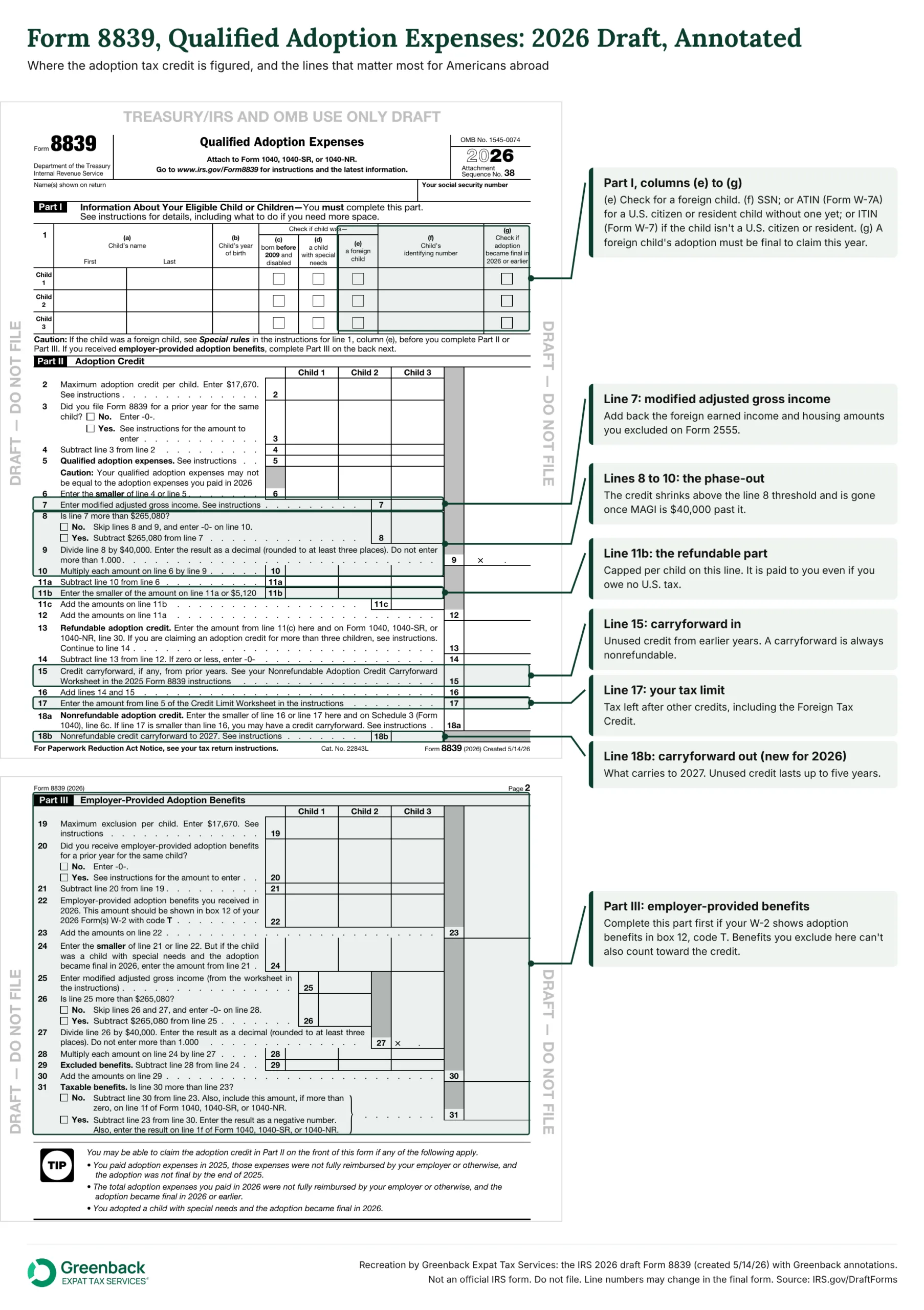
To fill out Form 8839, complete Part I for each child, then Part III if your employer paid adoption benefits, then Part II to figure the credit. The line numbers below follow the 2026 draft Form 8839 the IRS posted in May 2026 and may change on the final form. The form goes in with your return by the filing deadline, including a return filed on extension with Form 4868.
Part I Records Each Child
Line 1 has a row for up to three children; attach another Form 8839 if you are claiming more. Columns (a) to (d) ask for the child’s name and year of birth, and whether the child was born before 2009 and disabled or has special needs. Check column (e) for a foreign child, which triggers the year-of-finality rule, and column (g) if the adoption became final in 2026 or earlier. If you made more than one attempt to adopt one U.S. child, report all of them on the Child 1 line.
Column (f) asks for the child’s identifying number:
| Child’s situation when you file | Identifying number | How to get it |
|---|---|---|
| Has an SSN, or can get one in time to file | Social Security number | Social Security Administration |
| U.S. citizen or resident without an SSN yet | Adoption taxpayer identification number (ATIN) | Form W-7A |
| Not a U.S. citizen or resident | ITIN | Form W-7 |
If you don’t have a number for a child whose adoption failed or isn’t final yet, leave column (f) blank.
Part III Comes Before Part II When Your Employer Paid Benefits
If your employer paid adoption benefits, complete Part III first. Lines 19 to 31 work out how much of those benefits you can exclude from income, up to $17,670 per child, and that amount can’t also count toward the credit. Lines 25 to 28 apply the same MAGI phase-out as the credit, and line 31 carries any taxable benefits to Form 1040, line 1f.
Part II Calculates the Credit
- Lines 2 to 6: Start from the $17,670 maximum, subtract any credit already claimed for the child, and compare the result with your qualified expenses. The smaller figure goes on line 6.
- Lines 7 to 10: Enter MAGI on line 7, including excluded foreign income. Line 8 is the amount above $265,080, line 9 divides it by $40,000, and line 10 is the reduction.
- Lines 11a to 13: Line 11a is the credit after the phase-out. Line 11b caps the refundable part at $5,120 per child, and line 13 carries the refundable total to Form 1040, line 30.
- Lines 14 to 18b: The nonrefundable rest (line 14) is added to any carryforward from earlier years (line 15), which for now points to the worksheet in the 2025 instructions. Line 17 limits it to the tax left after other credits; line 18a is the amount you use this year, and line 18b, new on the 2026 draft, records what carries forward to 2027.
Where Each Form 8839 Amount Goes on Your Return
| Form 8839 line | What it is | Where it goes |
|---|---|---|
| Line 13 | Refundable credit | Form 1040, line 30 |
| Line 18a | Nonrefundable credit used this year | Schedule 3 (Form 1040), line 6c |
| Line 18b | Carryforward to 2027 | Your records, for line 15 next year |
| Line 31 | Taxable employer benefits | Form 1040, line 1f |
What Do Two Expat Families Get From the Same $17,670 of Adoption Costs?
The same $17,670 in adoption costs can yield very different results depending on MAGI and how much U.S. tax remains after the FEIE and the Foreign Tax Credit. Both families below finalized a foreign adoption in 2026 and paid at least $17,670 in qualified expenses.
1. A Family With $0 U.S. Tax Gets $5,120 Back and Carries $12,550 Forward
The first family’s MAGI, with excluded salary added back, is under $265,080, so there is no phase-out and their credit is the full $17,670. They receive $5,120 of it as a refund (lines 11b and 13). The remaining $12,550 is nonrefundable, and because the FEIE brought their U.S. tax to $0, they can’t use any of it this year. The full $12,550 carries forward (line 18b) and is available against U.S. tax from 2027 through 2031.
2. A Family With $285,080 of MAGI Gets an $8,835 Credit
The second family’s MAGI is $20,000 above $265,080, so half of the $17,670 is phased out (line 9 is 0.500), leaving a credit of $8,835. Of that, $5,120 is refundable. The other $3,715 reduces their U.S. tax if they still owe at least that much after the Foreign Tax Credit, and any part they can’t use carries forward.
What Should You Do While Your Adoption Is in Progress?
While your adoption is in progress, keep a record of every payment and start the child’s identifying number early. You don’t attach these records to your return, but the IRS can ask to see them.
- Payment records: Receipts, agency contracts, and travel records showing the date, amount, currency, and purpose of each payment.
- Adoption documents: The final decree, any U.S. State Department certificate, and any state or tribal special needs determination.
- Identifying number: An SSN, ATIN, or ITIN for the child, started as soon as you can.
- Employer benefits: Whether your employer has a written adoption assistance program, and your W-2 for box 12, code T.
- Past forms: Each year’s Form 8839, to track the per-child limit and any carryforward.
Frequently Asked Questions about the Adoption Tax Credit
You can claim the adoption tax credit for one child over several years, and any nonrefundable portion you can’t use carries forward for up to 5 more years before it expires. For a U.S. child, you claim expenses as they become allowable, which can span several years; for a foreign child, you claim everything paid in the year of finality at once that year. Across all years, the credit for one child can’t exceed the per-child limit, $17,670 for 2026.
Yes, for different expenses. You can exclude employer-provided adoption benefits and claim the adoption credit for the same child, each up to $17,670 per child for 2026, but one expense can’t count toward both.
No. The child’s SSN is the usual number, but a U.S. citizen or resident child without one can use an ATIN from Form W-7A, and a child who isn’t a U.S. citizen or resident can use an ITIN from Form W-7. If you have no number for a child whose adoption isn’t final or didn’t succeed, leave that column blank.
No. Costs to adopt your spouse’s child aren’t qualified adoption expenses, nor are surrogacy costs or costs paid by an employer or government program.
Greenback Prepares Form 8839 With Your Expat Return
Claiming the adoption credit from abroad means getting MAGI right by adding back excluded income, applying it after the Foreign Tax Credit, and keeping track of a carryforward that can run for up to 5 years. If you’re a parent adopting while living abroad, Greenback’s accountants prepare Form 8839 alongside your full U.S. expat tax return, so the refundable part is claimed, and your carryforward is tracked year to year, wherever you live abroad.

Let Greenback Prepare Your Form 8839
The 2026 Form 8839 line numbers and the Schedule 3-A requirement are based on an IRS draft form and proposed rules that would apply to 2026 only if finalized by the end of 2026, and they may change. The information in this article is for general informational purposes only and does not constitute tax, legal, or financial advice. Tax rules are complex and change frequently. Consult a qualified tax professional regarding your specific situation before taking any action.



Featured In


