Form 1040-C: U.S. Departing Alien Income Tax Return
- What Is Form 1040-C?
- Who Needs to File Form 1040-C?
- Who Is Exempt from Filing Form 1040-C?
- Can I File Form 2063 Instead?
- When Do I Need to File Form 1040-C?
- How Do I Complete Form 1040-C?
- What Information Do I Need to Complete Form 1040-C?
- How Do I File Form 1040-C?
- Can I Make Payment Arrangements Instead of Paying Immediately?
- Do I Still Need to File an Annual Tax Return?
- Can I File Jointly with My Spouse?
- What Happens If I Don't File Form 1040-C?
- What Mistakes Should I Avoid?
- Special Considerations for Green Card Holders
- How Greenback Can Help with Form 1040-C
- Related Resources


If you’re a foreign national planning to leave the United States, you may need to file Form 1040-C to calculate and pay any U.S. income tax you owe before your departure. According to IRS instructions, Form 1040-C requires you to report all income received or reasonably expected to be received during the entire tax year up to and including your departure date – not just the income you’ve already earned.
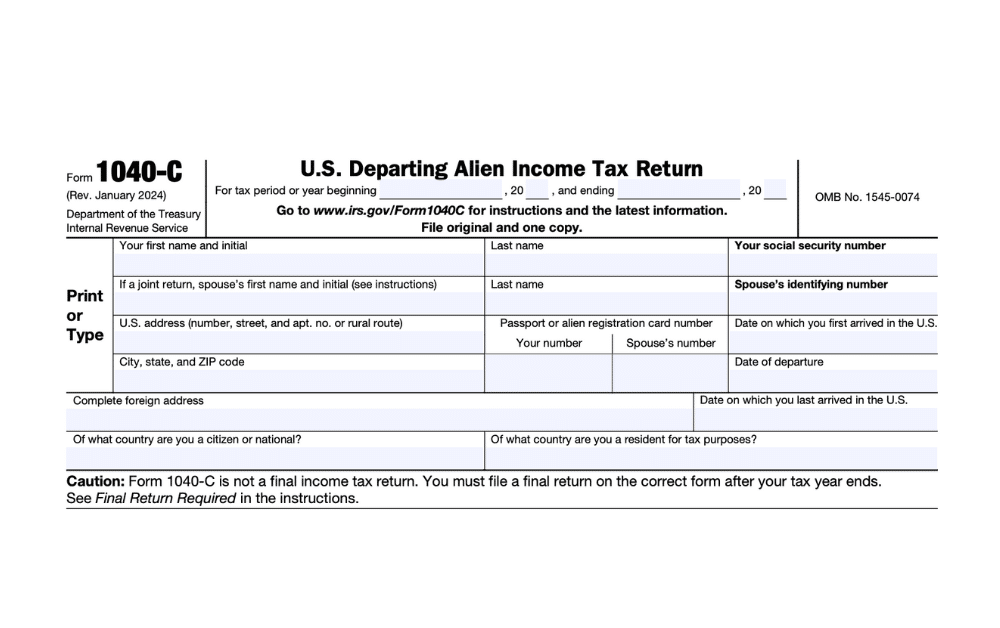
Form 1040-C (U.S. Departing Alien Income Tax Return) is a specialized tax form that certain resident and nonresident aliens must file before leaving the United States. Unlike your regular annual tax return, Form 1040-C calculates your estimated tax liability for the current year based on income you’ve earned and income you expect to earn through year-end, allowing you to settle your U.S. tax obligations before departure.
Here’s what’s important: Form 1040-C is not your final annual tax return. After filing Form 1040-C and leaving the U.S., you’ll still need to file your regular annual return (Form 1040 or Form 1040-NR) at the end of the tax year. Any tax you pay with Form 1040-C will be credited toward your annual tax liability, and you can claim a refund if you overpaid.
Most departing aliens who file Form 1040-C discover their tax liability is lower than expected, and many owe little to nothing after accounting for withholding and deductions.
What Is Form 1040-C?
Form 1040-C is the U.S. Departing Alien Income Tax Return that certain foreign nationals must file with the IRS before leaving the United States. The form calculates your estimated U.S. tax liability for the current tax year based on:
- All income you’ve already received from January 1 through your departure date
- All income you reasonably expect to receive for the remainder of the tax year
- Applicable deductions and credits you’re entitled to claim
The IRS uses Form 1040-C to ensure that departing aliens settle their U.S. tax obligations before leaving the country. Once you file the form and pay any tax due (or make payment arrangements), the IRS issues a certificate of compliance confirming your tax affairs are in order.

Form 1040-C is separate from your annual tax return. You must still file Form 1040 or Form 1040-NR at the end of the tax year to report your actual income and claim any overpayment as a refund.
Who Needs to File Form 1040-C?
You must file Form 1040-C if you’re a resident alien or nonresident alien planning to leave the United States, AND you don’t qualify for an exemption or the simpler Form 2063.
Nonresident Aliens
You need to file Form 1040-C if you:
- Have had any taxable U.S. income during the current or preceding tax year
- Are leaving the United States
- Don’t qualify for an exemption from filing
Taxable U.S. income includes wages from U.S. employment, self-employment income, business income, investment income, and rental income from U.S. property.
Resident Aliens
You need to file Form 1040-C if you:
- Are terminating your U.S. residency (temporarily or permanently)
- Have received taxable income during the current or preceding tax year
- The IRS determines your departure may hinder tax collection
Resident aliens include green card holders and those who meet the substantial presence test.
Green Card Holders Leaving Permanently
If you’re a green card holder with no definite plans to return to the U.S., you typically must file Form 1040-C before leaving. Additionally, if you’ve held your green card for 8 of the last 15 years, you may need to file Form 8854 for expatriation purposes.
Need Help Filing Form 1040-C Before You Leave the U.S.?
Who Is Exempt from Filing Form 1040-C?
Six categories of foreign nationals are exempt from filing Form 1040-C:
- Diplomatic Personnel: Foreign government representatives with diplomatic passports, their household members, and accompanying servants
- International Organization Employees: Employees of international organizations and foreign governments whose compensation is exempt from U.S. income tax, plus their household members
- Students and Exchange Visitors: Those on F-1, F-2, J-1, J-2, M-1, M-2, or Q visas with no U.S.-source income other than study-related allowances
- Short-Term Business and Pleasure Visitors: Individuals on B-1 or B-2 visas leaving within their authorized stay
- Transit Passengers: Those passing through the U.S. on C-1 visas
- Border Commuters and Military Trainees: Canadian or Mexican commuters with income subject to withholding, and certain military trainees
Can I File Form 2063 Instead?
Form 2063 is a simpler alternative for qualifying individuals who have no tax liability. You can file Form 2063 instead of Form 1040-C if:
- You’re a resident or nonresident alien with no taxable income for the current tax year and preceding year up to your departure date
- You’re a resident alien whose departure won’t hinder tax collection, as determined by the IRS
However, if the IRS has information suggesting you’re leaving to avoid paying taxes, you must file Form 1040-C regardless of your income situation.
When Do I Need to File Form 1040-C?
You must file Form 1040-C before leaving the United States, within a specific timeframe:
Filing Window: No earlier than 30 days before your planned departure, but at least 2 weeks before you leave
This narrow window is critical for proper planning. If you file too early, the IRS won’t accept your application. If you file too late, you may miss your departure date while waiting for the processing to be completed.

Schedule your IRS appointment as soon as you know your departure date. Call 844-545-5640 to make an appointment at your nearest IRS Taxpayer Assistance Center. Confirm the office provides alien clearance services, as not all locations do.
How Do I Complete Form 1040-C?
Form 1040-C divides filers into three groups based on residency status. Your group determines which tax rules apply to your return.
Group I: Resident Aliens
If you’re a resident alien, you:
- Report worldwide income (all income from any source)
- Use the same tax rates and rules as U.S. citizens
- Can claim the standard deduction ($15,750 single, $31,500 married filing jointly for the 2025 tax year)
- Follow Form 1040 instructions for calculations
Group II: Nonresident Aliens with Effectively Connected Income
If you’re a nonresident alien with income effectively connected to a U.S. trade or business, you:
- Report income connected to your U.S. business activities
- Pay tax at graduated rates (same as U.S. citizens)
- Follow Form 1040-NR instructions
- Can claim certain business-related deductions
Group III: Nonresident Aliens with FDAP Income
If you’re a nonresident alien with Fixed, Determinable, Annual, or Periodic (FDAP) income not connected to a U.S. business, you:
- Pay a flat 30% tax rate on this income (or lower treaty rate if applicable)
- Cannot claim the standard deduction
- Must attach documentation for treaty benefits if claiming a reduced rate
FDAP income includes interest, dividends, rents, royalties, and similar passive income.
What Information Do I Need to Complete Form 1040-C?
To complete Form 1040-C accurately, gather the following:
Income Documentation
- Form W-2 (wages from U.S. employers)
- Form 1099 series (interest, dividends, self-employment income)
- Records of income earned from January 1 through your departure date
- Estimates of income you expect to receive through December 31
- Business profit and loss statements (if self-employed)
Tax Payment Records
- Receipts for federal income tax withheld
- Records of estimated tax payments made during the year
- Copies of tax returns filed for the past two years
Deduction Documentation
- Receipts for deductible expenses
- Records of charitable contributions
- Business expense documentation
- Medical expense records (if itemizing)
Identification
- Valid passport
- Alien registration card (green card) or visa
- Social Security number or ITIN
How Do I File Form 1040-C?
Form 1040-C cannot be filed electronically. You must file in person at an IRS office.
Step 1: Schedule an Appointment
Call +1 (844) 545 -5640 to schedule an appointment at your nearest IRS Taxpayer Assistance Center. Schedule at least 2-4 weeks before your departure date to allow for any unexpected delays.
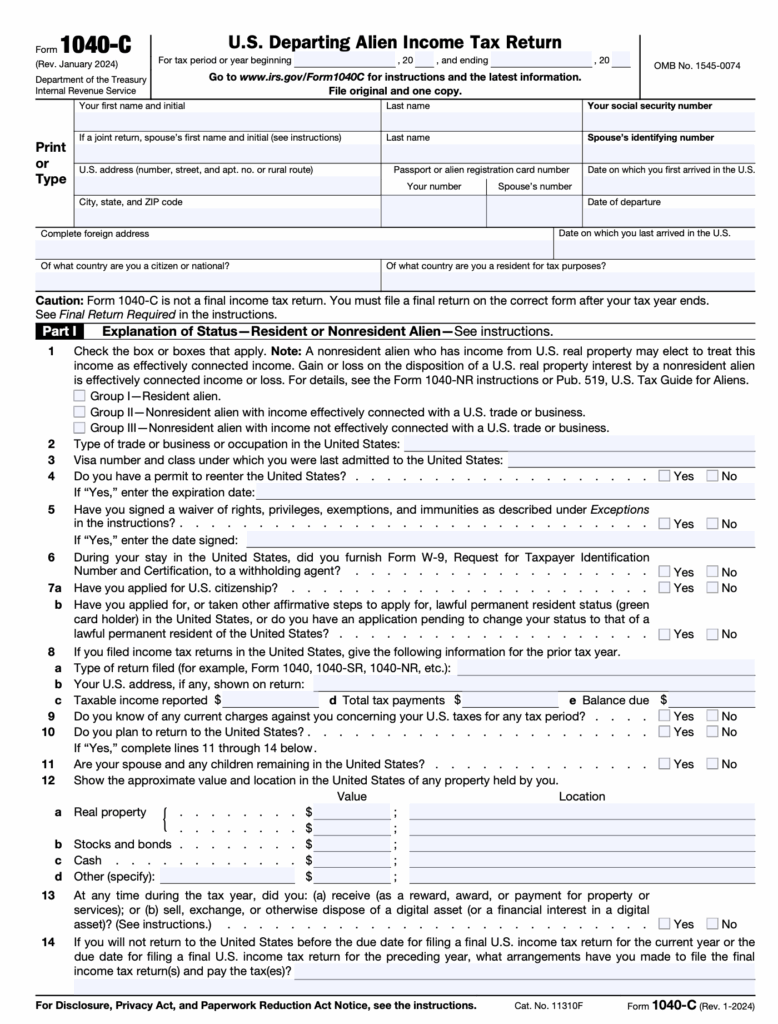
Step 2: Complete Form 1040-C
Before your appointment:
- Download Form 1040-C from the IRS website
- Complete all applicable sections based on your filer group (I, II, or III)
- Calculate your estimated tax liability for the entire year
- Prepare an original and one copy
Step 3: Prepare Payment
If you owe tax, prepare payment using:
- Cashier’s check
- Certified bank check
- Postal money order
- Cash (not recommended for security reasons)
Personal checks are generally not accepted.
Step 4: Attend Your IRS Appointment
Bring to your appointment:
- Completed Form 1040-C (original and copy)
- All supporting documentation
- Payment for any tax owed
- Identification documents
- Proof of departure plans (airline ticket, travel itinerary)
An IRS agent will review your form, verify your calculations, and process your payment. Once approved, you’ll receive a certificate of compliance on your copy of Form 1040-C.
Can I Make Payment Arrangements Instead of Paying Immediately?
In certain circumstances, the IRS may allow you to furnish a bond guaranteeing payment instead of paying the full tax amount immediately. This option is typically available if:
- You have substantial assets that secure the tax liability
- You can demonstrate you intend to return to the U.S.
- The IRS agrees that the bond adequately protects its collection interest
However, most filers pay the calculated tax amount at the time of filing to avoid complications.
Do I Still Need to File an Annual Tax Return?
Yes. Form 1040-C is not a final return. You must file a final income tax return after your tax year ends.
Which Form Should I File for My Final Return?
Your final return depends on your residency status on the last day of the tax year (December 31):
If you’re a U.S. citizen or resident alien on December 31:
- File Form 1040 (or Form 1040-SR if 65 or older)
- Report your worldwide income for the entire year
- This applies even if you left the U.S. earlier in the year
If you’re a nonresident alien on December 31:
- File Form 1040-NR
- Report only your U.S.-source income
- This applies if you terminated your residency status before year-end
If you changed status during the year:
- File a dual-status return
- This applies if you were a resident alien at the beginning of the tax year but became a nonresident alien by year-end (or vice versa)
- You’ll need to file both Form 1040 and Form 1040-NR as part of one complete return
How Does Form 1040-C Credit Work?
Any tax you pay with Form 1040-C counts as a credit against the tax liability on your final return. Here’s how it works:
If Form 1040-C shows tax due and you paid it:
- That payment appears as a credit on your final return
- If your final return shows you owe more tax, you pay the difference
- If your final return shows you owe less tax, you’ll receive a refund for the overpayment
If Form 1040-C shows an overpayment:
- You don’t receive a refund when you file Form 1040-C
- The overpayment will be refunded only if and to the extent your final return for the tax year shows an overpayment
- You claim the refund when you file your final annual return
Example: Maria filed Form 1040-C in July and paid $3,000 in estimated tax before leaving the U.S. When she files her final Form 1040 in April of the following year, her actual tax liability is $2,500. She receives a $500 refund because the $3,000 she paid with Form 1040-C exceeds her final tax liability.
Additional Items on Your Final Return
Some tax items are not addressed on Form 1040-C but must be included on your final return:
Premium Tax Credit Reconciliation: If you’re a Group I (resident alien) filer who received advance payments of the premium tax credit for health insurance, you must reconcile these payments with the actual credit allowed on your final tax return using Form 8962.
Other items that may apply:
- Additional Medicare Tax
- Net Investment Income Tax
- Credits not calculated on Form 1040-C (such as education credits or child tax credit)
- Income from foreign sources not reported on Form 1040-C
- Adjustments to income claimed on your final return
Your final return provides a complete and accurate picture of your tax situation for the entire year, while Form 1040-C is only an estimated payment before departure.
Can I File Jointly with My Spouse?
Your filing options depend on your residency status:
Nonresident aliens cannot file joint returns on Form 1040-C.
Resident aliens can file jointly if:
- Both spouses can reasonably be expected to qualify for joint filing at year-end
- Both spouses’ tax years end at the same time
- Your spouse is also leaving the U.S. or is a U.S. citizen/resident
If you’re married to a foreign spouse without a Social Security number, your spouse will need an ITIN to file jointly.
What Happens If I Don’t File Form 1040-C?
While the IRS rarely enforces Form 1040-C filing requirements at departure, failing to file when required creates several risks:
- Tax compliance issues: You’ll have difficulty proving you met your U.S. tax obligations
- Future immigration complications: Incomplete tax records may affect future visa applications or green card renewals
- Interest and penalties: Unpaid taxes continue to accrue interest
- Collection enforcement: The IRS can pursue collection actions even after you’ve left the U.S.
For foreign nationals who plan to return to the U.S. or maintain ongoing relationships with U.S. institutions, filing Form 1040-C provides documentation of tax compliance.
What Mistakes Should I Avoid?
Common errors when filing Form 1040-C include:
1. Incomplete Income Reporting
Include all U.S.-source income, even if:
- Tax was withheld at the source
- The amount seems minimal
- You received income in a foreign currency
Convert all foreign currency amounts to U.S. dollars using the appropriate exchange rate.
2. Underestimating Year-End Income
You must estimate the income you expect to receive through December 31, not just the income received through your departure date. Be realistic in your estimates to avoid underpayment.
3. Using Estimates Without Documentation
Support all income and expense claims with actual documentation:
- Pay stubs and wage statements
- Bank records
- Business receipts
- Investment statements
4. Missing Prior-Year Filing Requirements
You cannot receive a certificate of compliance if you have unfiled tax returns from prior years. File all delinquent returns and pay any outstanding taxes before your appointment.
5. Filing Too Late
Don’t wait until the last minute. Processing delays, missing documents, or appointment availability issues can cause you to miss your departure date.
Special Considerations for Green Card Holders
If you’ve been a lawful permanent resident for 8 of the last 15 years and are leaving permanently, you may be subject to the U.S. exit tax. Recent IRS guidance clarifies that years when you used a treaty position to claim nonresident status still count toward the 8-year calculation if you met U.S. residency criteria.
Before filing Form 1040-C, evaluate whether you need to:
- File Form 8854 (Initial and Annual Expatriation Statement)
- Calculate potential exit tax liability
- Notify the Department of Homeland Security of your residency termination
Learn more about renouncing U.S. residency and tax implications.
How Greenback Can Help with Form 1040-C
Filing Form 1040-C involves complex tax calculations, especially if you’re a dual-status alien or have income from multiple sources. Our team specializes in helping foreign nationals complete their U.S. tax obligations accurately.
Greenback Expat Tax Services has assisted over 23,000 clients in filing more than 71,000 returns, maintaining a 4.9-star average on TrustPilot. Our CPAs and Enrolled Agents work in 14 time zones and have extensive experience with:
- Form 1040-C preparation and filing
- Dual-status tax returns
- H-1B visa holder tax compliance
- Green card holder tax obligations
- Expatriation tax planning
- Delinquent return filing
Whether you’re leaving the U.S. temporarily or permanently, we’ll ensure your Form 1040-C is completed accurately and filed on time.
If you’re ready to be matched with a Greenback accountant, click the get started button below. For general questions about Form 1040-C or working with Greenback, contact our Customer Champions.
Get Your 1040-C Filed Correctly Before You Depart
This article provides general information about Form 1040-C filing procedures and should not be considered specific tax advice. Tax laws are complex and subject to frequent changes. Always consult with a qualified tax professional about your particular situation before filing.
Related Resources
- Form 1040-NR: U.S. Nonresident Alien Income Tax Return Guide
- Form 1040 vs Form 1040-NR: Which Tax Form Should I File?
- Resident Alien vs Nonresident Alien: Tax Differences Explained
- How to File as a Dual-Status Alien: Forms & Deadlines
- Resident Alien Tax Guide: New U.S. Arrivals Tax Requirements
- Do Green Card Holders Pay Taxes on Foreign Income?
- H-1B Taxes: Filing Rules, Worldwide Income, and Deadlines
- Form 8854: Expatriation Tax Guide
- U.S. Exit Tax: Who Pays, How It’s Calculated & How to Avoid It
- How to Apply for an ITIN