IRS Form 8960: Who It’s For, How It Works & Filing Instructions

- What Is Form 8960?
- Who Has to File Form 8960?
- How Do I Fill Out Part I of Form 8960?
- How Do I Fill Out Part II of Form 8960?
- How Do I Complete Part III and Calculate the Tax?
- Which Lines Do Estates and Trusts Complete?
- Where Does the Amount From Line 17 Go?
- Which Four Lines Differ on an Expat Return?
- When Is Form 8960 Due?
- Frequently Asked Questions
- Line 16 Decides the Size of This Tax on Its Own

Form 8960 is the IRS form uses to calculate the Net Investment Income Tax (NIIT), a 3.8% tax that can apply when you have investment income and your modified adjusted gross income exceeds certain thresholds. If the tax applies, you file Form 8960 with your federal income tax return.
The form accounts for investment income, such as interest, dividends, capital gains, rental income, and other passive income, and then determines how much of it is subject to the NIIT. For Americans abroad, the calculation can be especially important because foreign earned income excluded from taxable income may still affect your modified adjusted gross income for NIIT purposes.
In this guide, we’ll explain who needs to file Form 8960, how the tax works, how to complete the form, and the rules that are especially relevant to expats.
What Is Form 8960?
Form 8960, titled Net Investment Income Tax, Individuals, Estates, and Trusts, is the single-page attachment that computes the 3.8% tax imposed by Section 1411. It has 21 numbered lines across three parts and no separate schedules. The IRS publishes the form instructions, which include the worksheets that several lines refer to.
The Form Does One Job
It turns your investment income into a single dollar figure of tax. It does not calculate income tax, report income itself, or replace any other form.
The income on Form 8960 has already been reported elsewhere on your return, on Schedule B, Schedule D, Schedule E, or Form 4797. Form 8960 gathers those same amounts a second time so a separate tax can be applied to them.
What Each of the Three Parts Does
| Part | Lines | What it does |
|---|---|---|
| Part I | 1 to 8 | Totals your investment income, with adjustments for non-Section 1411 businesses, property dispositions, CFCs and PFICs |
| Part II | 9a to 11 | Totals the deductions and modifications properly allocable to that income |
| Part III | 12 to 21 | Nets Parts I and II, applies your threshold, and multiplies by 3.8% |
The Three Election Checkboxes Above Line 1
The three checkboxes at the top of Part I are elections, not entries. Two of them exist for people married to a nonresident spouse: the Section 6013(g) election and the Section 6013(h) election. The third is the Regulations section 1.1411-10(g) election, which concerns how income from a controlled foreign corporation or a PFIC is treated for this tax.
Check a box only if you are making or have made that election.

Who Has to File Form 8960?
You attach Form 8960 if your modified adjusted gross income is greater than the threshold for your filing status. That is the filing test, and it is measured before any calculations happen.
The Filing Test and the Tax Are Two Separate Questions
A return can clear the MAGI threshold, require Form 8960, and still show zero on line 17, because line 16 takes the smaller of your net investment income and your MAGI excess. If your net investment income is zero, the tax is zero, and the form still belongs with the return. Whether you have to file a return at all is a separate question, covered in our guide to the income level that triggers a U.S. filing requirement.
Who is within reach of this tax at all, including nonresident aliens and FDAP income, is covered in our guide to the Net Investment Income Tax.
How Do I Fill Out Part I of Form 8960?
Part I collects investment income on lines 1 through 7 and totals it on line 8. Every entry comes from a figure already on your return, so Part I transfers numbers and calculates nothing new. Line 8 combines lines 1, 2, 3, 4c, 5d, 6, and 7.
Form 8960 Instructions
| What you received | The line it goes on |
|---|---|
| Taxable interest, including foreign bank interest | Line 1 |
| Ordinary dividends | Line 2 |
| Annuity income, other than from a qualified plan | Line 3 |
| Rental real estate, royalties, partnership and S corporation income, passive trades or businesses | Line 4a |
| Income from a trade or business that is not a Section 1411 activity, entered as a subtraction | Line 4b |
| Net gain or loss on the sale of property, including a foreign home or foreign securities | Line 5a |
| Gain that is not subject to this tax, such as the portion of a home sale excluded under Section 121 | Line 5b |
| CFC and PFIC adjustments | Line 6 |
Line 3 covers annuities but excludes distributions from qualified retirement plans, and a foreign plan generally does not meet the U.S. definition of a qualified plan. Our guide to how a foreign pension is taxed covers where yours stands before it reaches this form.
Three other lines do more work than their labels suggest.
Line 4b Subtracts, It Does Not Add
It removes income that appeared on line 4a but came from a trade or business you materially participate in, which is outside the reach of this tax.
Rental income is the common case: foreign rental income usually stays on line 4a, but a real estate business you actively run may belong on line 4b.
Line 5b Removes the Gain That Is Not Taxed
The portion of a principal residence gain excluded under Section 121 is not subject to this tax, so it is entered on line 5b and removed from the total. Our guides to the Section 121 home sale exclusion and to foreign capital gains cover which gains qualify.
Line 6 Is Where Foreign Funds and Companies Reappear
The IRS puts the adjustments required when you own an interest in a CFC or a PFIC here, covering Section 1291 fund distributions, mark-to-market income under Section 1296, and QEF inclusions under Section 1293.
If you file Form 8621 or Form 5471, line 6 shows those figures.
How Do I Fill Out Part II of Form 8960?
Part II subtracts the deductions properly allocable to your investment income. Line 9a takes investment interest expense, line 9b takes state, local, and foreign income tax, line 9c takes miscellaneous investment expenses, line 9d adds the three, and line 11 adds line 9d to any additional modifications on line 10.
Two words govern every entry: properly allocable.
Line 9b is the entry expats get wrong, and it has two separate limits.
The First Limit on Line 9b is the Credit Bar
The IRS states that if you claim a foreign tax credit under Section 901, you cannot claim a deduction under Section 164(a)(3) for foreign income taxes.
Most Americans abroad claim the credit on Form 1116, which leaves line 9b at zero on their Form 8960 even though they paid substantial foreign tax. There is no credit against this tax to replace it. The Foreign Tax Credit reduces income tax, not the 3.8%.
The Second Limit on Line 9b is Allocation
Where the deduction is available, only the share attributable to investment income belongs on line 9b, and the IRS asks you to allocate foreign income taxes between investment income and other foreign source income using a reasonable method.
A filer with $200,000 in salary and $50,000 in dividends does not put the entire foreign tax bill on line 9b. Our guide to which foreign taxes qualify for the credit covers what counts first.
How Do I Complete Part III and Calculate the Tax?
Part III is six lines for individuals, and it is where the tax appears.
The Six Lines, in Order
- Line 12: Subtract line 11 from line 8. This is your net investment income. If the result is zero or less, enter zero.
- Line 13: Enter your modified adjusted gross income. This is your adjusted gross income increased by the foreign earned income you excluded, adjusted for the deductions and exclusions that the exclusion disallowed. Our guide to the difference between AGI and MAGI covers the two figures side by side.
- Line 14: Enter the threshold for your filing status from the table below.
- Line 15: Subtract line 14 from line 13. If zero or less, enter zero.
- Line 16: Enter the smaller of line 12 or line 15.
- Line 17: Multiply line 16 by 3.8%. This is the tax.
The Threshold Amount to Enter on Line 14
| Your filing status | Enter on line 14 |
|---|---|
| Married filing jointly | $250,000 |
| Qualifying surviving spouse | $250,000 |
| Single | $200,000 |
| Head of household | $200,000 |
| Married filing separately | $125,000 |
These amounts are set by Section 1411 and are not indexed for inflation, so line 14 does not change from one year to the next. The IRS states the same figures in the line 14 instructions.
A Completed Form 8960 for an Expat Return
Rachel is single, lives in Singapore, and earned $130,000 in salary that she excluded in full on Form 2555 using the Foreign Earned Income Exclusion. She also held $3,200 in bank interest, $9,800 in ordinary dividends, $21,000 in net rental income from a flat she owns, and a $52,000 net gain on shares she sold. She claims the Foreign Tax Credit, so she is not deducting foreign income tax.
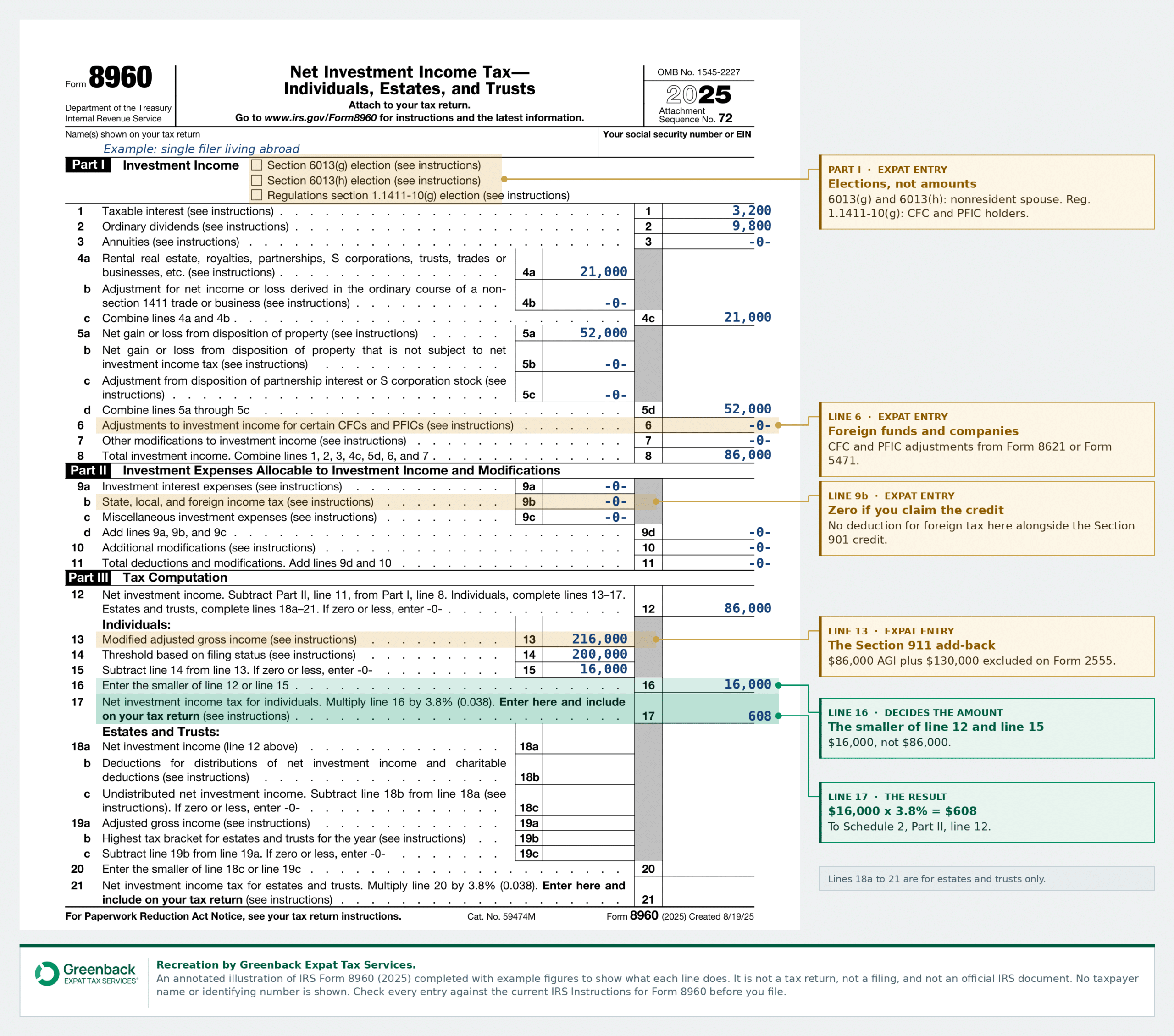
| Line | Entry | Amount |
|---|---|---|
| 8 | Total investment income | $86,000 |
| 11 | Total deductions and modifications | $0 |
| 12 | Net investment income | $86,000 |
| 13 | Modified adjusted gross income | $216,000 |
| 14 | Threshold based on filing status | $200,000 |
| 15 | Line 13 minus line 14 | $16,000 |
| 16 | Smaller of line 12 or line 15 | $16,000 |
| 17 | Net investment income tax | $608 |
Line 13 is the entry that surprises people. Rachel’s adjusted gross income is $86,000, because her salary was excluded. Adding back the $130,000 she excluded brings line 13 to $216,000, which puts her $16,000 over the threshold. Her tax is charged on $16,000, not on the $86,000 of investment income she holds. The foreign housing exclusion is added back on line 13 the same way, so a filer claiming both has more to add than salary alone.
The Same Return, With the Deduction Instead of the Credit
Suppose $9,000 of Rachel’s foreign income tax is allocable to her investment income, and she deducts it. Line 9b becomes $9,000, line 11 becomes $9,000, and line 12 falls to $77,000. Line 15 is unchanged at $16,000, so line 16 is still $16,000, and line 17 is still $608
The Part II deduction changed nothing, because her tax was already limited by the MAGI excess, not by her net investment income. Deductions on lines 9a through 10 only lower this tax when line 12 is the smaller of the two figures on line 16.
Which Lines Do Estates and Trusts Complete?
An estate or trust completes Parts I and II the same way an individual does, stops at line 12, and then works lines 18a through 21. Lines 13 through 17 are for individuals only.
Lines 18a Through 21, in Order
Line 18b removes distributions of net investment income and charitable deductions. Line 19a takes adjusted gross income, and line 19b takes the dollar amount at which the highest tax bracket for estates and trusts begins for the year. Line 20 takes the smaller of lines 18c and 19c, and line 21 applies 3.8%. If the trust is foreign, our guide to reporting a foreign trust to the IRS covers the returns that precede this calculation.
The Estate and Trust Threshold Is Not a Fixed Figure
It tracks the point at which the top bracket in Section 1(e) begins for the year, which is why an estate can owe this tax on a fraction of the income an individual could earn before the threshold applies.
Where Does the Amount From Line 17 Go?
The figure from line 17 goes on Schedule 2 (Form 1040), Part II, line 12, on the line labeled “Net investment income tax. Attach Form 8960.” Schedule 2 rolls Part II into its own line 21 total, and that total carries to Form 1040.
The Other Taxes That Share Part II of Schedule 2
Our guide to Schedule 2 covers them, including the 0.9% Additional Medicare Tax on Form 8959, one line above it at line 11, which is a separate tax with separate rules.
Form 8960 is attached to the return itself at sequence number 72.
Which Four Lines Differ on an Expat Return?
Four entries on Form 8960 behave differently when you live abroad. Everything else works the same as it does for a filer in the United States.
| Line | What changes abroad |
|---|---|
| Part I checkboxes | The Section 6013(g) and 6013(h) elections apply when you are married to a nonresident spouse. The Regulations section 1.1411-10(g) election applies to CFC and PFIC holders |
| Line 6 | Carries the CFC and PFIC adjustments that follow from holding foreign funds or a foreign company |
| Line 9b | Foreign income tax is deductible here only if you are not claiming the Section 901 credit, and only for the share allocable to investment income |
| Line 13 | Foreign earned income excluded under Section 911 is added back, so MAGI can clear the threshold on a return with little taxable income |
The Checkbox Elections Are the Easiest to Miss
They are the only entries on the form that are not a dollar amount, and a joint-filing choice made for income tax purposes does not carry over to this tax automatically. Our guide to filing jointly when your foreign spouse has no SSN or ITIN covers the income tax side of that election.
When Is Form 8960 Due?
Form 8960 is due with the return it attaches to, so it follows the same calendar and the same extensions. There is no separate filing date and no separate extension request for the form.
The Four Filing Dates
- April 15: The standard federal filing date for the prior tax year.
- June 15: The automatic two-month extension for U.S. citizens and residents whose tax home is abroad. Interest still runs on any unpaid balance from April 15.
- October 15: Available by filing Form 4868 before the June 15 date.
- December 15: A further two months, at the discretion of the IRS. The IRS asks for a letter explaining why you need the extra time, to be sent by October 15, and you will not be notified unless the request is denied.
The full calendar is in our guide to U.S. expat tax deadlines.
This Tax Is Meant to Be Paid During the Year
It falls under the estimated tax rules, and nothing requires it to be withheld, so the amount on line 17 is settled through quarterly estimated payments during the year, not at the time of filing.
Frequently Asked Questions
Form 8960 calculates the 3.8% Net Investment Income Tax under Section 1411 and produces a single figure for Schedule 2, Part II, line 12. It reports no income of its own. Every amount on it already appears elsewhere on your return, and the form exists to apply a separate tax to that income.
Only in a year when your modified adjusted gross income exceeds your threshold. Because the threshold is fixed and not indexed, a return can require the form one year but not the next, even if your income doesn’t change much. A property sale, a large fund distribution, or an excluded foreign salary added back on line 13 can each trigger it on its own.
No. The Foreign Tax Credit reduces income tax, and because this tax is in a different chapter of the code, the credit does not apply to it. You also cannot deduct foreign income taxes on line 9b if you are claiming the credit under Section 901. Treaty-based claims against this tax have been pursued through the courts, and that litigation is covered in our guide to the Net Investment Income Tax.
Your adjusted gross income increased by the foreign earned income you excluded. If your salary was fully excluded, your AGI reflects only your remaining income, and line 13 adds the excluded salary back. That figure, not your taxable income, is what line 15 compares to your threshold.
Line 16 Decides the Size of This Tax on Its Own
It takes the smaller of your net investment income and your MAGI excess, so the same $86,000 of dividends and gains can produce a $608 bill on one return and nothing on another. Work out which of the two numbers is binding before you spend time on Part II, because deductions only help when it is on line 12.
Greenback’s U.S. accountants and Enrolled Agents prepare returns for Americans in 218 countries, and the interaction between the exclusion, the Foreign Tax Credit, and this form is routine work for them. If your year includes a property sale, foreign funds, a nonresident spouse, or investment income alongside excluded foreign salary, having the form reviewed before you file is the practical step.

Ready to Hand This One Over?
This article is for general information and is not tax, legal, or accounting advice. Tax rules change and their application depends on your own facts. All line numbers, amounts, thresholds, rates, and deadlines were verified against the 2025 Form 8960, the IRS Instructions for Form 8960, and Schedule 2 (Form 1040). Please speak with a qualified tax professional with expertise in U.S. expat tax before acting on anything here.



Featured In