How to Pay the IRS: Payment Options, Fees, and Paying From Abroad

- What Are the IRS Payment Options?
- How Do You Pay the IRS Online From a Bank Account?
- How Do You Pay the IRS With a Credit Card, Debit Card or Digital Wallet?
- What Does the New IRS Card Payment Rule Change?
- How Do You Pay U.S. Taxes From Abroad?
- Which IRS Payment Option Should You Use?
- What If You Can't Pay Your Full Balance?
- How Do You Confirm the IRS Received Your Payment?
- Frequently Asked Questions about IRS Payment Options
- Greenback Helps You Know What You Owe Before You Pay


The main IRS payment options are a free bank payment through IRS Direct Pay or your IRS Online Account, a debit card, credit card, or digital wallet through an IRS-approved processor, a payment scheduled when you e-file your return, a same-day wire, and a check, money order, or cash. Bank payments cost nothing. A debit card costs a flat $2.10 to $2.15, and a credit card costs 1.75% to 1.85% of the payment. Whichever IRS payment option you choose, the payment is due April 15, even if you live abroad and use the automatic extension to file by June 15. Our guide to U.S. tax deadlines covers both dates.
Two recent changes affect paying the IRS by card. PayUSAtax stopped accepting payments on behalf of the IRS on January 1, 2025, according to the IRS Internal Revenue Manual, which left Pay1040 and ACI Payments as the two card processors listed on the IRS card payment page. Then, on October 19, 2026, a final IRS rule published in the Federal Register took effect that allows the IRS to accept credit and debit cards directly, with any processing fee charged on top of your tax. Card payments still go through Pay1040 and ACI Payments while the IRS sets that up. If you’re paying U.S. taxes from abroad without a U.S. bank account, a card, an international wire, or a mailed check in U.S. dollars are the options that work, and a debit card usually costs the least. The IRS itself suggests a card over a wire, which it says “can be costly.”
What Are the IRS Payment Options?
The IRS accepts payment by Direct Pay, your IRS Online Account, a withdrawal when you e-file, a debit card, a credit card, a digital wallet, a same-day wire, a check or money order, and cash at a retail store. The first three are free and draw on a bank account. Cards, wallets, and cash carry a small fee, and a wire costs whatever your bank charges.
| Payment option | What it costs | What you need | Works from abroad? |
|---|---|---|---|
| IRS Direct Pay | Free | U.S. bank account | Yes, with a U.S. bank account |
| IRS Online Account | Free | ID.me sign-in and a bank account | Yes, sign in from anywhere |
| Electronic funds withdrawal | Free from the IRS | An e-filed return or extension | Yes, when you e-file |
| Debit card | $2.10 to $2.15 per payment | A card the processor accepts | Yes |
| Credit card | 1.75% to 1.85% ($2.50 minimum) | A card the processor accepts | Yes |
| Digital wallet | Card fees apply | PayPal, Venmo, or Click to Pay | Yes, if the processor accepts your wallet |
| Same-day wire | Your bank’s wire fee | A bank that can wire U.S. dollars | Yes, from a foreign bank |
| Check or money order | Postage | Payment in U.S. dollars, payable to U.S. Treasury | Yes, by mail |
| Cash at a retail store | Up to $1.50 per payment, $500 limit | A participating retail store, 7 days before the due date | In person only |
1. Free Options: Use a Bank Account
Direct Pay, the IRS Online Account, and electronic funds withdrawal are the free electronic IRS payment options. Each one pulls money from a checking or savings account, so they suit anyone with a U.S. bank account, wherever they live. The roundup of the best U.S. banks for Americans abroad covers banks that keep accounts open for customers with a foreign address.
2. Cards and Digital Wallets Add a Processor Fee
Card and digital wallet payments go through Pay1040 or ACI Payments, and each processor charges its own fee. The fee is shown to you before you confirm the payment, so you always see the cost first.
3. Paper and Cash Payments Are Still Accepted
Mailed checks, money orders, and cash payments are still accepted, even as the IRS moves most payments online. The article on IRS paper checks ending explains what the shift to electronic payments means for Americans abroad, and our answers to common paper check questions separate IRS payments from IRS refunds. If you mail a check, include Form 1040-V, the payment voucher, and send it to the right address from our list of IRS mailing addresses.

How Do You Pay the IRS Online From a Bank Account?
You can pay the IRS online from a bank account for free in three ways: IRS Direct Pay, your IRS Online Account, or electronic funds withdrawal when you e-file. All three need a bank account. Direct Pay requires a U.S. routing number, so a foreign bank account without a U.S. affiliate won’t work.
1. IRS Direct Pay Works Without Signing In
IRS Direct Pay takes a payment from your U.S. checking or savings account without an account or sign-in. The IRS says it accepts all payment types, including a balance due, an estimated tax payment, an extension payment, and a payment on an amended return. You can schedule payments up to 365 days in advance and make up to 5 payments per day. Every payment returns a confirmation number that Direct Pay can’t retrieve later, so save it. Direct Pay only sends money to the IRS; refunds are returned via direct deposit.
2. Your IRS Online Account Saves Your Payment Details
Your IRS Online Account lets you pay from a bank account, see your balance, and keep a record of every payment in one place. You can pay the same day or schedule payments up to 365 days in advance, make up to 20 payments per day, and view up to 5 years of payment history, including estimated payments. You can also set up a payment plan there. The account is available to taxpayers with an international address, and our guide to the IRS Online Account walks through signing up from abroad. A card payment started from the account still goes through Pay1040 or ACI Payments.
3. You Can Schedule a Payment When You E-File
Electronic funds withdrawal lets you authorize a payment from your bank account as part of an e-filed return or extension. Your tax software or tax professional sets it up when you file your return. You can also schedule up to four quarterly Form 1040-ES payments with your return or extension, one per quarter.
4. EFTPS Is Closed to New Individual Accounts
Individual taxpayers can no longer open new EFTPS accounts. If you already use the Electronic Federal Tax Payment System, the IRS says you can keep using it for now. New individual users are pointed to the IRS Online Account instead.
How Do You Pay the IRS With a Credit Card, Debit Card or Digital Wallet?
You pay the IRS by credit card, debit card, or digital wallet through one of two IRS-approved processors, Pay1040 or ACI Payments. A debit card costs a flat $2.10 or $2.15, and a credit card costs 1.75% or 1.85% of the payment, with a $2.50 minimum. Both processors take PayPal and Click to Pay, and ACI Payments also takes Venmo. No part of the fee goes to the IRS, according to the IRS card payment page.
| Processor | Debit card | Credit card | Digital wallets |
|---|---|---|---|
| Pay1040 | $2.15 | 1.75% ($2.50 minimum) | PayPal, Click to Pay |
| ACI Payments | $2.10 | 1.85% ($2.50 minimum) | PayPal, Venmo, Click to Pay |
Fees from the IRS card payment page (last reviewed October 14, 2026), checked October 21, 2026. You can also pay by phone: Pay1040 at 888-729-1040 (international: 1-501-748-8507) and ACI Payments at 800-272-9829 (international: 1-703-653-2499), as listed in the IRS Internal Revenue Manual 21.2.1.
1. What It Costs to Pay the IRS by Card
On a $3,000 tax bill, a credit card costs $52.50 through Pay1040 or $55.50 through ACI Payments, while a debit card costs $2.15 or $2.10. Because the lowest credit card fee is $2.50 and the highest debit card fee is $2.15, a debit card is the cheaper card on any balance. A credit card makes sense only if the rewards you earn are worth more than the fee.
| Amount you owe | Debit card (either processor) | Credit card, Pay1040 | Credit card, ACI Payments |
|---|---|---|---|
| $1,000 | $2.10 to $2.15 | $17.50 | $18.50 |
| $3,000 | $2.10 to $2.15 | $52.50 | $55.50 |
| $5,000 | $2.10 to $2.15 | $87.50 | $92.50 |
| $10,000 | $2.10 to $2.15 | $175.00 | $185.00 |
2. Pay1040 and ACI Payments Are the Two IRS-Approved Processors
Pay1040 and ACI Payments are legitimate, IRS-authorized card processors, and they are the only two the IRS lists. ACI Payments was formerly known as Official Payments, which is why older bookmarks and search results still show that name. Pay1040 is run by Link2Gov Corporation. In a Pay1040 vs. ACI Payments comparison, Pay1040 has the lower credit card fee, and ACI Payments charges 5 cents less for a debit card. Pay1040 also takes more card brands: Visa, Mastercard, Discover, American Express, Diners Club International, China UnionPay, and JCB, while ACI Payments takes Visa, Mastercard, and American Express. To pay safely, start from the IRS card payment page and follow its link to either processor.
3. PayUSAtax Stopped Taking IRS Payments in 2025
PayUSAtax, also written payUSAtax, is no longer an IRS card processor. It was a legitimate IRS-listed processor until an IRS Internal Revenue Manual procedural update dated January 8, 2025, removed it as a provider as of January 1, 2025, stating that PayUSAtax “is no longer accepting payments on behalf of the IRS.” The current IRS manual lists only Pay1040 and ACI Payments, so a payusatax.com login is no longer available for paying the IRS. If you paid through PayUSAtax before 2025 and aren’t sure the payment posted, check your payment history in your IRS Online Account; the January 2025 update directs questions about past PayUSAtax payments to payusatax.com.
4. Card Payments Are Limited by Tax Type
The IRS limits how many card payments you can make for each type of tax. These are the IRS frequency limits for individuals:
- Form 1040 balance due: 2 card payments per year
- Form 1040-ES estimated tax: 2 per quarter
- Form 4868 extension: 2 per year
- Installment agreement: 2 per month
- Form 1040-X amended return: 2 per year
5. Card Fees Aren’t Deductible for Individuals
Individuals can’t deduct the card processing fee on their tax return. The IRS manual states that the deduction “no longer applies to individuals.” Businesses paying employment taxes by card can still treat the fee as a business expense.
What Does the New IRS Card Payment Rule Change?
A final IRS rule, Treasury Decision 10060, took effect on October 19, 2026, and allows the IRS to accept credit and debit card payments directly, without sending you to a third-party processor. If the IRS pays a fee under its card contracts, it must recover the full amount from you as a reimbursement. The fee is charged at the time of your payment, in addition to your tax, and it can’t exceed what the IRS itself pays. The Federal Register notice carries the full rule.
1. The Reimbursement Fee Isn’t Refundable
The reimbursement fee is not a tax, and no part of it can be refunded or credited to you. If you later overpay and get a refund, the card fee stays paid. The rule also says the IRS will seek to keep the fees it pays as low as possible.
2. No New Fee Rate Has Been Published
The rule doesn’t set a fee amount or percentage. As of October 21, 2026, the IRS card payment page still sends card payments through Pay1040 and ACI Payments, at the fees in the processor table. Until the IRS posts a new rate, those processor fees are the ones you pay.
3. Foreign Cards Aren’t Addressed Yet
The rule doesn’t mention foreign-issued cards or payments made from abroad. Today, whether a foreign card works depends on the processor, since the IRS manual says the cards accepted “may vary by service provider.” Once the IRS publishes a direct-card fee, compare it with your bank’s wire cost before choosing how to pay from abroad.
How Do You Pay U.S. Taxes From Abroad?
You can pay U.S. taxes from abroad by Direct Pay or your IRS Online Account if you keep a U.S. bank account, or by card, international wire, or mailed check if you don’t. Paying U.S. taxes while living abroad follows the same deadline as at home: the payment is due April 15, and interest runs on any tax not paid by then, even if you qualify for the automatic extension to June 15 to file. For the 2026 tax year, that means April 15, 2027. If you also don’t have a U.S. address, the guide to filing U.S. taxes from abroad covers the rest of the process. Our pillar on U.S. expat taxes explains who has to file, and U.S. citizen abroad taxes covers why you owe U.S. tax at all.
1. A U.S. Bank Account Works From Anywhere
If you kept a U.S. checking or savings account after moving abroad, Direct Pay and your IRS Online Account work the same as they would at home, at no cost. This is the cheapest way to pay from abroad. It also avoids currency conversion, since the money is already in U.S. dollars.
2. Paying by Card With a Foreign Card
A foreign credit or debit card can work through Pay1040 or ACI Payments, but you pay the processor fee plus any foreign transaction or currency conversion fee your card issuer charges. The IRS doesn’t set the issuer’s charge, so check your card’s terms first. If your card is a Discover, Diners Club International, China UnionPay, or JCB card, use Pay1040, since ACI Payments doesn’t list those brands. The guide to sending money internationally explains how exchange-rate markups add to the cost.
3. Paying by International Wire
The IRS accepts same-day wires in U.S. dollars from a foreign bank, but it warns that a wire “can be costly” and suggests a card instead. Your foreign bank must have a banking relationship with a U.S. bank. These are the IRS wiring instructions from the IRS foreign electronic payments page:
- Fill out the Same-Day Taxpayer Payment Worksheet before you go to your bank, with the right tax type code and tax period.
- Give your bank the IRS routing number, 091036164 (US TREAS SINGLE TX).
- Send the payment in U.S. dollars. Your bank converts the currency and may charge a wire fee.
- Keep the wire confirmation until the payment shows in your IRS Online Account.
| What you’re paying | Tax type code |
|---|---|
| Balance due on a return or IRS notice | 10407 |
| Estimated tax | 10406 |
| Extension payment | 10402 |
| Amended return | 10400 |
Foreign banks with questions can call the Federal Tax Payment Service at 314-425-1810 (not toll-free).
4. When a Wire Costs Less Than a Credit Card
A wire beats a credit card when the card’s fee percentage is higher than your bank’s flat wire fee. For example, if your bank charges $40 to send an international wire, a 1.75% credit card fee costs more on any balance above about $2,286. Add your bank’s exchange-rate margin to the wire fee before you compare. A debit card is still cheaper than either a wire or a credit card.
5. Mailing a Check From Abroad
You can mail a check or money order from abroad, payable to “U.S. Treasury,” in U.S. dollars. Write your name, tax year, form number, and SSN or ITIN on it, and send it with Form 1040-V to the address for your situation on our list of IRS mailing addresses. International mail is slow, so an electronic payment is safer close to April 15.
Which IRS Payment Option Should You Use?
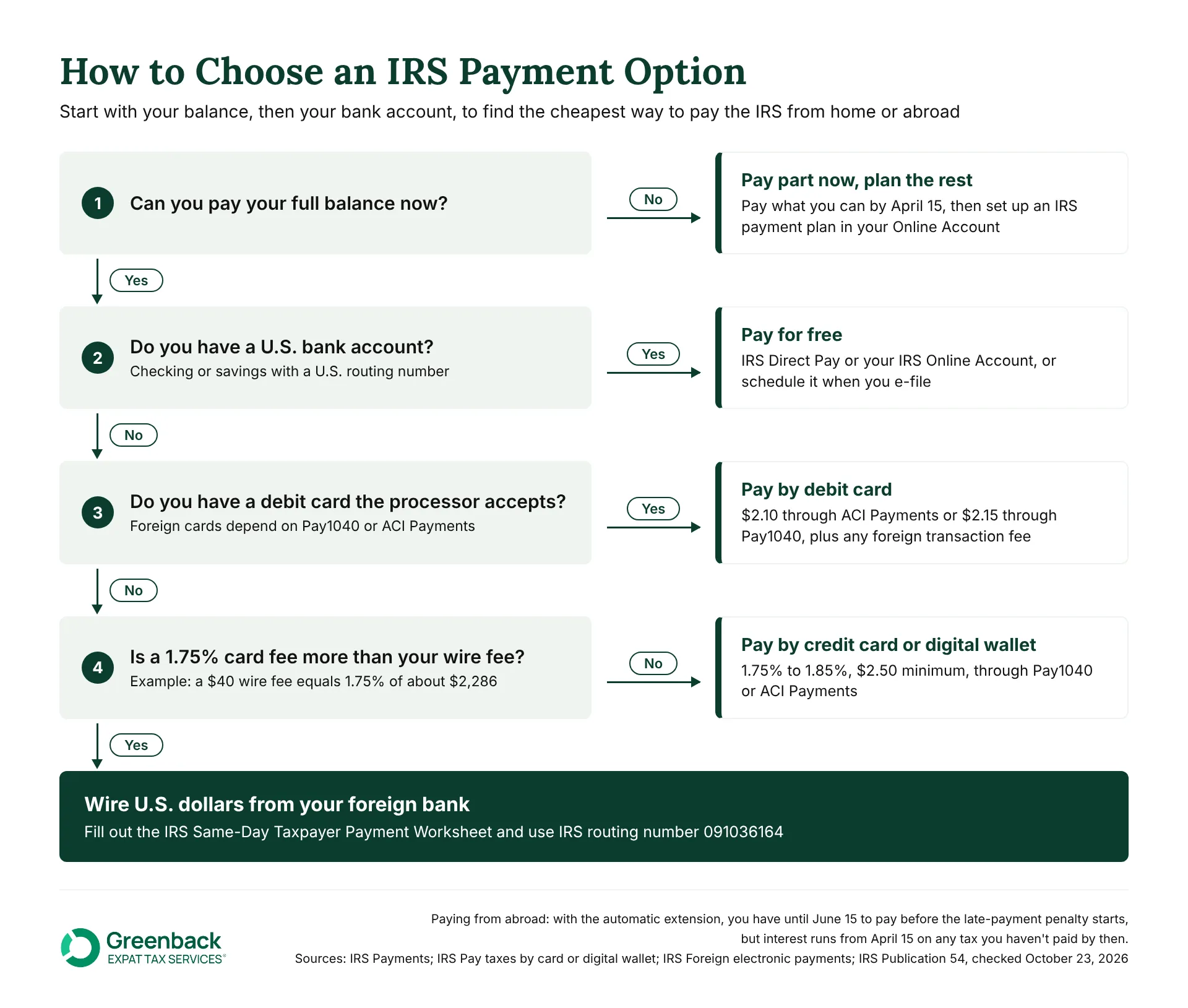
The best IRS payment option depends on whether you can pay the full balance now and whether you have a U.S. bank account. With a U.S. bank account, pay online for free. Without one, a debit card usually costs the least, and a payment plan covers what you can’t pay yet.
1. You Can’t Pay in Full Now
Pay what you can by April 15 with the cheapest option you have, then apply for a payment plan in your IRS Online Account. Paying part on time lowers the balance on which interest and the late payment penalty are calculated, and a short-term plan of up to 180 days has no setup fee. If you plan to pay the installments by card, the IRS allows 2 card payments a month on an installment agreement.
2. You Have a U.S. Bank Account
Pay for free with IRS Direct Pay or your IRS Online Account, or schedule the payment as an electronic funds withdrawal when you e-file. Direct Pay is the quickest for a one-time payment, since it needs no sign-in. The Online Account suits you better if you make estimated payments through the year, because it keeps 5 years of payment history in one place. Scheduling the payment with your e-filed return ties the two together, so there’s no separate step to remember.
3. You Have a Debit Card
Without a U.S. bank account, a debit card is the cheapest way to pay the IRS, at $2.10 through ACI Payments or $2.15 through Pay1040. The fee stays flat no matter how much you owe, so a $10,000 tax bill costs the same to pay as a $500 one. Check whether your bank adds a foreign transaction fee, and if your card is a Discover, Diners Club International, China UnionPay, or JCB card, use Pay1040.
4. You Only Have a Credit Card or a Foreign Bank Account
Compare your bank’s international wire fee with the credit card fee before you pay. A credit card is faster and needs no paperwork, which suits a smaller balance or a payment close to the deadline. For a larger balance, a wire in U.S. dollars from your foreign bank usually costs less, as long as the bank has a U.S. banking relationship and you complete the Same-Day Taxpayer Payment Worksheet first.
What If You Can’t Pay Your Full Balance?
If you can’t pay your full tax bill, the IRS advises paying as much as you can by the due date, because interest and a monthly late payment penalty build on the unpaid balance. A partial payment through any IRS payment option reduces the balance on which those charges are calculated. You can then apply for a payment plan for the rest in your IRS Online Account.
1. Partial Payments Reduce Interest and Penalties
The IRS accepts partial payments, and paying part of the balance reduces the interest and penalties that build up, according to IRS Tax Topic 202. The current IRS interest rate page shows what the unpaid balance costs each quarter, and U.S. expat tax penalties covers the late payment penalty.
2. Payment Plans Start in Your Online Account
Most individuals qualify for a short-term or monthly IRS payment plan they can set up online. A short-term plan of up to 180 days has no setup fee. Our guide to the Form 9465 installment agreement explains the monthly options, and the IRS tax debt help tool article shows which IRS debt programs fit your situation, without signing in. If you’re also behind on filing, our guide for Americans abroad who never filed and our page for late filers show how to catch up. If you can’t pay at all, an offer in compromise may settle the debt for less than the full amount.
3. A Balance Due Notice Has Its Own Deadline
If the IRS has already sent a CP14 balance-due notice, pay or set up a payment plan by the date on the notice. IRS Notice CP14 walks through each part of the letter and what to do next.
How Do You Confirm the IRS Received Your Payment?
Keep the confirmation number from your payment, then check that the payment appears in your IRS Online Account. A Direct Pay payment submitted after 8 p.m. Eastern time usually shows as the next business day. Card processors and banks provide their own confirmation, which serves as your proof of payment.
1. Save the Confirmation Number
Save every confirmation number and receipt until the payment shows on your account. Direct Pay can’t look up a lost confirmation number for you.
2. Check Your Payment History
Your IRS Online Account shows pending, scheduled, and completed payments for up to 5 years. If a payment is missing after a few business days, contact the processor or bank that sent it before you pay again to avoid paying twice. If you need to call the IRS directly, check its current hours first.
3. When a Payment Doesn’t Show Up
A payment with a missing or wrong tax year, form, or ID number can sit unapplied until the IRS matches it to your account. Our report on the IRS’s unidentified taxpayer payments explains how that happens. If you then receive a CP14, our answer to what an IRS CP14 balance due notice means covers the next steps.
Frequently Asked Questions about IRS Payment Options
You can make a payment to the IRS online for free through IRS Direct Pay or your IRS Online Account, using a U.S. bank account. You can also pay by debit card, credit card, or digital wallet through Pay1040 or ACI Payments for a fee, schedule a payment when you e-file, wire U.S. dollars from a foreign bank, or mail a check payable to “U.S. Treasury” with Form 1040-V.
The fee to pay the IRS with a credit card is 1.75% of the payment through Pay1040 or 1.85% through ACI Payments, with a $2.50 minimum at both. On a $3,000 tax bill, that is $52.50 or $55.50. A debit card costs a flat $2.15 through Pay1040 or $2.10 through ACI Payments, so it is cheaper than a credit card on any balance.
No, payUSAtax is no longer an IRS payment processor. The IRS removed PayUSAtax as a provider as of January 1, 2025, and its Internal Revenue Manual now lists only Pay1040 and ACI Payments for card payments. Anyone who paid through PayUSAtax before 2025 can check their IRS Online Account to confirm the payment posted.
Yes, Pay1040 is a legitimate, IRS-authorized card processor run by Link2Gov Corporation. The IRS card payment page lists Pay1040 and ACI Payments as the two processors for paying federal taxes by debit card, credit card, or digital wallet. Starting from the IRS card payment page and following its link is the safest way to reach Pay1040.
Yes, you can send a partial payment to the IRS, and the IRS advises paying as much as you can by the due date. A partial payment reduces the interest and late payment penalty that build on the unpaid balance. After a partial payment, you can set up a payment plan for the rest in your IRS Online Account.
Without a U.S. bank account, you can pay U.S. taxes from abroad by debit card, credit card, or digital wallet through Pay1040 or ACI Payments, or by an international wire in U.S. dollars from your foreign bank using the IRS Same-Day Taxpayer Payment Worksheet and routing number 091036164. A debit card usually costs the least, about $2 per payment, plus any foreign transaction fee your bank charges.
Greenback Helps You Know What You Owe Before You Pay
The right IRS payment option is usually the cheapest: a free bank payment if you have a U.S. account, or a debit card if you don’t. What matters more is paying the right amount by April 15. Greenback’s accountants prepare your U.S. return wherever you live, show you exactly what you owe before you file, and tell you when and how to make the payment, so the payment step is simple.

Get Your Return Done Right, Then Pay With Confidence.
This article is for general information and isn’t tax or legal advice. Processor fees, card limits, and IRS payment procedures can change. Treasury Decision 10060 took effect on October 19, 2026, but the IRS had not published a direct-card fee as of October 21, 2026; check the IRS card payment page for current fees before you pay. For advice on your situation, speak with a qualified tax professional.



Featured In


