IRS Schedule 1-A (Form 1040): Who It’s For, How It Works & Filing Instructions



Schedule 1-A (Form 1040), “Additional Deductions,” is the IRS form for claiming four deductions created by the One Big Beautiful Bill Act (OBBB): qualified tips, qualified overtime, car loan interest, and an extra deduction for filers 65 and older. They apply for tax years 2025 through 2028, and you attach Schedule 1-A to your Form 1040, Form 1040-SR, or Form 1040-NR.
You can claim these deductions whether you itemize or take the standard deduction, and the total goes on line 13a of your 2026 Form 1040, filed in 2027. If you live abroad, any income you exclude with the Foreign Earned Income Exclusion (FEIE) is added back to your modified adjusted gross income (MAGI) before any of the four is figured, which can reduce or remove them.
Most Americans working for foreign employers won’t have qualifying tips or overtime. Retirees abroad and anyone paying off a loan on a new, U.S.-assembled car should take a closer look. Here’s what Schedule 1-A is, who should file it, how the FEIE affects it, and how to complete each part.
What Is Schedule 1-A?
Schedule 1-A is the IRS schedule that calculates four temporary deductions and carries their total to your Form 1040. Each deduction has its own part, its own cap, and its own income phase-out, and every part uses the same MAGI figure from Part I.
Schedule A, Schedule 1, and Schedule 1-A Are Separate Forms
The names are similar, but each schedule serves a different purpose, and you may file one, two, or all three.
| Schedule | What it does | Who files it |
|---|---|---|
| Schedule A | Itemized deductions, such as mortgage interest, state and local taxes, and charitable gifts | Filers whose itemized deductions are larger than the standard deduction |
| Schedule 1 | Additional income and adjustments, such as business income, the FEIE and the foreign housing deduction | Americans abroad who claim the FEIE, which is reported there |
| Schedule 1-A | Tips, overtime, car loan interest and the senior deduction | Only filers claiming one of those four |
Schedule 1-A also differs from Schedule 3-A, which covers certain refundable credits.
Who Should File Schedule 1-A?
You file Schedule 1-A only if you claim at least one of its four deductions, and no one has to file it otherwise. For Americans abroad, the senior and car loan interest deductions are the most likely to apply, while tips and overtime rarely do. These situations are the ones worth checking:
- Retirees 65 or older: you were born before January 2, 1962, have a valid Social Security number, and your MAGI, with excluded foreign income added back, is under $175,000 ($250,000 on a joint return).
- A new car on a loan: you’re paying interest on a loan taken out after December 31, 2024, for a new personal-use vehicle that completed final assembly in the United States.
- Reported tips: your tips appear on a W-2 (box 12, code TP) or a Form 1099, or you’re self-employed in an occupation that customarily receives tips.
Overtime rarely applies abroad because the federal overtime rule doesn’t cover workweeks performed in a foreign country (as explained under Part III).
Married couples have to file jointly to claim the tips, overtime, and senior deductions; only the car loan interest deduction is available on a separate return. That matters if you’re married to a nonresident spouse and file separately: the senior deduction isn’t available unless you file jointly, which requires an election to treat your spouse as a U.S. resident and brings their worldwide income onto your return. The tips and overtime deductions also need a Social Security number valid for employment.

How Does the FEIE Affect Schedule 1-A?
Income you exclude under the Foreign Earned Income Exclusion still counts toward Schedule 1-A. Part I starts with your adjusted gross income and adds back the amounts on Form 2555, so the exclusion works exactly as before for your income tax, but it doesn’t lower the MAGI that sets each deduction’s phase-out.
Excluded Income Is Added Back Before Each Deduction Is Figured
Part I adds back amounts from Form 2555 (lines 45 and 50, the foreign earned income and foreign housing exclusions and the foreign housing deduction), the Puerto Rico exclusion, and Form 4563 for American Samoa. Our FAQ on AGI vs. MAGI covers how the two numbers differ.
Claiming the Foreign Tax Credit instead doesn’t change much here. Nothing is excluded, so nothing is added back, and your MAGI ends up close to the same figure. The choice between them is covered in our guide to FEIE vs. FTC.
Schedule 1-A Example: Two Retirees Abroad and the Senior Deduction
Sarah, 67, teaches part-time in Portugal. She earns $70,000 in salary, which she excludes under the FEIE (the 2026 limit is $132,900), and takes $30,000 of taxable distributions from a U.S. IRA. John, 68, is retired in France on a $160,000 foreign pension. Both file as single.
| Step | Sarah | John |
|---|---|---|
| Income | $70,000 salary (excluded) + $30,000 IRA | $160,000 foreign pension |
| Adjusted gross income (line 1) | $30,000 | $160,000 |
| Added back in Part I | $70,000 | $0 (a pension isn’t earned income, so the FEIE never applied) |
| MAGI (line 3) | $100,000 | $160,000 |
| Over the $75,000 threshold | $25,000 | $85,000 |
| Reduction at 6% | $1,500 | $5,100 |
| Senior deduction | $4,500 | $900 |
Sarah’s deduction reduces the tax on her IRA income because that income remains taxable after the exclusion. Without the IRA income, Sarah’s excluded salary would leave her with no taxable income to reduce with the deduction.
If the FEIE and MAGI interaction makes your return harder to plan, expat tax return preparation with an accountant who handles foreign income can review each deduction against your numbers.
How Do You Fill Out Schedule 1-A?
Start with Part I, which every filer completes, then fill in only the parts for the deductions you claim, and add them on line 44. Each part caps the deduction, then reduces it once your MAGI passes that part’s threshold.
| Part | Lines | Maximum deduction | Phase-out starts (MAGI) | How it shrinks |
|---|---|---|---|---|
| I: MAGI | 1 to 3 | n/a | n/a | n/a |
| II: Tips | 4 to 15 | $25,000 per return | $150,000 ($300,000 joint) | $100 per $1,000 over |
| III: Overtime | 16 to 27 | $12,500 ($25,000 joint) | $150,000 ($300,000 joint) | $100 per $1,000 over |
| IV: Car loan interest | 28 to 36 | $10,000 | $100,000 ($200,000 joint) | $200 per $1,000 over |
| V: Seniors | 37 to 43 | $6,000 per qualifying person | $75,000 ($150,000 joint) | 6% of MAGI over the threshold |
| VI: Total | 44 | n/a | n/a | Goes to Form 1040, line 13a |
Figures from the 2026 Schedule 1-A (Form 1040).
Part I: Modified Adjusted Gross Income (Lines 1 to 3)
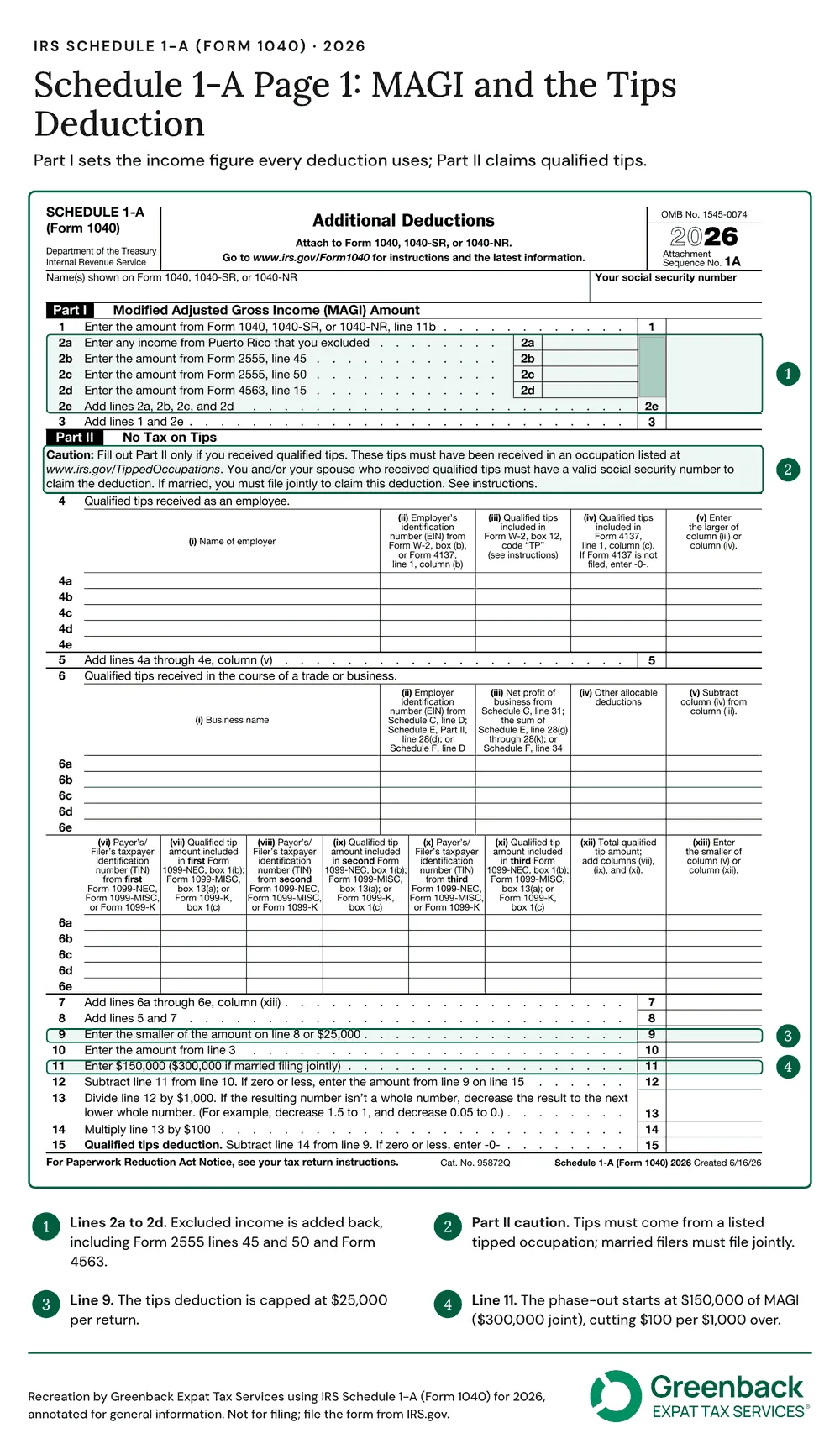
Line 1 is your adjusted gross income from Form 1040, line 11b. Lines 2a to 2d add back excluded income (Puerto Rico, Form 2555 lines 45 and 50, and Form 4563), and line 3 is your MAGI for every part that follows. The FEIE section above shows how this changes the result.
Part II: Qualified Tips (Lines 4 to 15)
You can deduct up to $25,000 of qualified tips per return. Employee tips come from box 12 of your W-2 (code TP) or Form 4137, and tips from self-employment come from Schedule C, E, or F and can’t exceed that business’s net profit. The tips have to be earned in an occupation that customarily and regularly receives tips, as listed by the Treasury.
Most Americans working abroad for a foreign employer won’t have tips reported this way. Our article on the tips, overtime, and senior deductions for expats covers why.
Part III: Qualified Overtime (Lines 16 to 27)
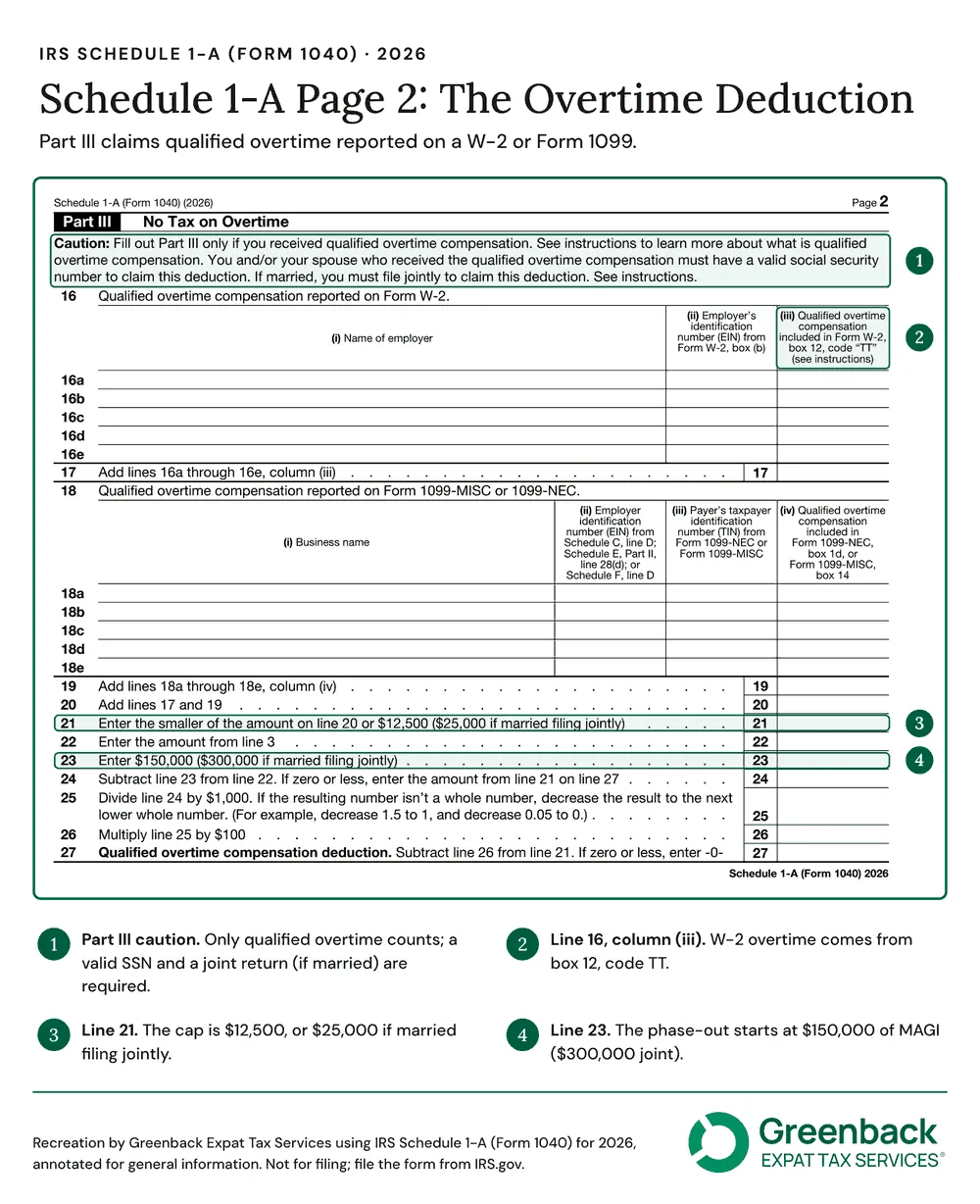
You can deduct up to $12,500 of qualified overtime, or $25,000 on a joint return. Only the extra pay above your regular rate counts (the “half” of time-and-a-half), and only overtime the Fair Labor Standards Act requires. Employers report it in box 12 of the W-2 with code TT, and line 18 covers overtime reported on Form 1099-MISC or 1099-NEC.
The FLSA’s overtime rule doesn’t apply to workweeks performed in a foreign country, so most Americans working abroad, including those on a U.S. employer’s payroll, won’t have qualified overtime for that work. Work in U.S. territories such as Puerto Rico, Guam, the U.S. Virgin Islands, and American Samoa is still covered.
Part IV: Car Loan Interest (Lines 28 to 36)
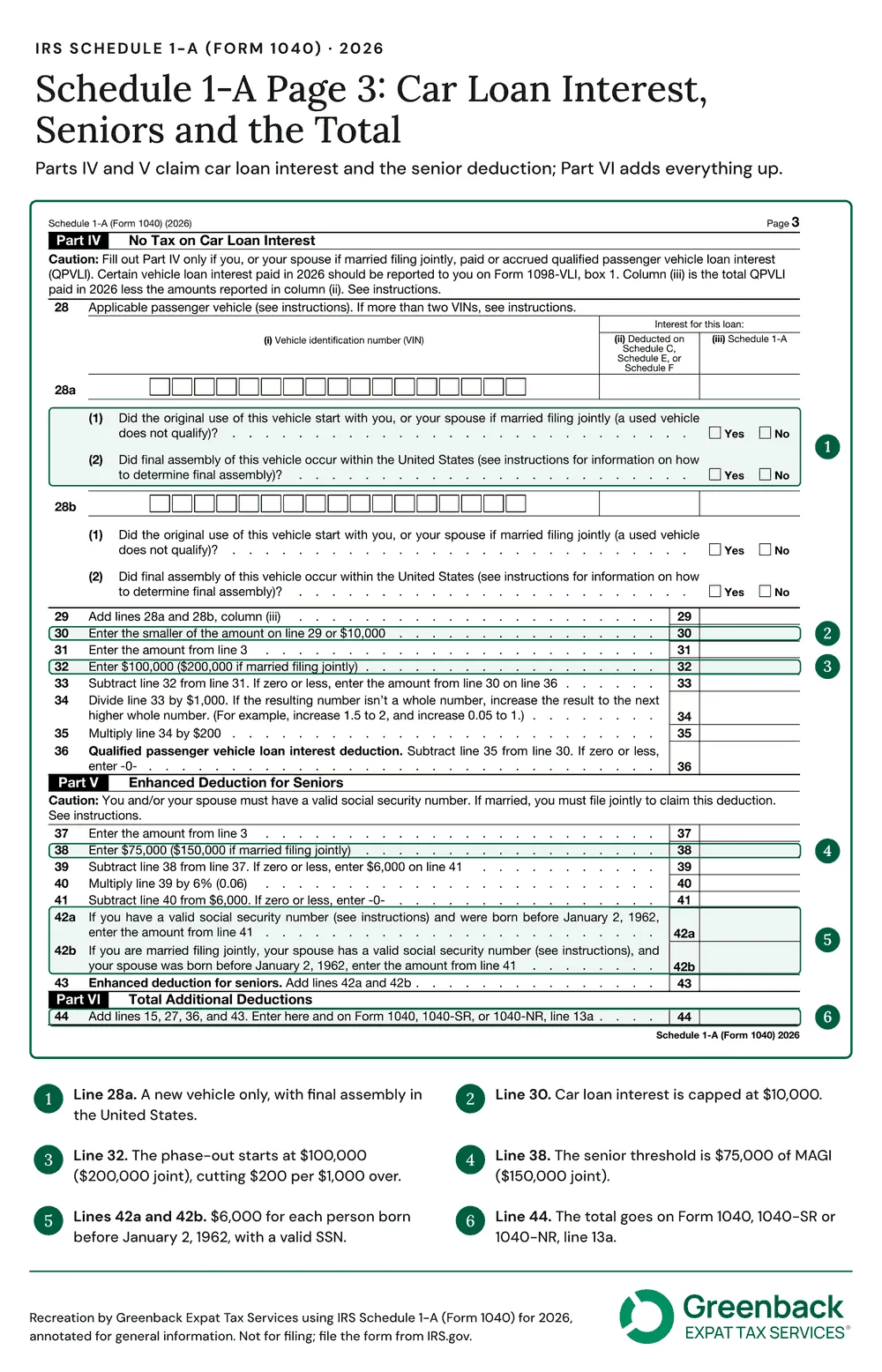
The OBBB car loan interest deduction lets you deduct up to $10,000 of interest on a loan for a new personal-use vehicle. Line 28 asks for the vehicle identification number (VIN) and two yes-or-no questions: whether the vehicle’s original use began with you so used cars don’t qualify, and whether final assembly took place in the United States. You can check the plant of manufacture in the VIN or on the label on the vehicle.
The loan must be taken out after December 31, 2024, secured by a first lien on the vehicle, and leases don’t qualify. The phase-out removes $200 for every $1,000 of MAGI over the threshold (rounded up), so the full $10,000 is gone at $150,000 for a single filer, and a smaller deduction phases out at a lower income. Nonresident aliens are generally not eligible.
The Treasury’s final rules for this deduction take effect on November 9, 2026. They also require lenders that receive $600 or more of interest in a trade or business to report it on Form 1098-VLI. A lender outside the U.S. may send you no statement, so keep your own loan records.
Part V: Enhanced Deduction for Seniors (Lines 37 to 43)
You can deduct $6,000 if you were born before January 2, 1962, and $12,000 on a joint return when both spouses qualify. Each qualifying person needs a valid Social Security number, as noted in the IRS’s Schedule 1-A fact sheet. Line 38 holds the threshold: $75,000, or $150,000 on a joint return. The deduction falls by 6% of MAGI over it, so it’s gone at $175,000 for a single filer and $250,000 for a couple.
The senior deduction sits on top of your standard deduction or itemized deductions. The standard deduction and tax brackets guide lists the 2026 amounts, and our article on OBBB Social Security changes for expats covers how the new law affects benefits.
Part VI: Your Total Goes on Form 1040, Line 13a
Line 44 adds the four deductions, and the total goes on line 13a of Form 1040, 1040-SR, or 1040-NR. Because line 13a comes after your adjusted gross income, these deductions lower your taxable income but don’t lower AGI.
You file Schedule 1-A with your return: by April 15, 2027, or June 15, 2027 if you live abroad, with interest from April 15 on any tax not paid by then, or October 15, 2027 with a Form 4868 extension. If you also file Form 2555 or Form 1116, you attach them to the same return.
Frequently Asked Questions about Schedule 1-A
No, Schedule 1-A and Schedule 1 are separate forms. Schedule 1 reports additional income and adjustments, including the Foreign Earned Income Exclusion. Schedule 1-A claims only four deductions: qualified tips, qualified overtime, car loan interest and the senior deduction. Many Americans abroad file Schedule 1 and never need Schedule 1-A.
Yes, Schedule 1-A deductions are available whether you take the standard deduction or itemize. The total from Schedule 1-A goes on line 13a of Form 1040, in addition to your standard deduction or itemized deductions.
Only the car loan interest deduction is open to filers without a Social Security number, and nonresident aliens are generally not eligible for it. The tips and overtime deductions need a Social Security number valid for employment, and the senior deduction needs a valid Social Security number for each qualifying person, so filers with an ITIN can’t claim those three.
Yes, but only the car loan interest deduction. Married couples must file a joint return to claim the Schedule 1-A deductions for qualified tips, qualified overtime, and seniors.
Yes, the four Schedule 1-A deductions are temporary. They apply to tax years 2025 through 2028 under the One Big Beautiful Bill Act (OBBBA) and expire after 2028 unless Congress extends them.
The Schedule 1-A requirements for car loan interest concern the vehicle and the loan: a new personal-use vehicle with final assembly in the United States, a loan taken out after December 31, 2024, and a first lien on the vehicle. None of them name the lender’s country. A foreign bank may not send an interest statement, so keep records that show the interest you paid.
Your MAGI Decides Most Schedule 1-A Claims From Abroad
For most Americans abroad, the deciding number on Schedule 1-A is MAGI with excluded foreign income added back. Tips and overtime rarely apply to work done outside the U.S., while the senior deduction and the car loan interest deduction can apply to retirees and to anyone financing a new, U.S.-assembled car.
If you’re retired abroad and drawing a pension or IRA income, the senior deduction may lower your U.S. tax. Learn more about how we help retirees abroad. If you’re a U.S. citizen working abroad, the add-back is the first thing to check, excluding your salary. Learn more about how we help U.S. citizens living abroad. For the credits that sit alongside these deductions, such as the child tax credit for expats, our guide to U.S. expat tax deductions and credits covers the rest.

An Expat Accountant Checks Every Deduction
This article is for general informational purposes only and does not constitute legal, tax, or financial advice. It’s based on the 2026 Schedule 1-A released in June 2026 and current IRS guidance, which can change. Please consult a qualified tax professional about your specific situation.


Featured In


