PFIC Tax Rules for U.S. Expats: What They Are and How They Affect Your Return

- How Do I Know If I Own a PFIC?
- What Foreign Investments Are PFICs?
- Why Are PFIC Rules So Punitive?
- How Are PFICs Taxed?
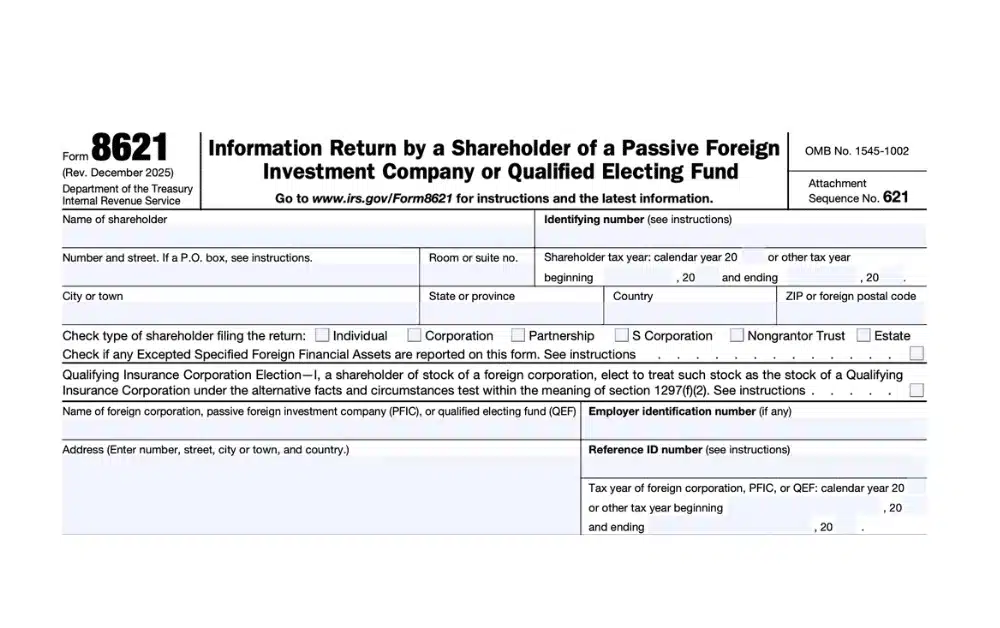
- What Are My Form 8621 Filing Requirements?
- Are There Any Exceptions to PFIC Rules?
- What Mistakes Should I Avoid?
- How Can I Minimize PFIC Tax Impact?
- What If I'm Behind on PFIC Reporting?
- When Should I Seek Professional Help?
- Related Resources


A Passive Foreign Investment Company (PFIC) is a foreign corporation that generates at least 75% of its income from passive sources (like dividends, interest, or rent) or holds at least 50% of its assets for producing passive income. According to the IRS, most foreign mutual funds, ETFs, and certain foreign pension or insurance products qualify as PFICs, triggering special tax reporting requirements for U.S. taxpayers.
PFIC rules impose punitive tax treatment designed to discourage U.S. taxpayers from deferring tax through foreign investments. If you own shares in a PFIC, you must file Form 8621 annually and pay taxes using one of three methods, the default of which can be costly. However, with proper planning and election timing, you can significantly reduce the tax burden.
Most Americans living abroad discover they own PFICs without realizing it. That foreign mutual fund recommended by your local bank? Almost certainly a PFIC. The unit trust you invested in through your UK broker? Likely a PFIC. Even some foreign pension funds can trigger PFIC reporting. This guide explains how to identify PFICs, outlines the applicable filing requirements, and discusses tax strategies to minimize your liability.
Unsure Whether Your Foreign Funds Count as PFICs?
How Do I Know If I Own a PFIC?
The IRS applies two tests annually to determine whether a company is a PFIC. A foreign corporation qualifies as a PFIC if it meets either test:
Income Test (75% Rule)
If 75% or more of the corporation’s gross income comes from passive sources, it’s a PFIC. Passive income includes:
- Dividends and interest
- Rents and royalties
- Capital gains from securities trading
- Income from commodities and currency transactions
- Annuity payments
Asset Test (50% Rule)
If 50% or more of the corporation’s assets produce passive income or are held for the production of passive income, it qualifies as a PFIC.
Example: A foreign mutual fund that invests in stocks and bonds generates income primarily from dividends and interest. Since more than 75% of its income is passive, it qualifies as a PFIC under the income test.
What Foreign Investments Are PFICs?
Common PFIC Investments:
- Foreign mutual funds: Including index funds and actively managed funds
- Foreign ETFs: Exchange-traded funds listed on non-U.S. exchanges
- Foreign hedge funds: Alternative investment vehicles
- Non-U.S. unit trusts: Pooled investment vehicles
- Foreign real estate investment trusts (REITs): Property investment funds
- Some foreign insurance or pension products: Particularly those with investment components
What’s NOT a PFIC:
- U.S.-registered funds: Even those with significant foreign holdings (ISIN starting with “US”)
- Individual foreign stocks: Direct ownership of shares like Shell, Toyota, or Nestlé
- Most qualified foreign pension plans: Until the distribution phase
- Active operating businesses: Companies that fail both PFIC tests

Check the International Securities Identification Number (ISIN) on your investment statements. If it starts with “US,” the fund is registered in the United States and not a PFIC. Any other country code (like “GB” for Great Britain or “CA” for Canada) likely indicates a PFIC.
Why Are PFIC Rules So Punitive?
Congress enacted PFIC rules in 1986 to prevent U.S. taxpayers from deferring taxes by investing in foreign corporations that accumulate income without distributing it to their shareholders. The regulations impose harsh tax treatment to eliminate any advantage of offshore investing.
The complexity and penalties serve as deterrents. The IRS wants you to either:
- Avoid foreign pooled investments entirely
- Make elections that eliminate tax deferral benefits
- Pay significantly higher taxes than on U.S. investments
This policy treats foreign and domestic investors differently, creating a substantial disadvantage for Americans living abroad who naturally invest in local markets.
How Are PFICs Taxed?
You have three taxation methods available, each with different requirements and consequences:
1. Excess Distribution Method (Default)
This is the method you use if you don’t make a special election. It’s typically the most expensive option for long-term investors.
How It Works: When you receive a distribution or sell PFIC shares, the IRS treats part of the gain as “excess distribution” and allocates it across all years you owned the investment. You pay ordinary income tax rates on each year’s allocated portion, plus an interest charge for the theoretical deferral benefit.
Tax Rate: Ordinary income rates (up to 37%) plus interest charges
Example: Miguel bought shares in a German mutual fund in 2020 for $10,000. He sold them in 2025 for $20,000. Under the excess distribution method, the $10,000 gain is allocated across the five-year holding period. He pays ordinary income tax on approximately $2,000 per year (2020-2024), plus interest charges compounding from each year. His effective tax rate could exceed 50% of the gain.
When It Makes Sense: Almost never by choice. This is the default if you don’t make an election.
2. Mark-to-Market (MTM) Election
Available only for PFICs traded on qualified exchanges.
How It Works: You treat your PFIC shares as sold on December 31 each year, recognizing gain or loss as ordinary income even if you didn’t sell anything. This eliminates the interest charge component but means paying tax on unrealized gains.
Tax Rate: Ordinary income rates (up to 37%), but no interest charges
Requirements:
- PFIC must be traded on a qualified exchange
- Election made on Form 8621 with your tax return
- Can be made in any year you own the PFIC
Example: Sarah owns shares in a Canadian ETF worth $30,000 as of January 1, 2025, and $35,000 as of December 31, 2025. Under the MTM election, she reports $5,000 as ordinary income on her 2025 return, even though she didn’t sell. If the value drops to $32,000 in 2026, she can recognize a $3,000 ordinary loss (limited to prior gains).
When It Makes Sense: When you own publicly traded PFICs and expect modest annual gains. Best for investments you plan to hold long-term in countries where local taxes are low.
3. Qualified Electing Fund (QEF) Election
The most favorable method, but it requires information from the fund that many won’t provide.
How It Works: You report your proportionate share of the PFIC’s ordinary earnings and net capital gain annually, similar to how U.S. mutual funds are taxed. Ordinary earnings are taxed at ordinary rates, but capital gains qualify for preferential long-term capital gains rates.
Tax Rate: Ordinary income rates on earnings, preferential rates (0-20%) on capital gains
Critical Requirements:
- PFIC must provide an Annual Information Statement (PFIC Annual Information Statement)
- Must make an election in the first year you own the PFIC
- If missed, requires IRS approval to make a late election (Form 8621 with “protective” statement)
Example: David owns shares in a foreign fund that provides QEF information. The fund earned $2,000 in ordinary income and $1,500 in long-term capital gains attributable to David’s shares. He reports $2,000 as ordinary income (taxed at his regular rate) and $1,500 as long-term capital gains (taxed at a preferential rate of 15% or 20%). Total tax: approximately $830, compared to potentially over $1,750 under the excess distribution method.
When It Makes Sense: Whenever possible, if the fund provides the required information. Makes the PFIC tax treatment comparable to that of U.S. mutual funds.

Most foreign funds don’t provide QEF information because they have no U.S. reporting requirements. Always check before investing.
What Are My Form 8621 Filing Requirements?
You must file Form 8621 (Information Return by a Shareholder of a Passive Foreign Investment Company or Qualified Electing Fund) when you:
- Receive distributions from a PFIC
- Recognize gain on disposition of PFIC shares
- Make a QEF or MTM election
- Own PFICs with a combined value exceeding $25,000 (single) or $50,000 (married filing jointly)
Filing Requirement: One Form 8621 per PFIC per year
Example: If you own five different foreign mutual funds, you file five separate Forms 8621 with your tax return.
Information You’ll Need:
- Name and EIN (if available) of the PFIC
- Your beginning and ending shares or value
- Distributions received during the year
- Sales or dispositions during the year
- Election type and supporting calculations
Are There Any Exceptions to PFIC Rules?
Yes, two primary exceptions may eliminate PFIC reporting requirements:
Foreign Pension Plan Exception
Specific qualifying foreign retirement plans are exempt from PFIC rules if:
- Income is tax-deferred under the plan structure
- No early withdrawals or unauthorized plan modifications
- The plan qualifies under U.S. tax treaty provisions
Examples:
- UK SIPPs (Self-Invested Personal Pensions)
- Canadian RRSPs (Registered Retirement Savings Plans)
- Australian Superannuation (under specific conditions)
This exception typically applies only until you take distributions. Once you begin withdrawing, the underlying investments may trigger PFIC reporting.
Controlled Foreign Corporation (CFC) Overlap
If your PFIC also qualifies as a Controlled Foreign Corporation (where U.S. persons own more than 50% of the foreign corporation):
- You may file Form 5471 instead of Form 8621
- Different and sometimes more favorable rules apply
- Complex ownership attribution rules determine CFC status
Example: You and three other U.S. citizens collectively own 80% of a foreign investment company. The investment company is both a PFIC (based on its income) and a CFC (based on U.S. ownership). CFC rules would generally apply instead of PFIC rules.
What Mistakes Should I Avoid?
Not Recognizing PFIC Status
Many expats invest through local banks in what appear to be simple mutual funds, unaware that they’ve triggered complex U.S. reporting requirements.
What to Do: Before investing in any foreign fund, ETF, unit trust, or pooled investment vehicle, check whether it’s a PFIC. If you can’t determine the status, assume it is and plan accordingly.
Missing the First-Year QEF Election
QEF elections must be made in the first year you own the PFIC to be effective. Missing this deadline forces you into the much less favorable excess distribution or mark-to-market methods.
What to Do: If you’re considering foreign investments, work with a tax professional before investing to determine whether QEF elections are available.
Failing to File Form 8621
Some expats don’t realize they own PFICs until years later, or they know but hope the IRS won’t notice.
Consequences:
- Penalties up to $10,000 per form, per year for failure to file
- No statute of limitations on IRS audits (they can audit indefinitely)
- Loss of the ability to make favorable elections
- Compounding interest charges on the excess distribution method
What to Do: If you’ve missed filing Form 8621 in past years, Streamlined Filing Procedures may allow you to catch up without penalties if your failure was non-willful.
Inadequate Record-Keeping
PFIC calculations require detailed records of purchase dates, cost basis, annual values, and distributions for every year you owned the investment.
What to Do: Maintain comprehensive records, including:
- Original purchase confirmations
- Annual statements showing year-end values
- Distribution records
- Currency conversion rates for each transaction
How Can I Minimize PFIC Tax Impact?
Before Investing:
- Choose U.S.-Domiciled Funds: U.S.-registered mutual funds and ETFs are not PFICs, even if they invest entirely in foreign stocks and bonds. Vanguard Total International Stock Index Fund (a U.S. fund) is not a PFIC. Vanguard FTSE All-World Ex-US UCITS ETF (a foreign fund) is a PFIC.
- Consider Individual Stocks: Direct ownership of foreign company stocks (Shell, Nestlé, Samsung) does not trigger PFIC rules. Individual stocks provide foreign market exposure without PFIC complexity.
- Verify QEF Availability: Before investing in a foreign fund, confirm whether the fund provides QEF information statements. If not available, the investment becomes significantly less tax-efficient.
After Discovering PFICs:
- Evaluate Election Options: Work with a tax professional to determine whether QEF or MTM elections reduce your tax burden. Run calculations comparing all three methods before making elections.
- Consider Disposition Timing: If you’re subject to the excess distribution method, the timing of sales affects tax liability. Spreading dispositions across multiple years can reduce the annual impact.
- Coordinate with Other Expat Benefits: Your Foreign Earned Income Exclusion and Foreign Tax Credit strategies should coordinate with PFIC tax liabilities to minimize overall U.S. taxes.
What If I’m Behind on PFIC Reporting?
If you own PFICs and haven’t filed Form 8621 in previous years, you have options to come into compliance.
- Streamlined Filing Procedures: This IRS program allows you to file up to three years of delinquent tax returns and six years of FBARs, often without penalties, if your failure to report was non-willful. Form 8621 for each PFIC must be included with each delinquent return.
- Protective QEF Elections: If you want to make QEF elections for PFICs you’ve owned for years, you can file “protective” elections that may be effective if the IRS approves them. This requires detailed explanations and additional forms.
- Disposition Strategy: Some expats choose to dispose of PFICs to simplify future compliance, accepting the tax hit in one year rather than managing ongoing complex reporting.
- Critical Timing: You must act before the IRS contacts you. Once they initiate an audit or examination, you lose access to favorable compliance programs.
When Should I Seek Professional Help?
PFIC taxation represents one of the most complex areas of U.S. international tax law. Consider professional assistance if you:
- Own or are considering foreign mutual funds, ETFs, or pooled investments
- Discovered you own PFICs from previous years not reported
- Need to evaluate QEF, MTM, or excess distribution methods
- Face PFIC reporting requirements while catching up on unfiled returns
- Have both PFICs and CFCs requiring coordination
- Live in a country where local investment advisors recommend products that are PFICs
At Greenback Expat Tax Services, we’re an American company founded in 2009 by U.S. expats for expats. Expat taxes are our core expertise and always have been. Many of our CPAs and Enrolled Agents are expats themselves, and because they live in 14 time zones, they experience firsthand the challenges of international investing.
No matter how late, messy, or complex your PFIC situation may be, we can help. You’ll have peace of mind, knowing that your taxes were done right, backed by our Make It Right guarantee.
Get started today:
- Contact us – Our customer champions will gladly answer your questions
- Schedule a consultation – Get specific advice on your PFIC investments
- Get matched with an accountant – We’ll pair you with a CPA or EA experienced in PFIC reporting
If you’re ready to be matched with a Greenback accountant, click the Get Started button below.
Not Certain Which PFIC Reporting Method Fits Your Situation?
This guide provides general information about PFIC taxation and should not be considered specific tax advice. PFIC rules are highly complex and fact-specific. Always consult qualified tax professionals regarding your particular situation before making investment decisions or PFIC elections.
Related Resources
PFIC Forms and Requirements:
- Form 8621 – PFIC Reporting
- Common Expat Tax Forms
- Form 1040 for Expats
- Form 1040 Schedule 2
- PFIC Service Pricing
Related Foreign Investment Topics:
- Foreign Bank Accounts and Tax Filing
- UK ISA Taxation for U.S. Expats
- Assurance Vie (French Life Insurance) PFIC Rules
- FBAR Filing Requirements
- FATCA (Form 8938)
Tax Strategies and Credits:
Late Filing and Compliance: