Physical Presence Test: How to Count 330 Days and Qualify for the FEIE

- What Is the Physical Presence Test?
- What Counts as a "Full Day" Outside the U.S.?
- Which Locations Qualify as "Foreign Countries"?
- How Do You Choose Your 12-Month Qualifying Period?
- Can You Qualify for the FEIE with a 9-Month Assignment?
- What If You Only Qualify for Part of the Tax Year?
- How Do Flights and Layovers Affect Your Day Count?
- What Documentation Do You Need?
- How Do You File for the Physical Presence Test?
- What Are the Most Common Mistakes?
- FAQs About the Physical Presence Test
- Get Your Day Count Right the First Time


The Physical Presence Test qualifies you for the Foreign Earned Income Exclusion (FEIE) if you spend 330 full days in foreign countries during any 12 consecutive months. Pass it, and you can exclude up to $130,000 on your 2025 return or $132,900 on your 2026 return by filing Form 2555. Those 12 months do not have to match the calendar year.
Here is what you need to know at a glance:
- 330 full days: you must spend at least 330 complete 24-hour periods (midnight to midnight) outside the U.S. in any 12 consecutive months
- Flexible 12-month window: your qualifying period can start on any date, not just January 1, and you should test multiple windows to maximize your exclusion
- Tax home required: your principal place of business or employment must be in a foreign country during the qualifying period
- Proration applies: if your 12-month period spans two tax years, the exclusion is prorated based on the number of qualifying days in each year
Below, we cover how to count days correctly, which locations qualify, how to choose your 12-month period strategically, whether a 9-month assignment is long enough, how flights and layovers work, and what forms to file.
What Is the Physical Presence Test?
The Physical Presence Test is one of two methods for qualifying for the Foreign Earned Income Exclusion (FEIE), and it is purely mathematical. It counts where you physically spent your time, with no questions about your intentions, ties to a foreign country, or plans to return to the U.S.
To pass, you need three things:
- 330 full days in one or more foreign countries during any 12 consecutive months
- A tax home in a foreign country (your principal place of business or employment must be abroad)
- Foreign earned income from work performed outside the U.S. (wages, salaries, bonuses, self-employment income)
Only earned income qualifies. Passive income, like dividends, interest, rental income, pensions, and capital gains, cannot be excluded under the FEIE regardless of how many days you spend abroad.
What Counts as a “Full Day” Outside the U.S.?
The IRS defines a full day as a complete 24-hour period from midnight to midnight. This creates three critical rules:
- Arrival days do not count: if you land in London at 2:00 PM, your first full day abroad starts at midnight that night. The hours between arrival and midnight do not qualify.
- Departure days do not count: if you leave Paris at 11:00 PM, that day is not a full day abroad because you were not present for the complete 24-hour period.
- Any time in the U.S. counts as a day: if you are in the U.S. for even one minute during a 24-hour period, that entire day counts toward your 330.
Example: You fly from New York to Berlin on March 10, arriving at 8:00 AM on March 11. Your first full day abroad is March 12 (midnight to midnight on March 11 includes your travel time, so March 11 does not count as a full day in Germany). If you return to the U.S. on December 5, your last full day abroad is December 4.
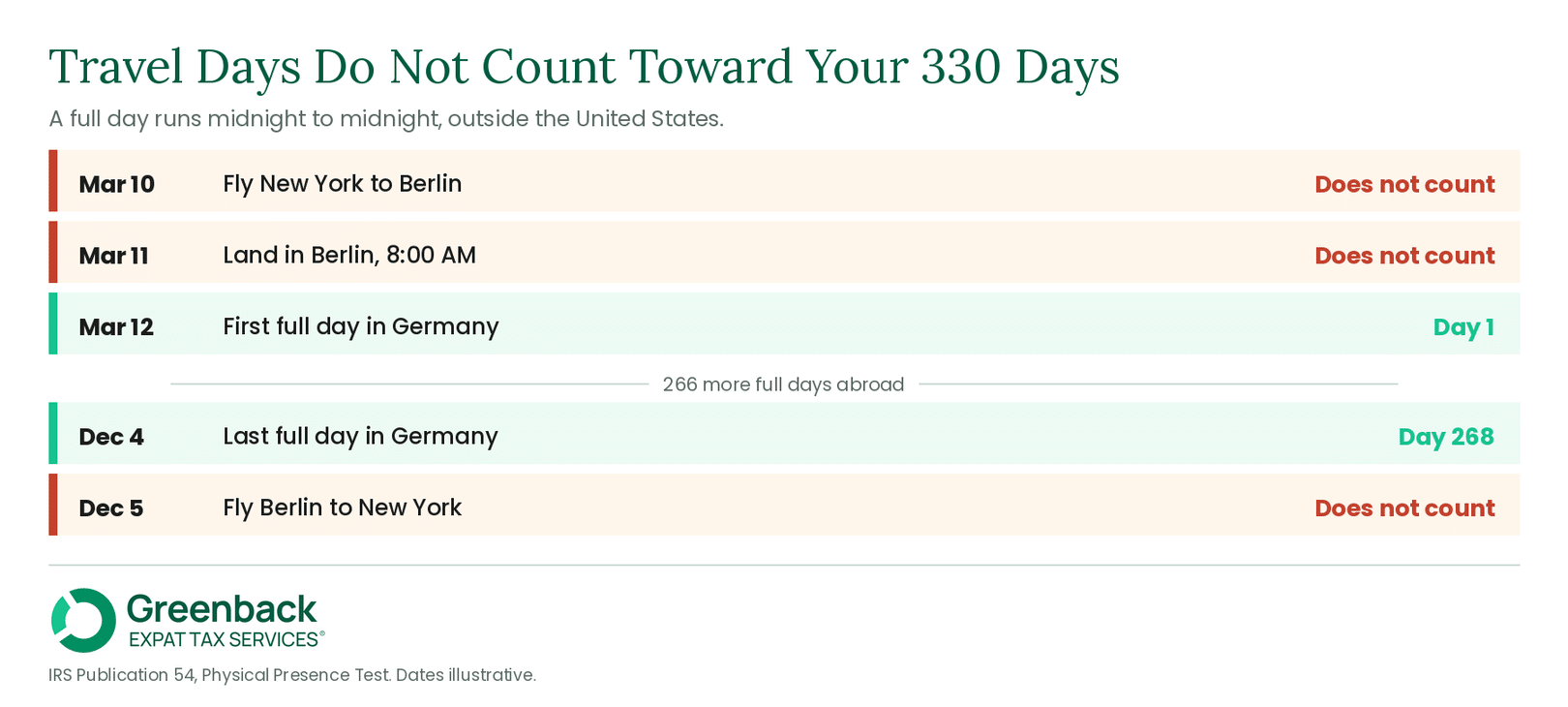
Counting March 12 through December 4 gives you 268 full days. The two travel days are gone at both ends of every trip, and the rule applies each time you cross into or out of the U.S., not only on the way out and the way home.
Which Locations Qualify as “Foreign Countries”?
Most places outside the U.S. count, but there are exceptions:
| Counts Toward 330 Days | Does Not Count |
|---|---|
| Any recognized foreign country | U.S. territories (Puerto Rico, Guam, U.S. Virgin Islands, American Samoa, Northern Mariana Islands) |
| Multiple foreign countries combined | International waters or airspace |
| Travel between foreign countries (if under 24 hours) | Antarctica |
| Foreign military bases (if you have a tax home abroad) | Countries where your presence violates U.S. law |
You do not need to spend all 330 days in the same country. Time spent in any combination of foreign countries counts toward the total.

The 330-Day Rule Is Simpler Than It Looks.
How Do You Choose Your 12-Month Qualifying Period?
Your 12-month period must be consecutive, but it can start on any date. It does not need to align with the calendar year. This flexibility is one of the biggest advantages of the Physical Presence Test.
Strategy: Test Multiple Windows
If you moved abroad mid-year or took trips back to the U.S., different 12-month windows may capture different numbers of qualifying days. You should test several options before filing.
Example: You moved to Germany on March 15, 2025, and returned to the U.S. for two weeks in October 2025. You could test:
- March 16, 2025, to March 15, 2026: avoids the October trip if you stayed abroad the rest of the time
- April 1, 2025, to March 31, 2026: a different window that may capture more or fewer qualifying days
The period you choose is reported on Form 2555, Line 16. Choose the window that gives you the highest day count before you file.
Can You Qualify for the FEIE with a 9-Month Assignment?
Yes, but not on the assignment alone. Nine months is roughly 273 days, which leaves you 57 days short of 330. The gap is usually wider than it looks, because a trip home during the posting costs you the days in the U.S., plus a travel day at each end. Two one-week trips home take about 18 days out of your count, so you would need roughly 75 qualifying days either side of the assignment rather than 57.
Here is how it works in practice:
Example: You deploy to Kuwait on January 15, 2025, for a 9-month assignment ending October 15, 2025. That is approximately 273 days. If you stayed abroad for any reason (vacation, another assignment, personal travel) for at least 57 additional days within a 12-month window that includes your assignment, you reach 330.
If you cannot reach 330 days, you have 3 options:
- Shift your 12-month window: the period does not have to start when the assignment does. A window that opens before you deploy or closes after you return may reach 330 days with no extra time abroad.
- Extend your time abroad: even personal travel in a foreign country counts toward the 330 days, as long as your tax home remains abroad.
- Qualify under the Bona Fide Residence Test instead: if you settled in the country with no fixed end date to your stay, that route asks about your intent rather than your day count, so the 330-day cutoff no longer matters. A 9-month posting with a set return date usually will not meet it.
What If You Only Qualify for Part of the Tax Year?
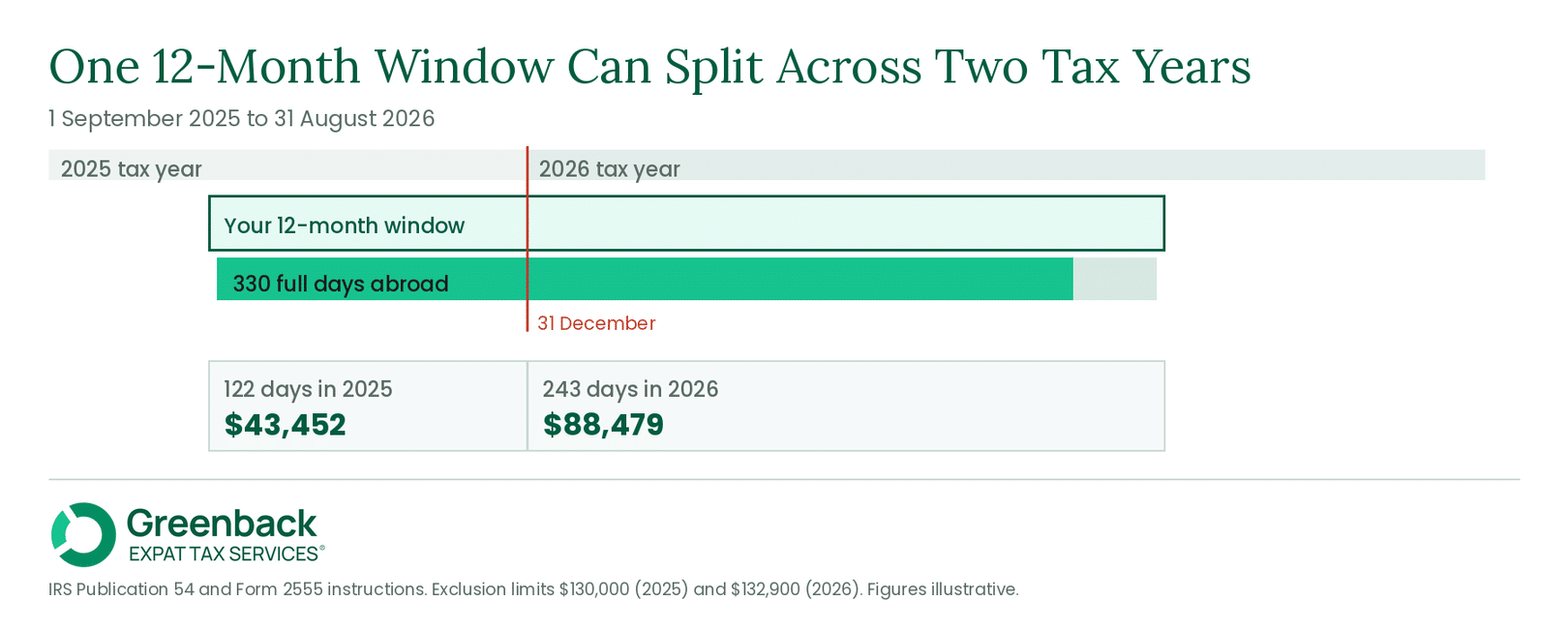
If your 12-month qualifying period spans two tax years, the IRS prorates your exclusion based on the number of qualifying days in each year.
Proration formula: (Maximum exclusion / 365) x qualifying days in the tax year = your exclusion for that year
Example: Your qualifying period runs from September 1, 2025, to August 31, 2026. Only 122 days (September 1 to December 31) fall within the 2025 tax year. Your 2025 exclusion: ($130,000 / 365) x 122 = $43,452.
The remaining 243 days apply to your 2026 return: ($132,900 / 365) x 243 = $88,479. You claim each share on its own return. Because your 2025 return comes due before the window closes, this is the situation for which Form 2350 exists, and it buys you an extension until you qualify.
How Do Flights and Layovers Affect Your Day Count?
- U.S. layovers: if you fly Paris to JFK (5-hour layover) to Mexico City, the day you are in the U.S. does not count as a full day abroad. However, it also does not reset any other requirement. You simply lose that one day from your count.
- Travel between foreign countries: moving between foreign countries does not break your streak as long as the travel takes less than 24 hours. If you leave London at 11:00 PM and arrive in Stockholm at 5:00 AM the next day, you lose no full days.
- International waters: time spent over international waters or in international airspace does not count toward your 330 days. For most commercial flights between foreign countries, this is not an issue because the travel is under 24 hours.
What Documentation Do You Need?
The IRS can audit your Physical Presence Test claim and request proof. Keep these records organized throughout the year:
- Passport with entry/exit stamps: your primary evidence
- Flight itineraries and boarding passes: backup for passport stamps
- Hotel reservations and receipts: show where you stayed
- Lease agreements or rental contracts: prove your foreign residence
- Employment contracts: confirm your foreign tax home
- Bank statements with foreign transactions: corroborate your location
- Phone location data or tracking apps: supplementary evidence
Start a tracking spreadsheet or use a day-counting app from the beginning of your time abroad. Reconstructing months of travel from memory after tax season can lead to costly errors.
How Do You File for the Physical Presence Test?
Report your qualification on Form 2555, Part III:
- Line 16: your 12-month qualifying period (start and end dates)
- Line 17: your principal country of employment
- Line 18: all travel during your qualifying period, including dates, countries, and the number of days in each location
If you had no travel between countries, you can write “Physically present in a foreign country for the entire 12-month period.”
If you will reach 330 days after the normal filing deadline, file Form 2350 to request an extension until you qualify.
What Are the Most Common Mistakes?
- Off-by-one errors: arriving on March 15 means your first full day is March 16. Departing on December 1 means November 30 is your last full day. Being off by one day at exactly 330 can cost you the entire exclusion.
- Forgetting the tax home requirement: passing the day count is not enough. Your principal place of business must be in a foreign country. If you work remotely for a U.S. company while traveling, consult a tax professional about whether you meet the tax home test.
- Not planning for emergencies: if war, civil unrest, or similar adverse conditions force you to leave a foreign country before reaching 330 days, the IRS may waive the time requirement. Early each year, the IRS publishes the list of qualifying countries and their effective dates in an Internal Revenue Bulletin. Write “Claiming Waiver” on page 1 of Form 2555 and attach an explanation.
- Counting U.S. territory days: time in Puerto Rico, Guam, the U.S. Virgin Islands, and other territories does not count toward your 330 days.
FAQs About the Physical Presence Test
Not on its own. Nine months is roughly 273 days, which falls 57 days short of the 330-day requirement. If you combine your 9-month assignment with additional time abroad before or after it (vacations, personal travel, another assignment) inside the same 12-month window, you reach 330.
No, the IRS requires full 24-hour periods from midnight to midnight. The day you arrive in a foreign country and the day you depart do not count as full days abroad.
Yes, you can spend your qualifying days in any combination of foreign countries. You do not need to stay in one location. This makes the test ideal for digital nomads and frequent travelers.
Try shifting your 12-month window first, since a different start date may capture the days you need. If you will reach 330 after your filing deadline, Form 2350 extends the deadline until you qualify. If war or civil unrest forced you out of a country early, the IRS may waive the minimum time requirement. If none of those apply, the Bona Fide Residence Test is the other route to the same exclusion and does not count any days. Our guide to choosing between the two tests walks through which one fits your situation.
Yes, self-employment income earned while working in a foreign country qualifies for the FEIE under the Physical Presence Test, as long as you meet the 330-day and tax home requirements. You still owe self-employment tax (Social Security and Medicare) on excluded income unless a totalization agreement applies.
Get Your Day Count Right the First Time
One miscounted day or a poorly chosen 12-month period can cost you the entire exclusion. Whether you need help choosing the optimal qualifying period, documenting your days abroad, or filing Form 2555, our team handles Physical Presence Test filings regularly.

Ready to Claim the FEIE With Confidence?
This article is for informational purposes only. The content does not constitute tax, legal, or financial advice. Tax rules and regulations change frequently, and your individual circumstances may affect how they apply to you. For personalized guidance, consult a qualified tax professional.



Featured In





