Form 8938 Instructions: Who Must File, Thresholds, and How to File

- What Is Form 8938?
- Who Has to File Form 8938?
- What Are the Form 8938 Filing Thresholds?
- What Accounts Need to Be Reported on Form 8938?
- How Do You Fill Out Form 8938, Step by Step?
- What Are the Penalties for Not Filing Form 8938?
- What If You Missed Form 8938 in Earlier Years?
- Frequently Asked Questions about Form 8938
- Your Maximum Values Do Most of the Work on Form 8938


Form 8938, Statement of Specified Foreign Financial Assets, is the FATCA form you attach to your tax return to report foreign bank accounts, foreign investments, and other foreign financial assets. It’s an informational form, so filing it doesn’t incur any tax, and it’s sent to the IRS with your Form 1040.
Form 8938 is required under the Foreign Account Tax Compliance Act (FATCA), the 2010 law covered in our guide to FATCA reporting requirements. You file Form 8938 when your foreign financial assets are worth more than $50,000 at year-end or $75,000 at any time during the year if you’re single and live in the U.S., or more than $200,000 at year-end or $300,000 at any time if you live abroad. Joint filers use double those amounts, and if you don’t have to file a tax return, you don’t file Form 8938.
Many people who file an FBAR for accounts over $10,000 never reach these thresholds. For your 2026 tax return, filed in 2027, you’ll find out who files Form 8938, what it reports, how to complete each part, and how to fix a year you missed.
What Is Form 8938?
Form 8938 discloses your specified foreign financial assets once their total value passes a reporting threshold. It lists each foreign account and asset, its maximum value during the year, and any income it produced. The income itself is taxed through the usual schedules of your return, so Form 8938 only discloses it. In a year you aren’t required to file a federal income tax return, you don’t file Form 8938, as our guide to the FATCA exemption explains.
The New 2026 Form 8938 Clarifies Where Other Foreign Accounts Go
Form 8938 (Rev. December 2026) applies to tax years beginning in 2026 and now stays in use from year to year until the IRS replaces it. The main change is how you report foreign financial accounts that aren’t deposit or custodial accounts, such as a cash value life insurance policy. The new version makes clear that these accounts go in Part II, renamed “Other Foreign Assets and Accounts Summary,” with the details in Part VI, and many line descriptions are reworded to match.
Form 8938’s thresholds and part numbers don’t change in the new version. The IRS may still adjust the wording of lines before the final form, and 2025 returns use the November 2021 version, as covered by the current IRS instructions. The IRS Form 8938 page links the current form and instructions.
Who Has to File Form 8938?
You file Form 8938 if you’re a specified individual, you’re required to file a tax return, and your foreign financial assets are over your threshold. Specified individuals are:
- U.S. citizens: wherever they live.
- Resident aliens: for any part of the tax year, including green card holders and people who meet the substantial presence test.
- Nonresident aliens who elect resident treatment: usually to file jointly with a U.S. spouse.
- Residents of American Samoa or Puerto Rico: nonresident aliens who are bona fide residents of either territory.
Some Entities and Treaty Dual Residents Follow Their Own Rules
Certain domestic trusts and closely held domestic corporations and partnerships with mainly passive income or assets, called specified domestic entities, also file Form 8938, using the $50,000 and $75,000 thresholds. A treaty dual resident who files as a nonresident generally doesn’t report assets for that part of the year, as long as Form 8833 is attached. The dual-status aliens guide covers the year you arrive or leave.

What Are the Form 8938 Filing Thresholds?
Your Form 8938 threshold depends on your filing status and whether you live in the U.S. or abroad. You file if your specified foreign financial assets are over either amount in your row: the value on the last day of the tax year, or the maximum value at any time during it.
| Filing status | Where you live | Last day of the year | Any time during the year |
|---|---|---|---|
| Single or married filing separately | U.S. | More than $50,000 | More than $75,000 |
| Married filing jointly | U.S. | More than $100,000 | More than $150,000 |
| Single or married filing separately | Abroad | More than $200,000 | More than $300,000 |
| Married filing jointly | Abroad | More than $400,000 | More than $600,000 |
Assets you report on Forms 3520, 3520-A, 5471, 8621 or 8865 still count toward the threshold, even though Form 8938 doesn’t list them again.
Living Abroad Means Meeting the Presence Abroad Test
You use the higher thresholds if you meet the presence abroad test. That means you’re a U.S. citizen who is a bona fide resident of a foreign country for a period that includes a full tax year, or a U.S. citizen or resident present abroad for at least 330 full days in 12 consecutive months ending in the tax year. These are similar to the Bona Fide Residence Test and the Physical Presence Test.
Joint Assets Are Counted Once on a Joint Return
Married couples filing jointly count a jointly owned asset once. If you file separately and your spouse is also a specified individual, you each count half for the threshold test, and each of you reports the full value if you file. If your spouse is a nonresident alien who hasn’t elected resident treatment, you count the full value. Our FAQ on the threshold for married couples filing jointly abroad goes into more detail.
Example: A Home Sale Can Push a Single Filer Over the Threshold
Emma, a U.S. citizen in Germany who meets the presence abroad test, files as single. She sells her Munich apartment in June, and with the proceeds her German bank account peaks at €285,000. By December 31, €170,000 remains after she buys another home. Converted at an illustrative year-end rate of 1.10:
- Maximum value: €285,000 × 1.10 = $313,500.
- Year-end value: €170,000 × 1.10 = $187,000.
Her year-end value is under $200,000, but her maximum value is over the $300,000 any-time threshold, so she files Form 8938. She reports the bank account; the apartment itself isn’t reported because foreign real estate you own directly isn’t a specified foreign financial asset.
What Accounts Need to Be Reported on Form 8938?
Form 8938 covers foreign financial accounts plus foreign financial assets held outside an account, such as shares in a foreign company held in your own name. Once you’re required to file, you report every specified foreign financial asset, including small ones.
| Reported on Form 8938 | Not on Form 8938, and where it goes instead |
|---|---|
| Bank and deposit accounts at foreign financial institutions | Foreign real estate you own directly: rental income goes on Schedule E, and a taxable sale goes on Form 8949; a main home may qualify for the home sale exclusion |
| Foreign brokerage and custodial accounts | Foreign currency, precious metals and personal property you hold directly: nothing to report while you hold them; a taxable gain when you sell or exchange them goes on your return, as with currency gains |
| Foreign mutual funds, hedge funds and private equity funds | Foreign government social security-type benefits: generally taxed like an annuity on your Form 1040, unless a tax treaty treats them as U.S. Social Security |
| Foreign pensions and deferred compensation plans | Accounts at U.S. financial institutions: interest and dividends go on your return, with Schedule B above $1,500; an account at a foreign branch of a U.S. bank also goes on the FBAR |
| Foreign-issued life insurance or annuities with a cash value | Accounts you can sign on but have no financial interest in: the FBAR for signature authority |
| Foreign stock, bonds and partnership interests held outside an account | U.S. mutual funds, even if they invest abroad: dividends go on your return (Schedule B above $1,500) and gains on Schedule D |
Holdings Inside a Foreign Account Are Reported as the Account
If foreign stocks or funds sit in a foreign brokerage account, you report the account alone. Listing each holding again is a common double-reporting mistake. Our FAQ on reporting a custodial account on Form 8938 shows how those accounts are entered, and foreign funds may also need Form 8621 under the PFIC rules.
Foreign Pensions Are Reportable
A foreign pension or retirement plan is a specified foreign financial asset. If you can’t find its value from readily available information and received no distributions, you report a maximum value of zero. For the income side, see how foreign pensions are taxed, with UK examples for the UK SIPP and the UK State Pension. Where a foreign trust is involved, our FAQ on Form 8938 vs. Form 3520 explains which form applies.
Filing Form 8938 Doesn’t Replace the FBAR
Form 8938 and the FBAR are separate filings, and one doesn’t satisfy the other. The FBAR (FinCEN Form 114) has its own lower threshold, and a foreign bank account is often reported on both. Our guide to FBAR vs. Form 8938 explains the differences and when you need each, and the FinCEN Form 114 guide covers filing the FBAR.
How Do You Fill Out Form 8938, Step by Step?
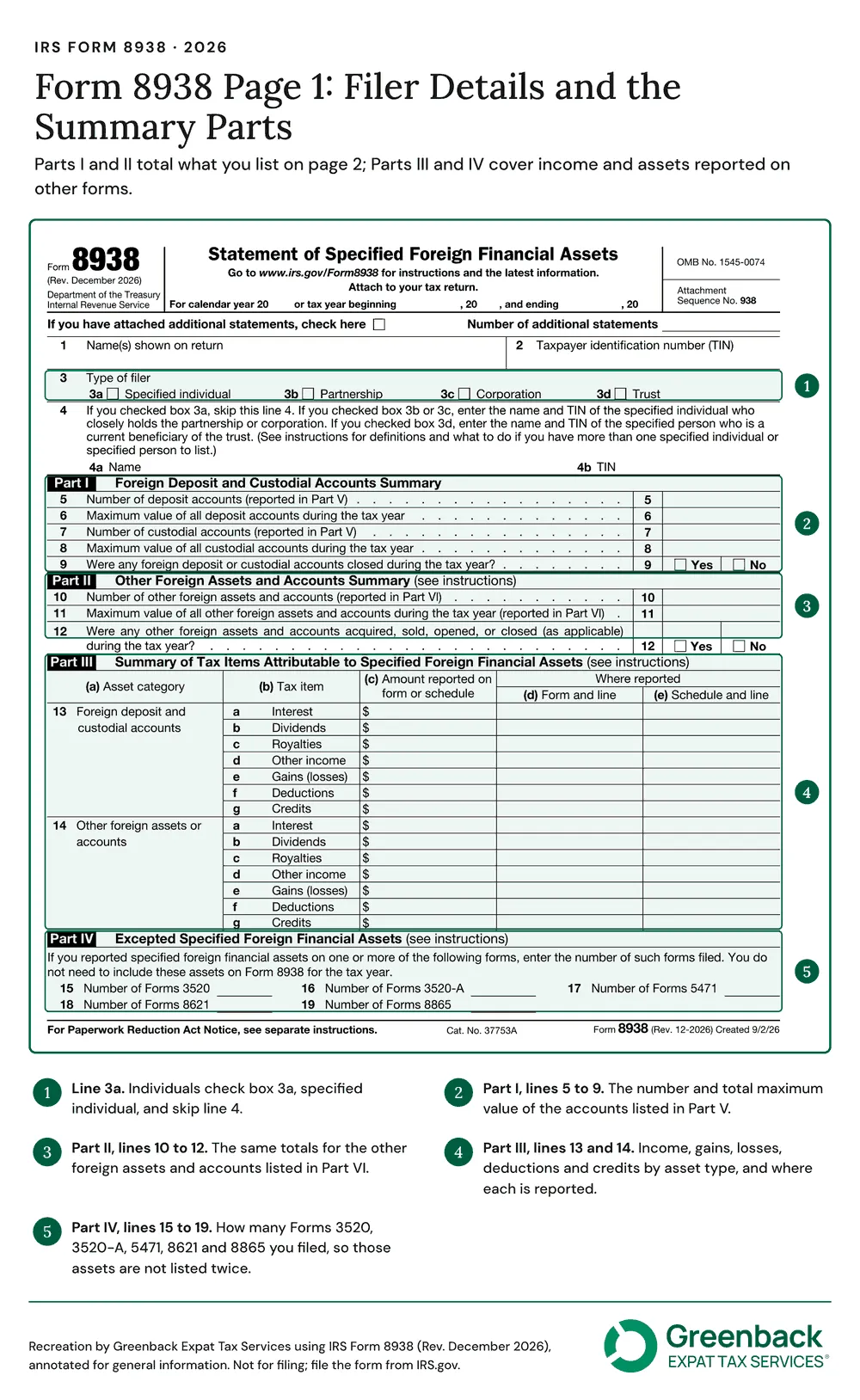
You fill out Form 8938 by entering each deposit or custodial account in Part V and each other asset or account in Part VI, totaling them in Parts I and II, then listing related income in Part III and excepted assets in Part IV. Filling in the detail parts first makes the summaries quick. These steps follow the version the IRS has released for 2026 returns.
1. Confirm You Need to File
Compare your maximum and year-end values against the threshold table and confirm whether you have to file a return. If every asset is already reported on Form 3520, 3520-A, 5471, 8621, or 8865, you complete only the identifying lines and Part IV.
2. Find Each Maximum Value in U.S. Dollars
Gather a year-end statement for each account and asset and find its maximum value for the year. You can rely on periodic statements unless you know they don’t reasonably reflect the maximum. Convert at the Treasury Bureau of the Fiscal Service rate for the last day of the tax year, even for an asset sold earlier. If a currency has no Fiscal Service rate, use another public rate and name it on the form. You can find them through our article on IRS foreign exchange rates.
3. Complete the Identifying Lines
Lines 1 to 4 ask for your name, taxpayer identification number, and whether you’re filing as an individual or an entity. Individuals check box 3a and skip line 4, which is for a partnership, corporation, or trust filing for a specified person.
4. Report Each Foreign Account in Part V
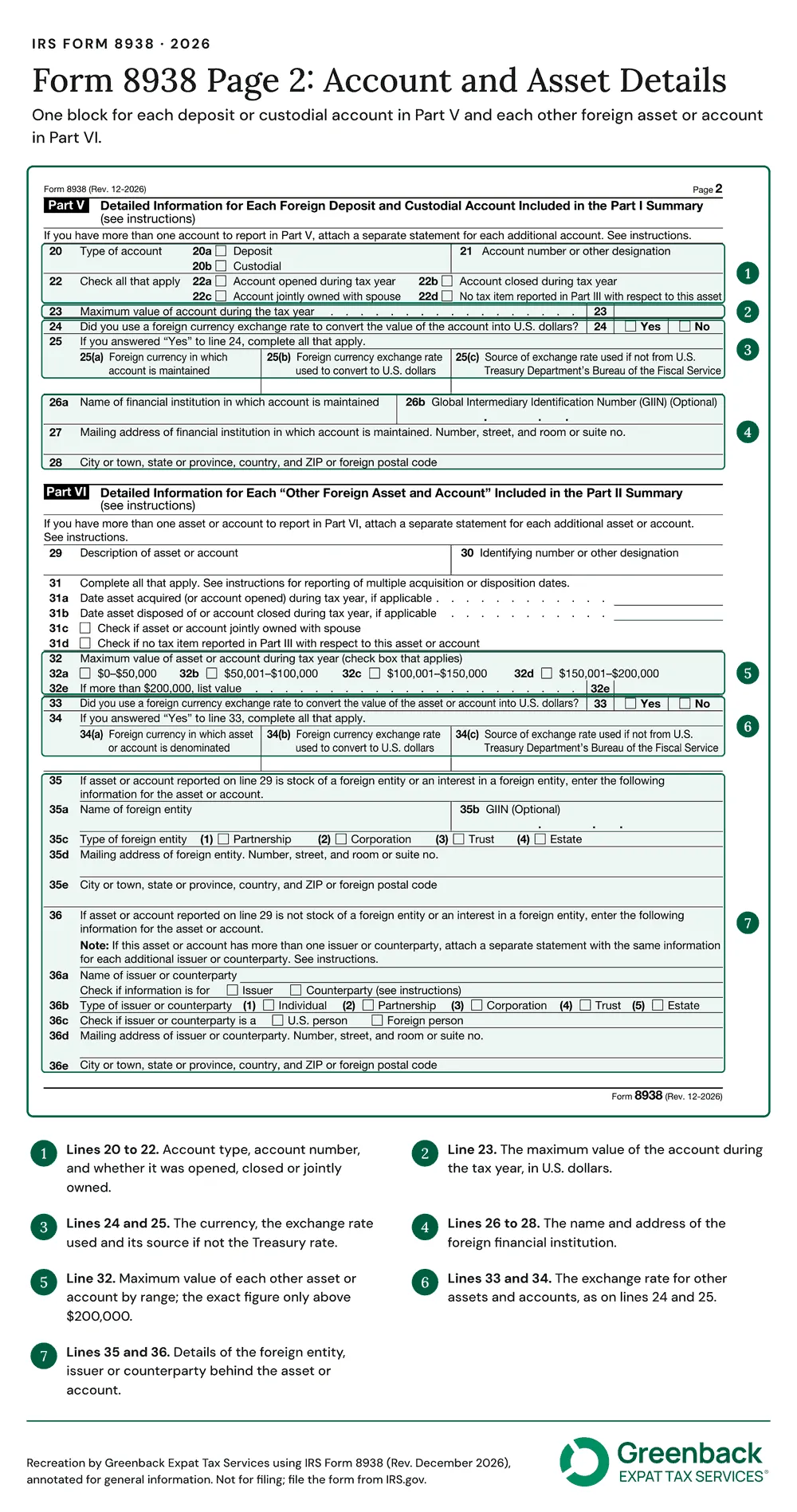
Part V takes one block per foreign deposit or custodial account, on lines 20 to 28. You enter the account type and number, whether it opened or closed during the year, its maximum value on line 23, the exchange rate on lines 24 and 25, and the institution’s name and address. For more accounts, attach a statement with the same details.
5. Report Other Foreign Assets and Accounts in Part VI
Part VI takes one block per other foreign asset or account, on lines 29-36. That includes directly held foreign stock or partnership interests, foreign pensions, and accounts such as cash value life insurance. Line 32 asks for the maximum value as a range, with the exact figure only above $200,000. Lines 35 and 36 ask about the foreign entity, issuer, or counterparty.
6. Total Everything in Parts I and II
Part I summarizes your Part V accounts, and Part II summarizes your Part VI assets and accounts. Lines 5 to 8 give the number and total maximum value of deposit and custodial accounts; lines 10 and 11 do the same for other assets and accounts; line 9 asks whether any account was closed; and line 12 asks whether any other asset or account was acquired, sold, opened, or closed.
7. Complete Parts III and IV
Part III lists the income, gains, losses, deductions, and credits from each type of asset and where you reported them. Interest and dividends usually appear on Schedule B and gains on Schedule D. Part IV records how many Forms 3520, 3520-A, 5471, 8621 and 8865 you filed, each explained in our articles on Form 3520, Form 5471 and Form 8865.
8. Attach Form 8938 and File on Time
Form 8938 is attached to your Form 1040 and never sent on its own. Your 2026 return is due April 15, 2027. Americans abroad get an automatic extension to June 15, 2027, but interest runs from April 15 on any tax not paid by then, and Form 4868 extends the deadline to October 15, 2027. Our FAQ on the tax extensions available to expats covers each option. Keep your statements while the IRS can still review the return, which may take longer than 3 years when foreign assets are involved.
What Are the Penalties for Not Filing Form 8938?
The penalty for not filing Form 8938 is $10,000, plus up to $50,000 more if you don’t file within 90 days of an IRS notice. No penalty applies if the failure was due to reasonable cause and not willful neglect, which you show with the facts of your situation, according to the IRS instructions. A foreign law that penalizes disclosure isn’t reasonable cause.
| Situation | What can apply |
|---|---|
| Form 8938 not filed when required | $10,000 |
| Still not filed 90 days after an IRS notice | $10,000 for each 30 days, up to $50,000 more ($60,000 in total) |
| Tax underpaid on income from an undisclosed foreign asset | A 40% accuracy-related penalty on that underpayment |
| Form 8938 not filed, or an asset left off | The IRS’s time to assess tax can stay open until 3 years after you file Form 8938 |
| More than $5,000 of foreign asset income left off the return | The assessment period runs 6 years |
Our FAQ on writing a reasonable cause letter explains what the IRS looks for, and our article on FBAR penalties covers the separate FBAR rules.
What If You Missed Form 8938 in Earlier Years?
You file an amended return on Form 1040-X with Form 8938 attached for each year you missed, using the version of the form for that year.
A Reasonable Cause Statement Can Go With Each Late Form
If the IRS hasn’t contacted you about the missing forms and you aren’t under examination, you can attach a reasonable cause statement to each late Form 8938. The IRS may still assess a penalty at first and ask you to respond to a letter. Our FAQ on the delinquent international information return procedures explains how these procedures work.
The Streamlined Procedures Can Fit When Income Was Also Missed
If you also left foreign income off past returns, often alongside missed FBARs, and the failure was non-willful, the Streamlined Filing Compliance Procedures may apply, because they bring returns and FBARs current together. You certify that your conduct was non-willful; please review your situation before choosing a course of action. Greenback’s Form 8938 preparation covers current and prior years, along with your return.
Frequently Asked Questions about Form 8938
Form 8938 is the form individuals use to meet their own FATCA reporting requirement. FATCA, the Foreign Account Tax Compliance Act, is the wider law that also requires foreign banks to report U.S. customers’ accounts. A foreign bank’s FATCA report doesn’t file Form 8938 for you.
No, Form 8938 can’t be filed on its own. It’s attached to your annual income tax return, or to an amended return on Form 1040-X when filed late, and it’s due with the return, including extensions.
No, you don’t file Form 8938 in a year you aren’t required to file a federal income tax return, even if your foreign financial assets are above the Form 8938 threshold.
If your spouse is a nonresident alien and you haven’t elected to file jointly, you don’t file a joint return, so the single and married filing separately Form 8938 thresholds apply. You count the full value of any asset you own jointly with that spouse.
No, an account maintained by a U.S. financial institution, including its foreign branch, isn’t reported on Form 8938. The same account can still count toward the FBAR, which covers accounts located outside the United States.
Your Maximum Values Do Most of the Work on Form 8938
Once you know whether you’re over your threshold and have each maximum value converted at the year-end rate, the form follows a set order: detail first, totals second, income and exceptions last. Because the form discloses what you hold and adds no tax, it asks for accurate values and a complete list of accounts. If you’re a U.S. citizen living abroad with accounts or a pension in your home country, Form 8938 and the FBAR can be prepared together with your return. Learn more about how we help U.S. citizens living abroad.

Catch Up on Form 8938 With Confidence
This article is for general information only. Form 8938 rules depend on your filing status, residence, and the type of each asset, and the IRS may update the form and its instructions. Please consult a qualified tax professional with expertise in international reporting about your specific situation.



Featured In


