Spain Non-Lucrative Visa: Requirements, Costs, and Renewals for Americans

- Spain Non-Lucrative Visa at a Glance
- What Is Spain's Non-Lucrative Visa?
- How Much Income Do You Need for Spain's Non-Lucrative Visa
- Non-Lucrative Visa Requirements: The Documents Consulates Ask For
- How to Apply for the Non-Lucrative Visa From the U.S.
- How to Renew Spain's Non-Lucrative Visa
- What Happens If Your Non-Lucrative Visa Is Refused?
- Switching From the Non-Lucrative Visa to a Work Permit
- From the Non-Lucrative Visa to Permanent Residency in Spain
- U.S. Taxes for Americans on the Non-Lucrative Visa
- Frequently Asked Questions About the Spain Non-Lucrative Visa
- How Greenback Helps Americans on the Non-Lucrative Visa

Spain’s non-lucrative visa lets you live in Spain without working, as long as you can show €2,400 a month (€28,800 a year) in passive income or savings, plus an additional €600 a month per family member. The first permit is valid for one year from the day you enter Spain, and each renewal adds two more years. U.S. citizens pay $153 in consular fees, and they apply in person before moving.
The rules to plan around before you apply:
- No work of any kind: U.S. consulates count remote work for a U.S. employer or clients as work.
- Your consulate is determined by your address: the Spanish consulate serving the state where you live handles your file and maintains its own checklist.
- Documents that expire: your FBI check is valid for 6 months, and your medical certificate for about 3.
- More than 183 days in Spain: you need them in the calendar year to renew.
This guide takes each requirement in the order you meet it, then covers what the visa changes on your U.S. return. For the rest of the move, from taxes to healthcare, see our living in Spain hub.
Spain Non-Lucrative Visa at a Glance
| Question | Answer |
|---|---|
| How much money do you need for a non-lucrative visa in Spain? | The main applicant needs €2,400 a month, or €28,800 a year, in passive income or savings, and €600 a month more per family member. |
| Can you work remotely on a non-lucrative visa in Spain? | No. U.S. consulates treat remote work for a U.S. employer or clients as work, which the visa bars. |
| How much does the Spain non-lucrative visa cost for Americans? | U.S. citizens pay $153: $140 for the visa and $13 for the residence permit. |
| How long is a non-lucrative visa in Spain valid for? | The first permit lasts one year from the day you enter Spain, and each renewal adds two years. |
| What health insurance do you need for the non-lucrative visa? | Private cover from a Spain-authorized insurer; Washington and Los Angeles also bar copays. |
| What happens after 5 years on a non-lucrative visa? | Five years of legal residence qualify you for long-term residence, with the right to live and work in Spain. |
What Is Spain’s Non-Lucrative Visa?
Spain’s non-lucrative visa is a residence visa for people from outside the EU who can support themselves in Spain without working there. Spain’s immigration regulation, Real Decreto 1155/2024, defines it as residence “sin realizar actividades laborales o profesionales,” meaning without work or professional activity.
With the non-lucrative visa, you can:
- Live in Spain long term: the permit is renewed as long as you continue to meet the conditions.
- Bring your family: a spouse and children apply on the same file.
- Qualify at any age, with no investment: the only financial test is income or savings.
- Build toward permanent residence: five years on the visa lets you apply for long-term residence.
It suits retirees, people living on investments or savings, and anyone taking a planned break from work. If you need to earn income while living in Spain, this visa is the wrong route. For budgets, healthcare, and where to settle, see our guide to retiring in Spain.
Can You Work Remotely on the Non-Lucrative Visa?
The non-lucrative visa does not allow remote work. The Spanish consulates in Washington, Los Angeles, New York, and San Francisco state that the regulation’s ban on work includes online work for employers or clients outside Spain. San Francisco goes further and asks for a notarized letter in Spanish stating that you will not work, even online. The consulate decides your application, so plan on no income from work of any kind. Remote work has its own route, Spain’s digital nomad visa.
How Much Income Do You Need for Spain’s Non-Lucrative Visa
You need €2,400 a month, or €28,800 a year, for the main applicant and €600 a month, or €7,200 a year, for each family member. These amounts are 400% and 100% of IPREM, Spain’s Indicador Público de Renta de Efectos Múltiples. IPREM is the reference income figure Spain created in 2004 to set benefit amounts and income thresholds for public programs, and immigration rules use it for this visa’s means test. The government normally updates it in the annual state budget; with no new budget passed, it will remain at €600 per month for 2026, the same as in 2025.
Three points about the figure catch applicants out:
- It is set in euros: the dollar amounts some consulates print are conversions that move with the exchange rate. Washington quotes $32,000 a year, and Houston about $33,400.
- It is a floor: the Washington consulate asks for means that are “sufficient and guaranteed,” so showing a margin above the minimum strengthens a file.
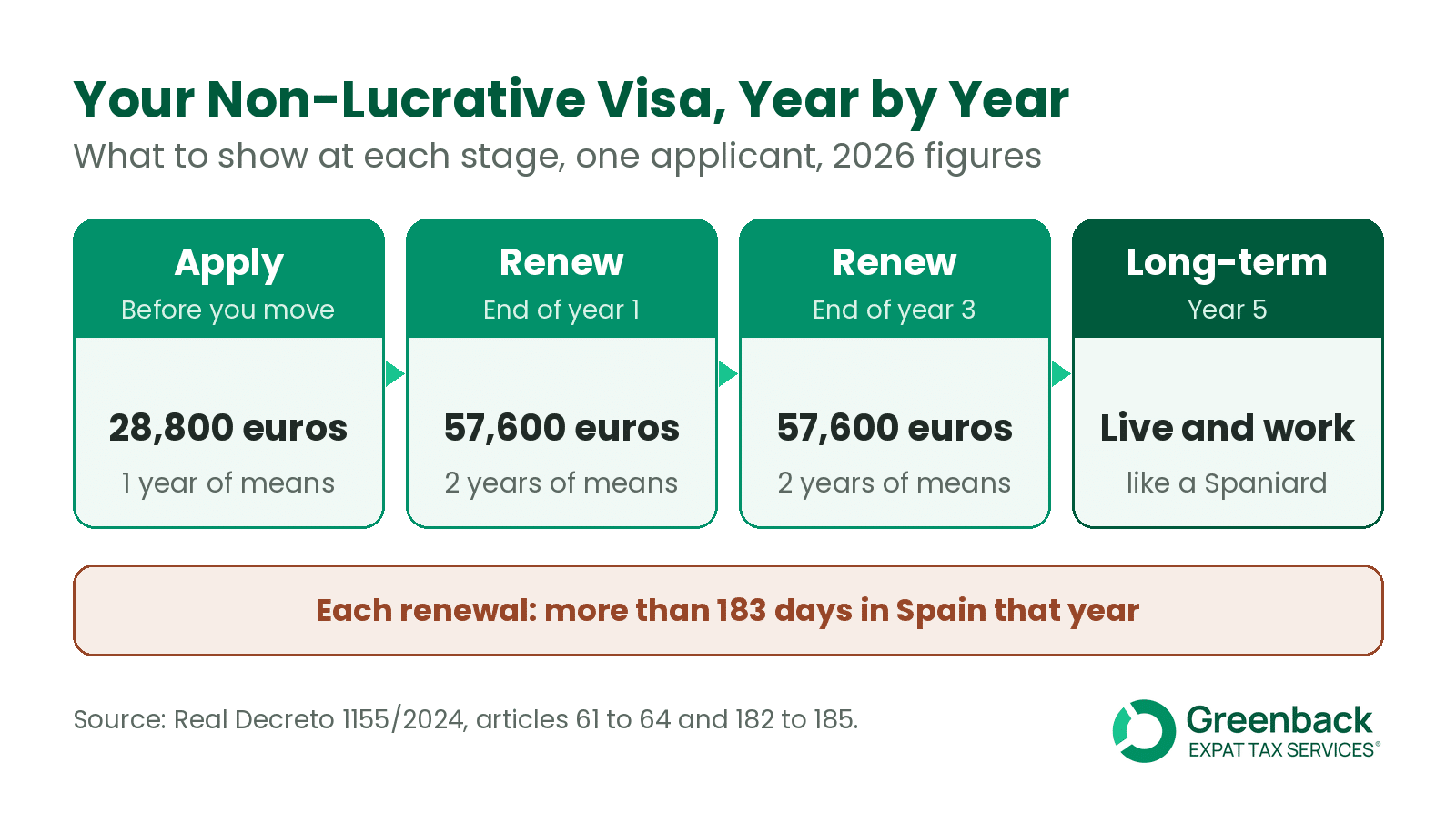
- It covers one year at a time: your first application proves one year of means, and each two-year renewal asks you to prove two.
| Household | At application (1 year) | At each renewal (2 years) |
|---|---|---|
| One applicant | €28,800 | €57,600 |
| Couple | €36,000 | €72,000 |
| A couple with two children | €50,400 | €100,800 |
Renewal figures assume IPREM stays at €600 a month.
What Counts as Income or Savings for the Non-Lucrative Visa
The consulates accept regular passive income or liquid savings, documented with statements:
- Retirement income: Social Security, public or private pensions, and annuities. Washington and Houston name these on their checklists.
- Investment income: dividends, interest, and rent, backed by statements that show it arrives regularly.
- Savings: enough in the bank to cover the full year’s amount. Washington asks for a bank certificate showing your 31 December balance and your average balance over the last 12 months.
Salary and self-employment income do not count, because the visa forbids the work that produces them. Retirement account balances are not a safe substitute for income: the Boston consulate states that an IRA or 401(k) is not accepted as proof for applicants who are not officially retired.
Adding a Spouse or Children to the Non-Lucrative Visa
Each family member adds €7,200 a year to the amount you show and applies with you. None of them can work on this visa either. At renewal, children of compulsory school age must be enrolled in school in Spain.
Non-Lucrative Visa Requirements: The Documents Consulates Ask For
Spain’s consulates in the U.S. work from the same core documents but vary in timing, format, and translation. Your FBI check and medical certificate both expire quickly, so the order in which you collect them matters as much as the documents themselves.
1. FBI Background Check and Apostille
The consulates accept only an FBI Identity History Summary; a state or local police check is rejected. It must be no older than six months when you file.
- The check: the FBI charges $18, and an online request returns results within about 48 hours of fingerprinting at a participating Post Office.
- The apostille: the U.S. Department of State authenticates it for $20 per document on Form DS-4194, and a mailed request takes about five weeks.
- The translation: a sworn translator then puts it into Spanish.
The five-week apostille wait, within a six-month validity window, is why this document comes first.
2. Medical Certificate
A doctor’s statement that you have no disease with serious public health effects under the International Health Regulations of 2005. Washington and Los Angeles want it dated within 90 days of filing, and most other consulates within three months. Washington also requires a physician’s signature and license number; a nurse practitioner or physician assistant cannot sign it.
3. Health Insurance for the Non-Lucrative Visa
The policy must be issued by an insurance company authorized by Spain to operate there and must cover everything Spain’s public system covers for at least 12 months. Washington and Los Angeles spell out no copays, no deductibles, and no coverage limits. A travel policy will be turned down. Los Angeles also bars waiting periods, and San Francisco bars exclusions for pre-existing conditions.
4. Proof of Income or Savings
Washington asks for your last three months of bank statements, the bank certificate described above, and your most recent U.S. tax return. Houston asks for twelve months of statements. Translation rules for financial documents differ from one consulate to the next, so check your own list before paying a translator.
5. Passport, Application Forms and Fees
Your passport must be valid for at least a year, have two blank pages, and have been issued within the last ten years. You also file the national visa application form (Form EX-01) for the residence authorization and the fee form (Modelo 790-052). The fees for U.S. citizens are $140 for the visa and $13 for the residence permit.
Where U.S. Consulates Differ
| Consulate | How you book | Medical certificate | Other rules |
|---|---|---|---|
| Washington | BLS International | Within 90 days; physician only | Police record from any other country where you spent six months or more in the last five years |
| Los Angeles | BLS International | Within 90 days | Insurance with no waiting period; fees by money order at the appointment |
| New York | By email | Not stated | Police records from every country you have lived in over the last five years |
| San Francisco | BLS International | Within 3 months | Notarized no-work letter in Spanish; no pre-existing condition exclusions |
| Houston | BLS International | Within 3 months | Twelve months of bank statements; insurance certificate in Spanish |
| Miami | BLS International | Within 3 months | $18 BLS processing fee |
| Boston | By email | Within 3 months | IRA or 401(k) not accepted as proof unless you are retired; police record from any other country where you spent six months or more |
| Chicago | BLS International | Within 3 months | Not stated |
Source: each consulate’s non-lucrative visa page.
How to Apply for the Non-Lucrative Visa From the U.S.
You apply in person at the Spanish consulate serving the state where you live, and the documents that expire soonest take precedence.
- Confirm your consulate: check whether it books through BLS International or by email.
- Order the FBI check and apostille: request the FBI Identity History Summary first, then the State Department apostille, since the State Department has the longest lead time.
- Book your appointment for when your apostilled FBI check will be back.
- Buy the health insurance: choose a policy that meets your consulate’s terms.
- Get the medical certificate: dated inside your consulate’s window.
- Have the translations done: by a translator on Spain’s official list of sworn translators, for the documents your consulate lists.
- Attend the appointment: pay the fees and submit your file in person.
- Once approved: collect the visa within one month, enter Spain, and apply for your TIE residence card at a police station within one month of arrival.
Our guide to moving to Spain picks up from there, with housing, a bank account, and your first weeks after arrival.
Which Consulate Handles Your Application
Your legal residence decides it, and you cannot apply from inside Spain. An American living in a third country, such as the UK or Mexico, applies at the Spanish consulate serving that country and shows legal residence there. A non-U.S. citizen applying in the U.S. needs a green card or a long-term visa, so a B-1/B-2 visitor cannot apply.
Processing Time and When You Must Enter Spain
The legal period for a decision is 3 months, and it may be extended if the consulate requests additional documents or calls you for an interview. Within that period, Spain’s immigration office has one month from the date the consulate sends your file, and if it does not respond within that month, the application is treated as refused. You must enter Spain within the validity printed on your visa. Consulate pages differ on how long that is, and the Ministry of Inclusion caps it at three months, so plan to enter within 90 days. Your one-year permit starts on the day you enter.
How to Renew Spain’s Non-Lucrative Visa
You renew from inside Spain, two years at a time, filing in the two months before your permit expires or up to three months after it expires, though filing late can bring a fine. Real Decreto 1155/2024 sets the rules in article 64, and the Ministry of Inclusion summarizes them on its renewal page.
At renewal, you must show:
- Means for the next two years: €57,600 for one applicant at the current IPREM, with the household figures in the table above.
- Continuous health insurance: held for the whole of the permit you are renewing and continuing.
- School enrollment: for children of compulsory school age.
- More than 183 days in Spain: in the calendar year.
The immigration office must decide within three months, and if it does not, the renewal is treated as approved. That is the reverse of the first application, where no answer counts as a refusal.
The 183-Day Rule for Non-Lucrative Visa Renewal
Article 64 requires “more than 183 days” of real residence in Spain during the calendar year. It does not specify which calendar year it refers to when you renew early in the year, so the safe practice is to spend over half of each year in Spain and keep travel records. Spain’s tax residency test uses the same threshold, so a holder who meets the renewal rule is almost always a Spanish tax resident for that year. Our Spanish tax system guide explains when that residency starts and what Spain then taxes.
What Happens If Your Non-Lucrative Visa Is Refused?
The refusal letter states the reason, and you have two ways to challenge it. The Washington consulate sets them out:
- Reconsideration: a written appeal in Spanish to the office that refused you, within one month of the day after you receive the notice.
- Court review: an application to the High Court of Justice of Madrid within two months of the day after you receive it.
Match the reason in the letter against the requirements above, such as the income floor, the insurance terms, or a document’s validity window, before choosing a route.
Switching From the Non-Lucrative Visa to a Work Permit
Spain lets holders of a residence permit that does not allow work apply to change to a residence and work permit without leaving the country, under article 191 of Real Decreto 1155/2024. Before a year of residence, the new permit is assessed against the national employment situation, which, in practice, means a job on Spain’s list of hard-to-fill occupations or an employer who demonstrates it could not hire locally. After a year, that test no longer applies. The article does not name the non-lucrative visa, and its exclusions do not cover it either, so confirm your position with an immigration lawyer before relying on this route. Our digital nomad visa guide sets the three residence routes side by side.
From the Non-Lucrative Visa to Permanent Residency in Spain
Once you reach five years of legal residence in Spain, long-term residence is open to you, giving you the right to live and work in Spain on the same terms as Spanish nationals. Time abroad does not reset the count as long as no single absence lasts more than six months and your absences add up to no more than ten months. Spanish citizenship is a separate step that takes ten years of residence for Americans under the Spanish Civil Code (article 22).
U.S. Taxes for Americans on the Non-Lucrative Visa
Your U.S. return stays due each year you live in Spain, and on this visa, the Foreign Tax Credit is what prevents double tax. Our guide to U.S. expat taxes in Spain lays out the full filing picture, and the U.S.-Spain tax treaty guide explains how the two countries share your pension and Social Security. What changes for a non-lucrative visa holder:
- The exclusion has little to exclude: the Foreign Earned Income Exclusion covers earned income only, up to $130,000 for tax year 2025, and the IRS lists pensions, Social Security, interest, and dividends as outside it. Once Spain taxes that income, the Foreign Tax Credit lets you subtract the Spanish tax from your U.S. tax on the same income.
- When you sell matters: an IRA withdrawal or a stock sale made to fund your life in Spain is reported on your U.S. return for the year it occurs. After you become a resident in Spain for tax purposes, Spain taxes it as well, so a sale made in a year before your first Spanish tax year stays on your U.S. return alone.
- Your Spanish account is reportable: the account you open for rent and bills is reported on an FBAR when the combined balance of your foreign accounts exceeds $10,000 on any day of the year. Form 8938 is required once your foreign financial assets pass $200,000 on the last day of the year or $300,000 on any day, if you file single and live abroad; the thresholds double for a joint return.
Example: When to Sell Shares If You Plan to Live in Spain
Maria, a single filer, holds U.S. shares worth $40,000 that she plans to live on in Spain. Her long-term gain is $15,000, taxed at the 15% rate that applies to single filers with taxable income between $48,350 and $533,400 for 2025, according to IRS Topic 409. She arrives in Spain in April and becomes a Spanish tax resident that year.
| When Maria sells | U.S. tax | Spanish tax | Total |
|---|---|---|---|
| December, the year before she moves | $2,250 | None | $2,250 |
| June, after she arrives in Spain | About $0 after the credit | About €2,671, or $3,015 | About $3,015 |
In the second case, Spain taxes the gain on its savings scale: 19% on the first €6,000 and 21% above that. The treaty assigns gains on shares to Spain as her country of residence, and the U.S. re-sources the gain, which lets the Spanish tax offset her U.S. tax. Selling before the move saves her about $765. The figures use the IRS 2025 yearly average rate of 0.886 euros per dollar; Spain measures the gain in euros at the exchange rates on the days she bought and sold, so its figure may differ. Spain’s rules on the sale itself, including its exemptions, are in our capital gains tax in Spain guide.
Frequently Asked Questions About the Spain Non-Lucrative Visa
A non-lucrative visa holder faces two limits at once. To renew, you need more than 183 days in Spain in the calendar year, which leaves room for just under 6 months away. To qualify for long-term residence after five years, no single absence can exceed six months, and your absences cannot add up to more than ten months across the five years.
The non-lucrative visa cannot be applied for from inside Spain. The application is submitted to the Spanish consulate serving the place where you legally live, so a tourist’s stay in Spain cannot be converted into a non-lucrative residence. Americans living in the U.S. apply at their home consulate before they travel.
Buying property does not qualify you on its own. Owning a home in Spain does not meet the income test, although the rent you receive from a property can count toward it. Spain closed its property-for-residence route on 3 April 2025, so all applicants now qualify based on income or savings.
Medicare does not meet the insurance requirement for a non-lucrative visa. The consulates require a policy from a Spain-authorized insurer, and Medicare is not one. What happens to your Medicare enrollment while you live abroad is covered in our guide to Medicare for U.S. expats.
How Greenback Helps Americans on the Non-Lucrative Visa
Greenback’s accountants prepare the U.S. returns for Americans living in Spain on a non-lucrative visa. We apply the Spanish tax on your pension and investment income as a Foreign Tax Credit, report your Spanish accounts on the FBAR and Form 8938 from your first year, and file the return that covers your move. If you’re planning the move now, Greenback helps Americans plan the U.S. tax side of the withdrawals and sales that fund an application.

Renewing your non-lucrative visa?
This article is for informational purposes only and does not constitute tax, legal, or immigration advice. Visa requirements, IPREM and consular checklists change, and each consulate sets its own list; confirm current requirements with the Spanish consulate that serves you and speak with a qualified professional about your situation.




Featured In