Capital Gains Tax in Spain: Rates, Exemptions, and Non-Resident Rules

- Capital Gains Tax in Spain at a Glance
- How Much Is Capital Gains Tax in Spain?
- Selling Property in Spain as a Non-Resident
- How Can You Reduce Capital Gains Tax in Spain Legally?
- How Does the U.S. Tax a Capital Gain in Spain?
- Frequently Asked Questions About Capital Gains Tax in Spain
- How Greenback Helps Americans With Capital Gains in Spain


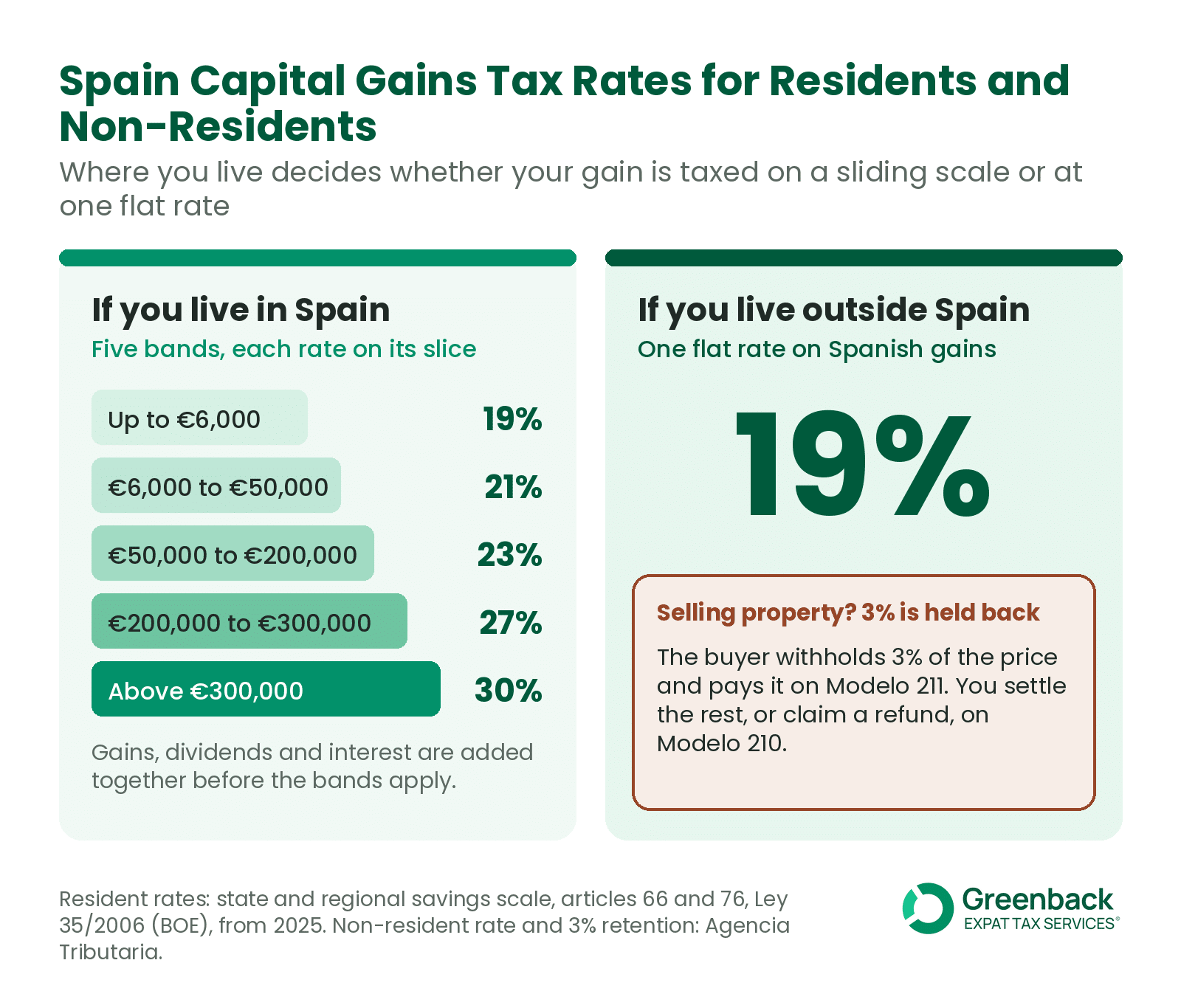
Spanish residents pay 19% to 30% on capital gains, with the rate rising in five bands as the gain grows. Non-residents pay a flat 19% on gains from Spanish assets, and when a non-resident sells Spanish property, the buyer withholds 3% of the price as a payment toward that tax, according to the Agencia Tributaria. If you live in Spain, selling your main home can be tax-free when you reinvest the proceeds, or you are over 65.
If you are American, the same gain also goes on your U.S. return, and the Spanish tax usually becomes a credit against the U.S. tax, so the same gain is rarely taxed twice. This guide is part of our living in Spain hub.
Capital Gains Tax in Spain at a Glance
| Question | Answer |
|---|---|
| What is the capital gains tax rate in Spain? | For residents: 19% on the first €6,000, 21% to €50,000, 23% to €200,000, 27% to €300,000 and 30% above. |
| How much capital gains tax do I pay as a non-resident selling property in Spain? | 19% of the gain. The buyer holds back 3% of the sale price, and you settle the rest or claim a refund on Modelo 210. |
| Do you pay capital gains tax in Spain if over 65? | Not on your main home, if you live in Spain. Other gains are taxed, unless you put up to €240,000 of the proceeds into a lifetime annuity. Non-residents pay 19% at any age. |
| How to avoid capital gains tax in Spain? | If you live in Spain, reinvest in a new main home or use the over-65 exemptions. Anyone can offset losses and claim every cost of buying, improving and selling. |
| When do you pay capital gains tax in Spain? | Residents pay in the annual income tax return, filed from April to 30 June of the following year. Non-resident property sellers file within four months of the sale. |
How Much Is Capital Gains Tax in Spain?
Spain taxes capital gains as savings income on a progressive scale, with each rate applying only to the portion of the gain within its band. Residents are taxed on worldwide gains, including those from the sale of a home or shares sold in the U.S., while non-residents are taxed only on Spanish assets. Whether you count as a resident depends on the 183-day and other tests covered in our guide to U.S. expat taxes in Spain.
| Savings income (gains, dividends, interest) | Rate for residents |
|---|---|
| Up to €6,000 | 19% |
| €6,000 to €50,000 | 21% |
| €50,000 to €200,000 | 23% |
| €200,000 to €300,000 | 27% |
| Above €300,000 | 30% |
The rates combine the state and regional scales in the Personal Income Tax Law, articles 66 and 76, and the 30% top band applies from 2025.
How Dividends and Interest Are Taxed in Spain
Dividends and interest sit on the same savings scale as your gains. They are added together before the bands apply, so a year with a large sale can push your dividends into a higher band. Spanish banks and companies withhold 19% up front, and that is credited when you file.
How Your Gain Is Calculated
Spain works out the gain in euros, in three steps:
- Start with the sale price: take off the costs you paid to sell, such as the agent’s commission.
- Work out your acquisition value: the price you paid, plus the taxes and fees on the purchase and the cost of any improvements, less depreciation if the property was rented out.
- Subtract one from the other: the sale figure minus the acquisition value is your gain, or your loss.
If the sale price in the deed is below market value, the Agencia Tributaria taxes you on market value instead (article 35). Keep the purchase deed, the invoices for improvements, and the receipts for purchase taxes, notary fees, and registry fees, since each one reduces the gain.
Selling Property in Spain as a Non-Resident
The buyer withholds part of the price, and you settle the rest on your own return at the non-resident rate of 19%. Non-resident sellers follow this sequence, set by the Agencia Tributaria:
- At the sale, the buyer withholds 3% of the price and pays it to the Agencia Tributaria on Modelo 211 within one month.
- Your return: you file Modelo 210 within four months of the sale (the buyer’s month, then three more). You pay the difference if 19% of your gain is more than the 3% withheld, or claim the excess back if it is less.
Keep the deed, the Modelo 211 receipt, and the invoices that prove your acquisition value, since any refund depends on them.
The main-home reinvestment exemption is only open to non-residents in the EU or the European Economic Area, and the over-65 exemptions are for Spanish residents, including if you move away before you sell. If you live in the U.S. or the UK, your gains are taxed even if you buy another home.
The sale can also trigger the plusvalía municipal, a separate city tax on the rise in the land’s value. Your town hall charges it separately from the capital gains tax.
Example: Selling a Flat With a €150,000 Gain
An owner bought a flat in Valencia for €250,000 and sold it for €400,000, a €150,000 gain. Costs are left out to keep the figures simple.
| Seller | Spanish tax on the gain | How it is paid |
|---|---|---|
| Non-resident | €28,500 (19%) | €12,000 withheld by the buyer (3% of €400,000), then €16,500 paid with Modelo 210 |
| Resident | €33,380 (€1,140 + €9,240 + €23,000), an effective 22.3% | In the annual return |
If the gain is small, the 3% withholding can exceed the tax. A non-resident who bought for €300,000 and sold for €320,000 owes €3,800 on the €20,000 gain, while the buyer withholds €9,600. Filing Modelo 210 on time brings the €5,800 difference back as a refund, so keep every receipt.
How Can You Reduce Capital Gains Tax in Spain Legally?
If you live in Spain, the law exempts gains on your main home and offers extra relief after 65, and anyone can reduce a gain by offsetting losses and claiming all costs. Each option below comes from the Personal Income Tax Law:
- Reinvest in a new main home: the gain on selling your main home is exempt if you reinvest the full proceeds in another main home, and partly exempt if you reinvest part of them (article 38.1).
- Sell your main home after 65: the gain is exempt if you are 65 or older when you sell (article 33.4.b). Our guide to retiring in Spain covers the rest of the retirement picture.
- Over 65, turn other gains into an annuity: gains on other assets are exempt if you put the proceeds into a lifetime annuity within six months, up to €240,000 in total (article 38.3).
- Offset your losses: gains and losses net against each other each year. A net loss can also offset up to 25% of your dividend and interest income, and whatever remains carries forward for 4 years (article 49).
- Watch the two-month rule: if you sell listed shares at a loss and buy the same shares within two months before or after, the loss is deferred until you sell the new shares (article 33.5.f).
- Claim every cost: purchase taxes, notary and registry fees, agent commissions, and improvements all reduce the gain, as long as you have the paperwork.
- Time sales around your move: selling assets outside Spain before you become resident keeps those gains out of Spanish tax, as set out in our guide to moving to Spain.
- Check the Beckham Law: under the Beckham Law, Spain taxes only your gains on Spanish assets.
How Does the U.S. Tax a Capital Gain in Spain?
U.S. citizens and green card holders report every sale on their U.S. return, regardless of where they live or where the asset is located. Spain and the U.S. can both tax the same gain, and the U.S. side follows its own rules:
- Reporting: the sale goes on Form 8949 and Schedule D, in dollars.
- The credit: Spanish tax on the gain becomes a Foreign Tax Credit on Form 1116. Spain’s rates are often higher than U.S. long-term rates, so the credit can wipe out the U.S. tax and leave a carryover for later years.
- Your main home (Primary residence): the Section 121 exclusion lets you exclude up to $250,000 of gain, or $500,000 filing jointly, if you owned and lived in the home for two of the last five years (IRS). It applies to a home in Spain, so the U.S. may tax little or no gain that Spain taxes.
- The exchange rate: the U.S. measures your gain in dollars, so a flat that did not rise in euros can still show a U.S. gain if the euro strengthened. A euro mortgage paid off can create a separate currency gain.
- The 3.8% surtax: the Net Investment Income Tax can apply to the gain, and the IRS does not let the Foreign Tax Credit offset it.
- Spanish funds: Spanish investment funds are generally PFICs, which the U.S. taxes under special rules, so check before you sell.
Example: The Same Flat on a U.S. Return
Say the Valencia owner is an American who has moved back to the U.S. Measured in dollars, using the exchange rates on the purchase and sale dates, the gain comes to about $175,000. The figures are illustrative.
| If the flat was | U.S. result |
|---|---|
| The owner’s main home for two of the last five years | Section 121’s $250,000 limit applies to the entire gain, so the U.S. taxes none of it. Spain’s €28,500 is still due. |
| A holiday home | The U.S. taxes the gain at 15%, about $26,250. Spain’s €28,500, roughly $32,000, is larger, so the credit cancels the regular U.S. tax. The 3.8% surtax still applies if the owner’s income exceeds the threshold. |
The same sale can cost nothing extra in the U.S. or incur a surtax. Knowing how the home was used tells you which result to plan for.
The U.S. rates, holding periods, and planning options are covered in our guide to foreign capital gains.
Frequently Asked Questions About Capital Gains Tax in Spain
Yes, if you are not a resident in Spain. The buyer must withhold 3% of the price and pay it on Modelo 211, whether or not a gain is made. If 19% of your gain comes to less than the amount withheld, or you sell at a loss, you claim the difference back on Modelo 210.
Yes, if you are a Spanish resident, because Spain taxes residents on their worldwide gains. The country where the property sits can also tax the gain, and Spain provides a credit for that tax under its tax treaty with that country. If you are not a resident in Spain, Spain does not tax the property you sell elsewhere.
You don’t need a calculator to estimate it. Start with what you sold for, then deduct your selling costs, such as the agent’s fee. Then deduct what you paid, plus purchase taxes, fees, and improvements. What is left is your gain, and you apply the resident bands of 19% to 30% to it, or the flat 19% non-resident rate. If you are a non-resident selling property, the 3% the buyer withheld counts toward that bill. Greenback can check your figures and show how the same sale lands on your U.S. return.
How Greenback Helps Americans With Capital Gains in Spain
Greenback prepares U.S. returns for Americans with homes, shares, and funds in Spain. We report the sale in dollars, claim the Foreign Tax Credit for your Spanish taxes, and apply the Section 121 exclusion where applicable. We also flag currency gains and PFIC holdings before they become a problem. The rest of life in Spain is covered in our guide to living in Spain.

Capital Gains Tax in Spain, U.S. Side Handled
This article is for informational purposes only and does not constitute tax or legal advice. Spanish rates are the combined state and regional savings scale that will be in force from 2025, and your personal situation can affect the result. Speak with a qualified professional about your situation.




Featured In





