Buying Property in Spain as an American: Costs, Taxes, and Mortgages

- Buying Property in Spain at a Glance
- Can Americans Buy Property in Spain?
- How Does Buying a Home in Spain Work?
- What Does Buying Property in Spain Cost Above the Asking Price?
- Can Americans Get a Mortgage in Spain?
- What Taxes Do You Pay Each Year on Spanish Property?
- How Does Spanish Property Show Up on Your U.S. Return?
- Frequently Asked Questions About Buying Property in Spain
- How Greenback Helps Americans Buying Property in Spain

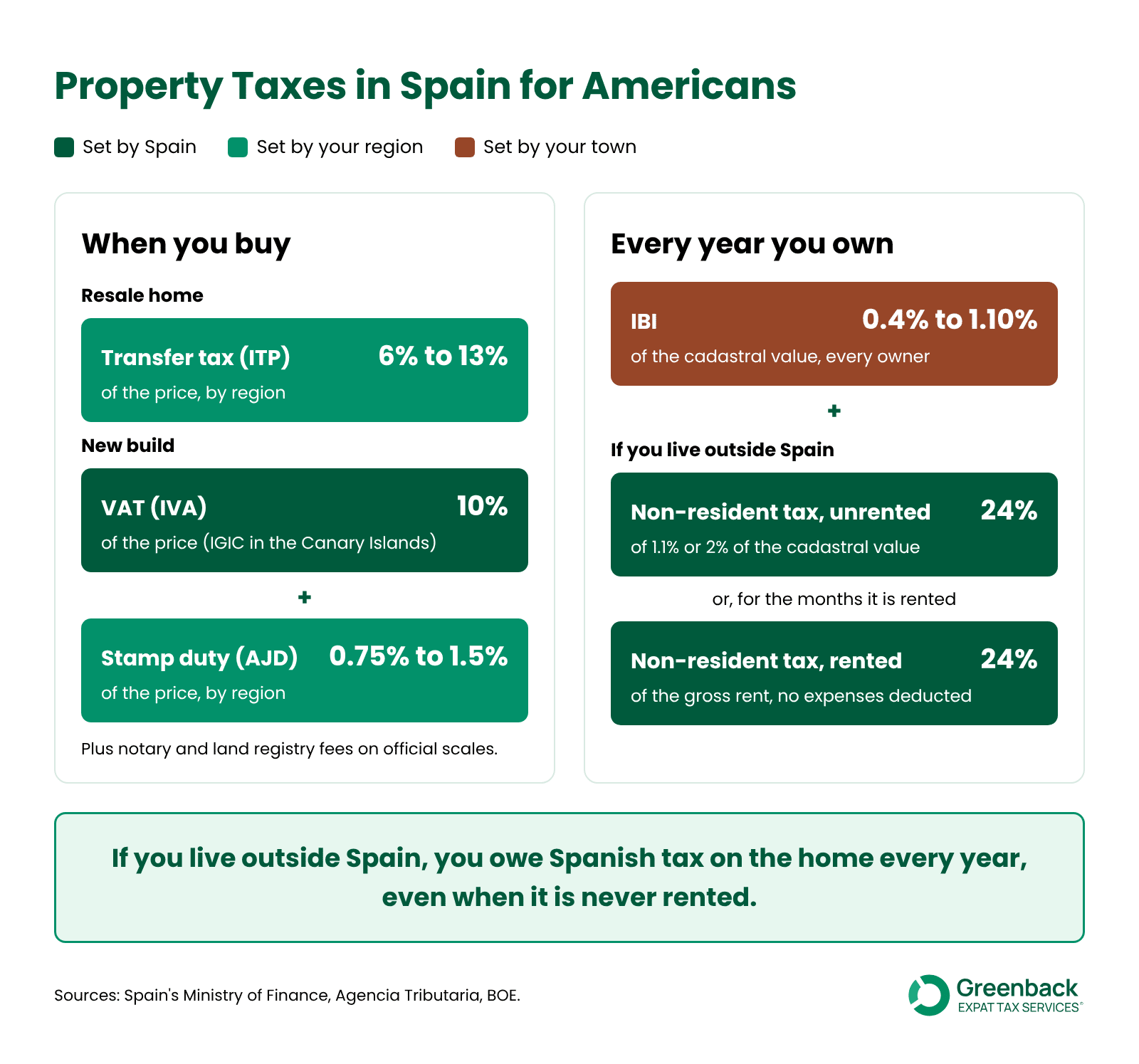
Americans can buy property in Spain without living there, as long as they have an NIE, the foreigner tax number every buyer needs on the deed. Plan for the purchase to cost more than the asking price: on a resale home, your region’s transfer tax adds 6% to 13%, while a new build carries 10% VAT plus a stamp duty of 0.75% to 1.5%. Buying a home no longer leads to a residence visa, so living in Spain still takes a visa of its own.
If you keep the home while living in the U.S., Spain taxes you on it every year, even if no one rents it. On the U.S. side, a home you own directly stays off Form 8938, but the Spanish account you buy through is reported on your FBAR once your foreign accounts exceed $10,000. For life there beyond the property, start with our living in Spain guide.
Buying Property in Spain at a Glance
| Question | Answer |
|---|---|
| Can Americans buy property in Spain? | Americans can buy with an NIE, which every buyer needs on the deed. |
| Does buying give you residency? | Buying no longer leads to residency, since the golden visa closed to new applicants on 3 April 2025. |
| What does buying cost on top of the price? | Transfer tax of 6% to 13% on a resale home, or 10% VAT plus 0.75% to 1.5% stamp duty on a new build, plus notary, registry and legal fees. |
| Can Americans get a Spanish mortgage? | Some Spanish banks offer mortgages to people who live abroad, subject to the bank’s approval. |
| What yearly taxes do owners living abroad pay? | IBI to the town, plus 24% Spanish tax on an imputed rent of 1.1% or 2% of the cadastral value. |
| Does the IRS need to know? | The home itself stays off Form 8938, but the Spanish accounts you use go on your FBAR. |
Can Americans Buy Property in Spain?
Americans can buy Spanish property as non-residents, and every buyer needs an NIE on the deed. The NIE is your foreigner tax number, and Spain’s land registry won’t record a purchase unless every party’s number is on the deed. You can apply for one through the Spanish consulate for your area, and our guide to the NIE number lists the documents.
Buying a home doesn’t come with a visa. That route closed when the golden visa stopped accepting new applications on 3 April 2025, so living in Spain now requires a residence visa of its own. Owning a Spanish home doesn’t make you a Spanish tax resident either. Spending more than 183 days in Spain during a calendar year generally does, and the full residency tests sit in our Spanish tax system guide.
Is Spain Taxing Foreign Buyers 100%?
A 100% tax on foreign buyers has been proposed in Spain, but it isn’t a law. The proposal would charge a new tax equal to the full price on buyers of any nationality who don’t live in the EU, minus the transfer tax they paid. It was admitted to Congress on 27 May 2025, and as of October 2026, it was still waiting for its first vote in the full chamber, according to the Congress record for bill 122/000196. An American who lives in Spain would fall outside it.
How Does Buying a Home in Spain Work?
Buying a home in Spain takes six steps, and it ends with signing the deed before a notary:
- Get your NIE from a consulate in the U.S. or a police office in Spain.
- Open a Spanish bank account to pay the deposit, the taxes, and later bills. Our guide to banks in Spain compares the banks that open accounts for Americans.
- Have a lawyer check the property, including the land registry extract (nota simple), which shows the owner and any debts registered against the home.
- Sign a deposit contract (contrato de arras). The amount and penalties for pulling out are agreed upon by the buyer and seller.
- Sign the deed (escritura) before a notary and pay the balance.
- Pay the transfer tax on a resale home, or the stamp duty on a new build, then register the deed at the land registry. On a new build, the developer charges the VAT in the price.
You don’t have to fly over for the signing: someone holding your power of attorney can sign for you. If you sign it before a notary in the U.S., expect it to need an apostille and, for an English document, a sworn Spanish translation.
What Does Buying Property in Spain Cost Above the Asking Price?
For a resale home, the extra cost is mostly the regional transfer tax, ranging from 6% in Madrid to 13% in the top bands in Catalonia and the Balearics. A new build carries 10% VAT (IGIC in the Canary Islands) instead, plus your region’s stamp duty of 0.75% to 1.5%. Every buyer also pays the notary and the land registry on official scales, about €410 and €220 on a €350,000 home under Royal Decree 1426/1989 and Royal Decree 1427/1989 before page and copy charges, plus the fee you agree with a lawyer or gestoría and, if you borrow, the property valuation.
Transfer Tax by Region
Each region sets its own transfer tax rate on resale homes. These are the general rates for 2026, from Spain’s Ministry of Finance summary of regional taxes:
| Region | Transfer tax on a resale home |
|---|---|
| Madrid | 6% |
| Canary Islands | 6.5% |
| Andalucía | 7% |
| La Rioja | 7% |
| Murcia | 7.75% |
| Galicia | 8% |
| Castilla y León | 8%, or 10% on the value above €250,000 |
| Aragón | 8% up to €400,000, rising to 10% above €750,000 |
| Asturias | 8% up to €300,000, 9% to €500,000, 10% above |
| Extremadura | 8% up to €360,000, 10% to €600,000, 11% above |
| Cantabria | 9% |
| Castilla-La Mancha | 9% |
| Valencia | 9%, or 11% for homes over €1 million |
| Balearic Islands | 8% up to €400,000, rising in bands to 13% above €2 million |
| Catalonia | 10% up to €600,000, rising in bands to 13% above €1.5 million |
The Basque Country and Navarre have separate rate tables, and several regions charge lower rates to young buyers, large families, or first-time homebuyers.
Example: A €350,000 Resale Home in Málaga
Grace and Daniel Kim, from Seattle, bought a €350,000 resale apartment in Málaga as a holiday home. They pay cash and keep living in the U.S.
| Cost | Amount | How it’s calculated |
|---|---|---|
| Price | €350,000 | Agreed with the seller |
| Transfer tax | €24,500 | 7%, Andalucía’s rate |
| Notary | About €410 | Official scale, before page and copy charges |
| Land registry | About €220 | Official scale |
| Lawyer | Their quote | Agreed with the firm |
| Total before the lawyer | About €375,130 | 7.2% above the price, or about $423,400 at €0.886 to $1 |
Can Americans Get a Mortgage in Spain?
Some Spanish banks, Santander among them, offer mortgages to Americans and other buyers who live abroad, and each bank decides whether to lend and on what terms. Under Spain’s mortgage law (Ley 5/2019), the bank has to give you a standard information sheet on the loan, the FEIN, before you commit, and the law splits the costs between you:
- You pay the property valuation.
- The bank pays the gestoría, the notary for the mortgage deed, and the registration fee.
What Taxes Do You Pay Each Year on Spanish Property?
Every owner pays the town’s property tax, the IBI. Owners who live outside Spain also pay Spanish income tax on the home every year, even when it’s never rented. Spain treats an unrented home as earning an imputed rent and taxes that figure, according to the Spanish tax agency.
| Tax | Who pays | How much | When |
|---|---|---|---|
| IBI (local property tax) | Every owner | 0.4% to 1.10% of the cadastral value, plus some local additions | On your town’s billing dates |
| Non-resident tax on an unrented home | Owners living outside Spain | 24% of an imputed rent of 1.1% or 2% of the cadastral value | Modelo 210; for 2026, from 1 April to 31 December 2027 |
| Non-resident tax on rent | Owners living outside Spain who rent it out | 24% of the gross rent, with no expenses deducted | Modelo 210; a year’s rent can be filed together from 1 to 20 April of the next year |
| Wealth tax | Owners living outside Spain whose Spanish assets top €700,000 each | Set by Spain and the region | See our guide to the Spanish wealth tax |
The cadastral value is printed on your IBI bill. The imputed rate is 1.1% if your town’s values were revised in the last ten years and 2% otherwise. The new April-to-December window for the unrented-home tax starts with the 2026 tax year, per the tax agency’s Modelo 210 deadlines.
Example, Continued: What the Kims Pay Each Year
Say the IBI bill shows a cadastral value of €140,000. The Kims’ Spanish tax on the unrented apartment is about €370 a year at the 1.1% rate, or €672 at 2%, filed between April and December of the following year. Their IBI falls between €560 and €1,540 within the legal rate range, and Málaga’s bill provides the exact figure. At €175,000 each, their Spanish assets are well under the wealth tax allowance.
How Does Spanish Property Show Up on Your U.S. Return?
The IRS sees a Spanish home mostly through the money around it: the accounts you pay through go on your FBAR, any rent goes on your U.S. return, and a home you own directly stays off Form 8938.
- Form 8938: a home or rental property you own in your own name isn’t reported. It becomes reportable only through an interest in a foreign company that holds it. See our Form 8938 guide.
- FBAR: The Spanish account you use to buy through and pay bills from counts once all your foreign accounts together exceed $10,000 on any day of the year. See our FBAR guide.
- Mortgage interest: a Spanish main home or second home can count as a qualified home for the mortgage interest deduction if you itemize, under IRS Publication 936.
- IBI: not deductible. The Schedule A instructions leave out foreign taxes paid on real estate.
- Rent: reported on your U.S. return, with credit for the Spanish tax. See our guide to foreign rental income.
For the Kims, there’s no Form 8938 for the apartment. Paying about $423,000 through a Spanish account means they file an FBAR for the purchase year and again for any later year when their foreign accounts exceed $10,000. The wider rules are in our guide to U.S. taxes on foreign property.
Frequently Asked Questions About Buying Property in Spain
Owning a home in Spain doesn’t change how long you can stay. Americans can spend up to 90 days in Spain within any 180-day window without a visa. Staying longer needs a residence visa, and our guide to moving to Spain compares the options.
Owners who live outside Spain pay 19% Spanish tax on the gain, and the buyer keeps back 3% of the price toward that tax. The sale and how it shows on your U.S. return are covered in our capital gains tax in Spain guide.
The cadastral value is the official value Spain’s land cadastre records for the property, and it’s separate from the price you pay. It’s printed on the IBI bill, and both the IBI and the imputed rent are based on it.
Americans can rent out a Spanish home from the U.S. You pay Spanish non-resident tax on the gross rent, and the U.S. taxes it too. Your U.S. return claims a credit for the Spanish tax, and our guide to the U.S.-Spain tax treaty shows how the two countries share it. Holiday rentals are regulated by regions and towns, so check the local rules before listing the home.
How Greenback Helps Americans Buying Property in Spain
Greenback’s tax team handles the U.S. side of a Spanish home. We determine whether Form 8938 applies, file your FBAR for the accounts you use, report any rental income with a credit for the Spanish tax, and handle the U.S. return when you sell. Your Modelo 210 and IBI stay with a Spanish adviser. For the full list of U.S. forms, see U.S. expat taxes in Spain, and see how Greenback supports U.S. citizens living abroad.

Buying a Home in Spain?
This article is for informational purposes only and does not constitute tax or legal advice. Transfer tax and stamp duty rates come from Spain’s Ministry of Finance summary of regional taxes for 2026. The notary and registry amounts are the official base fees before page and copy charges, and your costs depend on your region, the property, and your lawyer. Speak with a qualified professional about your situation.




Featured In





