Inheritance Tax in Spain for Americans: Regions, Deadlines, U.S. Rules

- Inheritance Tax in Spain at a Glance
- Who Pays Inheritance Tax in Spain?
- How Much Is Inheritance Tax in Spain?
- What If You Inherit a Spanish Home From a Parent in the U.S.?
- What Do You Need to Do After Someone Dies?
- Does the U.S. Estate Tax Still Apply?
- How Are Gifts Taxed Between Spain and the U.S.?
- Frequently Asked Questions About Inheritance Tax in Spain
- How Greenback Helps Americans With an Inheritance in Spain


Spain’s inheritance tax is paid by each heir on their own share at national rates ranging from 7.65% to 34%, and the region whose rules apply can cut a child’s or spouse’s bill to almost nothing. The same €600,000 left to an adult child costs €0 in Andalucía, about €1,357 in Madrid, and about €41,175 in Catalonia. If you live in Spain, you pay on everything you inherit, including from family in the U.S.; if you live in the U.S., you pay only on what’s in Spain.
The return is due within six months of the death. On the U.S. side, there’s no estate tax treaty with Spain; U.S. estate tax applies only above $15,000,000 for 2026 deaths, and the inheritance itself isn’t income on your U.S. return. Our guide to living in Spain covers the rest of life there.
Inheritance Tax in Spain at a Glance
| Question | Answer |
|---|---|
| Who pays the Spanish inheritance tax? | Each heir pays on their own share; the estate itself owes nothing. |
| Do Americans living in Spain pay it on a U.S. inheritance? | Residents of Spain pay on everything they inherit, wherever it is. |
| Do heirs living in the U.S. pay it? | Heirs living in the U.S. pay only on assets in Spain, and can use the regional allowances. |
| How much is it? | On €600,000 left to an adult child, from €0 in Andalucía to about €41,175 in Catalonia. |
| What is the deadline? | Six months from the death, or 12 if you ask for an extension in the first five months. |
| Does the U.S. estate tax also apply? | U.S. estate tax applies only when the estate and lifetime taxable gifts top $15,000,000 for 2026 deaths. |
Who Pays Inheritance Tax in Spain?
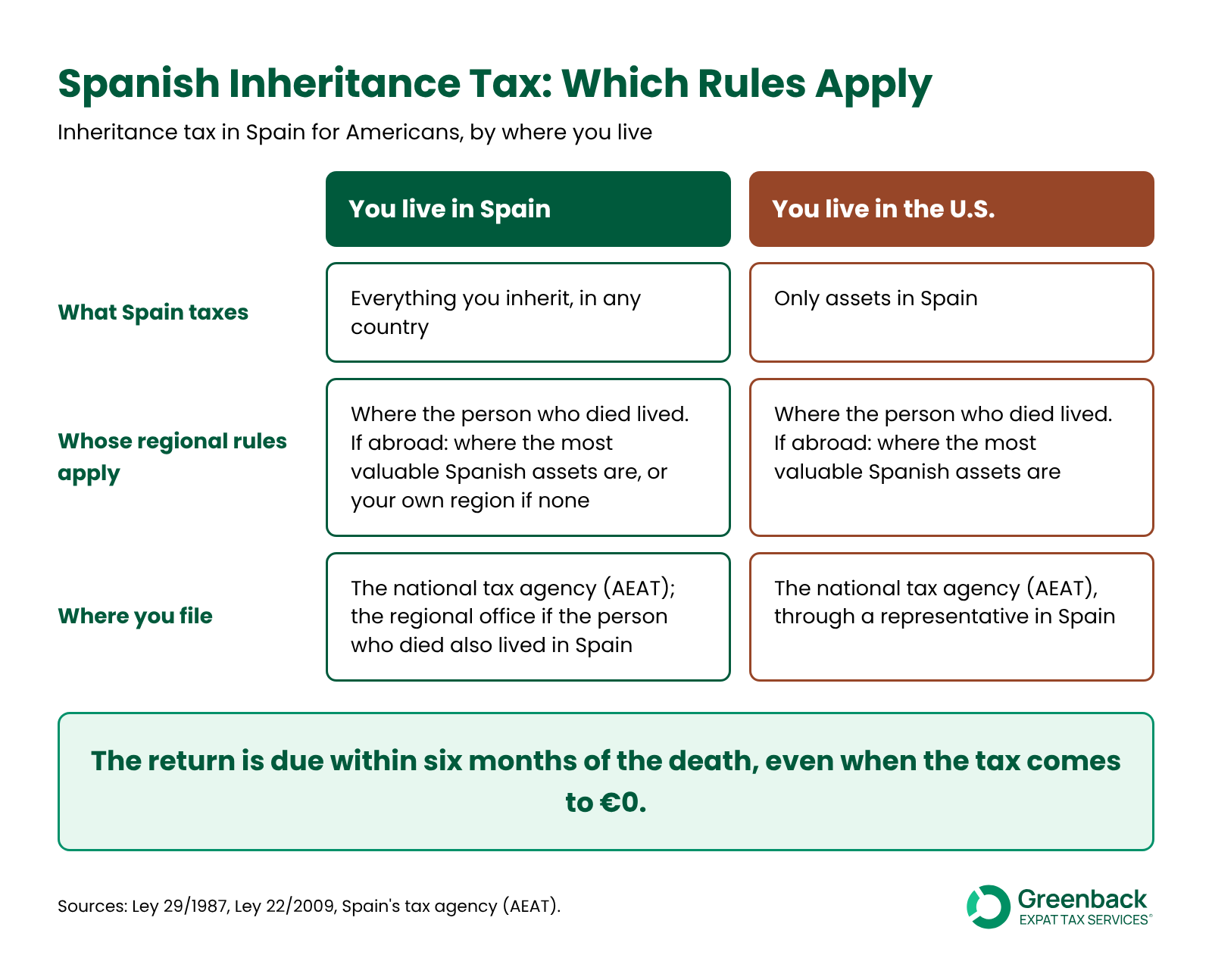
The heir pays Spanish inheritance tax, and where the heir lives decides what Spain can tax. Spanish tax residents are taxed on everything they inherit, in any country. Heirs who live elsewhere are taxed only on property, accounts, and other assets located in Spain. Residency follows the income tax tests, primarily the 183-day rule in Spain, as set out in our guide to Spanish tax residency.
Which Region’s Inheritance Tax Rules Apply to You?
Where the person who died lived decides which region’s allowances you use:
- They lived in Spain: their region’s rules apply, wherever you live.
- They lived outside Spain: the rules of the region that holds the most valuable Spanish assets apply. If there’s nothing in Spain, an heir living in Spain uses the rules of their own region, meaning the one where they spent most days in the five years before the death.
You file Modelo 650 with Spain’s national tax agency (AEAT) in every case except one: when you and the person who died both lived in Spain, you file with their regional tax office.
Can Heirs Living in the U.S. Use the Regional Allowances?
Heirs living in the U.S. have been able to use the regional allowances since 11 July 2021, when Ley 11/2021 extended them beyond cases involving the EU and the European Economic Area. One condition remains: heirs living outside the EU and EEA must appoint a representative resident in Spain to deal with the tax agency on their behalf.
The rules on whose allowances apply come from the second additional provision of Spain’s inheritance tax law, and the rules on where you file from article 32 of the regional financing law.
How Much Is Inheritance Tax in Spain?
On a €600,000 inheritance left to an adult child, Spanish inheritance tax comes to little or nothing in seven of the eight regions shown here, and to about €41,175 in Catalonia. Each heir receives an allowance based on the closeness of the relationship and pays 7.65% to 34% on the remainder, with higher rates for substantial existing wealth; each region then sets its own allowance and discount.
These are the 2026 rules for an adult child or a spouse, with the tax on a €600,000 inheritance left to an adult child, as published in the Ministry of Finance’s regional tax summary:
| Region | Allowance and discount for a child or spouse | Tax on €600,000 left to an adult child |
|---|---|---|
| Andalucía | €1,000,000 allowance, then 99% off | €0 |
| Galicia | €1,000,000 allowance, then 5% to 18% on any excess | €0 |
| Illes Balears | €25,000 allowance, then 100% off | €0 |
| Canarias | €23,125 allowance for a child (€40,400 for a spouse), then 99.9% off | About €134 |
| Comunitat Valenciana | €100,000 allowance, then 99% off | About €1,115 |
| Madrid | €16,000 allowance, then 99% off | About €1,357 |
| Región de Murcia | €15,956.87 allowance, then 99% off | About €1,395 |
| Cataluña | €100,000 allowance; a spouse gets 99% off, a child 60% off the first €100,000, falling to 0% above €3,000,000 | About €41,175 |
The figures assume the heir’s own wealth is under €300,000, with no earlier gifts or life insurance. Siblings, nieces and nephews get smaller allowances and, in most of these regions, smaller discounts: Madrid takes 50% off their tax and Valencia 25% (rising to 50% from 1 June 2027), while the Canaries keep 99.9%.
Example: Laura Inherits €600,000 From Her Father in Ohio
Laura, 45, a U.S. citizen, moved to Barcelona six years ago. Her father dies in Ohio in 2026 and leaves her €600,000 in cash and investments, about $672,000 at €1 to $1.12. Because she lives in Spain, Spain taxes the whole inheritance, even though all of it is in the U.S. With no Spanish assets involved, her own region’s rules apply: Catalonia’s. She owes about €41,175, which must be filed with the AEAT within six months. Had she spent most of the last five years in Valencia, she’d owe about €1,115.
On the U.S. side, her father’s estate is well under $15,000,000, so it owes no U.S. estate tax, and the inheritance itself isn’t income for Laura’s return (see our guide to foreign inheritance tax). Her father was a U.S. person, so there’s no Form 3520 to file. If she keeps the money in U.S. accounts, it is reported on Spain’s Modelo 720 once a category exceeds €50,000, as the Spanish wealth tax and Modelo 720 page sets out. If she moves it to a Spanish bank, the account goes on her FBAR.
What If You Inherit a Spanish Home From a Parent in the U.S.?
When the parent and the heir both live in the U.S., Spain taxes only the Spanish home, under the rules of the region where it sits, and the heir still files within six months, even when nothing is owed.
Michael and Dana, both adults living in the U.S., inherit their mother’s apartment in Málaga, with a reference value of €300,000, half each. Their mother lived in the U.S. and owned nothing else in Spain, so Andalucía’s rules apply. The €1,000,000 allowance brings each €150,000 share to €0. Each still files Modelo 650 with the AEAT within six months, through a representative in Spain. Had the apartment been in Sitges, in Catalonia, each would owe about €1,458.
What Else Applies When You Inherit a Spanish Home?
An inherited Spanish home also brings the town’s plusvalía tax in Spain and a new starting value for U.S. tax:
- The town’s plusvalía tax, charged on the growth in land value, is paid by the heir and declared within six months (up to a year with an extension). Each town sets its own rate and can offer up to 95% off for children and spouses.
- The U.S. basis of the home resets to its value at their mother’s death, which usually lowers the taxable gain when they sell; our page on the step-up in basis for inherited foreign property has the details. Spain taxes the sale on its own terms, covered in capital gains tax in Spain.
A home held in their own names stays off Form 8938.
What Do You Need to Do After Someone Dies?
Spanish inheritance tax is due within six months of death, so the work is gathering documents and lining up help in Spain early on.
- Gather the documents. Spain asks for the death certificate, a certificate from its central register of wills, the will or a declaration of heirs, the deed accepting the inheritance (or an inventory of the assets and heirs), and each heir’s passport or NIE, according to the tax agency’s Modelo 650 instructions.
- Appoint a representative in Spain if you live outside the EU or EEA.
- File Modelo 650 within six months. If you need more time, ask for a six-month extension within the first five months; it is deemed granted if the office doesn’t reply within a month, and interest runs from the end of the first six months under articles 67 and 68 of the inheritance tax regulation.
- Pay before withdrawing money from a Spanish bank. A Spanish bank that hands over an inherited account before the tax is paid can be held liable for the tax, though it can issue a check to the tax office to pay it.
- Handle the U.S. side: Form 3520 if the person who died wasn’t a U.S. person, your FBAR for any Spanish accounts you now hold, and a record of each asset’s value at the date of death.
Filing late without a request from the tax office adds a surcharge of 1% plus 1% for each full month, or 15% plus interest after 12 months, cut by 25% if you pay in full on time, under article 27 of the General Tax Law. Timing can also determine the discount: Madrid’s 99% applies only to assets declared on time or before the tax office requests them.
Does the U.S. Estate Tax Still Apply?
The U.S. estate tax covers a U.S. citizen’s worldwide assets, but it applies only when the estate and lifetime taxable gifts top $15,000,000 for 2026 deaths, according to the IRS. The U.S. has no estate or gift tax treaty with Spain, so nothing in a treaty divides the two taxes.
An estate that owes U.S. estate tax can claim a credit for Spanish inheritance tax paid on property in Spain, but Spanish tax on U.S. assets, as in Laura’s case, does not earn a U.S. credit. The estate return itself is covered in estate taxes for U.S. citizens living abroad.
For heirs, an inherited IRA or 401(k) is the exception to the no-income rule: withdrawals are taxed as you take them, under the inherited IRA rules. An inheritance from a nonresident alien or a foreign estate is reported on Form 3520 once the year’s total exceeds $100,000.
How Are Gifts Taxed Between Spain and the U.S.?
Spain taxes the person who receives a gift, while the U.S. taxes the person who gives it. In Spain, residents pay tax on every gift they receive, and non-residents pay tax on Spanish assets, and the return is due within 30 working days. Madrid and Andalucía take 99% off gifts to children and spouses, but both require a notarized deed exceeding the set amounts (€10,000 in Madrid, €5,000 in Andalucía, counting three years of gifts) and, for cash, proof of the source of the funds.
In the U.S., the giver files Form 709 for gifts above $19,000 per person in 2026 and owes tax only once lifetime gifts pass the $15,000,000 exemption. Our guide to U.S. gift tax for Americans abroad covers both sides of giving.
Frequently Asked Questions About Inheritance Tax in Spain
Spain isn’t among the 15 countries with a U.S. estate tax treaty. The U.S.-Spain tax treaty covers only income tax, so it doesn’t address inheritance or estate tax.
A surviving spouse pays little or nothing in the eight regions in the table, through a 99% to 100% discount, or in Galicia through the €1,000,000 allowance. A spouse’s share in Galicia above €1,000,000 is taxed at 5% to 18%.
Residents of Spain pay inheritance tax on a life insurance payout when someone else took out the policy, including a U.S. policy. Heirs living in the U.S. pay only on policies issued by Spanish insurers or signed in Spain by a foreign insurer operating there.
An inheritance from a Spanish relative who isn’t a U.S. person is reported on Form 3520 once the year’s total exceeds $100,000. It isn’t taxed as income, and any Spanish account you inherit counts toward your FBAR.
How Greenback Helps Americans With an Inheritance in Spain
Greenback’s tax team takes on the U.S. reporting that comes with a Spanish inheritance. We report the inheritance correctly, file Form 3520 when it applies, add inherited Spanish accounts to your FBAR, and keep the stepped-up basis on record for a later sale. Your Modelo 650 stays with an adviser in Spain. For the full list of U.S. forms, see U.S. expat taxes in Spain, and see how Greenback supports U.S. citizens living abroad.

Inherited Something in Spain?
This article is for informational purposes only and does not constitute tax or legal advice. Regional figures come from the Ministry of Finance’s 2026 regional tax summary, and the examples assume no earlier gifts, life insurance, or special reductions. Speak with a qualified professional about your situation.




Featured In





