How Is Cryptocurrency Taxed for U.S. Expats?



- How Does the IRS Tax Cryptocurrency?
- What Changed for 2025 and 2026?
- How Is Crypto Taxed for Expats Specifically?
- Do I Need to Report Crypto on the FBAR?
- Do I Need to Report Crypto Under FATCA?
- What About Sending and Receiving Crypto as Gifts?
- What Forms Do I Need to File for Crypto?
- Frequently Asked Questions
- Get Expert Help With Your Crypto Tax Obligations
- Related Resources
The IRS treats cryptocurrency as property, not currency. This means every time you sell, trade, spend, or otherwise dispose of crypto, you trigger a taxable event and must report the capital gain or loss on your U.S. tax return. This applies to all U.S. citizens and green card holders, regardless of where in the world you live.
For the 2025 tax year (filed in 2026), the IRS has introduced Form 1099-DA, a new reporting form that requires custodial brokers to report gross proceeds from digital asset transactions directly to the IRS. This is a significant enforcement shift: the IRS will now be able to match your crypto activity against what you report on Form 8949 and Schedule D.
Key facts for expats:
- Crypto gains are capital gains, taxed at short-term (ordinary income) or long-term (0%, 15%, or 20%) rates
- The FEIE does not apply to crypto gains because they are unearned income
- The Foreign Tax Credit may help if your country of residence also taxes crypto gains
- FBAR and FATCA reporting may be required if you hold crypto on a foreign exchange
- The wash sale rule now applies to digital assets under the One Big Beautiful Bill Act (OBBB)

Holding or Trading Crypto While Living Abroad?
Here is how cryptocurrency is taxed for Americans abroad, what you need to report, and how to stay compliant.
How Does the IRS Tax Cryptocurrency?
The IRS classifies all digital assets, including Bitcoin, Ethereum, stablecoins, NFTs, and other tokens, as property under IRS Notice 2014-21. The same general tax principles that apply to property transactions apply to crypto.
Capital Gains and Losses
Every time you dispose of cryptocurrency, you have a taxable event. The gain or loss equals the difference between the fair market value at the time of disposal and your cost basis (what you originally paid for the crypto in USD).
| Transaction Type | Taxable Event? | What to Report |
|---|---|---|
| Selling crypto for USD or other fiat | Yes | Capital gain or loss |
| Trading one crypto for another | Yes | Capital gain or loss |
| Using crypto to buy goods or services | Yes | Capital gain or loss |
| Receiving crypto as payment for work | Yes | Ordinary income at FMV when received |
| Mining crypto | Yes | Ordinary income at FMV when received |
| Staking rewards | Yes | Ordinary income at FMV when received |
| Receiving crypto as a gift | No (until you sell it) | Report when you eventually dispose of it |
| Transferring crypto between your own wallets | No | No taxable event |
| Buying crypto with USD | No | No taxable event (but track your cost basis) |
Short-Term vs. Long-Term Capital Gains
| Holding Period | Tax Rate | How It Works |
|---|---|---|
| One year or less (short-term) | Your ordinary income tax rate (10% to 37%) | Taxed as regular income |
| More than one year (long-term) | 0%, 15%, or 20% depending on income | Preferential rates apply |

Because crypto gains are unearned income, the Foreign Earned Income Exclusion (FEIE) does not apply. You cannot exclude crypto gains from U.S. taxation using Form 2555. If your country of residence taxes crypto gains, use the Foreign Tax Credit (FTC) to offset your U.S. liability.
What Changed for 2025 and 2026?
Form 1099-DA (New for 2025)
Starting with transactions on or after January 1, 2025, custodial brokers (exchanges like Coinbase, Kraken, and Gemini) must report gross proceeds from digital asset sales to the IRS using Form 1099-DA. For 2025 transactions, brokers report gross proceeds only. Beginning with 2026 transactions, brokers must also report cost basis for “covered” digital assets (those acquired and held within the same broker account).
What this means for you:
- The IRS will have independent records of your crypto sales to match against your return
- Brokers may deliver Forms 1099-DA late in 2026 due to transitional relief (the IRS is not penalizing good-faith late filings for 2025)
- Cost basis is your responsibility for assets transferred between exchanges or acquired before 2025
- Do not rely solely on Form 1099-DA to prepare your return; reconcile it against your own records
Wash Sale Rule Now Applies to Crypto (OBBB)
The One Big Beautiful Bill Act (OBBB), signed July 4, 2025, closed the wash sale loophole for digital assets. Previously, you could sell crypto at a loss and immediately repurchase the same asset to claim a tax deduction. Under the new rules, if you sell crypto at a loss and buy the same or substantially identical asset within 30 days (before or after the sale), the loss is disallowed.
This aligns crypto with the rules that have long applied to stocks and securities.
Form 1040 Digital Asset Question
Form 1040 continues to require all taxpayers to answer “yes” or “no” to the digital asset question. For the 2025 tax year, the question asks whether you received, sold, sent, exchanged, gifted, or otherwise disposed of any digital assets during the year. Answering “no” when the answer is “yes” is a red flag for the IRS. Answer this question accurately.
How Is Crypto Taxed for Expats Specifically?
The FEIE Does Not Apply to Crypto Gains
This is the most important thing for expats to know. The Foreign Earned Income Exclusion applies only to earned income (wages, salaries, self-employment income). Crypto capital gains are unearned income and cannot be excluded.
However, if you receive crypto as payment for services (freelancing, consulting, employment), the fair market value at the time of receipt is earned income and may qualify for the FEIE. The subsequent capital gain or loss when you later sell the crypto is still unearned income and does not qualify.
The Foreign Tax Credit Can Help
If your country of residence taxes crypto capital gains, you can use the Foreign Tax Credit (Form 1116) to offset your U.S. tax liability dollar-for-dollar. In high-tax countries, this can eliminate your U.S. crypto tax entirely.
Note that many popular expat destinations do not tax crypto gains or have favorable treatment:
| Country | Crypto Tax Treatment | FTC Available? |
|---|---|---|
| Germany | Tax-free if held over one year | No (no foreign tax paid) |
| Portugal | 28% on short-term gains; exempt if held over one year | Yes (on short-term gains only) |
| Singapore | No capital gains tax | No |
| UAE | No income or capital gains tax | No |
| UK | Capital gains tax applies (10% or 20%) | Yes |
| Australia | Capital gains tax applies; 50% discount if held over one year | Yes |
For a full comparison of how different countries work with the FEIE and FTC, see FEIE vs. Foreign Tax Credit.
Self-Employment Tax on Crypto Income
If you earn crypto through freelancing, consulting, or operating a business, the income is subject to the 15.3% self-employment tax (Social Security and Medicare) in addition to income tax. You will report this business income on Schedule C and calculate the self-employment tax on Schedule SE. The FEIE can exclude this income from income tax, but it does not eliminate self-employment tax. If your country has a totalization agreement with the U.S., you may be exempt from U.S. self-employment tax. For a complete walkthrough, see our step-by-step self-employment tax filing guide.
Do I Need to Report Crypto on the FBAR?
This is one of the most complex and evolving areas of crypto tax compliance for expats.
- Current rule: FinCEN has not yet formally required crypto-only accounts to be reported on the FBAR. Under current regulations, a foreign account holding only virtual currency is not reportable. However, if the account also holds fiat currency (USD, EUR, etc.) or other reportable assets, the entire account is FBAR-reportable.
- The conservative approach (recommended): Most tax professionals, including Greenback, recommend reporting crypto held on foreign exchanges (such as Binance, Bitstamp, or Bitfinex) on your FBAR if the total value of your foreign accounts exceeds $10,000 at any point during the year. FinCEN has signaled its intention to formally include virtual currency in FBAR requirements, and the penalty for non-filing ($16,536 per form for non-willful violations in 2025) far outweighs the cost of reporting.
Self-custodied wallets (where you control the private keys) are generally not considered foreign accounts, regardless of your location.
U.S.-based exchanges (Coinbase, Kraken, Gemini) are not foreign accounts and do not trigger FBAR reporting, even if you access them from abroad.
Do I Need to Report Crypto Under FATCA?
If you meet the FATCA (Form 8938) thresholds, crypto held on foreign exchanges is likely reportable as a specified foreign financial asset. The thresholds for expats are $200,000 at year-end or $300,000 at any point during the year (single filers). See our FBAR vs. FATCA comparison for a detailed breakdown of when each applies.
What About Sending and Receiving Crypto as Gifts?
Sending Crypto as a Gift
If you gift cryptocurrency to another person, you are not taxed on the gift itself. However, you must file Form 709 (Gift Tax Return) if the value of all gifts to any one person in a single year exceeds $19,000 (2026 annual exclusion). You must also inform the recipient of your cost basis so they can correctly calculate their gain or loss when they eventually sell.
Receiving Crypto as a Gift From a Foreign Person
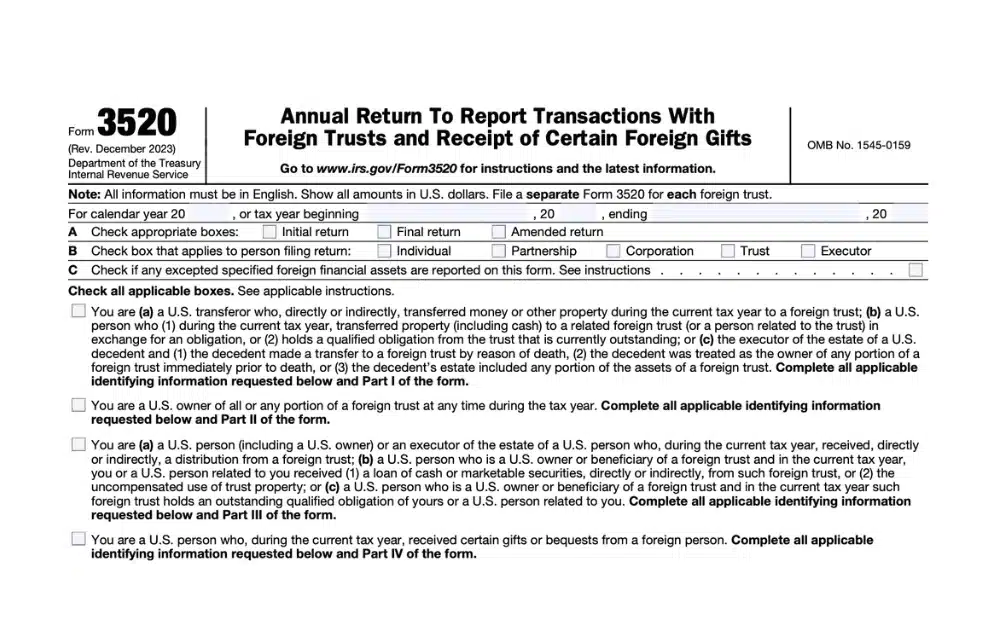
If you receive cryptocurrency worth $100,000 or more as a gift from a foreign national (non-U.S. person), you must report it on Form 3520. The gift itself is not taxable, but failure to report it carries a penalty of up to 25% of the value received.
If you receive crypto worth $175,000 or more from a foreign spouse who is not a U.S. citizen, the same Form 3520 reporting requirement applies.
Receiving Crypto as Payment
If you receive cryptocurrency as payment for goods sold or services rendered, the fair market value at the time of receipt is taxable income. Report this as business income on Schedule C (sole proprietors) or the appropriate business return.
What Forms Do I Need to File for Crypto?
| Form | When Required | What It Reports |
|---|---|---|
| Form 1040 | Always | Digital asset question; overall tax return |
| Form 8949 | Any crypto sale, trade, or disposal | Individual capital gain/loss transactions |
| Schedule D | Any crypto sale, trade, or disposal | Summary of capital gains and losses |
| Schedule C | Crypto received as business income | Business revenue |
| Schedule SE | Self-employment crypto income over $400 | Self-employment tax |
| FBAR (FinCEN Form 114) | Foreign exchange accounts over $10,000 aggregate (recommended) | Foreign financial account balances |
| Form 8938 (FATCA) | Foreign assets over FATCA thresholds | Foreign financial asset details |
| Form 709 | Crypto gifts over $19,000 to any one person (2026) | Gift tax return |
| Form 3520 | Crypto gifts received from foreign persons over $100,000 | Foreign gift/trust reporting |
Frequently Asked Questions
No. The Foreign Earned Income Exclusion applies only to earned income (wages, salaries, and self-employment). Crypto capital gains are unearned income and cannot be excluded using Form 2555. If you receive crypto as payment for work, the income at the time of receipt may qualify for the FEIE, but any subsequent gain when you sell the crypto does not.
Yes. U.S. citizens owe U.S. tax on crypto gains regardless of where they live. Living in a zero-tax country like the UAE or the Bahamas does not eliminate your U.S. tax obligation. Because you pay no foreign tax, you also have no Foreign Tax Credit to offset your U.S. liability.
Yes. Trading Bitcoin for Ethereum (or any crypto-to-crypto swap) is a taxable event. You must calculate the capital gain or loss based on the fair market value of the crypto received versus your cost basis in the crypto sold.
Form 1099-DA is a new IRS form introduced for the 2025 tax year. Custodial brokers (exchanges) must report gross proceeds from digital asset sales to the IRS and provide a copy to you. For 2025, only gross proceeds are reported. Starting in 2026, brokers must also report cost basis for covered digital assets. You may receive your Form 1099-DA later than other tax forms due to the transitional relief the IRS has granted to brokers.
The rules are not yet finalized, but the conservative and widely recommended approach is yes. If you hold crypto on a foreign exchange and the total value of all your foreign financial accounts exceeds $10,000 at any point during the year, report the exchange account on your FBAR. FinCEN has indicated it intends to formally include virtual currency accounts, and the penalties for non-filing are severe.
No, not anymore. The OBBB, effective for 2025, extended the wash sale rule to digital assets. If you sell crypto at a loss and repurchase the same or substantially identical asset within 30 days, the loss is disallowed.
Staking rewards and mining income are taxable as ordinary income at the fair market value when received. Report this income on your tax return. When you later sell the crypto, any additional gain or loss from the change in value since receipt is a capital gain or loss.
If you have unreported crypto transactions from prior years, the IRS Streamlined Filing Compliance Procedures allow qualifying expats to catch up on three years of tax returns and six years of FBARs with no penalties. With the introduction of Form 1099-DA and international crypto reporting agreements (CARF), the IRS’s ability to identify unreported crypto activity is increasing rapidly. Act before the IRS contacts you.
Get Expert Help With Your Crypto Tax Obligations
Cryptocurrency taxation for expats is complex, combining U.S. capital gains rules, foreign tax credit calculations, FBAR/FATCA compliance, and evolving broker reporting requirements. A single mistake can trigger IRS penalties or unnecessary double taxation.
If you are ready to be matched with a Greenback accountant, get started here. For general questions about expat taxes or working with Greenback, contact our Customer Champions.

Report Your Crypto Taxes Correctly as an Expat
This article is for informational purposes only and does not constitute tax or legal advice. Cryptocurrency tax rules are complex and evolving rapidly. Always consult with a qualified tax professional about your specific situation.
Related Resources
- Virtual Currency Checkbox on Form 1040
- U.S. Expat Taxes: The Complete 2026 Guide
- Foreign Tax Credit Guide
- FEIE vs. Foreign Tax Credit
- FBAR Filing Requirements
- FBAR vs. FATCA Comparison
- Form 8938 (FATCA) Reporting
- Form 3520: Foreign Gift and Trust Reporting
- Countries With No Income Tax
- Schedule C for Expat Businesses
- Schedule SE: Self-Employment Tax Guide
- Self-Employment Tax for U.S. Expats


Featured In