Expat Tax Documents Checklist for the 2027 Filing Season



An expat tax documents checklist covers everything a stateside checklist does, plus the records only Americans abroad need: foreign payslips, your country’s year-end pay statement, foreign tax statements, foreign bank and investment account records, and proof of the days you spent outside the U.S. For your 2026 tax return, filed in 2027, gathering these through the year means your return comes together quickly once filing season opens.
Sort them into four folders for the tax year, add to them monthly, and you’ll have everything ready for the 2027 filing season. This guide lists what to collect, shows what your country’s pay statement is called and when it arrives, explains what to do if a document is late, and provides a one-page summary to hand to your preparer. For the bigger picture, see how U.S. expat taxes work, the tax forms expats file, and the expat tax deadlines for the year.
What Documents Do Expats Need to File U.S. Taxes?
Expats need six groups of documents for a U.S. tax return: personal and identity information, income records, proof of foreign taxes paid, foreign account records, proof of time abroad, and records for deductions, credits, and life changes. The checklist below shows every item; the sections under it explain what each group is for.
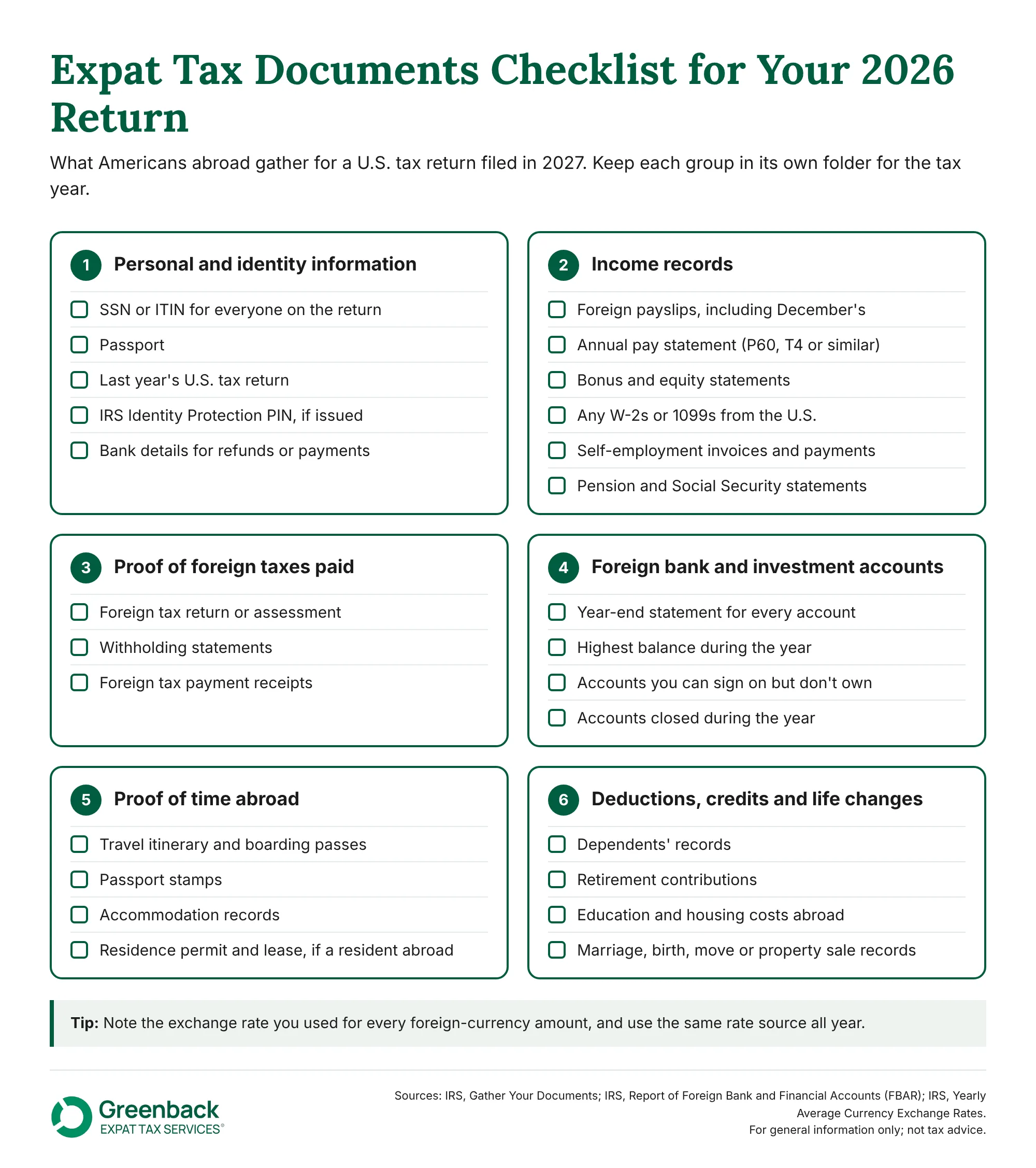
If Greenback prepares your return, our FAQ on what Greenback needs to prepare your expat tax return shows exactly what we ask for.
1. Personal and Identity Information
Start with the Social Security number or ITIN for everyone on your return, your passport, last year’s return, and your bank details. Last year’s return gives you the prior-year adjusted gross income you may need to e-file, and an IRS Identity Protection PIN goes on the return if you have one. If a spouse or dependent uses an ITIN, check that it hasn’t expired.
2. Income Records
Your income records start with your foreign payslips and your employer’s year-end pay statement, plus any bonus or equity statements. The table in the next section shows what that statement is called in eight countries and when it arrives. Add any W-2s or 1099s you still receive from the U.S., invoices and payment records if you’re self-employed, and pension or Social Security statements if you’re retired. All of it counts, because U.S. citizens report worldwide income.
3. Proof of Foreign Taxes Paid
Keep your foreign tax return or assessment, withholding statements, and payment receipts, because they support the Foreign Tax Credit on Form 1116. Proof of what you paid abroad is what lets the credit offset U.S. tax on the same income.
4. Foreign Bank and Investment Account Records
For every foreign account, keep the year-end statement and a record of the highest balance during the year. Those numbers decide whether you file an FBAR and what goes on it. Include accounts you can sign on but don’t own, such as an employer account, and accounts you closed during the year.
5. Proof of Time Abroad
Keep your travel itinerary, boarding passes, passport stamps, and accommodation records, because they show how many days you spent outside the U.S. That count matters if you claim the Foreign Earned Income Exclusion under the Physical Presence Test. For the 2026 tax year, the exclusion is up to $132,900. If you qualify under the Bona Fide Residence Test instead, keep your residence permit, lease, and local tax registration.
6. Deductions, Credits and Life Changes
Keep records for anything that changes your tax picture: dependents, retirement contributions, education costs, housing costs abroad, and any marriage, birth, move or property sale during the year. A move abroad mid-year also changes which records you need, as our moving abroad checklist explains.
What Annual Pay Statement Will You Get Abroad?
Most countries require or expect employers to give staff a year-end statement of pay and tax withheld, and it’s the single most useful income document for your U.S. return. Its name and the date you’ll have it depend on the country, and in several countries it arrives after the U.S. filing season has started.
| Country | Annual statement | When you’ll usually have it | Local tax year |
|---|---|---|---|
| United Kingdom | P60 | By May 31 | April 6 to April 5 |
| Canada | T4 slip | By the end of February | Calendar year |
| Australia | Income statement in myGov, marked “tax ready” | By mid-July | July 1 to June 30 |
| Germany | Lohnsteuerbescheinigung | From the end of February | Calendar year |
| Spain | Certificado de retenciones e ingresos a cuenta | Before the Spanish filing period opens in April | Calendar year |
| Portugal | Annual statement of income and tax withheld | By January 20 | Calendar year |
| France | No annual statement; use December’s payslip and the prefilled return | Prefilled return in April | Calendar year |
| Netherlands | Jaaropgaaf | Usually January or February | Calendar year |
If your country isn’t listed, ask payroll for the year-end statement showing gross pay, tax withheld, and social contributions. How those wages are then reported on a U.S. return is covered in our guide to filing without a W-2.
What If Your Country’s Tax Year Is Different?
If your country’s tax year doesn’t run from January to December, a U.S. return may span two foreign tax years, so you need two annual statements and the December payslip from each year. The U.S. tax year for individuals is the calendar year, and every foreign document has to be split at December 31.
Here’s how it works for someone paid in the UK. Their 2026 U.S. return covers pay from January 1 to December 31, 2026. That spans two UK tax years:
- January 1 to April 5, 2026, falls at the end of the UK tax year shown on the P60 issued in May 2026.
- April 6 to December 31, 2026 falls within the next UK tax year, whose P60 doesn’t arrive until May 2027.
UK payslips show year-to-date totals for the UK tax year. So the December 2026 payslip covers April 6 to December 31, 2026, and the earlier P60, minus the December 2025 payslip’s totals, gives you January 1 to April 5, 2026. That’s why the December payslip is the one document to save every year if your country’s tax year is different. Australia’s July-to-June year works the same way.
Because the second statement can arrive after April 15, many filers in these countries use the automatic two-month extension to June 15 for Americans living abroad, or file Form 4868 for more time. Interest still runs from April 15 on any tax you owe. For how foreign tax years line up with U.S. rules on the Foreign Tax Credit, see our FAQ on U.S. and foreign tax years.
Why Doesn’t a Stateside Tax Checklist Work Abroad?
A stateside checklist assumes your employer sends a W-2 and your bank sends a 1099, and abroad, neither usually happens. A foreign employer reports your pay on its own country’s forms, foreign banks don’t send U.S. tax forms, and the records behind the Foreign Earned Income Exclusion and the Foreign Tax Credit are ones only you keep. Our guide to filing U.S. taxes from abroad walks through the full process.
A foreign tax assessment or a missing bank statement can take weeks to obtain from another country, so gathering records throughout the year pays off.
What If a Foreign Tax Document Is Missing or Late?
A missing or late foreign document rarely stops your return, because the same figures usually exist in another record you can access. Work through these in order:
- Use your last payslip of the year. Its year-to-date totals show gross pay, tax withheld, and social contributions, which covers most of what the annual statement shows.
- Check your local tax portal. Most countries show the income and tax your employer reported online, including myGov in Australia, the HMRC personal tax account in the UK, ELSTER in Germany, Portal das Finanças in Portugal, the Agencia Tributaria in Spain, impots.gouv.fr in France, Mijn Belastingdienst in the Netherlands and CRA My Account in Canada.
- Ask your employer, bank or broker for a copy. Payroll can reissue an annual statement, and most banks keep statements in online banking for several years.
- Extend if a key document won’t arrive in time. The June 15 date for Americans abroad, and Form 4868 after it, give you room to file with final figures.
- Amend if a corrected document arrives after you file. An amended return updates the figures once you have them.
If the missing document is a U.S. W-2, the steps are different; our guide to filing without a W-2 covers them.
How Do I Organize My Expat Tax Documents?
Create one folder for each tax year, split it into four folders (income, foreign taxes and accounts, time abroad, and deductions), and add documents as they arrive. A digital system is easiest to share with your preparer from anywhere, but paper works if you keep to the same structure.
1. Set Up One Folder per Tax Year
Label it with the tax year the documents cover. Documents for your 2026 return go in a “2026 Tax Year” folder, even when they arrive in 2027.
2. Split It Into Four Folders
Use the same four folders every year: income; foreign taxes and accounts; time abroad; and deductions, credits, and life changes. Personal and identity documents can sit at the top level, since they carry over from year to year.
3. Name Files the Same Way Every Time
Start each file name with the date, then the document, such as “2026-03 Payslip” or “2026-12 Bank Statement Account 1.” Files then sort in order on their own, and nothing gets lost.
4. Keep a One-Page Summary for Your Preparer
A one-page summary gives your preparer the full picture in minutes and shows at a glance if anything is missing. Copy this outline into a document and fill it in as the year goes on:
| Section | What to write down |
|---|---|
| Income sources | Each employer, client, pension, or rental, with the country and currency |
| Foreign accounts | Each bank, brokerage or pension account, its country, and its highest balance during the year |
| Foreign tax paid | Tax withheld or paid in each country, and whether a foreign return was filed |
| Days in the U.S. | Total days spent in the U.S. during the year, with dates |
| Life changes | Marriage, birth, move, new job, property bought or sold |
| Still waiting on | Any document that hasn’t arrived yet, and when you expect it |
What Order Should Tax Documents Be In?
Put personal information first, then income, foreign taxes paid, foreign accounts, proof of time abroad, and deductions and credits. That’s roughly the order in which a return is prepared, so your preparer can work straight through your folders without hunting.
What Is the Best Way to Store Tax Documents?
The best way to store tax documents is in secure cloud storage, organized by tax year, with a second backup in a separate place. Cloud storage lets you access your records from anywhere, and the backup protects you if your account is lost or locked. Protect files that carry Social Security numbers, passport scans, or account numbers, and share them with your preparer through a secure portal.
How Do I Organize Receipts and Foreign Currency Amounts?
Photograph each receipt when you get it, file it by category in that tax year’s folder, and note the exchange rate you used for any amount in foreign currency.
For currency, the IRS has no official exchange rate. According to the IRS, you generally use the rate on the day you receive or pay an amount, and you can use any posted rate as long as you use it consistently; it also publishes yearly average rates. FBAR balances follow their own rules, covered in our FBAR guide. Whichever rate you use, write it next to the amount so your preparer can follow it.
A Monthly Routine That Keeps Your Checklist Current
Ten minutes a month keeps your expat tax documents current, so nothing piles up before filing season. At the start of each month:
- Save last month’s payslip in the income folder.
- Download statements for each foreign account and note the highest balance.
- Update your travel log with last month’s days in and out of the U.S.
- Photograph new receipts and file them by category.
Once a quarter, check the bigger picture: your running total of days abroad, account balances, foreign tax withheld, and whether you owe estimated tax payments for the quarter. In January, save the December payslip and update your one-page summary.
Extra Documents by Situation
Some expats need a few additional documents beyond the checklist, depending on how they live, work, and file abroad.
| Your situation | Extra documents to keep |
|---|---|
| Employee of a foreign or U.S. company abroad | Assignment letter with dates, housing and cost-of-living allowance statements, tax equalization agreement, equity vesting records |
| Self-employed | Invoices, separate business account statements, expense receipts, records of foreign social security paid |
| Retiree | Foreign pension statements, Form SSA-1099, IRA and 401(k) distribution forms |
| Digital nomad | Daily location log, accommodation bookings, coworking memberships, proof of where you work from |
| Mixed-citizenship family | Spouse’s passport and ITIN, or Form W-7 documents if they need one; signed statement if you elect to treat a nonresident spouse as a U.S. resident; a U.S. citizen child’s Consular Report of Birth Abroad and Social Security number |
Digital nomads and other frequent travelers lean hardest on the time-abroad folder; our guide to digital nomad taxes covers how those records are used. Retirees can find more on Social Security benefits abroad.
If your spouse isn’t a U.S. citizen, start their paperwork early, because an ITIN application can take several weeks. Our guides cover Form W-7 for expat families and filing with a foreign spouse, and our FAQ on the election to file jointly with a nonresident spouse explains the statement you’d sign.
How Long Should Expats Keep Tax Documents?
Keep tax documents for at least three years after you file, and keep foreign account records for five years from the FBAR due date. Some situations call for longer, such as unreported income or a return you never filed. Our guide on how long to keep tax records covers every rule, and our FAQ on how long to keep foreign bank statements covers account records.
Frequently Asked Questions
Expats need personal and identity information; income records, such as foreign payslips and the employer’s year-end pay statement; proof of foreign taxes paid; foreign bank and investment account statements; proof of time spent abroad; and records of any deductions, credits, or life changes. These documents support the Foreign Earned Income Exclusion, the Foreign Tax Credit, and FBAR reporting.
You use the annual pay statements for both foreign tax years that overlap the U.S. calendar year, plus the December payslip from each year. The December payslip’s year-to-date totals let you split each foreign year at December 31. In the UK, for example, a U.S. return for one calendar year draws on two P60S, with the second arriving in May of the following year.
The best way to store tax documents is in secure cloud storage organized by tax year, with a second backup kept separately. Protect any files that show Social Security numbers, passport details, or account numbers, and share them with your tax preparer through a secure portal.
Photograph each receipt as soon as you get it, file it by category in that tax year’s folder, and record the exchange rate used for any foreign-currency amount. Use the same exchange rate source throughout the year to keep conversions consistent.
Put personal and identity information first, followed by income records, proof of foreign taxes paid, foreign account statements, proof of time abroad, and deduction and credit records. This order follows the process for preparing a tax return.
Expats should keep tax documents for at least 3 years after filing and foreign account records for 5 years from the FBAR due date. Longer periods apply in some cases, such as unreported income or a return that was never filed.
Greenback Turns Your Checklist Into a Finished Return
Once your documents are gathered, Greenback’s accountants, many of them expats themselves, can take it from there. We’ll review what you’ve collected, tell you if anything is missing, and prepare your 2026 return so it’s filed on time and done right.

Start Your Return With Greenback
The information in this article is for general informational purposes only and does not constitute tax, legal, or financial advice. Tax rules are complex and change frequently, and this content reflects IRS guidance. Consult a qualified tax professional regarding your specific situation before taking any action.



Featured In


