Why Do I Have to Pay U.S. Taxes If I Live Abroad?



- Do U.S. Citizens Living Abroad Pay U.S. Taxes?
- Why Does the U.S. Tax Citizens Who Live Abroad?
- Who Has to File, and What Is the Minimum Income?
- What Income Do I Have to Report From Abroad?
- Do I Owe U.S. Tax, or Do I Just File?
- Do I Pay U.S. Taxes on Money I Earn Working Abroad?
- Do I Still Have to File If I Never Move Back?
- Filing and Owing Are Two Separate Questions
U.S. citizens and green card holders file a U.S. tax return every year they live abroad, because the United States taxes on citizenship. Your worldwide income goes on that return, no matter where you live, who pays you, or which country has already taxed it. The IRS puts it plainly: you are subject to tax on worldwide income from all sources. For the 2025 tax year, you file once that income tops $15,750 single or $31,500 married filing jointly, and the exclusion can take up to $130,000 of foreign earned income back out again. Both figures rise for 2026.
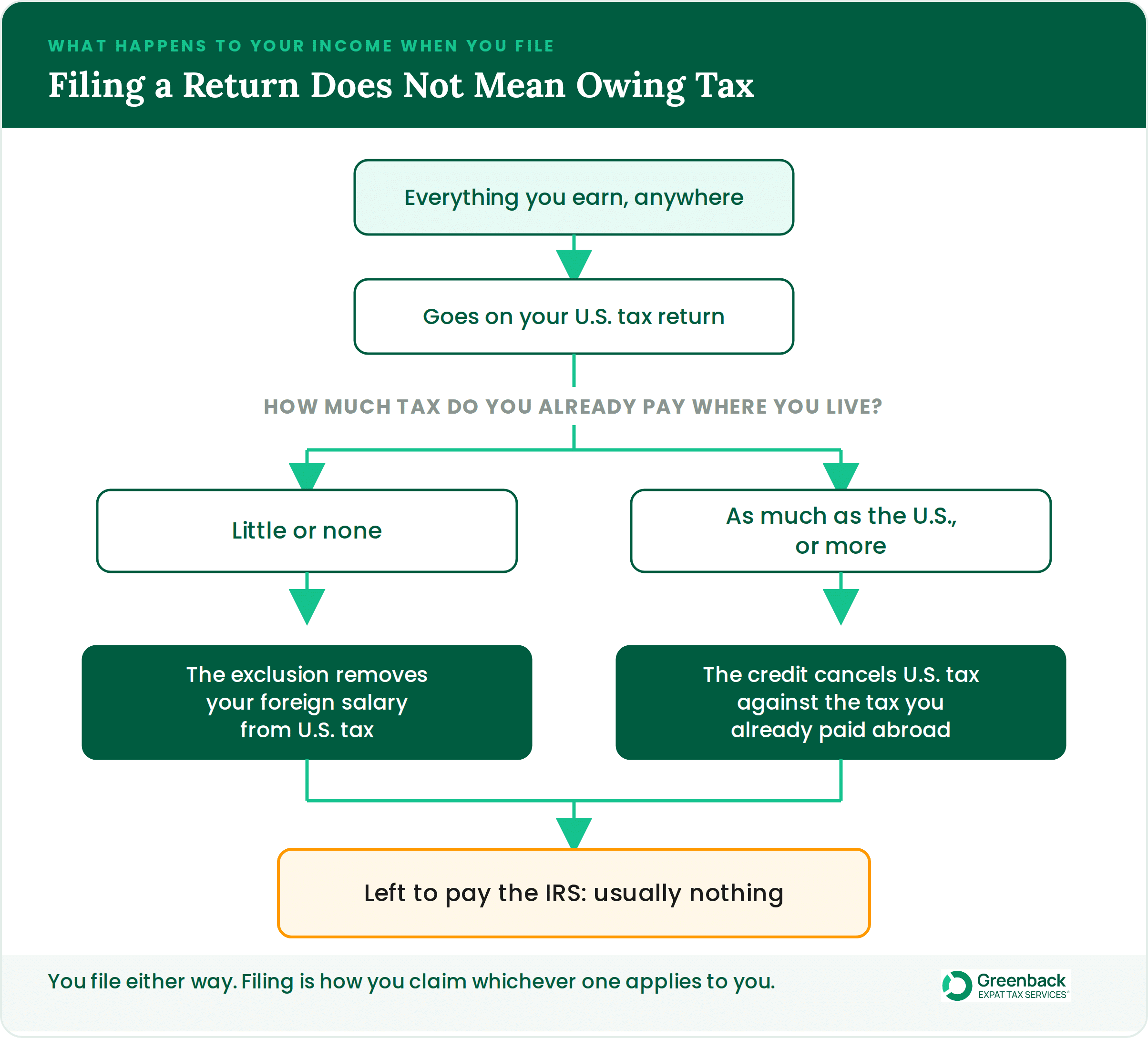
The return is the compulsory part. The bill usually is not. Two protections exist for exactly this situation: the Foreign Earned Income Exclusion (FEIE), which takes foreign earned income out of U.S. tax, and the Foreign Tax Credit (FTC), which offsets what you have already paid to another government. Both are claimed on the return itself.
Do U.S. Citizens Living Abroad Pay U.S. Taxes?
You file U.S. taxes every year you live abroad. Whether you owe anything is decided separately, after the exclusion or the credit has been applied against what you reported. Your worldwide income goes on the return, then the exclusion or credit is applied against it, and if you already pay income tax in the country where you live, that generally leaves nothing owed to the IRS.
Living abroad does not suspend the obligation, shorten it, or phase it out over time. Someone who left the U.S. thirty years ago and has not been back files on the same basis as someone who moved last spring.
Why Does the U.S. Tax Citizens Who Live Abroad?
The United States ties the tax obligation to citizenship, so it follows you wherever you live. Almost every other country taxes on residence instead. The Supreme Court settled the U.S. position in Cook v. Tait in 1924, holding that the power to tax rests on your relation as a citizen to the United States and not on where you or your property happen to sit.
If you want the fuller comparison, see citizenship-based taxation versus residency-based taxation.
Who Has to File, and What Is the Minimum Income?
You file if your worldwide income exceeds the minimum for your filing status, or if you had $400 or more in self-employment earnings. The thresholds count every source, U.S. and foreign, together, before any exclusion is applied.
| Filing Status | 2025 Threshold | 2026 Threshold |
|---|---|---|
| Single | $15,750 | $16,100 |
| Married Filing Jointly | $31,500 | $32,200 |
| Head of Household | $23,625 | $24,150 |
| Married Filing Separately | $5 | $5 |
| Self-Employed (any status) | $400 | $400 |
The $5 line is not a typo. Married filing separately carries a threshold of $5, so almost any income at all puts you over it. It catches people abroad most often because marrying someone who is not American is what pushes many of them into that status in the first place.

What Income Do I Have to Report From Abroad?
Every source counts. Salary from a foreign employer, freelance and contract work, interest and dividends from foreign accounts, capital gains, rent from property anywhere in the world, and foreign pension income all go on the return, converted to U.S. dollars using the Treasury’s yearly average rate.
Where the money is paid and where it sits make no difference to whether it is reportable. A salary paid in euros into a local bank account you have had for twenty years is reported the same as a U.S. paycheck. Which forms each type of income needs is covered in the filing guide.
Do I Owe U.S. Tax, or Do I Just File?
Whether you owe depends on which of the two protections you qualify for and how much tax you already pay where you live. The FEIE removes foreign-earned income up to $130,000 for the 2025 tax year and $132,900 for the 2026 tax year. The FTC works differently, giving you a dollar-for-dollar credit for income tax you have already paid to another government.
Which one fits depends on where you live. In a country that taxes at or above U.S. rates, the credit generally covers the U.S. liability on its own. In a low-tax or no-tax country, the exclusion does the work.
Qualification Requirements for FEIE
You have to qualify for the exclusion, and not everyone abroad does. You qualify by meeting either the Physical Presence Test or the Bona Fide Residence Test. If, in a year, you meet neither, the exclusion is unavailable, and the credit is what you are working with. The election is sticky, too: revoke it, and you cannot elect it again for 5 years without the IRS’s consent.
The two also do not stack on the same income. You cannot claim the credit on money that the exclusion has already removed, so they work alongside each other and never on the same dollars. The mechanisms that prevent double taxation are set out separately.
Federal Relief Does Not Reach Your State Return
Relief on your federal return does not carry to the state level. Most states do not recognize the exclusion, so a state that still counts you as a resident can tax income that your federal return excluded. Whether it does comes down to whether you ended your state residency properly before you left.
Foreign Accounts Are Reported Separately
Filing has a second half that has nothing to do with what you owe. If your foreign accounts together exceeded $10,000 at any point in the year, you must file an FBAR as well, and it goes to FinCEN rather than with your return.
Do I Pay U.S. Taxes on Money I Earn Working Abroad?
Foreign wages are reportable and usually excludable. Foreign self-employment income is reportable, partly excludable, and still subject to self-employment tax. That gap most often catches freelancers and contractors, because the exclusion sets the income tax to zero while leaving the self-employment tax unchanged on the same earnings.
A totalization agreement between the U.S. and your host country can remove that second charge, where you are paying into the local social security system instead. Whether your country has one decides it, and the Social Security Administration keeps the list.
If you work for yourself abroad, expect the income tax to clear and the self-employment tax to remain unless an agreement covers you.
Do I Still Have to File If I Never Move Back?
Yes, as long as you hold citizenship or a green card. There is no residency clock that runs out, and no point at which living abroad ends the obligation on its own.
Two things end it. Renouncing U.S. citizenship is a formal process at a U.S. embassy, and long-term green card holders formally abandon their status with Form I-407. Letting a green card lapse on its own does not do it. Both routes have their own tax consequences, covered under the U.S. exit tax.
If you have been abroad for years without filing, you are far from the first person to be in that position, and there is a route back through streamlined filing procedures, which are the subject of a separate guide for people who have never filed.
Filing and Owing Are Two Separate Questions
The obligation is annual, and it follows your citizenship instead of your address. The protections that remove the bill are claimed on the return itself, which is why the return is filed even in years when it produces nothing to pay. What goes on it and in what order is set out in the U.S. expat tax filing guide.

Filing is required. Owing is often not.
This article provides general information and should not be considered specific tax advice. Tax laws are complex and subject to change. Always consult with a qualified tax professional regarding your specific situation.



Featured In





