U.S. Tax Extensions for Expats: Every Option and Which One You Need

- Do U.S. Expats Get an Automatic 2-Month Tax Extension?
- Do Expats Need to File an Extension?
- Which Tax Extensions Give You More Time to Pay?
- Can You Get More Time After October 15?
- How Do Extensions Work for Military Service and Combat Zones?
- Which Deadlines Don't Move With Your Extension?
- How Do State Tax Extensions Work When You Live Abroad?
- Frequently Asked Questions about Expat Tax Extensions
- An Extension Gives You Time to File, and Only Sometimes Time to Pay


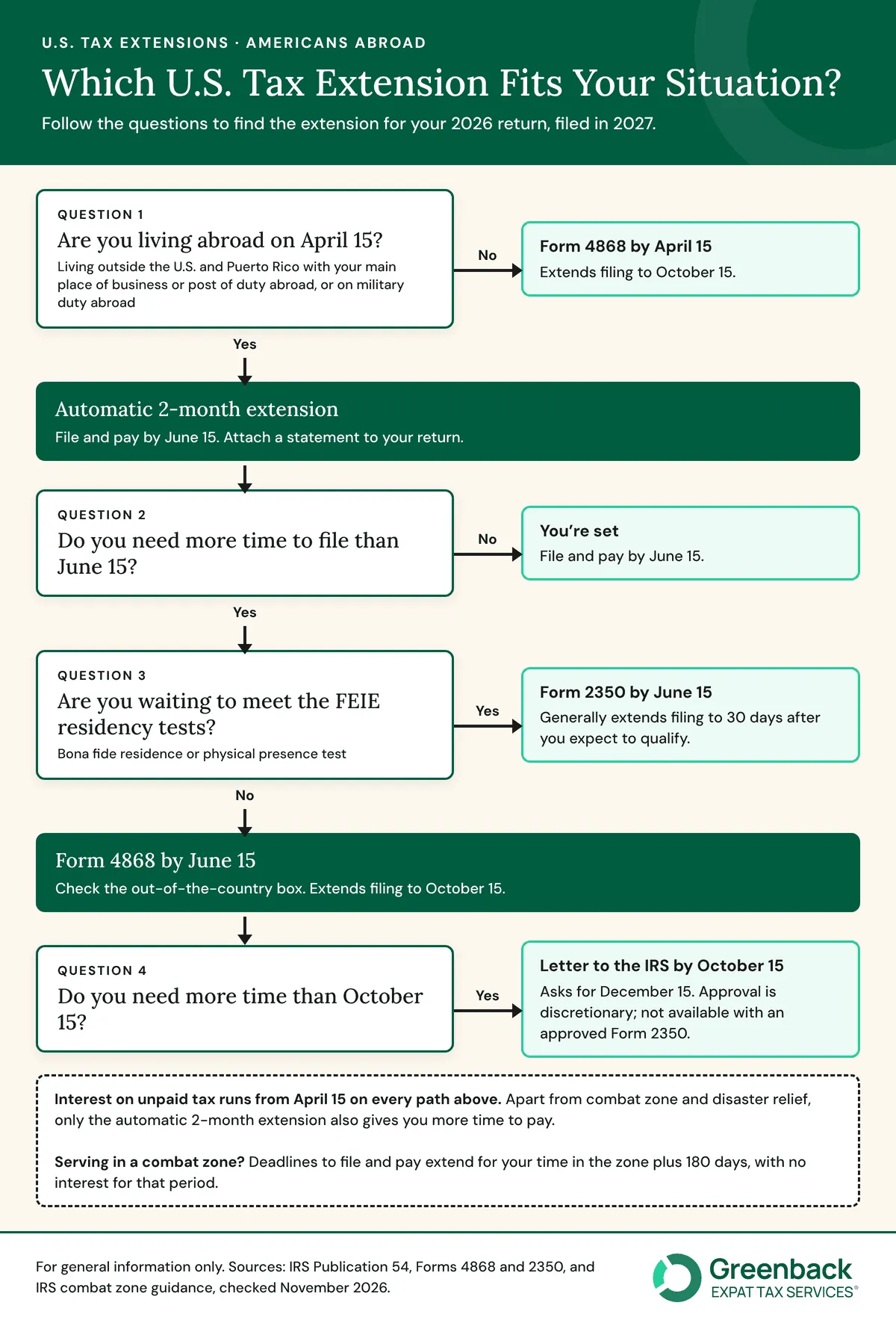
A U.S. tax extension for expats is automatic: you get two extra months, to June 15, 2027, to file and pay your 2026 return, with interest from April 15, 2027, on any tax you haven’t paid. You qualify if you’re a U.S. citizen or green card holder living outside the U.S. and Puerto Rico on April 15, with your main place of business or post of duty outside the U.S. and Puerto Rico as well. If you need more time to file, Form 4868 extends your filing deadline to October 15, 2027, but not your payment deadline. After that, you can ask the IRS by letter for a December 15 deadline if you’re abroad and already have the Form 4868 extension. If you’re still waiting to qualify for the Foreign Earned Income Exclusion, Form 2350 extends your filing deadline instead, generally to 30 days after you expect to qualify.
Some deadlines follow your extension and some don’t. Forms you attach to your return move with it, while the FBAR has its own automatic extension to October 15. States set their own extension rules, and some don’t accept the federal one. Every date sits in one place in our expat tax deadlines guide.
Already a Greenback client? Your federal extension is included at no extra cost. Just ask your accountant, and we’ll choose the right extension for your situation and file it for you. Already filed one yourself? We’ll prepare your return from there.

Your Extension, Included With Your Return
Do U.S. Expats Get an Automatic 2-Month Tax Extension?
Yes. If you live outside the U.S. and Puerto Rico on April 15 and your main place of business or post of duty is also outside them, you get an automatic 2-month extension to file and pay. The same applies if you’re on military duty outside the U.S. and Puerto Rico. Interest still runs from April 15 on any tax you haven’t paid. Paying what you can by April 15 keeps the interest smaller. The FAQ on interest during the June 15 extension shows how it adds up.
Who Qualifies for the Automatic Extension
The IRS tests your situation on the regular due date, April 15. You qualify if you’re a U.S. citizen or resident alien (including a green card holder) and, on that date, you meet one of these:
- Living abroad: you live overseas, outside the U.S. and Puerto Rico, and your main place of business or post of duty is outside them too.
- Military duty abroad: you’re in military or naval service on duty outside the U.S. and Puerto Rico.
Attach a Statement to Your Return
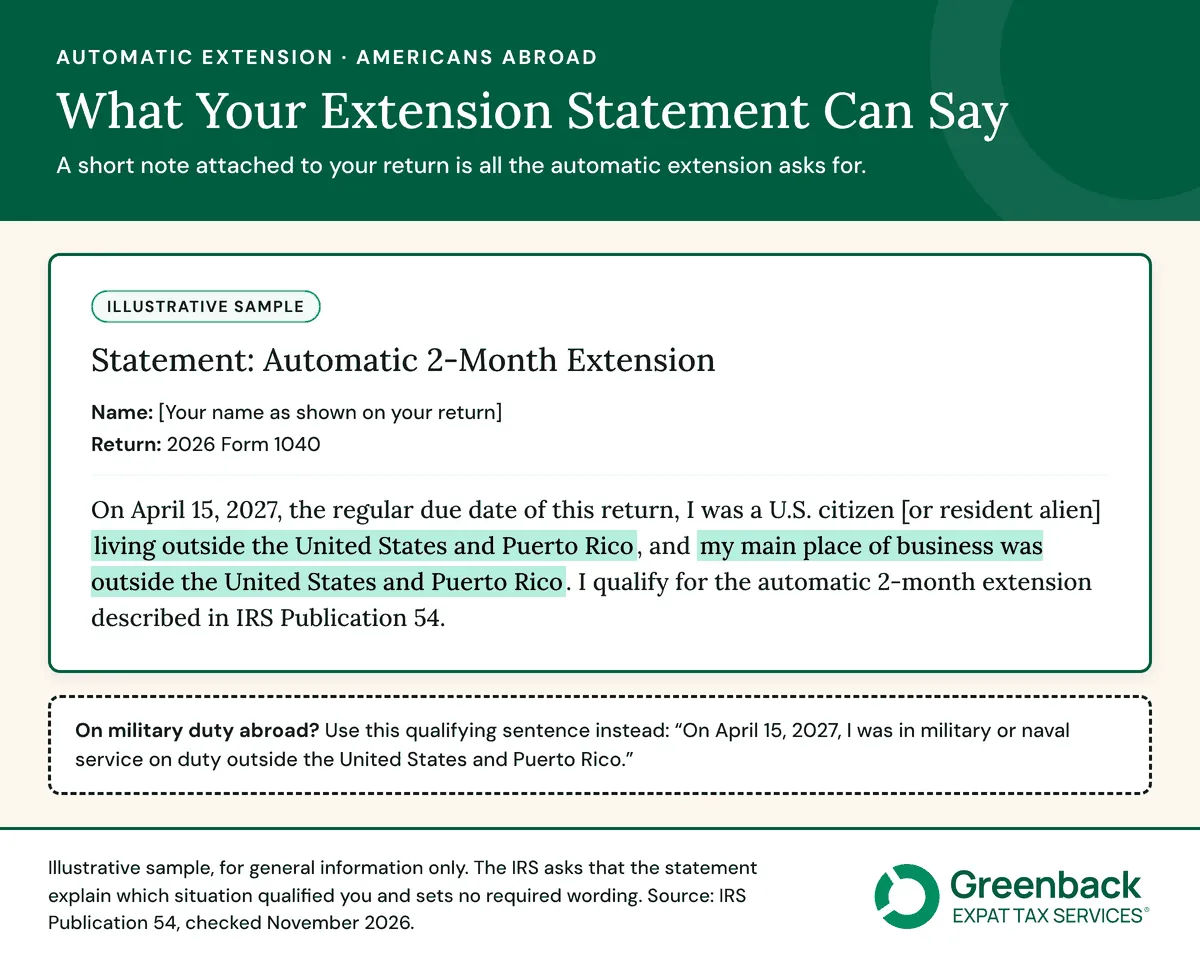
You don’t file a form to get the 2-month extension, but you do attach a statement to your return explaining which situation qualified you. It can be short: a sentence saying you lived and had your main place of business outside the U.S. and Puerto Rico on April 15, or were on military duty abroad.
Joint and Separate Returns Work Differently
On a joint return, either spouse can qualify for both of you. If you file separately, the extension applies only to the spouse who qualifies. That matters for couples where one spouse lives abroad and the other lives in the U.S.
Do Expats Need to File an Extension?
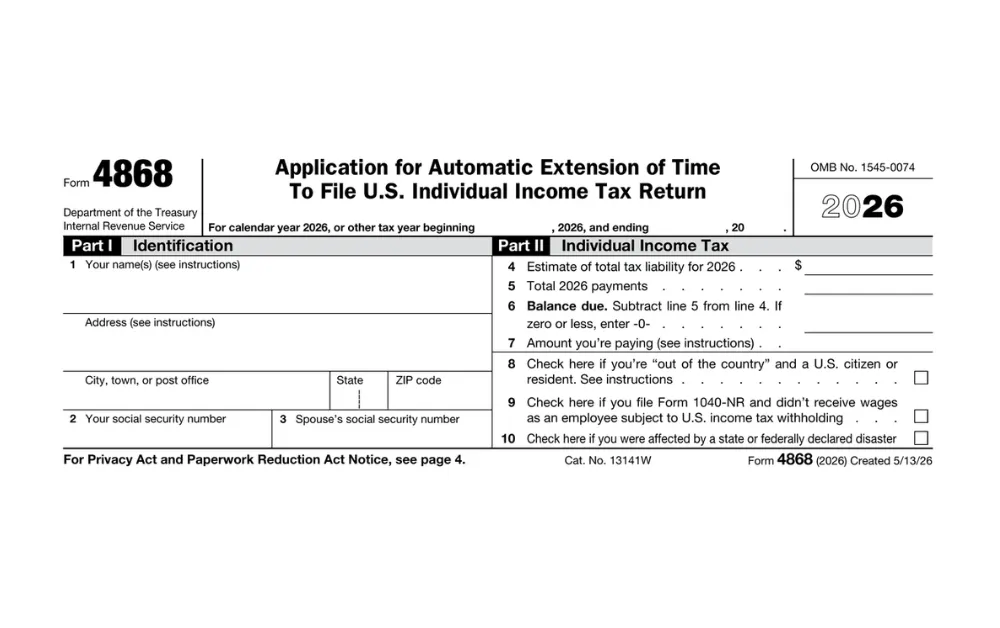
Not for the first two months, because the June 15 extension is automatic. To extend to October 15, file Form 4868 by June 15 and check the out-of-the-country box. Interest on unpaid tax still runs from April 15. If you’re waiting to meet the residency tests for the Foreign Earned Income Exclusion, use Form 2350 instead.
Ways to Request an Extension
You can request an extension online, by payment, or by mail:
- E-file Form 4868 through tax software or IRS Free File, which has no income limit for extension requests.
- Pay electronically and mark the payment as an extension payment. No separate form is needed. IRS Direct Pay requires a U.S. bank routing number, so expats without a U.S. account may need an alternative method, as outlined in our guide to paying the IRS from abroad.
- Mail a paper Form 4868 to the address for filers abroad, listed on our IRS mailing addresses page.
For a step-by-step version of each method, see how to file a tax extension.
Which Tax Extensions Give You More Time to Pay?
Apart from combat zone and disaster relief, only the automatic 2-month extension for expats works as a tax payment extension, to June 15, and interest still runs from April 15. Form 4868, the December 15 letter, and Form 2350 extend only the time to file; unpaid tax accrues interest and may incur late-payment penalties.
| Extension | Extends filing to | Extends payment? | Late-payment penalty starts |
|---|---|---|---|
| Automatic 2-month (living abroad) | June 15, 2027 | Yes, to June 15, 2027 (interest from April 15) | June 15, 2027 |
| Form 4868 | October 15, 2027 | No | June 15, 2027 if you qualify for the automatic extension; April 15 if you don’t |
| December 15 letter | December 15, 2027 | No | June 15, 2027 for qualifying expats |
| Form 2350 | Generally 30 days after you expect to qualify for the FEIE | No | June 15, 2027 if you qualify for the automatic extension; April 15 if you don’t |
What This Looks Like for an Expat Who Needs Until October
Say you live in Germany and expect to owe tax on your 2026 return, but your German tax statement won’t arrive until summer. By June 15, 2027, you file Form 4868 with the out-of-the-country box checked and pay a reasonable estimate of your balance. Interest runs on that balance from April 15, 2027, to the day you pay, and no late-payment penalty applies because you paid by June 15. You then file the return by October 15.
If your estimate falls short, interest accrues on the difference from April 15, 2027, and a late-payment penalty may apply from June 15 unless you pay at least 90% of your total tax by then and pay the rest with your return. An estimate that isn’t reasonable can void the extension. In the Karp ruling, a $0 estimate held up on its specific facts, which may not match yours.
Can You Get More Time After October 15?
Yes. If you’re abroad and already have the Form 4868 extension, you can ask the IRS by letter, sent by October 15, for an extension to December 15, 2027. Approval is discretionary, and the IRS writes back only to deny. It extends filing only and isn’t available with an approved Form 2350 extension.
How the December 15 Letter Works
Your letter explains why you need the extra two months. There’s no IRS form for it. What to include and where to send it are set out in another tax extension after October 15.
If You’re Still Waiting to Meet the FEIE Tests
If the reason you need time is that you haven’t yet met the Physical Presence Test or Bona Fide Residence Test, Form 2350 may give you a later date than December 15. It generally extends your deadline to 30 days after the date you expect to qualify. You file it by June 15 if you qualify for the automatic extension (April 15 otherwise), and if you then can’t meet a test, you file as soon as possible to limit interest.
How Do Extensions Work for Military Service and Combat Zones?
The military tax extension starts with the same automatic 2-month extension other expats get for members on duty outside the U.S. and Puerto Rico. Combat zone service extends the deadlines further: for your time in the zone plus 180 days for filing and paying. Spouses are generally covered. Contractors qualify only when serving in support of the U.S. Armed Forces.
Combat Zones and Contingency Operations
The combat zone extension adds the days remaining before the deadline when your service began, on top of the 180 days, and no interest or penalties are charged for the extension period. The same relief covers service in a contingency operation and qualifying service in direct support of a combat zone. The IRS combat zone deadline guidance lists the deadlines it covers, which include filing and paying income tax. For contractors overseas, how your income is taxed depends on your role; start with whether military contractors pay U.S. taxes and how combat zone workers can use the FEIE.
Federally Declared Disasters
The IRS can postpone tax deadlines for taxpayers in federally declared disaster areas. Relief is announced area by area on the IRS tax relief in disaster situations page, so check it if a disaster affected you.
Which Deadlines Don’t Move With Your Extension?
Forms you file with your tax return are extended to the same due date, including Form 8938 and Form 5471. The FBAR, Form 3520-A, and estimated tax payments keep their own deadlines. Form 3520 is due no later than October 15 if your return is extended.
| Filing | Usual due date | When you extend your return |
|---|---|---|
| FBAR (FinCEN Form 114) | April 15 | Automatic extension to October 15, no request needed; the December 15 letter doesn’t extend it |
| Form 8938, Form 5471, Form 8865, Form 8621 | With your return | Due with your return, including extensions |
| Form 3520 | April 15 (June 15 if you live abroad and attach a statement; interest on any tax due still runs from April 15) | No later than October 15 if your income tax return is extended |
| Form 3520-A | March 15 for a calendar-year trust | Not tied to your return; extended separately with Form 7004 |
| Form 709 | April 15 | Filing Form 4868 or Form 2350 for your income tax return also extends Form 709; it doesn’t extend the time to pay gift tax |
| Estimated tax payments | Form 1040-ES schedule | Keep their own dates; a filing extension doesn’t move them |
Because the FBAR extension is automatic, there’s nothing to request; the FAQ on the automatic FBAR extension covers the details.
How Do State Tax Extensions Work When You Live Abroad?
A state tax extension is separate from your federal one, and the rules differ by state. Some states automatically extend; some accept your federal extension; and New York requires its own form. California, New York, and Virginia give extra time if you’re abroad. If you still file a state return from abroad, check that state’s rule before its deadline.
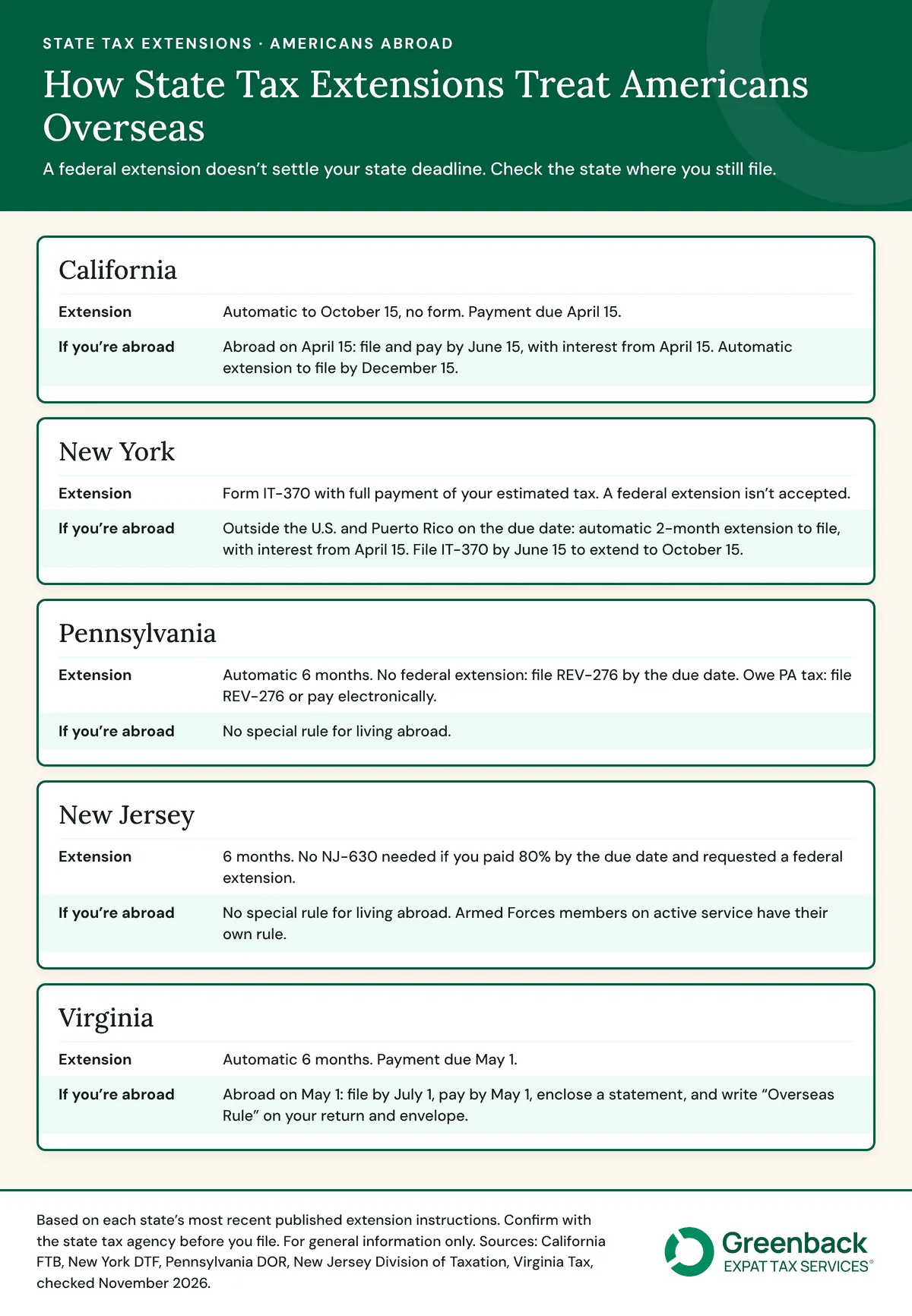
These rules come from each state’s most recent published extension instructions, checked in November 2026:
- California: extends the filing deadline automatically to October 15 with no form, but payment is due April 15. Living or traveling outside the U.S. on April 15 gives you until June 15 to file and pay, with interest from April 15, and an automatic extension to file by December 15.
- New York: doesn’t accept a federal extension. You file Form IT-370 by the due date with full payment of your properly estimated tax. Outside the U.S. and Puerto Rico, you get an automatic 2-month extension to file, with interest from April 15 on unpaid tax, and filing IT-370 by June 15 extends your deadline to October 15.
- Pennsylvania: automatically gives 6 months if you have a federal extension. Without one, you file Form REV-276 by the original due date; if you owe Pennsylvania tax, you file REV-276 or pay electronically by that date. There’s no separate rule for living abroad.
- New Jersey: gives 6 months. You don’t need Form NJ-630 if you’ve paid at least 80% of your tax by the original due date and requested a federal extension; otherwise, you file NJ-630 with your payment. Its only separate rule covers Armed Forces members on active service.
- Virginia: extends filing automatically for six months. Living or traveling outside the U.S. or Puerto Rico on May 1 gives you until July 1 to file, but you still pay by May 1, enclose a statement, and write “Overseas Rule” on your return and envelope.
Whether you owe state tax at all depends on whether you’re still a resident, which state taxes for expats breaks down state by state. Greenback also prepares expat state tax returns alongside your federal return.
If Your State Has No Income Tax
If your last state was one of the states with no income tax, there’s no state return to extend.
Frequently Asked Questions about Expat Tax Extensions
No, the IRS doesn’t charge for a federal tax extension. IRS Free File costs nothing, though some paid tax software charges for it. A tax extension doesn’t cancel any tax you owe, so interest runs on unpaid tax from April 15.
Yes, you can e-file Form 4868 from abroad through IRS Free File or tax software. If you owe tax and don’t have a U.S. bank account, the IRS accepts payment by credit card or by international wire from a foreign bank that works with a U.S. bank.
If you file after your extended deadline and owe tax, the failure-to-file penalty is 5% of the unpaid tax per month, up to 25%, with a minimum after 60 days. If you owe nothing, the penalty is zero. However, late information returns, such as Form 8938 or Form 5471, carry their own penalties, so file as soon as you can.
Yes, green card holders are generally resident aliens for U.S. tax purposes, so the automatic 2-month extension applies to them on the same terms as U.S. citizens.
An Extension Gives You Time to File, and Only Sometimes Time to Pay
Most expats get two extra months to file and pay without asking, and Form 4868 adds four more months to file. The other options cover special cases: waiting to qualify for the Foreign Earned Income Exclusion, needing past October 15, or serving in a combat zone.
- If you’re a U.S. citizen living abroad, Greenback prepares your federal return and files your federal extension when you need one. Learn more about how we help U.S. citizens living abroad.
- If you’re a late filer, Greenback helps you catch up on missed returns without judgment. Learn more about how we help late filers.
- If you’re a digital nomad, Greenback keeps your filing on track wherever you work. Learn more about how we help digital nomads.
- If you’re a corporate expat, Greenback helps you file correctly while you’re on assignment abroad. Learn more about how we help corporate expats.

One Team for Your Extension and Your Return
This article is for informational purposes only and does not constitute tax, legal, or financial advice. Extension rules, deadlines, and state requirements can change, and the right extension depends on your circumstances. Greenback Expat Tax Services, with expertise in U.S. taxes for Americans at home and abroad, recommends consulting a qualified tax professional about your specific situation.


Featured In


