Net Investment Income Tax (NIIT): The 3.8% Rule and Who Pays It

- What Is the Net Investment Income Tax?
- Who Pays the 3.8% Net Investment Income Tax?
- What Are the NIIT Threshold Amounts?
- How Is the NIIT Calculated?
- Why Does the Foreign Earned Income Exclusion Push Me Over the Threshold?
- What Counts as Net Investment Income?
- Which Investment Expenses Reduce Net Investment Income?
- Can I Use the Foreign Tax Credit to Offset the Net Investment Income Tax?
- How Do I Reduce or Avoid the Net Investment Income Tax?
- How Does the Net Investment Income Tax Apply When I Sell Property Abroad?
- Does My Child's Investment Income Count Toward Mine?
- How Does the Tax Work If I File Jointly With a Nonresident Spouse?
- Are Foreign Pensions, RRSPs and HSAs Subject to the Net Investment Income Tax?
- How Are Estates and Trusts Taxed on Net Investment Income?
- Where Does the NIIT Go on Schedule 2, Line 12 or Line 21?
- Frequently Asked Questions
- Most of the Risk Here Sits in One Number

The Net Investment Income Tax is a 3.8% federal tax on investment income, and it applies to U.S. citizens and residents whose modified adjusted gross income tops $200,000 filing single or head of household, $250,000 filing jointly, or $125,000 filing separately. The 3.8% applies to the lesser of two amounts: your net investment income for the year, or the amount by which your MAGI exceeds your threshold.
A single filer who is $10,000 over the threshold and receives $60,000 in dividends is taxed on the $10,000, which comes to $380. The thresholds are set by Section 1411 of the Internal Revenue Code, are not indexed for inflation, and have not changed since the tax took effect on January 1, 2013. The Net Investment Income Tax is calculated on Form 8960 and reported on Schedule 2, line 12, of Form 1040.
You are likely to meet this tax if any of the following describes your year:
- Investment income on top of a good salary: Interest, dividends, capital gains, rents, or royalties in a year when your total income clears the threshold.
- A property or investment sale: A single large gain can carry you past a threshold your ordinary income never reaches.
- Foreign salary you excluded from taxable income: Income excluded with the Foreign Earned Income Exclusion is added back when MAGI is measured for this tax.
- A married-filing-separately return: The threshold halves to $125,000, which catches filers who chose that status for an unrelated reason.
The sections below provide the thresholds, the calculation with the numbers filled in, what you can deduct, and the practical steps to keep the charge small.
What Is the Net Investment Income Tax?
The Net Investment Income Tax, or NIIT, is a 3.8% tax imposed by Section 1411 on the net investment income of individuals, estates, and trusts whose income passes a statutory threshold. The NIIT rate is a flat 3.8% and has not changed since the tax began. The tax took effect on January 1, 2013, and the rules governing it were finalized in regulations published in December 2013.
How It Differs From Regular Income Tax
The NIIT is charged on top of income tax and calculated on its own form, so it never appears as a change to your bracket. A long-term capital gain taxed at 20% can carry the 3.8% as well, for a combined federal rate of 23.8% on that gain.
Section 1411 sits in a chapter titled Unearned Income Medicare Contribution, which is why the NIIT is sometimes called a Medicare surtax.
The Three Terms That Decide Your Answer
- Net investment income: Investment income such as interest, dividends, capital gains, rents, and royalties, reduced by the deductions properly allocable to that income.
- Modified adjusted gross income: Your adjusted gross income increased by foreign earned income excluded under Section 911(a)(1), adjusted for the deductions and exclusions that the exclusion disallowed.
- Threshold amount: The fixed dollar figure for your filing status, above which the tax can apply.
Who Pays the 3.8% Net Investment Income Tax?
You pay the 3.8% tax if you have net investment income and your modified adjusted gross income exceeds the threshold for your filing status. The tax applies to U.S. citizenship and residence rather than to your address, so a citizen in Lisbon is covered on the same terms as one in Ohio.
Both Conditions Must Be Met
Either one alone produces nothing. A $700,000 salary with no investments has no net investment income to tax; $50,000 in dividends, with no other income, never reaches the threshold. The tax lives only in the overlap.
| Who it applies to | How it applies |
|---|---|
| U.S. citizens, wherever they live | In full, on worldwide net investment income above the threshold |
| Green card holders and other U.S. tax residents | In full, on the same terms |
| Dual-status individuals | Only for the U.S.-resident part of the year, and the threshold is not prorated. Our comparison of Form 1040 and Form 1040-NR covers which return to file |
| Dual-resident individuals claiming treaty benefits as a nonresident | Treated as a nonresident alien, so not subject |
| Nonresident aliens | Not subject. Investment income falls under the FDAP income rules where they apply |
| Estates and trusts | On undistributed net investment income, against their own threshold |
A Medicare Exemption Does Not Carry Over
The IRS states that an individual exempt from Medicare taxes may still owe the NIIT if net investment income and MAGI exceed the threshold. That matters for Americans abroad covered by a totalization agreement, who often assume the two travel together.
What Are the NIIT Threshold Amounts?
The Net Investment Income Tax thresholds are $250,000 for married filing jointly and a qualifying surviving spouse, $200,000 for single and head of household, and $125,000 for married filing separately. The IRS states they are not indexed for inflation, so they never move, and more filers reach them each year with no change in the law.
Thresholds by Filing Status
| Filing status | Threshold, 2025 tax year | Threshold, 2026 tax year |
|---|---|---|
| Married filing jointly | $250,000 | $250,000 |
| Qualifying surviving spouse | $250,000 | $250,000 |
| Single | $200,000 | $200,000 |
| Head of household | $200,000 | $200,000 |
| Married filing separately | $125,000 | $125,000 |
Two Single Filers Get $150,000 More Room
There is no marriage bonus here. Two single filers each get $200,000, for a total of $400,000 between them. The same two people filing jointly get $250,000. Filing jointly lowers the combined threshold by $150,000.
How Is the NIIT Calculated?
The Net Investment Income Tax is 3.8% of the smaller of two figures: your net investment income for the year, or the amount by which your modified adjusted gross income exceeds your threshold. You work out both numbers, take the lower one, and multiply it by 3.8%. Where MAGI sits below your threshold, nothing is owed on this basis at all.
The Five-Step Calculation
- Total your net investment income. Interest, dividends, capital gains, rents, royalties, non-qualified annuity income, and passive business income, reduced by the deductions properly allocable to that income.
- Calculate your modified adjusted gross income. Start from adjusted gross income and add back foreign earned income excluded under Section 911(a)(1), net of the deductions and exclusions the exclusion disallowed.
- Subtract your threshold from your MAGI. If the result is zero or less, the tax does not apply, and no Form 8960 is required.
- Compare that excess against your net investment income. Take whichever is smaller. This is the step that decides the size of the bill.
- Multiply by 3.8%. That is your NIIT for the year.
The Same $60,000 of Dividends, Two Different Bills
Quick example
Two single filers each hold $60,000 of dividends. On a $150,000 salary, MAGI is $210,000, the excess is $10,000, and the tax is $380. On a $400,000 salary, MAGI is $460,000; the excess of $260,000 is bigger than the dividends, so all $60,000 is taxed, and the bill is $2,280.
Close to the threshold, the comparison protects you. Well past it, it stops mattering, and the NIIT reaches every dollar of net investment income you hold.
Why Does the Foreign Earned Income Exclusion Push Me Over the Threshold?
The Foreign Earned Income Exclusion removes foreign salary from your taxable income, but not from the MAGI test for the Net Investment Income Tax. Excluded foreign earned income is added straight back when modified adjusted gross income is measured, so a filer who excludes the full amount can face the 3.8% on investment income even though the salary itself was never taxed.
How the Add-Back Works
The IRS defines the add-back by reference to Section 911(a)(1), net of the deductions and exclusions that Section 911(d)(6) disallowed. The threshold comparison, therefore, runs on a figure that includes income you were never taxed on.
This is the most common way Americans abroad meet the NIIT unexpectedly, and general guides omit it. The maximum Foreign Earned Income Exclusion is $130,000 per qualifying person for the 2025 tax year and $132,900 for 2026, claimed on Form 2555. Excluding the full amount consumes most of a $200,000 single threshold before a single dividend is counted.
The Add-Back on a Full $132,900 Exclusion
Quick example
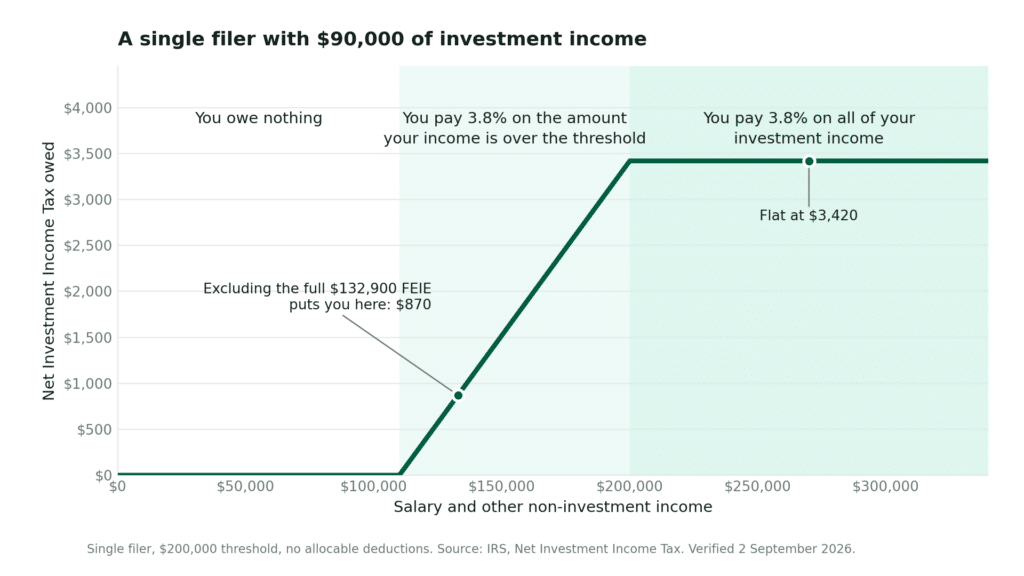
A single filer abroad excludes $132,900 of foreign salary in 2026 and holds $90,000 of foreign dividends and interest. Her adjusted gross income is $90,000, but her MAGI is $222,900 once the excluded salary is added back, which is $22,900 over the threshold. The lower of the two figures is $22,900, so she pays about $870. On the full $90,000, it would have been $3,420. Her regular income tax on that $90,000 is not small either, because the Form 2555 instructions require tax on non-excluded income to be figured “using the tax rates that would have applied had you not claimed the exclusions.”
Extra Adjustments for CFC and PFIC Holders
Holding a controlled foreign corporation or a passive foreign investment company can add further adjustments to adjusted gross income before MAGI is measured, under the final regulations at Section 1.1411-10(e). Work that case through with an accountant. Dropping the exclusion does not avoid the add-back, for reasons covered under reducing the tax below.
What Counts as Net Investment Income?
Net investment income is income from capital rather than from work: interest, dividends, capital gains, rental and royalty income, non-qualified annuities, and income from a business that is a passive activity to you or that trades in financial instruments or commodities.
Income In and Out at a Glance
| Included in net investment income | Excluded from net investment income |
|---|---|
| Interest and dividends, from U.S. or foreign sources | Wages, salary and other compensation |
| Capital gains on securities, fund distributions, investment real estate including a second home, foreign property, and partnership or S corporation interests you held passively | Self-employment income and operating income from a nonpassive business |
| Rental and royalty income, net of allocable deductions | Distributions from 401(a), 403(a), 403(b), 408, 408A and 457(b) plans |
| Non-qualified annuity income | Social Security benefits, unemployment compensation and alimony |
| Passive business income, and businesses trading financial instruments or commodities | Tax-exempt interest and Alaska Permanent Fund Dividends |
| PFIC amounts, depending on the election in place | Gain excluded from gross income for regular tax purposes |
Gains on foreign assets are measured in U.S. dollars, which can result in a taxable gain on an asset that broke even in the local currency. Our guide to earned and unearned income covers the classification.
Three Cases That Behave Differently Than They Look
- Rental income is usually included, with two exceptions: Rental activity counts as passive whether or not you materially participate. Real estate professional status, with the participation test in the Form 8960 instructions, moves it out. So does self-rental, where you rent to a business in which you materially participate.
- Foreign mutual funds depend on your election: The same fund gives a different answer under the default PFIC rules than under a qualified electing fund election. Reporting runs through Form 8621.
- Self-employment income is out, but only the part already taxed as such: Passive income from a business you do not run stays in.
Which Investment Expenses Reduce Net Investment Income?
Net investment income is a net figure, so gross investment income is reduced by the deductions properly allocable to it. This is the part of the calculation filers most often skip, and it lowers the number the 3.8% applies to before any threshold comparison happens.
Deductions Properly Allocable to Investment Income
| Deduction | Typical allocation point |
|---|---|
| Investment interest expense | Interest on money borrowed to buy or hold investment assets |
| Investment advisory and brokerage fees | Fees charged on the portfolio producing the income |
| Expenses related to rental and royalty income | Repairs, management, insurance and depreciation on the let property |
| Tax preparation fees | The portion attributable to the investment schedules |
| State, local and foreign income taxes | The portion allocable to investment income, not to salary |
| Fiduciary expenses | For an estate or trust only |
The Allocation Rule
Only the portion properly allocable to investment income counts, determined under a reasonable method, so tax on your salary and fees on a non-investment matter never reach Form 8960. Realized capital losses also reduce gains in the calculation, so loss harvesting directly lowers net investment income.
The savings are real. Every $10,000 of allocable deductions removes $10,000 from the figure the 3.8% is applied to, which is $380 off the bill, wherever your MAGI excess is the larger number.
Can I Use the Foreign Tax Credit to Offset the Net Investment Income Tax?
The Foreign Tax Credit cannot offset the Net Investment Income Tax. The Foreign Tax Credit reduces only regular U.S. income tax because the credits under Sections 27(a) and 901(a) are allowed against tax imposed by chapter 1 of the tax code, and the Net Investment Income Tax is imposed in chapter 2A.
Why the Credit Cannot Reach This Tax
The rule is broader than the Foreign Tax Credit alone: any credit usable against a subtitle A liability may be applied here, while a credit allowed only against chapter 1 tax may not. The IRS puts the foreign tax credit and the Section 38 general business credit in that second group, stating those credits “may not be used to reduce your NIIT liability.”
So your Form 1116 credit can reduce regular income tax on a foreign dividend to nothing, and the 3.8% still applies on top. Unused credits carried forward do not help either.
What the August 2026 Federal Circuit Ruling Changed
Two taxpayers argued that a tax treaty promised broader relief than the code permitted, and both prevailed before the Court of Federal Claims. In August 2026, the Federal Circuit reversed both, in Christensen under the France treaty and Estate of Bruyea under the Canada treaty, holding that a treaty credit carries the same limitations as the code’s.

Two things bound the ruling.
- The Federal Circuit hears appeals from the Court of Federal Claims, where both suits were brought, so it controls that route; a refund suit filed in a U.S. district court is appealed to a regional circuit that has not ruled.
- Rehearing and Supreme Court review were still open when this page was written. If you have a protective refund claim on file, leave it in place and talk to your accountant.
The Deduction Route and Its All-or-Nothing Election
The credit is blocked. The same foreign tax taken as a deduction still affects the calculation because taxes properly allocable to investment income are deducted on Form 8960.
The catch is that the choice is all-or-nothing for the year. IRS Publication 514 states that if you take a credit for any qualified foreign taxes in a year, “you must take the credit for all qualified foreign taxes paid or accrued in that year,” and the reverse applies if you deduct. You can switch between years, but not split within a year. Because the deduction only shrinks the base of a 3.8% charge while the credit reduces regular tax dollar for dollar, it helps only where nearly all your foreign tax relates to investment income and your regular U.S. tax is already small.

How Do I Reduce or Avoid the Net Investment Income Tax?
The Net Investment Income Tax is measured on one year’s figures against a fixed threshold, so the levers are the year income lands in, the size of your net investment income, and which threshold you are tested against. None is guaranteed to remove the charge, but each generally helps.
Levers That Change the Year and the Amount
- Spread disposals across tax years: Two gains in two years each get a fresh threshold. Watch what else lands alongside a sale, since a bonus or an equity vest raises MAGI and the excess with it.
- Draw on qualified retirement accounts in a high-gain year: Distributions from 401(k), 403(b), 457(b), IRA, and Roth accounts are excluded from net investment income, so spending from those sources does not enlarge the base.
- Harvest losses and claim every allocable deduction: Both cut net investment income before the comparison runs.
- Check the rental exceptions: Real estate professional status and self-rental can move rental income out altogether.
- Hold tax-exempt bonds where they fit your plan: Municipal bond interest sits outside net investment income and outside MAGI.
- Check the separate-filing threshold: Filing separately halves it to $125,000, so a status chosen for another reason can raise this tax.
Why Dropping the FEIE Does Not Help Here
Switching from the exclusion to the Foreign Tax Credit sounds like it should work, but it does not. Drop the exclusion, and the salary is no longer added back, but it lands in adjusted gross income instead, so your MAGI barely moves, and the threshold comparison comes out the same. The switch changes your regular income tax and your credit position, not this charge.
Revoking FEIE carries a lasting cost. The Form 2555 instructions state that if you revoke your choice to claim the exclusion, “you can’t claim the exclusion(s) for your next 5 tax years without the approval of the IRS.” So the switch gives up the exclusion for five years without reducing this tax. Before making this switch, have the MAGI figure calculated both ways.
How Does the Net Investment Income Tax Apply When I Sell Property Abroad?
The Net Investment Income Tax applies only to the taxable part of a property gain. Gain excluded from gross income for regular income tax purposes sits outside net investment income entirely, so the primary residence exclusion of $250,000 filing single or $500,000 filing jointly comes off first and does the largest piece of the work.
Section 121 Does the First and Largest Piece
The Section 121 primary residence exclusion applies to a main home anywhere in the world. Whatever taxable gain remains after it is net investment income, tested against your threshold with everything else that year, which makes timing the strongest lever on a sale.
What Reaches the 3.8% After the Exclusion
On a $600,000 gain, a married couple excludes $500,000 under Section 121, and only the remaining $100,000 is net investment income. That $100,000 then joins their other investment income and is tested against the $250,000 joint threshold like anything else. For a couple who are also excluding foreign salary, the add-back is usually what carries them over the line, not the gain itself.
Our guide to foreign capital gains tax covers the currency conversion and basis rules that decide how large the gain is. The sale itself is reported on Form 8949. If you are giving up citizenship or a long-held green card, gains treated as recognized under the U.S. exit tax rules are treated as capital gains and can carry the 3.8% tax as well.
Does My Child’s Investment Income Count Toward Mine?
A child’s investment income counts toward yours when you choose to report it on your own return. Where a parent elects to report a child’s interest, dividends, and capital gain distributions on their own Form 1040 using Form 8814, the IRS confirms those amounts are included in the parent’s net investment income.
What Form 8814 Pulls Onto Your Return
The election that simplifies your child’s filing therefore enlarges your own figure, which is the trade-off Form 8814 always carries.
What Stays Out
Income excluded from your Form 1040 because of the threshold amounts on Form 8814 is not part of your net investment income, and Alaska Permanent Fund Dividends are excluded regardless of how they are reported. If your MAGI sits just above your threshold, the election is worth running both ways, since reporting a child’s income separately keeps it out of your net investment income entirely.
How Does the Tax Work If I File Jointly With a Nonresident Spouse?
Filing jointly with a nonresident spouse is governed by its own election for this tax. A nonresident alien married to a U.S. citizen or resident can elect under Section 6013(g) or 6013(h) to be treated as a resident so the couple can file jointly, and the final regulations provide a corresponding election for the Net Investment Income Tax.
The Election Is Made Twice, Not Once
Because nonresident aliens are not subject to this tax, the income tax election does not automatically pull the spouse into it. The IRS states these couples get special rules and their own 6013(g) or 6013(h) election here, so the treatment is decided separately from the joint-filing choice. Our guide to filing jointly when your foreign spouse has no SSN or ITIN covers the income tax mechanics.
What to Weigh Before Electing
| Consideration | Why it matters here |
|---|---|
| The joint threshold is $250,000, not $400,000 | Filing jointly can lower the combined threshold two single filers would have had |
| The nonresident spouse’s investment income | An election can bring foreign investment income into the U.S. net investment income figure |
| The alternative statuses | Married filing separately carries a $125,000 threshold, and head of household may be available in some situations |
Are Foreign Pensions, RRSPs and HSAs Subject to the Net Investment Income Tax?
Foreign pensions, RRSPs, and HSAs fall outside the retirement-distribution exclusion because that exclusion is a closed list of U.S. plan types. The Net Investment Income Tax rules exclude distributions from plans described in Sections 401(a), 403(a), 403(b), 408, 408A, and 457(b), and a foreign plan is none of those.
The Exclusion List Is a Closed List of U.S. Plans
A Canadian RRSP, a UK pension, and an Australian superannuation fund all sit outside those six sections, so the easy answer available for a 401(k) is not available for a foreign plan.
Plan by Plan
| Plan type | Position on this tax |
|---|---|
| U.S. 401(k), 403(b), 457(b), IRA, Roth IRA | Distributions excluded from net investment income |
| Foreign pension | No blanket exclusion. Depends on the character of the payment and the treaty article |
| Canadian RRSP or RRIF | Outside the closed list. The U.S.-Canada treaty pension article is where the analysis starts |
| Health savings account | Not on the closed list. Earnings inside the account and the character of the distribution both matter |

Falling outside the exclusion list does not mean a distribution is automatically caught, because pension payments are frequently not one of the categories the definition names. This is an unsettled corner where a single rule would mislead you. Our guide to whether a foreign pension is taxable in the U.S. covers the reporting side, and a foreign plan distribution with MAGI near a threshold is worth a conversation before you file.
How Are Estates and Trusts Taxed on Net Investment Income?
An estate or trust pays the Net Investment Income Tax on its undistributed net investment income, against its own threshold rather than the individual’s. That threshold is the point at which the highest trust and estate tax bracket begins, and, unlike the individual thresholds, it is reset for inflation each year.
The Threshold for Estates and Trusts
The figure is set each autumn in a revenue procedure, and for the 2026 tax year, it is $16,000. Both conditions have to hold: undistributed net investment income, and adjusted gross income above that figure. The tax is calculated on Form 8960 and reported on Form 1041.
Six Categories Sit Outside the Tax:
- Tax-exempt trusts: Trusts exempt from income tax under subtitle A, including charitable trusts and qualified retirement plan trusts exempt under Section 501, and charitable remainder trusts exempt under Section 664.
- Charitable-purpose trusts and estates: Where all unexpired interests serve the purposes in Section 170(c)(2)(B).
- Grantor trusts: Those under Sections 671 to 679, where the income is taxed to the grantor instead.
- Entities that are not trusts for federal tax purposes: Real estate investment trusts and common trust funds, for example.
- Electing Alaska Native Settlement Trusts: Named as an exclusion in their own right.
- Perpetual care trusts: Cemetery trusts.
Qualified funeral trusts, charitable remainder trusts, and electing small business trusts each carry their own computational rules in the final regulations.
The grantor trust point matters for Americans abroad, because many foreign structures are grantor trusts for U.S. purposes. The income does not escape the tax; it is tested on the grantor’s own return. Our guide to reporting a foreign trust covers the filing side.
Where Does the NIIT Go on Schedule 2, Line 12 or Line 21?
The Net Investment Income Tax is reported on line 12 of Schedule 2 (Form 1040), where the line reads “Net investment income tax. Attach Form 8960.” Line 21 is the separate total-other-taxes line that adds line 12 to the rest of Part II and carries the combined figure to your Form 1040.
Line 12 Reports It, Line 21 Totals It
Both numbers appear in the same section of your Schedule 2, which is why they get mixed up in search results. Line 12 is the one that carries this tax; line 21 is a subtotal that includes it alongside self-employment tax and the Additional Medicare Tax.
| Schedule 2, Part II line | What it reports |
|---|---|
| Line 4 | Self-employment tax, with Schedule SE attached |
| Line 11 | Additional Medicare Tax, with Form 8959 attached |
| Line 12 | Net investment income tax, with Form 8960 attached |
| Line 21 | Total other taxes, carried to Form 1040 |
Two Medicare Charges, Never on the Same Dollar
The 0.9% Additional Medicare Tax applies to wages and self-employment income, and never to income included in net investment income. You can be subject to both in the same year, but never on the same dollar, so seeing both on one Schedule 2 is normal.
This tax also falls under the estimated tax provisions, so it is settled through quarterly estimated payments or withholding rather than left to the filing date. Nothing requires withholding it from wages, though you may request additional withholding to cover it. Our Form 8960 walkthrough covers the form line by line.
Frequently Asked Questions
The tax applies to the income your investments produce, not only to sales. Interest, dividends, fund distributions, and rental income all count, so a year with no transactions can still carry the charge once MAGI clears the threshold. Check the interest and dividend lines on your return before assuming the figure is an error.
The IRS defines the add-back by reference to Section 911(a)(1), the foreign earned income exclusion. The foreign housing exclusion sits in Section 911(a)(2) and is not named in that definition. Because both are claimed on the same form and the amounts interact, confirm this with your accountant on your own figures rather than applying it as a rule.
Not on this basis. If MAGI does not exceed your threshold, the excess is zero, and so is the tax; there is nothing to report on Form 8960. Keep the calculation on file anyway, because a late bonus, a fund distribution, or a year-end sale can move MAGI after you thought the answer was settled.
Most of the Risk Here Sits in One Number
Three figures decide what you pay: where your MAGI lands once excluded foreign salary is added back, how much net investment income you hold after allocable deductions, and which of those two numbers is smaller.
Greenback’s U.S. accountants and Enrolled Agents work with Americans in 218 countries, and the interaction among the exclusion, the Foreign Tax Credit, and this surtax is routine for them. If your year includes a property sale, a large gain, a distribution from a foreign plan, a nonresident spouse, or investment income alongside excluded foreign salary, have someone model both routes before you file.
Have the arithmetic checked before you file.
This article is for general information and is not tax, legal, or accounting advice. Tax rules change, and their application depends on your own facts. The August 2026 Federal Circuit decisions in Christensen and Estate of Bruyea remain open to rehearing and Supreme Court review, and the treatment of treaty-based credits against this tax may change. Please speak with a qualified tax professional with expertise in U.S. expat tax before acting on anything here.


Featured In