U.S.-Spain Tax Treaty: How It Prevents Double Tax for Americans

- U.S.-Spain Tax Treaty at a Glance
- How the Saving Clause Works in the U.S.-Spain Tax Treaty
- Which Country Taxes Your Income First Under the U.S.-Spain Tax Treaty?
- How Double Taxation Relief Works Between Spain and the U.S.
- How Spain Credits U.S. Tax on Social Security Under the Treaty
- What the U.S.-Spain Tax Treaty Does Not Cover
- Green Card Holders, Spanish Spouses and Dual Citizens Under the Treaty
- Do Americans in Spain Need Form 8833?
- Frequently Asked Questions About the U.S.-Spain Tax Treaty
- How Greenback Helps Americans Use the U.S.-Spain Tax Treaty

The U.S.-Spain tax treaty sets out which country taxes each type of income first, and requires the other country to give a credit for that tax. It was signed in 1990 and last updated by a Protocol that has been in force since 27 November 2019. You still file a U.S. return every year, because the treaty lets the U.S. keep taxing its citizens, but on most income, you end up paying the higher of the two countries’ tax once the credit is applied. Spain taxes first on 401(k) withdrawals and U.S. interest, for example, and the U.S. taxes first on Social Security and U.S. dividends. Visas, housing and healthcare for Americans are in our living in Spain hub.
U.S.-Spain Tax Treaty at a Glance
| Question | Answer |
|---|---|
| Does Spain have a tax treaty with the U.S.? | Yes, an income tax treaty from 1990, updated by a Protocol that has been in force since 27 November 2019. |
| Does the treaty excuse Americans in Spain from U.S. filing? | No. U.S. citizens file every year, regardless of what the treaty says about a type of income. |
| Which country taxes my 401(k) withdrawals? | Spain taxes them first. The U.S. taxes them, too, and credits the Spanish tax. |
| Who gives the credit on U.S. Social Security? | Spain credits the U.S. tax on your benefit. |
| What does the treaty not cover? | U.S. state tax, Spanish wealth tax, and Social Security contributions. |
How the Saving Clause Works in the U.S.-Spain Tax Treaty
The saving clause, Article 1(3), lets the U.S. tax its citizens “as if the Convention had not come into effect,” so Americans in Spain still file a U.S. return every year. So when a treaty article says income is “taxable only” in Spain, it still goes on your Form 1040. The treaty changes how much U.S. tax you pay on it.
A few articles override the saving clause for every American, and the one that matters is Article 24, which sets the credit rules explained below. The articles on equal treatment (25) and on settling disputes (26) also still apply to you. Most of the other exceptions, such as those for government pay and students, protect only people who are neither U.S. citizens nor green card holders. Our saving clause explainer and our guide to U.S. tax treaties cover how the clause works across treaties.
Which Country Taxes Your Income First Under the U.S.-Spain Tax Treaty?
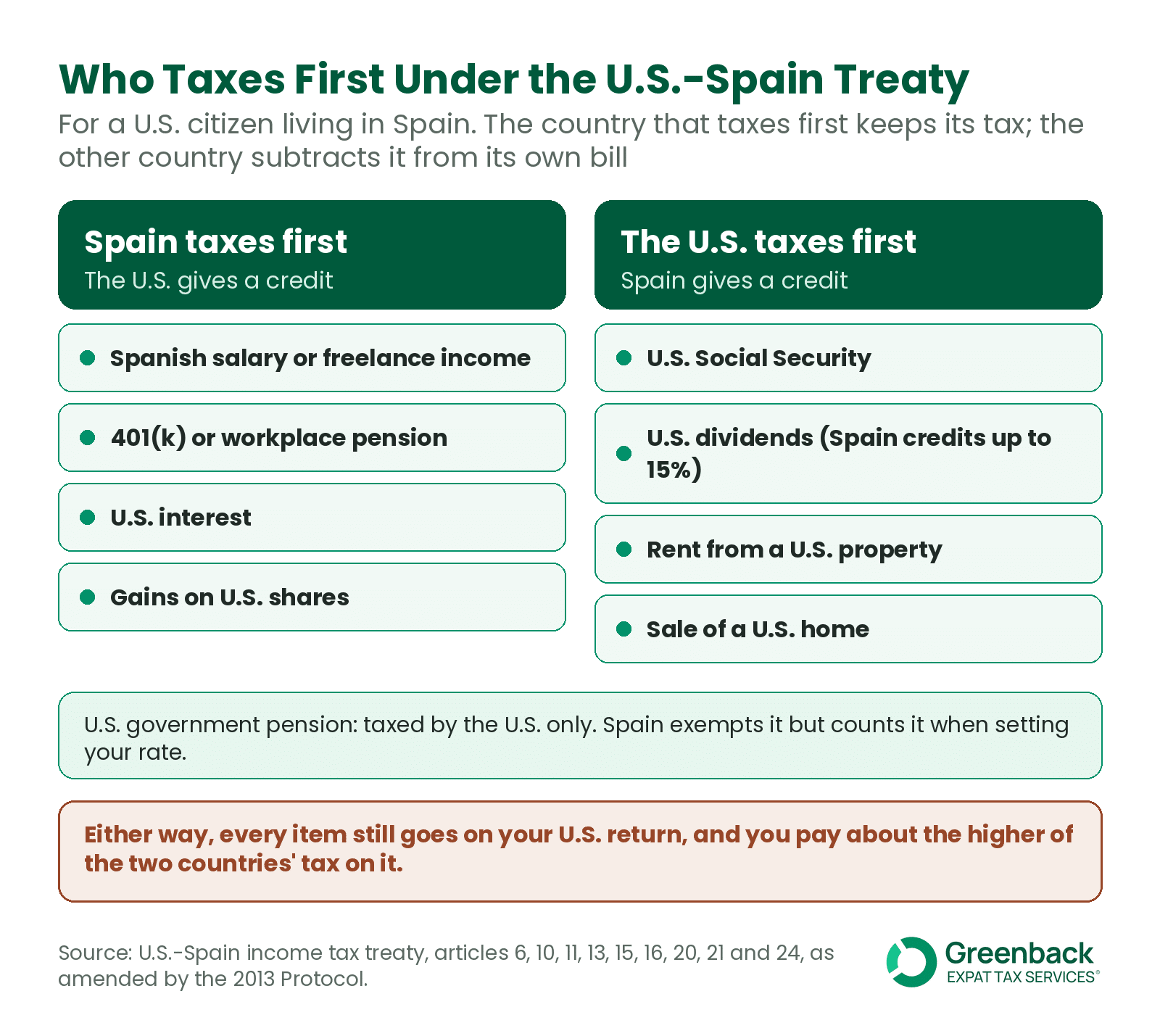
For each type of income, the treaty names the country that taxes first, and the other country then subtracts that tax from its own bill. That is usually the country from which the income comes. For pensions, interest, and most gains, the treaty grants Spain exclusive rights.
| Income | Taxed first by | Credit given by | Article |
|---|---|---|---|
| Spanish salary or freelance income | Spain | U.S. | 15, 16 |
| 401(k) or workplace pension | Spain | U.S. | 20(1)(a) |
| U.S. interest | Spain | U.S. | 11 |
| Gains on U.S. shares | Spain | U.S. | 13(6) |
| U.S. Social Security | U.S. | Spain | 20(1)(b) |
| U.S. dividends | U.S. (Spain credits at most 15%) | Spain | 10 |
| Rent from a U.S. property | U.S. | Spain | 6 |
| Sale of a U.S. home | U.S. | Spain | 13(1) |
| U.S. government pension | U.S. only | Spain exempts it but counts it when setting your rate on other income (Spanish nationals: see dual citizens below) | 21 |
Taxed first means the country that the treaty lets tax that income. As a U.S. citizen, you still report every row to the IRS, and the credit column shows which country it applies to, then subtracts the other country’s tax.
The treaty does not name IRAs. Article 20(1)(a) covers pensions paid “in consideration of past employment,” which fits a 401(k) or workplace plan, so an IRA withdrawal, especially one funded by your own contributions, is worth confirming before you rely on that row. How pensions fit a retirement budget is set out in our guide to retiring in Spain, and the Spanish side of a sale is in our guide to capital gains tax in Spain.
How Double Taxation Relief Works Between Spain and the U.S.
Article 24 sets the order. On U.S. income, Spain credits the U.S. tax first, up to a limit, and the U.S. then credits the remaining Spanish tax. Step by step:
- Spanish income, such as a salary: Spain taxes it, and the U.S. allows an ordinary Foreign Tax Credit or the Foreign Earned Income Exclusion.
- U.S. income, the Spanish credit: Spain credits the U.S. tax you paid, but only up to what the U.S. could charge someone who is not a U.S. citizen, and never more than the Spanish tax on that income. On dividends, the limit is 15%. For interest and 401(k) withdrawals, it is 0% because the treaty gives the U.S. no right to tax a non-citizen on them.
- U.S. income, the U.S. credit: the U.S. then treats the income as if it came from Spain, a rule called re-sourcing (Article 24(3)), so it can credit the remaining Spanish tax against your U.S. tax.
Whatever the credit, your U.S. tax never falls below what a non-citizen would pay on the same income.
The Agencia Tributaria says the same on its side in its guidance for residents with U.S. income: U.S. tax you pay only because you are a citizen is not eligible for a Spanish deduction.
On the U.S. return, the credit is claimed on Form 1116.
Re-sourcing applies only to citizens; green card holders are covered separately below.
Example: An American in Madrid With a Salary and U.S. Investments
An American in Madrid earns a Spanish salary and receives $10,000 of U.S. qualified dividends and $10,000 of U.S. interest in the same year. Spain taxes the $20,000 of investment income on its savings scale, about $4,065 in total at 0.886 euros to the dollar, or about $2,032 on each. The U.S. figures assume the 15% rate on qualified dividends and the 22% bracket on interest.
| Income | Taxed first by | Tax paid to Spain | Tax paid to the U.S. | Total |
|---|---|---|---|---|
| Spanish salary | Spain | The Spanish income tax on it | Usually $0, because the Foreign Tax Credit or the exclusion covers it | The Spanish tax |
| $10,000 of U.S. dividends | U.S. | About $532, after a $1,500 credit | $1,500 | About $2,032 |
| $10,000 of U.S. interest | Spain | About $2,032 | About $168, after a $2,032 credit | About $2,200 |
Each time, the total is the higher of the two countries’ tax on that income.
How Spain Credits U.S. Tax on Social Security Under the Treaty
Article 20(1)(b) lets the U.S. tax your Social Security, and Spain taxes it too as your country of residence, so Spain gives the credit. Spain’s credit is the lowest of the three figures:
- the U.S. tax you paid on the benefit;
- 25.5% of the benefit, the U.S. tax a nonresident alien pays, because the U.S. taxes 85% of a nonresident’s benefit at 30% (IRS Publication 915), and Spain is not on its exempt list;
- The Spanish tax on the benefit.
For many retirees, the U.S. tax paid is the lowest of the three, so Spain credits it in full. Keep your Form SSA-1099 and your U.S. return with your Spanish Renta return as proof of the U.S. tax. For how much of the benefit the IRS taxes in the first place, see our guide to retiring in Spain, and the wider picture in our guide to Social Security taxes overseas.
What the U.S.-Spain Tax Treaty Does Not Cover
The treaty names only the U.S. federal income tax and two Spanish taxes: the IRPF, Spain’s personal income tax, and the corporation tax (Article 2).
| Tax | What applies instead |
|---|---|
| U.S. state and local income tax | Your state’s own rules, covered in our guide to state taxes for expats |
| Spanish wealth tax | Spanish rules only, with no treaty relief |
| Social Security contributions | The separate totalization agreement, in force since 1 April 1988 |
Green Card Holders, Spanish Spouses and Dual Citizens Under the Treaty
Most of the treaty works the same way for every American in Spain, but green card holders, Spanish spouses, and dual citizens get different results. The Spanish residency tests that decide who counts as resident in Spain, including the 183-day rule, are set out in our guide to the Spanish tax system.
Green Card Holders and the Treaty Tie-Breaker
A 1990 Protocol rule treats a green card holder as a U.S. resident for treaty purposes only with a substantial presence in the U.S., or if the Article 4 tie-breaker (permanent home, then center of vital interests, then habitual abode, then nationality) points to the U.S. If the treaty makes you a resident of Spain and you claim it, you file Form 1040-NR as a nonresident, with Form 8833. After 8 or more of the last 15 years with a green card, that claim can be treated as leaving the U.S. under the exit tax rules.
If you keep filing Form 1040 as a U.S. resident instead, the U.S. taxes your 401(k) or pension under its own law, Spain gives no credit because the treaty gives the U.S. no right to tax it, and the U.S. cannot credit the Spanish tax on U.S. income, so it can be taxed twice. Our guide for green card holders abroad covers the wider rules.
Spanish Spouses and U.S. Treaty Withholding Rates
A spouse who lives in Spain and is not a U.S. person qualifies for the treaty’s lower U.S. withholding rates by providing the U.S. bank or broker with Form W-8BEN.
| U.S. income | Treaty rate for a Spanish resident |
|---|---|
| Dividends | 15% (5% for a company owning at least 10%) |
| Interest | 0% |
| Royalties | 0% |
If you elect to file a joint U.S. return by treating your spouse as a U.S. resident, your spouse is taxed on worldwide income like you, and these rates generally no longer apply.
Dual U.S.-Spanish Citizens
The saving clause still applies, because you are a U.S. citizen. A U.S. government pension paid to a Spanish national living in Spain is taxable only in Spain under Article 21(2)(b). The U.S. still taxes it by citizenship, sources it under Article 24(3), and credits the Spanish tax. Our guide to taxes for dual citizens covers the rest.
Do Americans in Spain Need Form 8833?
Most Americans in Spain never need Form 8833 because Treasury Regulation 301.6114-1(c) waives it for the positions individuals typically hold. The form discloses a return position based on a treaty, and the penalty for omitting it when required is $1,000.
| Treaty position | Form 8833 needed? |
|---|---|
| A green card holder claiming Spanish residence under the tie-breaker | Yes, always, with Form 1040-NR |
| Business profits claimed exempt because you have no U.S. permanent establishment (a fixed place of business) | Yes, in most cases |
| Reduced withholding on dividends, interest or royalties | No |
| Wages, pensions, annuities or Social Security | No |
| Income re-sourced under Article 24 | No |
| Other positions totaling $10,000 or less in a year | No |
The IRS explains the form on its Form 8833 page, and our Form 8833 guide walks through it. The treaty text and both Protocols are on the IRS Spain tax treaty documents page.
Frequently Asked Questions About the U.S.-Spain Tax Treaty
No. Spain is not on the IRS list of countries with a U.S. estate and gift tax treaty, and the income tax treaty does not cover estate, gift, or inheritance tax. Each country applies its own law to an estate, which our guide to estate planning abroad covers.
No. The Agencia Tributaria’s published position is that taxpayers under the Beckham Law are not residents of Spain for treaty purposes, so the regime and the treaty do not combine.
Yes. Under Article 26 mutual agreement procedure, you can ask either tax authority to resolve a tax charge in a way the treaty does not allow, as long as you present the case within five years of the first notice of that tax. Since the 2013 Protocol took effect in 2019, a case that the two authorities have not resolved within two years can go to binding arbitration.
How Greenback Helps Americans Use the U.S.-Spain Tax Treaty
Greenback’s accountants handle the U.S. side of the treaty for Americans living in Spain. We apply the credit order, re-source income under Article 24(3), and claim the Spanish tax on Form 1116, and we review the tie-breaker position for green card holders before anything is filed. Where a position needs Form 8833, we prepare it with your return. For everything beyond tax, from visas to healthcare, start with our living in Spain guide.

Know Which Country Credits Each Part of Your Income
This article is for informational purposes only and does not constitute tax or legal advice. Treaty positions depend on your citizenship, residence and the type of income, and the example uses simplified figures. Speak with a qualified professional about your situation.




Featured In