U.S. Expat Tax Deductions and Credits: What You Can Claim Abroad

- What Tax Breaks Can U.S. Citizens Living Abroad Claim?
- What Is the Difference Between a Tax Credit and a Tax Deduction?
- How Do Americans Abroad Reduce U.S. Tax on Foreign Income?
- How Does Claiming the FEIE Change Your Other Tax Benefits?
- Which Tax Deductions Can Americans Abroad Take?
- Which Tax Credits Can Americans Abroad Claim?
- What Can Self-Employed Expats Deduct?
- Frequently Asked Questions about U.S. Expat Tax Deductions and Credits
- Which Benefits You Keep Depends on How You Handle Your Foreign Income


U.S. expat tax deductions and credits are the same deductions and credits Americans at home claim, and most of them still apply when you live abroad. You can still claim the standard deduction, child and education credits, and retirement and business deductions. For 2026 tax returns, filed in 2027, the standard deduction is $16,100 for single filers and $32,200 for married couples filing jointly. Americans abroad also have two benefits of their own. The Foreign Earned Income Exclusion (FEIE) excludes up to $132,900 of foreign earned income. The Foreign Tax Credit offsets your U.S. tax with foreign income tax you’ve paid. You can use both on a single return, but not for the same income.
Most U.S. tax deductions for expats work the same way abroad as at home, but claiming the FEIE limits a few benefits: you aren’t eligible for the additional child tax credit or the earned income credit, and excluded pay doesn’t count as compensation for IRA contributions.
The biggest factor is whether you exclude your foreign income or credit the foreign tax on it. This guide provides each benefit’s 2026 amount, how tax on foreign income is reduced, what the FEIE limits are, and the rules for families, students, retirees, and the self-employed, along with the rest of your U.S. expat taxes.

Every Credit Depends on the Rest of Your Return.
What Tax Breaks Can U.S. Citizens Living Abroad Claim?
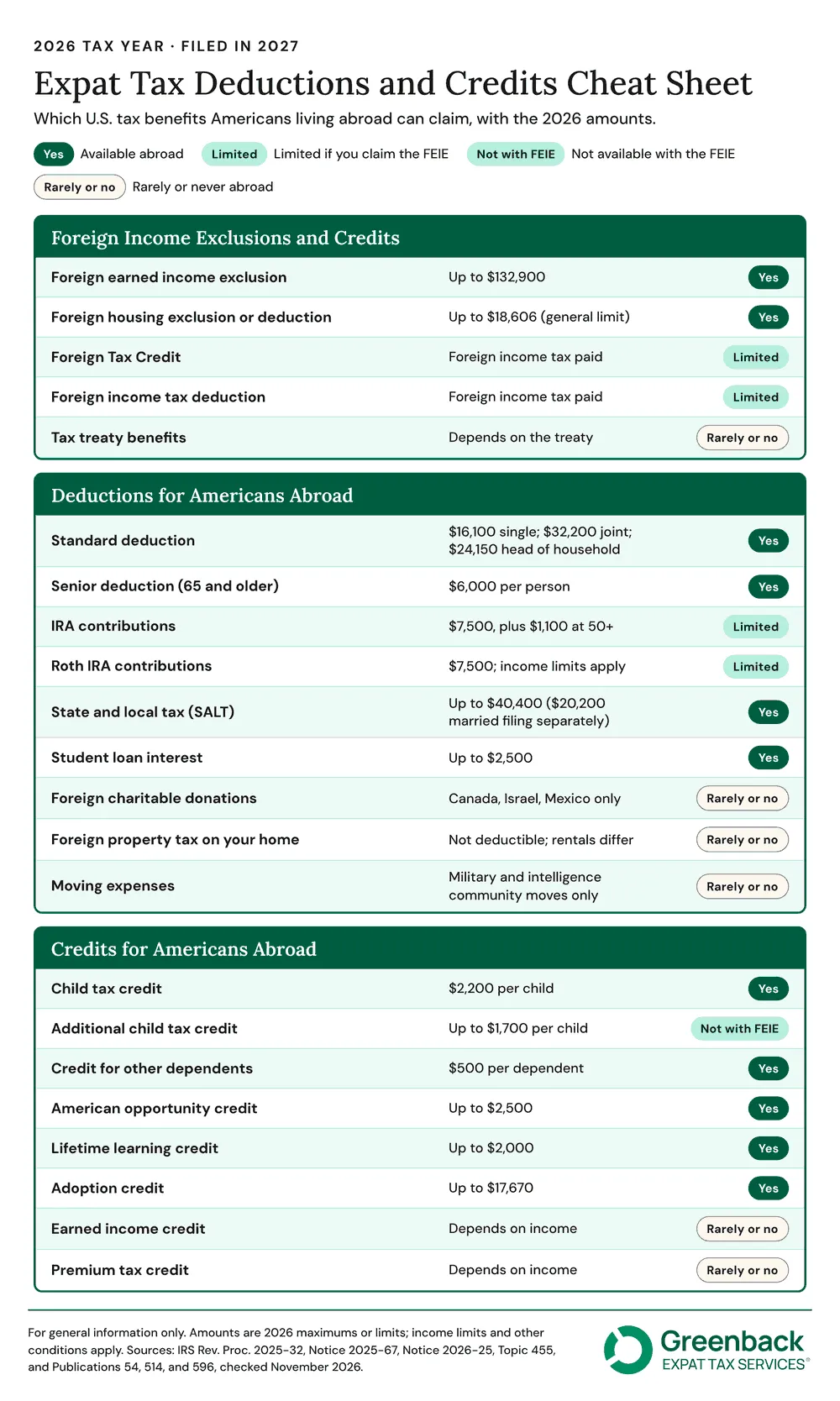
U.S. citizens living abroad can claim most of the same tax deductions, credits, and tax relief as people living in the U.S. Foreign income adds its own layer: the FEIE and housing exclusion, the Foreign Tax Credit or deduction, and tax treaties. The three tables give each benefit’s 2026 amount and what claiming the FEIE does to it.
1. Exclusions and Credits for Foreign Income
| Benefit (type) | 2026 amount | Abroad, and if you claim the FEIE | Guide |
|---|---|---|---|
| Foreign earned income exclusion (exclusion) | Up to $132,900 per qualifying person | Requires the Physical Presence or Bona Fide Residence Test; claimed on Form 2555 | FEIE guide |
| Foreign housing (exclusion or deduction) | Up to $18,606 at the general limit; higher in listed cities | Exclusion for employees, deduction for the self-employed; only costs above the $21,264 base count | Foreign housing exclusion |
| Foreign Tax Credit (credit) | Foreign income tax paid, up to the U.S. tax on that income | Not for tax on excluded income; unused credit carries back 1 year and forward up to 10 years | Form 1116 |
| Foreign income tax deduction (itemized deduction) | Foreign income tax paid | Taken instead of the credit, for all foreign taxes that year; not for tax on excluded income | FTC guide |
| Tax treaty benefits (treaty) | Depends on the treaty | The savings clause means treaties rarely reduce a citizen’s U.S. income tax | U.S. tax treaties |
2. Deductions You Can Take Abroad
| Benefit (type) | 2026 amount | Abroad, and if you claim the FEIE | Guide |
|---|---|---|---|
| Standard deduction (deduction) | $16,100 single; $32,200 married filing jointly; $24,150 head of household | Applies wherever you live | Standard deduction |
| Senior deduction (deduction) | $6,000 per person age 65 and older | Requires an SSN and a joint return if married; excluded income counts toward the income limit | Schedule 1-A |
| IRA contributions (deduction) | $7,500, plus $1,100 at age 50 and older | Needs compensation you don’t exclude | IRAs for expats |
| Roth IRA contributions (retirement contribution) | $7,500; phase-out from $153,000 ($242,000 joint) | Needs compensation you don’t exclude; excluded income counts toward the income limit | Backdoor Roth IRA |
| State and local tax (SALT) (itemized deduction) | Up to $40,400 ($20,200 married filing separately) | Excluded income counts toward the income limit | See the deductions section |
| Student loan interest (deduction) | Up to $2,500 | Excluded income counts toward the income limit | Education deductions |
| Foreign charitable donations (itemized deduction) | Generally not deductible | Exceptions under the Canada, Israel, and Mexico treaties | See the deductions section |
| Foreign property tax on your home (itemized deduction) | Not deductible | Rental property abroad: deductible against the rent | Foreign rental income |
| Moving expenses (deduction) | Active-duty Armed Forces and, for 2026 and later moves, the intelligence community | Same rule abroad; the move must be under orders or a required change of assignment | See the deductions section |
3. Credits You Can Claim Abroad
| Benefit (type) | 2026 amount | Abroad, and if you claim the FEIE | Guide |
|---|---|---|---|
| Child tax credit (credit) | $2,200 per child | Child needs an SSN; the nonrefundable credit stays with the FEIE; excluded income counts toward the income limit | Child tax credit for expats |
| Additional child tax credit (refundable credit) | Up to $1,700 per child | Not available if you file Form 2555, including for the housing exclusion alone | Form 8812 |
| Credit for other dependents (credit) | $500 per dependent | Works abroad | Credit for other dependents |
| American opportunity and lifetime learning credits (credits) | Up to $2,500 and $2,000 | Eligible foreign universities count; excluded income counts toward the income limit | Learning credits abroad |
| Adoption credit (credit) | Up to $17,670, with $5,120 refundable | Works abroad | Adoption tax credit |
| Earned income credit (refundable credit) | Depends on income and children | Generally no: it requires a U.S. main home, and Form 2555 filers aren’t eligible | EIC and foreign income |
| Premium tax credit (refundable credit) | Depends on income | Requires U.S. Marketplace coverage, so it rarely applies abroad | Form 8962 |
What Is the Difference Between a Tax Credit and a Tax Deduction?
A tax deduction lowers the income you’re taxed on, while a tax credit lowers the tax itself, dollar for dollar. That’s why a $1,000 credit is usually worth more than a $1,000 deduction. Expats also meet a third type, the exclusion, which removes income before deductions or credits apply. More examples are in our FAQ on tax credits vs. tax deductions for expats.
1. A Deduction Reduces Your Taxable Income
A deduction saves you tax at your top tax rate. If your income reaches the 22% bracket, a $1,000 deduction saves about $220. You take either the standard deduction or itemized deductions on Schedule A, plus above-the-line deductions such as IRA contributions and student loan interest.
2. A Credit Reduces Your Tax Dollar for Dollar
A $1,000 credit cuts your tax by $1,000, whatever your bracket. For the same reason, the Foreign Tax Credit usually saves more than deducting the same foreign tax: the credit offsets U.S. tax directly, and the deduction only lowers the income it’s figured on.
3. A Refundable Credit Can Be Paid to You
A nonrefundable credit can bring your tax down to zero but no further. A refundable credit can be paid to you as a refund even when you owe no tax. That matters abroad: if the FEIE already brings your U.S. tax to zero, the refundable portion of the American opportunity credit or the adoption credit can still put money back in your pocket. If you use the Foreign Tax Credit instead, the additional child tax credit can do the same.
4. An Exclusion Removes Income Before Either Applies
An exclusion keeps qualifying income entirely off your taxable income. The FEIE and the foreign housing exclusion work this way. Because excluded income is gone from your return, it can also take away eligibility for benefits that depend on earned income, as the FEIE section explains.
How Do Americans Abroad Reduce U.S. Tax on Foreign Income?
Americans abroad reduce U.S. tax on foreign income mainly through the FEIE and the Foreign Tax Credit, which together prevent most double taxation. Together, they’re the main forms of U.S. tax relief on foreign income. Tax treaties help less than people expect, and totalization agreements address Social Security taxes.
1. The FEIE and Housing Exclusion Remove Qualifying Income
If you meet the Physical Presence Test or the Bona Fide Residence Test, you can exclude up to $132,900 of foreign earned income for 2026, plus part of your housing costs. The FEIE and the housing exclusion are both claimed on Form 2555 and apply only to earned income, such as wages and self-employment income.
2. The Foreign Tax Credit or Deduction Offsets Foreign Tax
You can credit foreign income tax against your U.S. tax, or deduct it on Schedule A, and you choose one method for all foreign taxes each year. The credit also covers income the FEIE doesn’t, such as rent, dividends, and pensions. The two can share one return, as the FAQ on claiming both the FEIE and the Foreign Tax Credit shows, and our comparison of when the FEIE or the Foreign Tax Credit fits better runs the numbers.
3. Tax Treaties Rarely Reduce a Citizen’s U.S. Tax
Most U.S. tax treaties have a saving clause that keeps the U.S. right to tax its own citizens. As the IRS explains, that means a treaty generally won’t reduce a citizen’s U.S. income tax, except for specific exceptions such as certain pension and charitable donation articles. The common ones are listed in our FAQ on the saving clause.
4. Totalization Agreements Cover Social Security Only
A totalization agreement keeps you from paying Social Security tax to two countries on the same work. It applies only to Social Security and self-employment taxes. Our guide to totalization agreements lists the countries.
How Does Claiming the FEIE Change Your Other Tax Benefits?
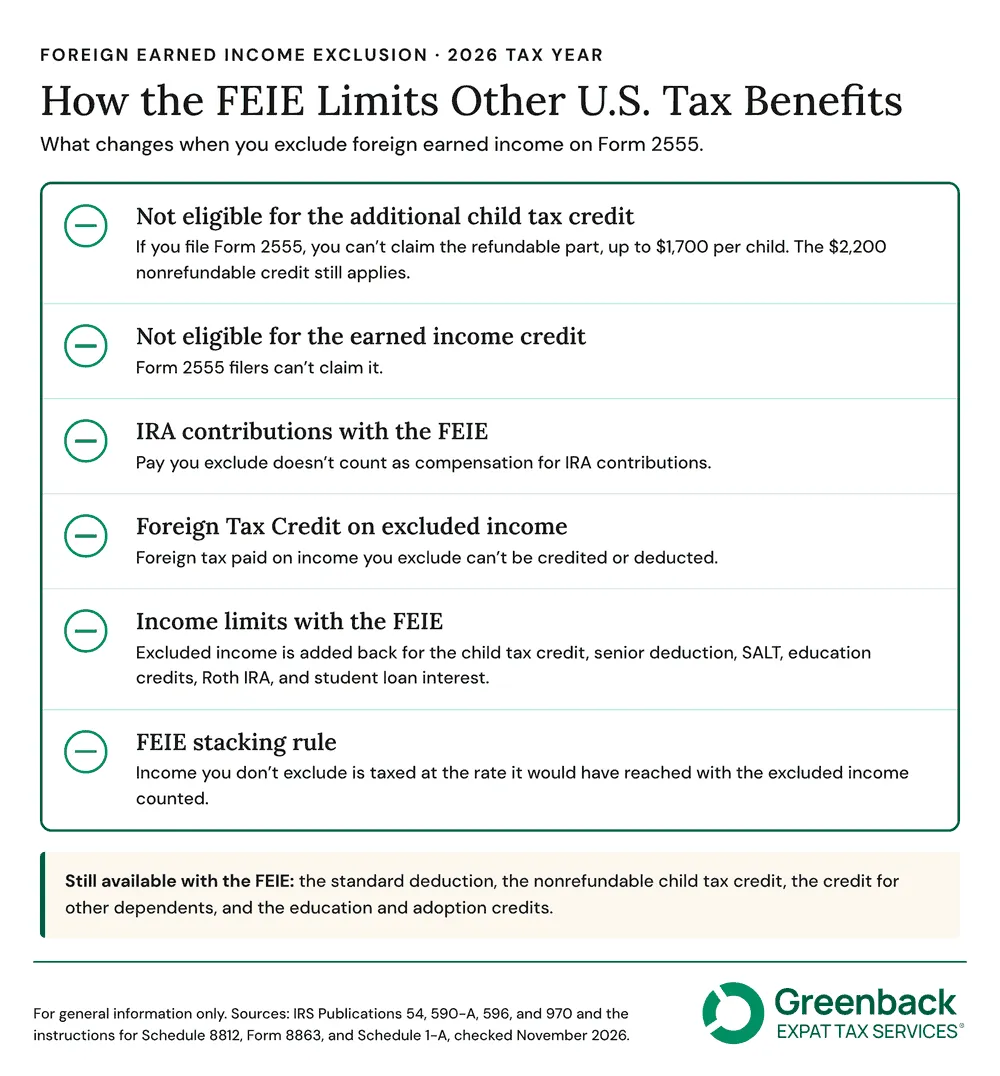
Claiming the FEIE removes income from your return, so a few benefits tied to that income are limited or no longer available. Form 2555 filers can’t claim the additional child tax credit or the earned income credit; excluded pay doesn’t count toward IRA contributions, and foreign tax on excluded income can’t be credited. Excluded income still counts toward several income limits, and your remaining income is taxed at a higher rate.
1. Form 2555 Filers Aren’t Eligible for the Additional Child Tax Credit or the EIC
If you file Form 2555 for any exclusion, including the housing exclusion alone, you can’t claim the additional child tax credit, the refundable part worth up to $1,700 per child. The nonrefundable child tax credit of $2,200 still applies against any U.S. tax you owe. Form 2555 filers also aren’t eligible for the earned income credit.
2. Excluded Pay Doesn’t Count Toward IRA Contributions
You can contribute to an IRA only up to your taxable compensation, and pay you exclude with the FEIE doesn’t count. If you exclude all your earnings and have no other compensation, you generally can’t contribute that year. Claiming the Foreign Tax Credit instead keeps your pay taxable, so it counts. For the details, see IRA contribution eligibility with the FEIE.
3. Foreign Tax on Excluded Income Can’t Be Credited
Foreign tax paid on income you exclude can’t be credited or deducted. If you earn above the FEIE limit, the foreign tax on the portion you don’t exclude can still be credited, which is how many expats use both on a single return.
4. Excluded Income Still Counts Toward Some Income Limits
Several benefits use modified adjusted gross income (MAGI), which adds your excluded income back, so the FEIE doesn’t help you qualify for them. They are the child tax credit, the senior deduction, the SALT deduction, the education credits, Roth IRA eligibility, and the student loan interest deduction. The deduction and credit sections give each limit.
5. Your Remaining Income Is Taxed at a Higher Rate
The IRS taxes income above the exclusion at the rate it would have reached if the excluded income were still counted. Take a single filer who earns $150,000 abroad and excludes $132,900. After the $16,100 standard deduction, $1,000 is left taxable. Without the FEIE stacking rule, that $1,000 would be taxed at 10%, for a total of $100. With it, the $1,000 falls in the 24% bracket, so the tax is $240. Our FAQ on the FEIE stacking rule walks through the IRS worksheet.
Which Tax Deductions Can Americans Abroad Take?
Americans abroad can take the standard deduction or itemize, plus above-the-line deductions such as IRA contributions and student loan interest. The main differences abroad are that foreign property tax on a personal home and most donations to foreign charities aren’t deductible, and some income limits count your excluded income.
1. The Standard Deduction Applies Wherever You Live
The 2026 standard deduction is $16,100 for single filers, $32,200 for married couples filing jointly, and $24,150 for heads of household. Living abroad doesn’t change it. You itemize on Schedule A of Form 1040 only when your itemized deductions are larger. The standard deduction and tax brackets guide covers each filing status.
2. Seniors Can Add the $6,000 Deduction
If you’re 65 or older, you can deduct an extra $6,000 per person, on top of the standard or itemized deduction. You need a valid SSN, and married couples must file jointly. The deduction phases out above $75,000 of MAGI ($150,000 for joint filers), with excluded foreign income added back. It’s claimed on Schedule 1-A, which also holds the new tips and overtime deductions that most expats can’t use.
3. Itemized Deductions Work Differently Abroad
Foreign real property tax on your own home isn’t deductible on Schedule A. Property tax on a rental property abroad is different: it’s a rental expense that reduces your rental income. Donations to foreign charities are generally not deductible, except under U.S. treaties with Canada, Israel, and Mexico, which allow some donations to qualifying charities in those countries within treaty limits.
Two other itemized deductions still matter for some expats. If you itemize and pay foreign income tax, you can deduct it on Schedule A instead of claiming the credit for it. If you still owe state taxes while living abroad, the SALT deduction is capped at $40,400 for 2026, reduced for MAGI above $505,000 but not below $10,000.
4. Student Loan Interest Is Still Deductible
You can deduct up to $2,500 of student loan interest without itemizing. For 2026, it phases out between $85,000 and $100,000 of MAGI ($175,000 to $205,000 joint), and excluded foreign income counts toward those limits. The guide to education tax deductions covers what qualifies.
5. Retirement Contribution Limits Are the Same Abroad
For 2026, you can contribute up to $7,500 to an IRA, plus $1,100 if you’re 50 or older. Roth IRA eligibility phases out between $153,000 and $168,000 of MAGI ($242,000 to $252,000 for joint filers). If you work for a U.S. employer, the 401(k) limit is $24,500, plus an $8,000 catch-up at age 50 ($11,250 at ages 60 to 63). For foreign pensions and contribution choices, see IRAs for expats; higher earners can consider a backdoor Roth IRA.
6. Moving Expenses Are Deductible Only for Military and Intelligence Community Moves
Moving expenses are deductible only for active-duty members of the Armed Forces and, starting with 2026 moves, employees and new appointees of the intelligence community. Most Americans who move abroad for a job or retirement can’t deduct their moving costs. Armed Forces members qualify when they move under military orders for a permanent change of station. Intelligence community employees qualify when a change of assignment requires them to relocate. Deductible costs include moving household goods and personal effects, storage, and travel and lodging for the move to the new home. Meals don’t qualify. You figure the deduction on Form 3903 and claim it on Schedule 1. Moving costs the government reimburses are excluded from your income, so you can’t also deduct them. The IRS explains the rules for each group.
Which Tax Credits Can Americans Abroad Claim?
Americans abroad can claim the child tax credit, the credit for other dependents, education credits, and the adoption credit, generally on the same terms as at home. Two credits rarely work abroad: the earned income credit and the premium tax credit.
1. The Child Tax Credit for Children Abroad Needs an SSN
The child tax credit is $2,200 per qualifying child under 17, and the child needs an SSN. On a joint return, at least one spouse also needs an SSN. The credit phases out above $200,000 of MAGI ($400,000 for joint filers), with excluded income added back. Children born abroad and the refundable part, figured on Form 8812, are covered in our guide to the child tax credit for expats.
2. Dependents Who Don’t Qualify Get the $500 Credit
A dependent who doesn’t qualify for the child tax credit may qualify for the $500 credit for other dependents. That includes children 17 and older and qualifying relatives, as explained in the credit for other dependents guide.
3. Education Credits Cover Eligible Foreign Universities
The American Opportunity Credit (up to $2,500, 40% refundable) and the Lifetime Learning Credit (up to $2,000) can be applied to tuition at a foreign university if the school is eligible for U.S. federal student aid. Both use MAGI with excluded income added back, and both phase out between $80,000 and $90,000 ($160,000 to $180,000 for joint filers). For more, read about learning credits while studying abroad and U.S. taxes for children studying abroad.
4. The Adoption Credit Has a Refundable Part
For 2026, the adoption credit covers up to $17,670 in qualified adoption expenses per child, with up to $5,120 refundable. Foreign adoptions qualify too, with timing rules covered in our guide to the adoption tax credit for U.S. expats.
5. The EIC and Premium Tax Credit Rarely Apply Abroad
The earned income credit generally requires having a main home in the U.S. for more than half the year, and filers of Form 2555 aren’t eligible. Our article on whether foreign income qualifies for the earned income credit covers the rules. The premium tax credit applies only to coverage bought through the U.S. Health Insurance Marketplace, so it rarely applies to someone living abroad, as our FAQ on Form 8962 for expats explains.
What Can Self-Employed Expats Deduct?
Self-employed expats deduct ordinary business expenses, half of their self-employment tax, and contributions to their own retirement plans, on top of the deductions most expats can take. Self-employment tax still applies when you claim the FEIE, unless a totalization agreement assigns your coverage to another country.
1. Business Expenses and a Home Office Are Deductible
Ordinary and necessary business expenses are deductible wherever you work, including a qualifying home office. If you exclude business income with the FEIE, you can’t deduct the expenses related to the income you exclude. For what counts, read about tax-deductible expenses for business owners abroad and our FAQ on deducting foreign business expenses.
2. Half of Self-Employment Tax and Health Insurance Premiums Can Be Deducted
You deduct half of your self-employment tax when figuring your adjusted gross income, and self-employed health insurance premiums can also be deductible.
3. Self-Employed Retirement Plans Allow Up to $72,000
A SEP IRA or solo 401(k) allows total contributions up to $72,000 for 2026, and a solo 401(k) can add catch-up contributions from age 50. See our FAQ on the solo 401(k) for self-employed expats.
4. Self-Employment Tax Still Applies Under the FEIE
The FEIE doesn’t reduce self-employment tax, which is calculated on Schedule SE. A totalization agreement can assign your Social Security coverage to one country, so you pay into only one system. Our guide on whether U.S. expats pay self-employment tax covers the details.
Frequently Asked Questions about U.S. Expat Tax Deductions and Credits
No, personal rent and living expenses abroad aren’t deductible on a U.S. tax return. If you qualify for the Foreign Earned Income Exclusion, the foreign housing exclusion or deduction can cover part of your housing costs above a base amount of $21,264 for 2026, up to $18,606 at the general limit and more in listed high-cost cities.
Generally, no. Donations to foreign charities aren’t deductible on a U.S. tax return. The exceptions are the U.S. tax treaties with Canada, Israel, and Mexico, which allow some donations to qualifying charities in those countries, usually limited to a share of your income from that country.
No, foreign real property tax on a home you live in isn’t deductible on Schedule A. If the property abroad is a rental, the property tax is a rental expense that reduces your rental income on the U.S. tax return.
Usually not. Most U.S. tax treaties include a saving clause that keeps the U.S. right to tax its own citizens, so treaties rarely reduce a U.S. citizen’s income tax. Americans abroad avoid double taxation mainly through the Foreign Earned Income Exclusion and the Foreign Tax Credit, with treaty exceptions for items such as certain pensions and charitable donations.
No. Expat tax relief means the exclusions, credits, and deductions that reduce U.S. tax on income earned abroad. IRS tax debt relief, such as the Fresh Start program, an offer in compromise, or a payment plan, helps people who owe more tax than they can pay.
Which Benefits You Keep Depends on How You Handle Your Foreign Income
Most U.S. deductions and credits stay available abroad, and the choice between excluding your foreign income and crediting your foreign tax decides the rest: the additional child tax credit, IRA contributions, and the tax rate on your remaining income. Greenback’s accountants compare both approaches for your income and family. Other parts of an expat return, such as the FBAR, catching up through Streamlined filing, taxes for a mid-year move, returning to the U.S., and digital nomad taxes, have their own guides.
If you’re a U.S. citizen living abroad, we help you determine which benefits apply to your return. See how we help U.S. citizens living abroad. If you’re self-employed, learn more about how we help self-employed expats, and if you’re retired abroad, here’s how we help retirees abroad.

You Don’t Have to Sort This Out Alone.
This guide gives general information about U.S. tax deductions and credits for Americans abroad. Tax rules and amounts change each year, and every situation is different, so please consult a qualified tax professional before you file.



Featured In


