Healthcare in Spain for Americans: Public System, Insurance, and Medicare

- Healthcare in Spain at a Glance
- How Does Healthcare in Spain Work?
- Can Americans Use Public Healthcare in Spain?
- What Is the Convenio Especial and What Does It Cost?
- Do You Need Private Health Insurance in Spain?
- How Long Are Waiting Times in Spain's Public System?
- Does Medicare Cover You in Spain?
- How Does Healthcare Affect Your Taxes?
- Frequently Asked Questions About Healthcare in Spain
- How Greenback Helps Americans Living in Spain


Spain’s public healthcare system, the Sistema Nacional de Salud, is free at the point of care for legal residents who pay into Spanish Social Security, Spanish pensioners and their families, with copays only on prescriptions. Many Americans start outside it: the non-lucrative visa, and the digital nomad visa for remote workers, which keeps them in U.S. Social Security, require private health insurance, and Medicare does not pay for care in Spain. After a year of registered residence, you can join the public system through the convenio especial for €60 per month under 65 or €157 per month at 65 and over. Visas, registration, and daily life are in our guide to living in Spain.
Your residency status decides your route into care and what it costs. Health coverage in Spain does not change your U.S. filing status, and the premiums you pay there can count as medical expenses on your U.S. return.
Healthcare in Spain at a Glance
| Question | Answer |
|---|---|
| Is healthcare free in Spain? | Free at the point of care for people covered by the public system, with copays for prescriptions |
| How do Americans get public healthcare? | Through a job or self-employment in Spain, or by joining the convenio especial after a year of residence |
| What does the convenio especial cost? | €60 a month under 65 and €157 at 65 and over |
| How much is private health insurance in Spain? | About €81 a month on average, rising with age (industry average) |
| How long is the wait for a specialist? | 102 days on average for a first appointment in the public system |
| Does Medicare work in Spain? | Medicare does not pay for care in Spain, apart from rare exceptions |
How Does Healthcare in Spain Work?
Spain’s national health system, the Sistema Nacional de Salud, is funded through taxes and social security, run by the 17 regions, and accessed through your local health center. There, you are assigned a family doctor (médico de cabecera), who refers you to specialists; emergencies go straight to the hospital. You show your regional health card, the tarjeta sanitaria individual, at each visit.
Visits and hospital stays cost nothing when you use them. Prescriptions carry an income-based copay: since May 2026, workers pay 40% to 60% of the price, and most Spanish pensioners 10%, with monthly caps for lower incomes.
Can Americans Use Public Healthcare in Spain?
Americans can use Spain’s public healthcare once they are covered by Spanish Social Security, while visa holders who have to prove private insurance are excluded by law. Spain’s health law limits publicly funded care for foreign residents to those with no obligation to prove coverage by other means (Ley 16/2003, article 3), and the non-lucrative and digital nomad visas carry exactly that obligation.
| Your situation | Public healthcare? | What covers you |
|---|---|---|
| Employee on a Spanish payroll | Yes | Spanish Social Security |
| Self-employed in Spain (autónomo) | Yes | Spanish Social Security |
| Remote worker kept in U.S. Social Security | No | Private insurance |
| Non-lucrative visa | No | Private insurance, then the convenio especial |
| Spouse or partner, or child under 26, of a covered person | Yes, if legally resident | The covered person’s entitlement |
On the digital nomad visa, it depends on where your Social Security goes: pay into Spain’s system as an autónomo, and you are covered; stay in the U.S. Social Security under a certificate of coverage, and you need private coverage, because the U.S.-Spain agreement deals only with pensions. Our guides to the digital nomad visa and self-employment in Spain explain which applies.
How Do You Register for Public Healthcare?
Register on the padrón at your town hall, get your Social Security number, then request your health card from your regional health service and choose a family doctor. Valencia calls the card the SIP card. Keep your NIE number to hand for each step.
What Is the Convenio Especial and What Does It Cost?
The convenio especial lets residents with no other public cover buy into Spain’s public system for €60 a month under 65 or €157 at 65 and over, once they have lived in Spain for a continuous year. You need a padrón in the region and no other public cover, and you sign it with your regional health service under Real Decreto 576/2013. Regions may add services and charge more; the national price has not changed since 2013.
It buys doctors, specialists, and hospital care. Pharmacy prescriptions sit in a separate tier of the public catalog, so Convenio members pay the full price for them unless their region adds them, a cost worth budgeting if you take regular medication.
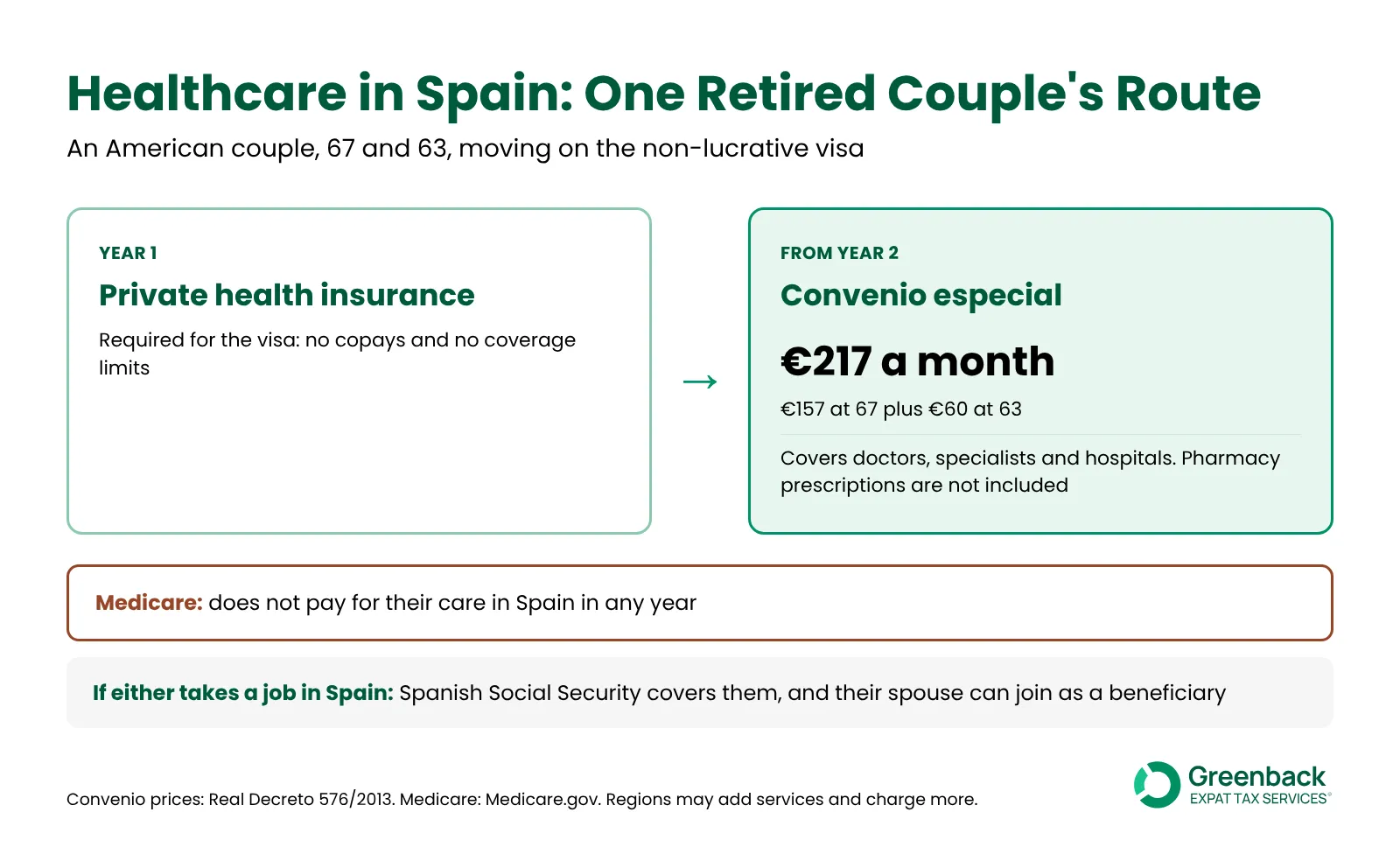
For a retired couple aged 67 and 63, the convenio comes to €217 a month from their second year. The rest of a retirement budget is in our guide to retiring in Spain.
Do You Need Private Health Insurance in Spain?
You need private health insurance for Spain’s non-lucrative and digital nomad visas, and residents often keep it alongside public cover to access specialists more quickly. The policy must be issued by an insurer authorized in Spain, with no copays and no coverage limits, as detailed in our non-lucrative visa guide.
An individual policy averages about €81 a month, and more than €145 after 65, according to industry figures published by Spain’s insurers. Visa-compliant policies cost more because they have no copays or limits, and age and health history further increase the price.
How Long Are Waiting Times in Spain’s Public System?
A first specialist appointment took an average of 102 days at the end of 2025, and non-urgent surgery took 122 days, according to the Ministry of Health. Waits vary widely by region. Urgent care is not on these lists.
| Region | Average wait for a specialist (days) |
|---|---|
| Basque Country | 49 |
| Madrid | 68 |
| Balearic Islands | 71 |
| Murcia | 89 |
| Valencian Community | 95 |
| Catalonia | 120 |
| Andalusia | 136 |
| Canary Islands | 162 |
Figures are the Ministry of Health’s waiting-list data at 31 December 2025, the latest published. Our guide to the best places to live in Spain compares cities across regions.
Does Medicare Cover You in Spain?
Medicare does not pay for care you receive in Spain, except in rare cases, such as an emergency while you are in the U.S. and the nearest hospital is abroad, and Medicare drug plans do not cover prescriptions purchased abroad (Medicare.gov). Whether to keep Part B, which carries a lifetime penalty if dropped, is covered in our guide to Medicare for U.S. expats.
How Does Healthcare Affect Your Taxes?
Spain provides limited tax relief for health insurance, and on your U.S. return, medical costs count only if they exceed 7.5% of your adjusted gross income. In Spain, employer-paid health insurance is tax-free up to €500 per person per year, and the self-employed can deduct premiums up to €500 per person. On the U.S. side, premiums and medical bills paid in Spain can be itemized on Schedule A (IRS Publication 502), though few expats using the FEIE or the Foreign Tax Credit gain from it. The details are in our guide to international health insurance.
Frequently Asked Questions About Healthcare in Spain
Spain compares well on life expectancy and cost: life expectancy at birth was 84.0 years in 2024 (INE), against 79 years in the U.S. (CDC), and a Spanish household spends about €1,413 a year on health against $6,197 for a U.S. household, as our guide to the cost of living in Spain shows. The trade-off is the wait for non-urgent care.
Spanish hospitals treat emergencies, but anyone outside the public system pays for care, including public hospitals, and most U.S. health plans and Medicare will not reimburse it (U.S. State Department). Call 112 in an emergency, and keep a travel or private policy until your Spanish cover starts.
For adults, the public system covers urgent dental care, extractions, and screening for oral lesions, while children also get check-ups, fillings, and sealants. Most adults pay out of pocket for fillings, cleanings, crowns, implants, and orthodontics.
Private insurers in Spain can exclude a pre-existing condition, impose a waiting period, or increase premiums, while the public system and the convenio especial do not ask about health history. Some consulates refuse visa policies that exclude pre-existing conditions, as our non-lucrative visa guide lists by consulate.
How Greenback Helps Americans Living in Spain
The job that brings you into Spanish Social Security, the remote role that keeps you in the U.S. system, and the Spanish account that pays your premiums all show up on your U.S. return. Greenback’s team prepares that return from Spain, applies the Foreign Tax Credit or the FEIE where each fits best, and files your FBAR. Learn more about how we help U.S. citizens living abroad.

Retiring in Spain?
This article is for informational purposes only and does not constitute tax, legal, or medical advice. Rules and waiting times come from the official sources named, and private insurance prices are industry averages. Speak with a qualified professional about your situation.




Featured In





