Countries With the Most U.S. Expats: Where Americans Are Heading and Why


The countries with the most U.S. expats are Mexico (823,502), Canada (256,571), the United Kingdom (243,570), Germany (152,501), and Australia (114,202), according to United Nations data on migration. Mexico leads by a wide margin, home to about a quarter of all U.S. expats counted abroad. An estimated 4 to 5.5 million Americans live overseas in total, and the same rule follows every one of them: the IRS taxes U.S. citizens on their worldwide income, no matter where they live or earn it. Interest in leaving has climbed too, with a record election-night surge in “move to Canada” searches after the November 2024 election and a record number of Americans applying for U.K. citizenship in early 2025.
- In this UN dataset, Mexico, Canada, and the U.K. together account for more than 4 in 10 Americans counted abroad
- Lower cost of living, travel, and safety are the top reasons Americans cite for moving, ahead of politics, per Greenback’s own survey
- 711,778 Social Security beneficiaries already collect U.S. benefits while living overseas, worth about $8.4 billion a year
- Moving abroad does not end your filing duty, because your U.S. tax obligation follows your citizenship, not your address
This report ranks the countries where Americans really live, shows how fast the map is shifting and why, and breaks down what you owe the IRS in each top destination, so you can see both where the community is and what compliance looks like before you move.
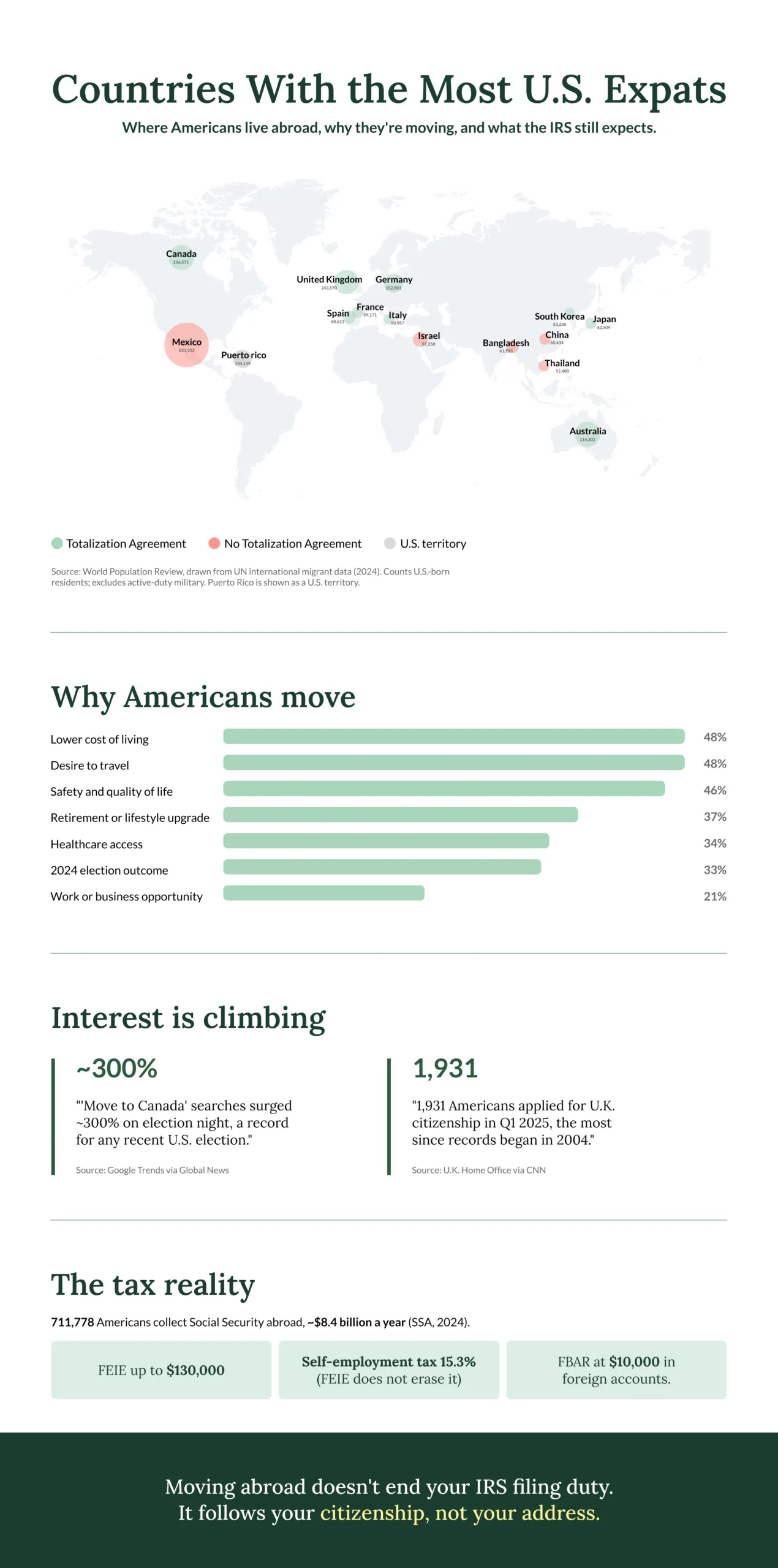
Sources: UN International Migrant Stock and World Population Review (2024), SSA, Greenback Expat Trends Survey (2025), Google Trends via Global News, and U.K. Home Office via CNN.
Mexico Leads the Countries With the Most U.S. Expats
The ranking below uses United Nations international migrant data, which counts U.S.-born residents living in each country. It is the most consistent country-by-country measure available, and it excludes active-duty military. The figures are the latest available, drawn from the most recent United Nations release (2024 data, updated every two years). The list follows the source exactly, which means it includes Puerto Rico, a U.S. territory rather than a foreign country, labeled below.
| Rank | Country or Territory | U.S. Expats | Totalization Agreement? |
|---|---|---|---|
| 1 | Mexico | 823,502 | No |
| 2 | Canada | 256,571 | Yes |
| 3 | United Kingdom | 243,570 | Yes |
| 4 | Germany | 152,501 | Yes |
| 5 | Puerto Rico (U.S. territory) | 144,149 | N/A |
| 6 | Australia | 114,202 | Yes |
| 7 | Israel | 97,258 | No |
| 8 | Spain | 68,613 | Yes |
| 9 | Japan | 62,509 | Yes |
| 10 | Bangladesh | 61,983 | No |
| 11 | China | 60,434 | No |
| 12 | France | 59,171 | Yes |
| 13 | South Korea | 53,226 | Yes |
| 14 | Thailand | 52,400 | No |
| 15 | Italy | 50,957 | Yes |
Source: World Population Review, American Expats by Country, drawn from United Nations international migrant stock data. Figures count U.S.-born residents and exclude active-duty military. Puerto Rico is a U.S. territory and is shown as it appears in the source.
Mexico is the clear outlier. It’s 823,500 Americans, representing close to 26% of all U.S. expats in the dataset, more than triple that of second-place Canada. Proximity, lower cost of living, a long-established retirement community, and an income tax treaty with the U.S. all keep it at the top. Setting aside Puerto Rico, the largest foreign destinations after the big four are Australia, Israel, and Spain.
After the top tier, the list splits between long-standing English-speaking destinations and a growing European contingent. Spain nearly doubled its American population between 2010 and 2024, and the Netherlands, Ireland, Poland, and Portugal all posted strong gains over the same period. For what daily life, healthcare, and U.S. taxes look like there, see our detailed guide to Living in Spain as an American.
Interest in Moving Abroad Climbed Sharply Around the 2024 Election
The interest is real and well-documented, even if relocations take longer to appear in the data. According to Google Trends data reported by Global News, U.S. searches for “move to Canada” surged by roughly 300% on election night in November 2024, a record high for any recent U.S. election, surpassing the 2016 and 2020 spikes. Interest ran highest in states such as Vermont, Maine, New Hampshire, Oregon, and Minnesota.
Some of that interest is turning into paperwork. A record 1,931 Americans applied for U.K. citizenship in the first quarter of 2025, the most since the U.K. Home Office began keeping records in 2004, according to CNN, with applications continuing to climb through the year.
A search or a citizenship application is not the same as relocating, and relocating does not cut your tax ties. The most common assumption (that leaving the country ends your relationship with the IRS) is wrong. The filing obligation travels with your citizenship, not your address.
No One Knows Exactly How Many Americans Live Abroad
Nobody has an exact count. The U.S. government does not require citizens to register when they move overseas, and the Census Bureau excludes them from the decennial count.
The United Nations migrant figures used in the ranking above total about 3.2 million U.S.-born residents worldwide. That number runs low for two reasons: it counts people born in the U.S. rather than all U.S. citizens, which misses dual nationals and accidental Americans, and it excludes military personnel. Broader modeling-based estimates land higher, generally between 4 and 5.5 million. The Federal Voting Assistance Program estimated the figure at 4.4 million in 2022, and the Association of Americans Resident Overseas puts the figure near 5.5 million. The State Department’s long-cited estimate of 9 million has now been retired, as we cover in our report on how many Americans live abroad.
Embassy-level estimates show the gap clearly. The State Department has put the U.S. population in Mexico as high as 1.6 million, roughly double the migrant-data figure. The takeaway: treat the rankings as a reliable picture of where Americans concentrate, not as a precise headcount.
The Map Is Shifting Toward Europe and Latin America
The destinations are changing in three directions.
- Europe is rising. Spain, Portugal, the Netherlands, Ireland, and Poland have all seen sustained growth, driven by remote work, residence, and “digital nomad” visa programs, and quality-of-life appeal. Dozens of countries, often described as more than 70, now offer some form of digital nomad visa, and Spain in particular has become a magnet for both retirees and location-independent professionals. For the income you need and how Spain taxes U.S. pensions and Social Security, read our guide to retiring in Spain.
- Latin America is steady and growing. Beyond Mexico, Panama, Costa Rica, Colombia, and Ecuador all host sizable and growing American communities, aided by lower living costs, established retiree networks, and residency programs for foreign nationals.
- Asia is mixed. Japan remains one of the largest destinations in the region, though its American population has come down from a 2020 peak. South Korea and Thailand continue to draw teachers, remote workers, and retirees.
For a closer look at where Americans are choosing to settle and why, see our guide to the best countries for Americans to live and our Expat Trends Report.
Over 700,000 Retirees Already Collect Social Security Abroad
Retirees are one of the largest and most overlooked groups of Americans abroad. As of December 2024, the Social Security Administration was paying benefits to 711,778 people living in foreign countries, worth roughly $8.4 billion a year, according to the SSA Annual Statistical Supplement. About 657,000 of those recipients are aged 65 or older.
Two practical points follow for anyone planning to retire abroad. First, your Social Security checks generally continue to arrive in most countries, though payments are blocked in a short list of nations, including Cuba and North Korea. Second, moving abroad does not change how your benefits are taxed; Social Security follows the same U.S. taxation rules overseas as it does at home, and your other retirement income still flows through your U.S. return. Our guide to retiring abroad and tax planning, and our breakdown of Social Security for expats, walk through the details.
Cost of Living and Lifestyle Drive the Move More Than Politics
When Americans are asked why they would move, money and quality of life lead the list, with politics a notable but secondary factor. In Greenback’s own 2025 Expat Trends Survey, which polled 1,145 Americans (including 719 expats) between February and March 2025, 35% of the general-population respondents said they were considering a move abroad, and 16% planned to move within the next year. Among those considering a move, the top motivators were:
| Reason for Moving Abroad | Share Citing It |
|---|---|
| Lower cost of living | 48% |
| Desire to travel | 48% |
| Safety and quality of life | 46% |
| Retirement or lifestyle upgrade | 37% |
| Healthcare access | 34% |
| 2024 election outcome | 33% |
| Work or business opportunity | 21% |
Source: Greenback Expat Trends Survey, 2025 (general-population respondents considering a move).
The pattern explains the rankings. The cost of living and healthcare draw Americans to Mexico and Latin America, where housing and medical care cost a fraction of U.S. prices. Career and remote-work opportunities, paired with new visa pathways, explain the rise of Spain, Portugal, and the Netherlands. Retirement draws hundreds of thousands toward warm, affordable, established hubs. Politics matters most at the margins: in the same survey, 63% of current expats said the 2024 election outcome reinforced their decision to stay abroad.
The financial reality behind all of these moves is the same. Your U.S. tax obligations change shape when you move abroad, but they do not disappear, and exactly how they change depends heavily on where you land. The next sections break that down by country.
What U.S. Expats Owe in the Top Destination Countries
Where you live changes your tax math more than almost any other factor. The single biggest variable is whether your country has a totalization agreement with the U.S., which determines whether you pay U.S. self-employment tax or contribute to the local system instead. The U.S. has agreements with 30 countries, and several major expat destinations are not on the list.
| Country | Totalization Agreement | What It Means for You |
|---|---|---|
| Mexico | No | Self-employed Americans owe the full 15.3% U.S. self-employment tax on top of any Mexican tax. A U.S.-Mexico income tax treaty still helps reduce double income taxation. |
| Canada | Yes | You generally pay into one social security system, not both. High Canadian income tax often makes the Foreign Tax Credit more valuable than the FEIE. |
| United Kingdom | Yes | National Insurance can substitute for the U.S. Social Security tax. U.K. rates are high enough that the FTC frequently beats the FEIE. |
| Germany | Yes | The agreement coordinates social security; the U.S.-Germany framework and high local rates usually favor the FTC. |
| Israel | No | No totalization agreement, so self-employed Americans owe the U.S. self-employment tax. A U.S.-Israel income tax treaty applies; see our Israel country guide. |
| Thailand | No | A popular low-tax base, but with no agreement, you still owe the 15.3% U.S. self-employment tax on net earnings. |
The pattern: in countries in agreement, such as Canada, the U.K., Germany, Australia, Spain, Japan, France, South Korea, Italy, and the Netherlands, you can usually avoid paying social security tax twice. In non-agreement countries such as Mexico, Israel, Bangladesh, China, and Thailand, self-employed Americans pay the full U.S. self-employment tax even when the FEIE wipes out their income tax.
The U.S. Tax Rules That Apply No Matter Where You Live
Regardless of which country you choose, the same core rules follow every American abroad. Here is the quick reference.
| Rule | Details |
|---|---|
| Filing deadline | Automatic two-month extension to June 15 for citizens abroad, with a further extension available to October 15 |
| Foreign Earned Income Exclusion | Exclude up to $130,000 of foreign earned income via Form 2555. The limit rises to $132,900 for the 2026 tax year |
| Self-employment tax | 15.3% (12.4% Social Security plus 2.9% Medicare). The FEIE does not eliminate it; only a totalization agreement or local employment can |
| FBAR | Required if your foreign accounts exceed $10,000 combined at any point in the year |
| FATCA (Form 8938) | Required if foreign financial assets exceed $200,000 at year-end while living abroad ($400,000 if married filing jointly) |
| State taxes | Some states (CA, NY, NJ, VA, NM, SC) may still claim you owe state tax after you move abroad |
If you are a retiree settling in Mexico, Portugal, or Spain, our team helps you coordinate Social Security, pensions, and foreign account reporting so nothing slips through the cracks; learn more about how we help retirees abroad. If you are a digital nomad or remote worker moving between countries, the tax home and Physical Presence rules decide whether you qualify for the FEIE at all; here is how we help digital nomads. And if you are still planning your move, the cleanest time to set up your tax position is before you go; see how we help Americans moving abroad.
Your Destination Decides Your Tax Bill, Not Just Your Lifestyle
Wherever you land on this list, your tax picture depends on your country of residence, your income type, your employment structure, and whether a totalization agreement or tax treaty applies.
Consider a self-employed American earning $90,000 who works remotely. In both Mexico and Germany, the Foreign Earned Income Exclusion can eliminate federal income tax on that $90,000. The difference is social security. In Mexico, which has no totalization agreement, that person still owes the U.S. self-employment tax of roughly $12,700 (15.3% on 92.35% of net earnings). In Germany, the U.S.-Germany totalization agreement lets them pay into the German system instead and obtain a certificate of coverage, which can bring the U.S. self-employment tax to zero. Same income, same exclusion, a roughly $12,700 swing in the U.S. tax bill, decided entirely by which country they moved to.
The time to sort that out is before you move, not at your first filing deadline abroad.
If you live in one of these countries or are planning to move to one, here is how Greenback helps Americans abroad file accurately and claim every exclusion and credit they are entitled to.

Join Thousands of Americans Filing Right From Abroad
Methodology
How We Built the Ranking
The ranking orders countries by their resident U.S. expat population, drawn from World Population Review’s American Expats by Country dataset, which is built on United Nations international migrant stock data. We chose this source because it applies a consistent methodology across all countries, which makes the ranking comparable. Full links to every figure appear in the Data Sources section below.
Time Period
The country counts are the latest available, from the most recent United Nations release (2024 data, which the U.N. updates every two years). Tax figures are current for the 2025 and 2026 tax years. The survey, search interest, and citizenship figures are from 2024 and 2025.
Definitions
- U.S. expat: a U.S.-born person recorded as residing in a foreign country in the United Nations migrant-stock data.
- Totalization agreement: a bilateral U.S. social security agreement that prevents double social security taxation.
- U.S. territories: Puerto Rico, Guam, and the U.S. Virgin Islands are treated and labeled as territories, not foreign countries.
Other Sources Used
- Total population estimates (4 to 5.5 million): Association of Americans Resident Overseas, the Federal Voting Assistance Program, and American Citizens Abroad.
- Search interest: Google Trends, as reported by Global News.
- U.K. citizenship applications: U.K. Home Office data, as reported by CNN.
- Reasons for moving: Greenback’s own 2025 Expat Trends Survey, a poll of 1,145 Americans (including 719 expats) fielded from February to March 2025.
- Social Security beneficiaries abroad: SSA Annual Statistical Supplement, 2025.
Limitations
- The dataset counts people born in the United States, not all U.S. citizens, so it undercounts dual nationals and accidental Americans.
- It does not capture short-term or unregistered residents.
- Country totals are therefore lower than broader population estimates, and the “more than 4 in 10” figure for Mexico, Canada, and the U.K. refers to shares within this dataset, not to all U.S. citizens worldwide.
- Search interest and citizenship applications reflect interest and intent, not confirmed relocations.
What We Excluded and Why
- Active-duty U.S. military, because the source dataset does not count them.
- An upward adjustment to the 4-to-5.5-million total, because no consistent country-by-country breakdown exists at that level, and mixing sources would make the ranking less comparable.
Verification
Tax figures (FEIE limits, the 15.3% self-employment tax rate, FBAR and FATCA thresholds, and filing deadlines) were checked against current IRS publications and Social Security Administration totalization data, accessed June 2026. The worked example was recalculated independently: 15.3% of 92.35% of $90,000 is about $12,700. Tax examples are simplified and do not account for every deduction, credit, treaty position, or individual circumstance.
Data Sources
- World Population Review: American Expats by Country
- United Nations: International Migrant Stock
- Association of Americans Resident Overseas: How Many Americans Live Abroad?
- Social Security Administration: Geographic Distribution of OASDI Benefits, 2025 Supplement
- Greenback Expat Trends Survey, 2025
- Global News: “Moving to Canada” searches spike after U.S. election
- CNN: Record number of Americans applied for U.K. citizenship
- IRS: U.S. Citizens and Resident Aliens Abroad
- IRS: Foreign Earned Income Exclusion
- Social Security Administration: Status of Totalization Agreements
Fair Use Statement
The data analysis and infographic in this report are original work produced by Greenback Expat Tax Services. If you would like to use or share any of the findings, statistics, or visuals, you are welcome to do so with proper attribution. Please link back to this page as the original source. For media inquiries or permission to reproduce the infographic in full, contact [email protected].
Important Notice
This report is for informational purposes only and does not constitute legal, tax, or financial advice. Tax laws, thresholds, exclusion amounts, and filing requirements change frequently, and the information here reflects data available as of June 2026. Your individual tax situation depends on factors such as your income level, country of residence, employment status, filing status, applicable tax treaties, and state tax obligations. The population, migration, and survey figures cited here are drawn from third-party and government sources, rest on modeling, estimates, search interest, or self-reported responses rather than a real-time count, and are subject to revision. Greenback Expat Tax Services does not guarantee the accuracy or completeness of third-party data. The tax examples used throughout are simplified illustrations and do not account for all possible deductions, credits, exclusions, or individual circumstances. You should consult a qualified tax professional before making decisions about your U.S. tax obligations, foreign income reporting, or any other tax matter.
Featured In





