Working in Spain as an American: Work Visas, Salaries, and Taxes

- Working in Spain at a Glance
- Can Americans Work in Spain?
- How Do You Get a Work Visa for Spain?
- What Is the Average Salary in Spain?
- What Does a Spanish Employment Contract Include?
- How Much Tax Do You Pay on a Spanish Salary?
- How Can a U.S. Employer Pay You in Spain?
- How Does a Spanish Salary Show Up on Your U.S. Return?
- Frequently Asked Questions About Working in Spain
- How Greenback Helps Americans Working in Spain

Americans can work in Spain once they hold a residence permit that includes the right to work. For most jobs, that means an employee work visa that your Spanish employer applies for, or a faster, highly qualified professional permit for roles paying at least €41,356 a year. Spain’s average gross salary should reach about €32,900 in 2027, and each payslip deducts 6.5% for social security plus income tax. In return, every employee receives a minimum of 30 calendar days’ paid holiday and two additional payments per year.
Your Spanish salary also goes on your U.S. return each year. Because Spain usually taxes the same pay more heavily than the U.S. does, the Foreign Tax Credit typically leaves nothing to pay the IRS, though you still have to file. For housing, healthcare, and the rest of the move, start with our guide to living in Spain.
Working in Spain at a Glance
| Question | Answer |
|---|---|
| Is a permit needed to work in Spain? | Yes, a residence permit that allows work. Visa-free visits never include work. |
| How do you get a work visa for Spain? | Your Spanish employer applies for your work authorization in Spain, then you apply for the visa at your consulate. |
| What is the average salary in Spain? | About €32,900 gross a year in 2027, projected from INE data. INE’s latest survey put it at €29,540 in 2024. |
| What does a Spanish employment contract include? | An open-ended contract by default, a 40-hour average week, 30 or more days of paid holiday, and two extra payments a year. |
| How much tax do you pay on a Spanish salary? | 6.5% for social security, plus state and regional income tax withheld each month. |
| Do you still file a U.S. return? | Yes. The Foreign Tax Credit usually cancels the U.S. income tax on a Spanish salary. |
Can Americans Work in Spain?
Americans can work in Spain, but only after Spain grants them a residence permit that includes the right to work. Spanish law requires authorization before any paid work, so a visa-free visit never covers a job, even a short one.
A Spanish company that hires you must sponsor your permit. Some Americans already hold a status that lets them work without a sponsor:
- Remote workers: the Digital Nomad Visa covers remote work for companies or clients abroad.
- Freelancers and business owners: a self-employment authorization lets you work for yourself, covered in our guide to being self-employed in Spain.
- Spouses and family: marrying a Spanish or other EU citizen, or joining a relative who legally resides in Spain, grants a permit that includes the right to work.
- Americans with Spanish ancestry: if you qualify for Spanish citizenship, you need no permit at all.
Teaching English in Spain as an American takes one of two forms. The Ministry of Education’s language assistant program is a cultural exchange grant, so assistants are not employees, while a job at a private language academy requires an employee work visa like any other job.
Where Sponsorship Is Realistic for Americans
A Spanish employer can sponsor an American most easily in three situations: the role is on Spain’s quarterly list of hard-to-fill occupations, it pays enough for the highly qualified professional permit, or a company transfers you from its U.S. office to its Spanish one. Other jobs in Spain for Americans are harder to land, because the employer must first show that they could not fill the role with someone already in the Spanish labor market.
How Do You Get a Work Visa for Spain?
Your Spanish employer applies for your work authorization in Spain first, and only after it is approved, do you apply for the visa at the Spanish consulate responsible for your home state. The standard route takes several months. The highly qualified route is faster and skips the employment test.
The Employee Work Visa
- Your employer applies. The employer files for initial residence and employment authorization with the government office in the province where you will work and pays its own fee.
- The job passes the employment test. The application succeeds if the occupation is on the hard-to-fill list the state employment service publishes each quarter, or if the employer proves it could not hire locally.
- The office decides within three months. No answer by then means the application has been refused.
- You apply for the visa within one month of the approval. The Washington consulate’s employee visa page lists a $190 fee for Americans and a one-month decision period.
- You start the slow documents early: an FBI background check under six months old, apostilled and officially translated, and a physician’s medical certificate under three months old.
Each consulate sets its own checklist and appointment system, so work from the page of the consulate that covers your state.
The Highly Qualified Professional Permit and EU Blue Card
For well-paid roles, the highly qualified professional permit is faster. Spain’s Unit for Large Companies and Strategic Groups (UGE) must decide within 20 days, or the permit counts as granted, no employment test applies, and you can apply from inside Spain. The rules are in Ley 14/2013.
- Salary floor: €41,356 a year in 2026, 1.4 times Spain’s average salary, so it rises each year. The UGE posts the current figure.
- Qualification: a higher vocational or university qualification, or three years of equivalent experience.
- Length: three years, or the length of your contract plus three months if shorter, with two-year renewals.
- The EU Blue Card version requires a three-year degree or five years of relevant experience, and a contract of at least six months. The floor drops to €33,085 for shortage occupations and recent graduates, and after 12 months, the card lets you move to most other EU countries.
The Job-Search Visa
Real Decreto 1155/2024 allows a 12-month visa to look for work in Spain, but only for children and grandchildren of Spanish nationals by origin and for occupations selected by the government. Once you find a job, the work authorization is decided within 10 days. The 2026 order allows the ministry to open places without setting any, so check with your consulate before planning around it.
Your First Weeks: NIE, Social Security Number, and TIE
- NIE: Spain’s identity and tax number for foreigners, which every employer, bank, and landlord asks for. Our NIE number guide explains how to get one.
- Social security number: your employer registers you before your first day, within three months of your arrival on the employee visa, and the number stays with you for life.
- TIE: your foreigner identity card, applied for in person within one month of that registration.
What Is the Average Salary in Spain?
Spain’s average gross salary should be about €32,900 a year in 2027, or roughly $37,100 at the IRS 2025 average exchange rate. That is a projection from two sets of figures published by INE, Spain’s statistics office:
- The latest annual survey: €29,540 in 2024, published in May 2026. The 2025 survey is expected in 2027.
- Quarterly wage data: pay rose 3.2% in 2025 and 4.5% in the first half of 2026, according to INE’s labor cost survey. The estimate assumes 2027 growth in line with 2025, at about 3.2%.
The average sits well above what most people earn. In 2024, the median, the point where half of workers earn more and half less, was €24,497, and the single most common salary was €16,520, close to the minimum wage. Where you work matters too: in 2024, pay averaged €35,170 in the Basque Country and €34,410 in Madrid, against €26,817 in Valencia, €26,090 in Andalusia, and €24,979 in Extremadura.
Spain’s minimum wage for 2026 is €1,221 per month, paid 14 times, or €17,094 per year, as set by Real Decreto 126/2026. The government reviews it each year.
The €41,356 floor for the highly qualified permit is 1.4 times INE’s latest average, so the roles that qualify are senior or specialist ones. Expect it to rise to roughly €42,700 once INE publishes its 2025 survey. Compare any offer with the average for its region, and remember that Spanish salaries are quoted gross.
What Does a Spanish Employment Contract Include?
A Spanish employment contract is open-ended unless it says otherwise, and the Workers’ Statute sets minimums your employer cannot go under. Your sector’s collective agreement often improves on them, so ask which one covers your job.
- Open-ended by default: Spanish law presumes every contract is permanent. A fixed-term contract is only allowed to address a temporary increase in work or to cover for another worker.
- 14 payments a year: two extra payments, one at Christmas, mean a €45,000 salary often arrives as 14 payments of about €3,214. Some agreements spread them over 12 months instead; the yearly total is the same.
- Working hours: the maximum is 40 hours a week, averaged over the year, and employers must keep a daily record of your start and finish times.
- Paid time off: a minimum of 30 calendar days’ holiday a year, plus up to 14 paid public holidays, 2 of them set locally. U.S. federal law requires neither.
- Trial period: if the collective agreement sets no limit, up to 6 months for qualified technicians and up to 2 months for other roles. Either party can end the contract at any time without notice.
- Dismissal: if a court rules a dismissal unfair, the employer either takes you back or pays 33 days’ salary for each year of service, up to 24 months’ pay.
How Much Tax Do You Pay on a Spanish Salary?
On a Spanish salary, you pay 6.5% in social security and income tax at your state and regional rates, and your employer withholds both from every payslip. The annual Spanish return, the Renta, then settles any difference between what was withheld and what you owe.
Your 6.5% social security is made up of four parts:
| What it pays for | Your share, 2026 |
|---|---|
| Pension, sickness and disability | 4.70% |
| Unemployment, on an open-ended contract | 1.55% |
| Training | 0.10% |
| Spain’s pension reserve fund (MEI) | 0.15% |
The rates come from Spain’s 2026 contribution order; for a fixed-term contract, the unemployment rate is 1.60%. Contributions stop at €5,101.20 per month, so paying above about €61,200 per year carries only a small solidarity surcharge. Your employer adds its own share, about 32% of your salary for an office job.
Income tax is withheld monthly. Your employer estimates your tax for the year based on the family details you provide on Modelo 145. With one employer, you must file a Renta only if your salary is above €22,000, though filing can still result in a refund.
A full-time job in Spain almost always means you’re treated as a resident for tax purposes for that entire year, so it taxes your worldwide income. The rates for each region are in our breakdown of Spain tax brackets. If you moved to Spain for the job, you may be able to elect the Beckham Law, which taxes salary at a flat 24% on the first €600,000 for the year you arrive and the five years after it.
How Can a U.S. Employer Pay You in Spain?
A U.S. employer can pay you in Spain through a Spanish entity, by registering with Spanish social security as a foreign employer, or, for a temporary posting, by keeping you on the U.S. payroll. You also need a permit that allows the work, usually the Digital Nomad Visa for remote employees.
- A Spanish entity: a subsidiary or branch hires you on a Spanish payroll and contract.
- A non-resident employer registration: a company with no presence in Spain registers with the Spanish social security and pays its contributions directly.
- A U.S. certificate of coverage: when your employer posts you to Spain on an assignment of five years or less, you stay in U.S. Social Security and Medicare and out of the Spanish system. Your employer requests the certificate from the Social Security Administration.
- Employer of record services: widely marketed, but Spanish law reserves placing workers with another company to licensed temporary work agencies, so your employer should take Spanish legal advice before using one.
The U.S.-Spain totalization agreement determines which country’s Social Security benefits you. Employees are covered where they work, so moving to Spain on your own puts you in the Spanish system, and only a temporary assignment keeps you in the U.S. one, as the IRS explains. Until your U.S. employer holds a Spanish certificate of coverage for you, it may keep withholding Social Security and Medicare while you also pay into Spain. More on the agreement is in our guide to totalization agreements, and the U.S. rules for remote employees are in Working Remotely Abroad.
How Does a Spanish Salary Show Up on Your U.S. Return?
Americans report a Spanish salary in dollars as wages, and the income tax Spain charges on it is usually treated as a Foreign Tax Credit that offsets the U.S. tax. The figures come from documents your Spanish employer has to give you.
- Your certificate of withholdings: before the Renta window opens each spring, your employer must give you a certificado de retenciones showing your gross pay, the income tax withheld, and your social security. It is the simplest document to use when preparing your U.S. return.
- What counts as your wages: your full gross salary, including both extra payments, converted to dollars.
- Which Spanish tax you credit: the income tax on your final Renta, not only what was withheld, because a refund or extra payment changes it. You claim it on Form 1116, where salary falls under the general category, and unused credit carries back 1 year and forward 10 years. Our Foreign Tax Credit guide explains the limits.
- Your own social security: it cannot be credited or deducted on your U.S. return, because IRS Publication 514 excludes social security paid to a country with a U.S. social security agreement.
- The exclusion as an alternative: the Foreign Earned Income Exclusion covers up to $132,900 of salary for 2026, with no credit allowed on excluded pay. On a Spanish salary, the credit usually fits better, as FEIE vs. FTC explains.
For the 2026 tax year, your Renta is due by 30 June 2027, and your U.S. return is automatically extended to June 15, 2027, because you live abroad, though interest runs on any unpaid tax from April 15. Your Spanish payroll account also counts toward the FBAR, which you file once your foreign accounts together exceed $10,000 at some point during the year. The U.S.-Spain tax treaty lets Spain tax salary for work done in Spain, while the U.S. credits that tax. Everything else your return needs is in U.S. expat taxes in Spain.
Example: What a €45,000 Salary Takes Home in Madrid
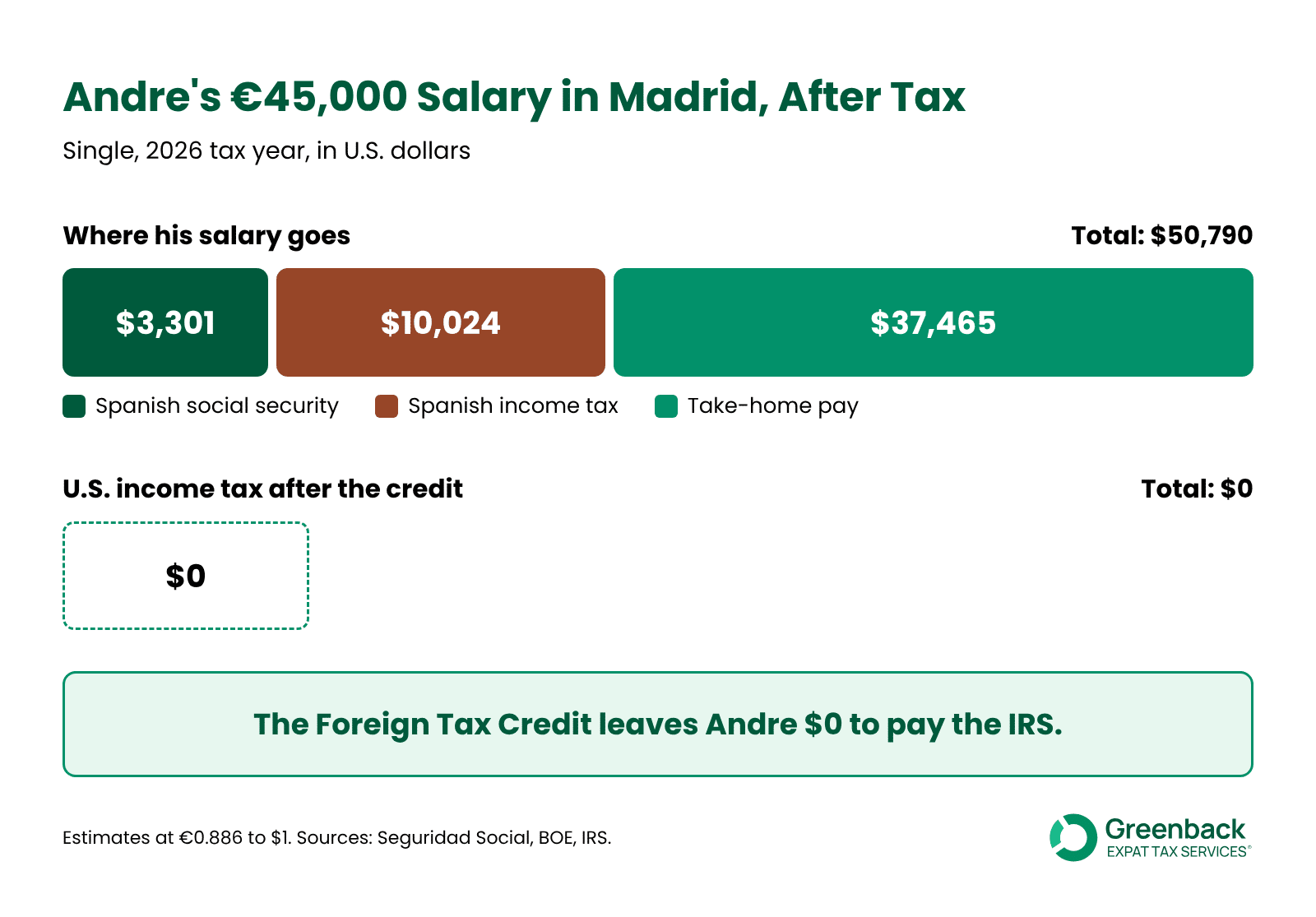
Andre, a data analyst from Denver, joins a Madrid company in January 2026 on a highly qualified professional permit, at €45,000 per year, paid in 14 installments. He is single, under 65, and has no children.
| 2026 | Amount | How it is calculated |
|---|---|---|
| Spanish social security | €2,925 (about $3,301) | 6.5% of his €45,000 salary |
| Spanish income tax | About €8,881 (about $10,024) | €45,000 less his social security and the €2,000 employee expense deduction gives a taxable base of €40,075, taxed at the state and Madrid scales after the personal allowance |
| Take-home pay | About €33,194 (about $37,465) | About €2,371 in each of his 14 payments |
| U.S. income tax before the credit | About $3,915 | His $50,790 salary less the $16,100 standard deduction, taxed at 10% and 12% |
| U.S. income tax after the credit | $0 | His Spanish income tax is larger, so it cancels the U.S. tax, and about $6,109 carries forward |
Andre’s employer pays about €14,470 in social security on top of his salary. The dollar figures are illustrative and use the IRS yearly average rate for 2025 (€0.886 to $1).
Frequently Asked Questions About Working in Spain
No. A U.S. citizen who does not also hold Spanish or another EU citizenship needs a residence permit that includes work before taking any paid job in Spain. Visa-free visits, capped at 90 days in a 180-day window, never include work.
Yes, by Spanish standards. $50,000 is about €44,300, roughly 35% above the average Spanish salary projected for 2027, and a single person in Madrid would keep about €32,800 of it after social security and income tax.
Spanish employees receive a minimum of 30 calendar days’ paid holiday per year, plus up to 14 paid public holidays, 2 of which are local. Collective agreements often add more.
Only if your U.S. employer posted you to Spain on an assignment of five years or less and holds a U.S. certificate of coverage for you. Otherwise, working in Spain puts you in the Spanish system, and your U.S. employer can stop withholding U.S. Social Security once it holds a Spanish certificate of coverage for you.
How Greenback Helps Americans Working in Spain
Greenback prepares the U.S. side for Americans on the Spanish payroll and for those posted to Spain by a U.S. employer. We work from your certificate of withholding and Renta to claim the Foreign Tax Credit, track carryforwards, file your FBAR and Form 8938, and ensure that only one country’s Social Security is withheld from your pay. We do not prepare Spanish returns. Learn more about how we help U.S. citizens living abroad.

Starting a job in Spain? Get the U.S. side right from year one.
This article is for informational purposes only and does not constitute tax or legal advice. Payroll figures use Spain’s 2026 contribution rates and tax scales; the 2027 average salary is an estimate based on INE data; and your take-home pay depends on your region, contract, and family. Speak with a qualified professional about your situation.




Featured In