Cost of Living in Spain for Americans: Monthly Budgets by Region and City

- Cost of Living in Spain at a Glance
- How Much Does It Cost to Live in Spain Per Month?
- How Does the Cost of Living Vary by Region in Spain?
- What Does It Cost to Live in Madrid, Barcelona and Other Spanish Cities?
- Is It Cheaper to Live in Spain Than in the U.S.?
- What Salary Do You Need to Live in Spain?
- Frequently Asked Questions About the Cost of Living in Spain
- How Greenback Helps Americans Planning Life in Spain


In 2027, living in Spain is expected to cost an average single person about €2,260 ($2,530) per month, a couple about €3,560 ($3,990) per month, and a family of four about €4,810 ($5,390) per month, with rent included. That is about 4% more than in 2026, when the same households spent about €2,170, €3,410, and €4,610, and roughly half what the average U.S. household spends. Where you live has the greatest impact on the number: a couple renting a two-bedroom flat can expect about €2,790 per month in Extremadura and about €4,310 per month in the Madrid region. Visas, registration, and daily life are covered in our guide to living in Spain.
The figures come from what Spanish households report spending to Spain’s national statistics office (INE), with current asking rents in place of the rent that INE counts homeowners as paying themselves, and 2027 estimates based on the Banco de España’s latest inflation projection. You’ll find budgets for three households, all 17 regions, and eight cities, along with the gross salary each budget shows after Spanish tax is deducted. On a Spanish salary, the Foreign Tax Credit or the FEIE usually means no U.S. tax is owed, though the U.S. return is still due every year. The one-time costs of the move itself are in our guide to moving to Spain.
Cost of Living in Spain at a Glance
| Question | Answer |
|---|---|
| How much does it cost to live in Spain per month? | About €2,260 for a single person, €3,560 for a couple and €4,810 for a family of four in 2027 (estimates), rent included, up from €2,170, €3,410 and €4,610 in 2026 |
| Why are costs rising in 2027? | Asking rents rose 5.6% in the past year, faster than the 3.7% inflation projected for everything else |
| What is the biggest expense? | Rent, about a third of a couple’s month |
| Which region costs the most? | Madrid, at about €4,310 a month for a couple in 2027 (estimate) |
| Is Spain cheaper than the U.S.? | The average Spanish household spends about half what a U.S. household does |
| Will you owe U.S. tax on a salary earned in Spain? | Usually no tax is owed once the Foreign Tax Credit or the FEIE applies, though you still file |
How Much Does It Cost to Live in Spain Per Month?
The average household in Spain is expected to spend about €2,260 a month for one person, €3,560 for a couple, and €4,810 for a couple with two children in 2027, up about 4% from 2026. Each figure covers rent on a flat sized for the household and the full spread of everyday spending.
| Household | 2027 estimate | 2026 | Essentials only, 2026 |
|---|---|---|---|
| Single person, 50 m² flat | €2,260 ($2,530) | €2,170 ($2,430) | €1,490 ($1,670) |
| Couple, 75 m² flat | €3,560 ($3,990) | €3,410 ($3,820) | €2,360 ($2,640) |
| Family of four, 90 m² flat | €4,810 ($5,390) | €4,610 ($5,160) | €2,960 ($3,320) |
The essentials column counts only rent, utilities, groceries, transport, and health. A careful budget lands near it, and it explains why many cost-of-living sites quote lower figures: they price the essentials, while the average Spanish household also spends on clothing, insurance, restaurants, travel, and replacing a car now and then.
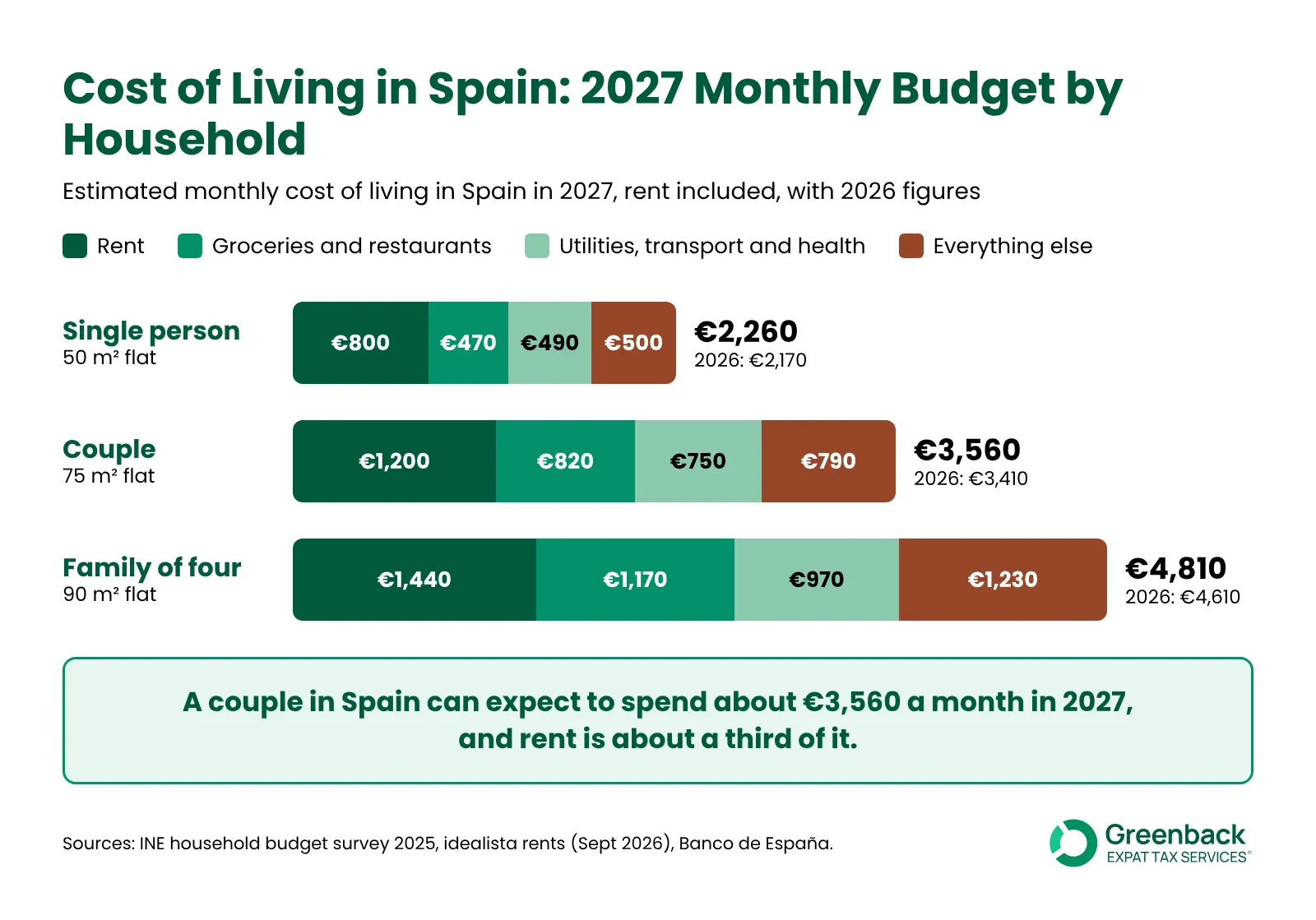
The budgets start with INE’s 2025 household budget survey for each household type, exclude the rent homeowners are counted as paying themselves, and add market rent at Spain’s average asking price of €15.10 per m² in September 2026. Spending is raised by 3.9% for 2026 and by 3.7% for 2027 in the Banco de España’s projections from October 2026, with rent raised at its own 5.6% annual pace. Use the European Central Bank rate of October 2026: €1 = $1.12.
Where Does the Money Go Each Month?
Rent takes the largest share of a couple’s monthly budget, followed by food and the cost of running a home and getting around.
| Couple’s monthly spending | 2027 estimate | 2026 |
|---|---|---|
| Rent, 75 m² flat | €1,200 | €1,130 |
| Groceries | €520 | €510 |
| Restaurants and hotels | €300 | €290 |
| Transport, including car costs | €370 | €360 |
| Utilities and home upkeep | €230 | €220 |
| Health, out of pocket | €150 | €140 |
| Everything else | €790 | €760 |
| Total | €3,560 | €3,410 |
Everything else covers clothing, insurance, phones and internet, furniture, recreation, and personal care. The health line reflects the medicines and private visits that households pay for themselves. Employees and pensioners in Spain’s public health system pay little beyond that, while anyone outside it budgets for private insurance, which our guide to healthcare in Spain covers.
Electricity is the utility to watch. Bills in Spain’s regulated tariff track wholesale prices, and the consumer group Facua estimated that an average household would pay about €107 in September 2026. Many older flats were built without insulation or central heating, so winter bills climb.
What Does Rent Cost in Spain?
Asking rents in Spain averaged €15.10 per m² a month in September 2026, 5.6% more than a year earlier, according to the listing portal idealista. That puts a 50 m² one-bedroom at about €755 and a 75 m² two-bedroom at about €1,130 nationally. Rents on new contracts rise faster than for sitting tenants: the INE rental price index shows rents up 3.5% overall in 2024 and 8.8% for new contracts.
Before you move in, a landlord can hold one month’s rent as the legal deposit plus up to two more months as an additional guarantee, so a 75 m² flat at the national average can tie up about €3,400 on day one. The Ley de Arrendamientos Urbanos makes the landlord pay any letting-agency and contract fees, so a request for one is worth questioning. Landlords usually ask for your NIE number before signing, and if you’re weighing a purchase instead, our guide to buying property in Spain sets out the costs.
How Does the Cost of Living Vary by Region in Spain?
For a couple renting a 75 m² flat, the 2027 estimate runs from about €2,790 a month in Extremadura to about €4,310 in the Madrid region, a gap of more than €1,500. Rent explains most of it, though everyday spending also runs about 10% above the national average in Madrid and 16% above in the Basque Country, and about 12% under it in Andalusia.
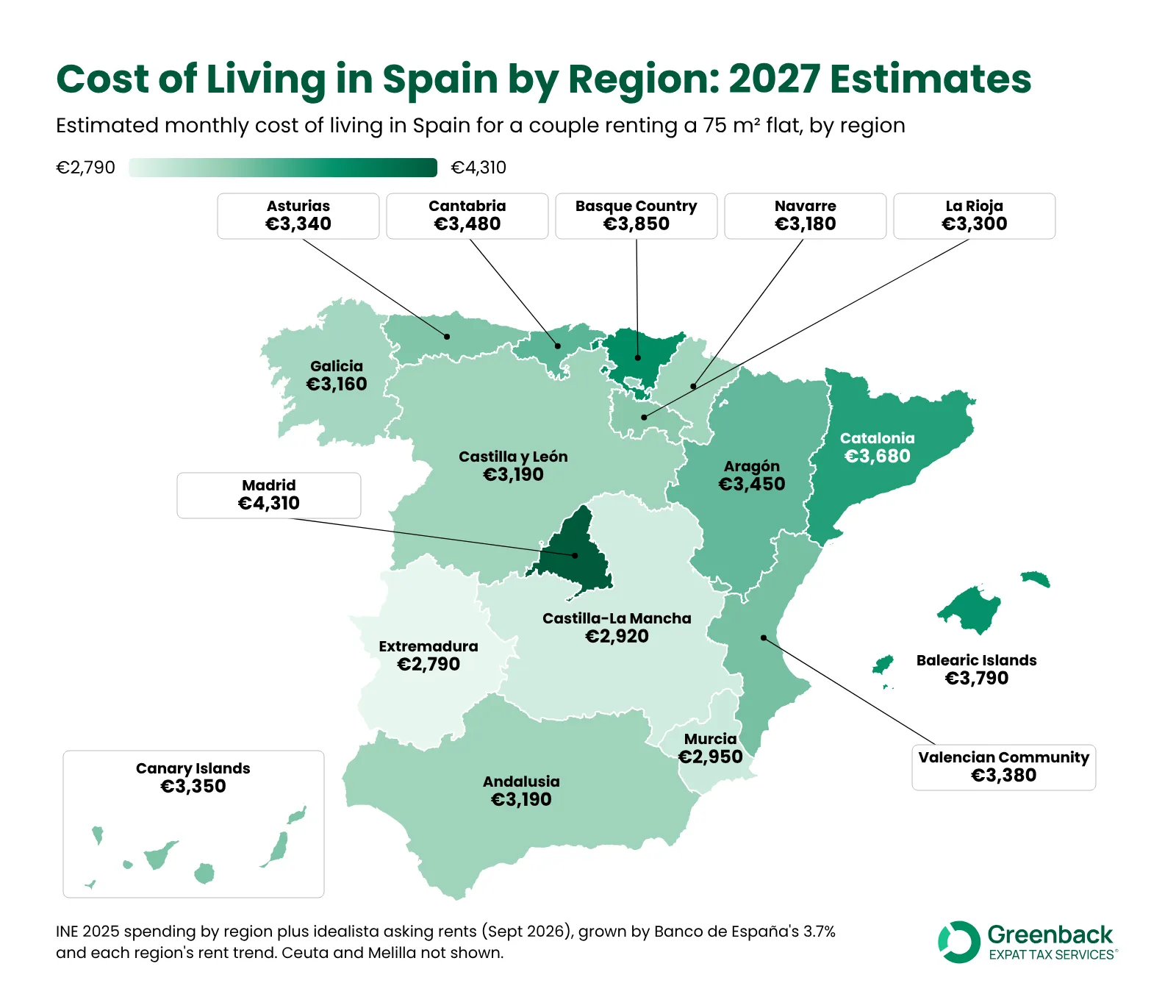
| Region | Rent, 75 m², 2026 | Rent change, past year | Couple’s month, 2027 estimate |
|---|---|---|---|
| Madrid | €1,620 | +5.7% | €4,310 |
| Basque Country | €1,125 | -0.3% | €3,850 |
| Balearic Islands | €1,515 | +3.6% | €3,790 |
| Catalonia | €1,190 | +2.2% | €3,680 |
| Cantabria | €885 | +5.4% | €3,480 |
| Aragón | €840 | +9.6% | €3,450 |
| Valencian Community | €990 | +6.0% | €3,380 |
| Canary Islands | €1,140 | +4.3% | €3,350 |
| Asturias | €820 | +9.3% | €3,340 |
| La Rioja | €710 | +5.3% | €3,300 |
| Andalusia | €1,060 | +5.2% | €3,190 |
| Castilla y León | €730 | +6.7% | €3,190 |
| Navarre | €800 | +0.9% | €3,180 |
| Galicia | €740 | +4.7% | €3,160 |
| Murcia | €710 | +4.8% | €2,950 |
| Castilla-La Mancha | €660 | +8.3% | €2,920 |
| Extremadura | €580 | +5.7% | €2,790 |
Each region’s estimate takes INE’s 2025 spending per person there, excluding rent, scales it to the national couple, and adds rent at the region’s average asking price from idealista. Rent then grows at the region’s own pace for 2027 and everything else at 3.7%. Regional rents average across all cities and towns in the region, so a flat in central Madrid or Palma costs more than the regional average.
The region also sets part of your tax bill. Each one adds its own income tax scale, which our guide to the Spanish tax system compares, and decides whether you pay wealth tax and how much your heirs pay in inheritance tax.
What Does It Cost to Live in Madrid, Barcelona and Other Spanish Cities?
Madrid is the most expensive of the eight cities Americans most often consider, at about €4,430 per month for a couple in 2027, and Sevilla is the least expensive at about €3,120 per month.
| City | Rent, 50 m² one-bedroom, 2026 | Couple’s month, 2027 estimate | Couple’s month, 2026 |
|---|---|---|---|
| Madrid | €1,170 | €4,430 | €4,260 |
| Barcelona | €1,010 | €3,950 | €3,880 |
| Bilbao | €790 | €3,910 | €3,810 |
| Palma | €980 | €3,800 | €3,620 |
| Valencia | €820 | €3,590 | €3,470 |
| Alicante | €700 | €3,430 | €3,290 |
| Málaga | €830 | €3,370 | €3,240 |
| Sevilla | €670 | €3,120 | €3,010 |
City rents are Idealista’s September 2026 asking prices for each city, with a 75 m² flat in the couple’s budget and everyday spending at the level of the city’s region. Barcelona and Bilbao barely moved in 2027 because their rents were flat over the past year, while Palma and Alicante rose by about 7% and 6%. Climate, community, and daily life in each city are covered in our guide to the best places to live in Spain.
Is It Cheaper to Live in Spain Than in the U.S.?
The average Spanish household spent €35,101 in 2025, about $39,300, while the average U.S. household spent $78,535 in 2024, according to the Bureau of Labor Statistics. Couples show a similar gap: €36,334 ($40,700) for a Spanish couple without children against $88,687 for a U.S. married couple, per BLS figures published by the Federal Reserve Bank of St. Louis.
| Yearly household spending | Spain (2025) | U.S. (2024) |
|---|---|---|
| Housing and utilities | €11,665 ($13,060) | $26,266 |
| Transportation | €4,020 ($4,500) | $13,318 |
| Food, at home and out | €8,908 ($9,980) | $10,169 |
| Healthcare | €1,413 ($1,580) | $6,197 |
| Total | €35,101 ($39,310) | $78,535 |
Housing, transport, and healthcare explain most of the difference. Food comes out close, because Spanish households eat out more. Healthcare spending is lower partly because Spain funds its public system through social security and taxes, which do not show up as household spending.
These are spending figures, and spending also reflects what people earn. Spain’s average gross salary was €29,540 in 2024, about $33,100, according to the INE, so Spanish households spend less partly because they earn less. Figures elsewhere that put Spain 21% to 33% under the U.S. usually compare prices for a set list of items, a narrower measure. Our guide to working in Spain sets out salaries and take-home pay.
What Salary Do You Need to Live in Spain?
A couple needs about €52,400 a year in combined gross salary to cover Valencia’s average month, and about €66,200 in Madrid; a single person needs about €34,900 and €44,100. Each figure is the salary that still covers that city’s budget after 6.5% employee social security and Spanish income tax, using 2026 budgets and tax rules, the latest year with every rate set.
| Valencia | Madrid | |
|---|---|---|
| Single person’s monthly budget | €2,210 | €2,720 |
| Gross salary needed, single | €34,900 ($39,000) | €44,100 ($49,400) |
| Couple’s monthly budget | €3,470 | €4,260 |
| Gross salary needed, two equal earners | €52,400 ($58,700) | €66,200 ($74,100) |
| Gross salary needed, one earner | €60,200 ($67,400) | €75,100 ($84,100) |
Madrid needs a higher salary because its monthly costs are higher, even though its income tax is lower than Valencia’s for the same pay. One earner needs more than two because a single salary pushes income into higher tax bands. The income tax applies once you become a Spanish tax resident, which happens for the whole year once you spend over 183 days there; the other tests are in our guide to the Spanish tax system.
Your situation can change the figure:
- A job that brings you to Spain: the Beckham Law lets qualifying new residents pay a flat 24% on Spanish work income, which mostly helps at higher salaries.
- Remote work for a U.S. company: once you live and work in Spain, you usually pay into Spanish social security, so the 6.5% still applies. The digital nomad visa sets its own income floor, and the exception for employees sent temporarily is in our U.S. expat taxes in Spain guide.
- Freelance or business income: contributions work differently for the self-employed, as our self-employed in Spain guide explains.
- Retirement income: pensions and Social Security follow different rules, which our guide to retiring in Spain explains.
- Children: Spain’s child allowances reduce the tax on a given salary, which these single- and couple-figure calculations omit.
Example: A Couple on Two Salaries in Valencia
Marcus and Priya moved from Chicago to Valencia in January 2026. Each earns about €26,200 a year from a Spanish employer, enough together to cover a Valencia couple’s average monthly cost of €3,470.
| Step | Spain (2026) | U.S. (2026 joint return) |
|---|---|---|
| Gross pay | €52,426 combined | $58,716 |
| Social security | €3,408 (6.5%) | Not creditable |
| Income tax | €7,390, or €3,695 each | About $2,686 before the credit |
| Foreign Tax Credit | Spanish tax of about $8,277 cancels it | |
| What is left | €41,628, or €3,469 a month | No U.S. income tax owed |
The U.S. figure applies the 2026 joint standard deduction of $32,200. Marcus and Priya owe no U.S. income tax because the Foreign Tax Credit lets their Spanish tax stand in for it, and the unused credit carries forward. The Foreign Earned Income Exclusion, $132,900 per person for 2026, would also leave no U.S. tax owed, though the credit usually suits people who pay Spanish tax all year.
Frequently Asked Questions About the Cost of Living in Spain
$2,000 is about €1,790 a month. That covers a single person’s essentials, about €1,490 for rent, utilities, groceries, transport, and health, but falls short of the average single budget in all eight cities in 2026, from €1,920 in Sevilla to €2,720 in Madrid. It is also under the €2,400 a month that the non-lucrative visa asks a single applicant to show, and our guide to retiring in Spain looks at that budget for retirees.
$1,000 is about €890 a month, while a single person’s essentials come to about €1,490, and the average 50 m² one-bedroom alone rents for about €755. Living on that amount in Spain generally means sharing a home.
Living at the level of the average Spanish household took about €2,210 a month for one person or €3,470 for a couple in Valencia in 2026, and €2,720 or €4,260 in Madrid. Covering that from a salary takes about €34,900 to €44,100 gross for one person and €52,400 to €66,200 for a couple on two incomes.
How Greenback Helps Americans Planning Life in Spain
Greenback’s team handles the U.S. side for Americans paid by Spanish employers or working remotely from Spain: we apply the Foreign Tax Credit or the FEIE where each fits best and file your FBAR and Form 8938, so the take-home pay you planned around is the pay you keep. Learn more about how we help U.S. citizens living abroad.

Comparing Regions Before You Move?
This article is for informational purposes only and does not constitute tax or legal advice. Costs, rents, tax rates, and exchange rates change, and the budgets and 2027 estimates here are built from the official and market sources named. Speak with a qualified professional about your situation.




Featured In